Golden Globe Winners 2019
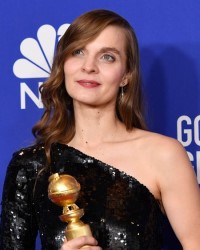 The Hollywood Foreign Press Association (HFPA) have announced the winners of the 77th Golden Globe Awards, honoring the best in film and American television of 2019.
In the Best Original Score category composer Hildur Guđnadóttir won the award for her challenging score for the comic book action-drama film Joker, a revisionist look at the origin story of Batman’s arch-nemesis. This is Guđnadóttir’s first Golden Globe, and in winning the award becomes the first solo female composer to win Best Score. The only other female composer to win was Lisa Gerrard, who shared the award for Gladiator with Hans Zimmer in 2000. In her acceptance speech, Guđnadóttir said:
“Wow. I thought they forgot the music! Well, this is truly… I’m speechless. This is unbelievable. Thank you Hollywood Foreign Press. Thank you Todd (Phillips) for inviting me on the journey of a lifetime, for all the trust and faith and your openness. Thank you, Joaquin (Phoenix) for making my job really easy with a spectacular, unbelievable performance. It’s mindblowing. Thank you Jason Ruder, music editor, for your fantastic job. Truly incredible. Conductor Jeff Atmajian. My brothers Gunnartin, Asthor, and Gunnarsson. My agent Patty, of course. My incredible family, and my mother, my husband and score producer Sam, my beautiful son Cody. That’s everything!”
The other nominees were Alexandre Desplat for Little Women, Randy Newman for Marriage Story, Thomas Newman for 1917, and Daniel Pemberton for Motherless Brooklyn
In the Best Original Song category, the winners were Elton John and Bernie Taupin for their song “I’m Gonna Love Me Again” from Rocketman, the biopic of John’s life starring Taron Egerton.
The other nominees were Cynthia Erivo and Joshuah Brian Campbell for “Stand Up” from Harriet; Beyoncé Knowles-Carter, Timothy McKenzie, and Ilya Salmanzadeh for “Spirit” from The Lion King; Robert Lopez and Kristin Anderson-Lopez for “Into the Unknown” from Frozen II; and Taylor Swift and Andrew Lloyd Webber for “Beautiful Ghosts” from Cats.
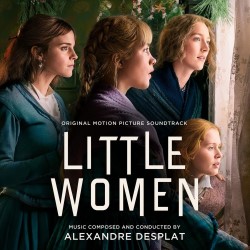
LITTLE WOMEN – Alexandre Desplat
 Original Review by Jonathan Broxton
Greta Gerwig’s Little Women is the latest big screen adaptation of the classic 1868 American novel by Louisa May Alcott. The story follows the March sisters – headstrong and mercurial Jo, willful and artistic Amy, maternal and meek Meg, creative but sickly Beth – as they come of age in post-civil war Massachusetts. The narrative deals with numerous issues of the day, including the effects of ‘genteel poverty,’ the fallout of the war, sibling rivalries, the entrenched class system, and of course romance and love, the latter of which usually revolves around Laurie, the handsome grandson of the March’s wealthy neighbor. What’s interesting about this version of the story is that Gerwig, acknowledging the social mores of the 2000s, has given her adapted screenplay a healthy dose of modern feminism, which touches on contemporary issues involving women’s suffrage, equal pay for equal work, and bucking the period convention that a woman was not complete without a husband. The film stars Saoirse Ronan, Emma Watson, Florence Pugh, and Eliza Scanlan as the four sisters, Timothée Chalamet as Laurie, Laura Dern as their ever-loving Marmee, and Meryl Streep as the cantankerous Aunt March, and is a sumptuous visual feast that looks likely to be a major player at the 2019 Academy Awards. Read more…
BORN ON THE FOURTH OF JULY – John Williams
 THROWBACK THIRTY
Original Review by Jonathan Broxton
In the late 1970s and 1980s a number of prominent American filmmakers took it upon themselves to take a long, hard look at the political and social ramifications of the country’s involvement in the Vietnam War. American involvement in the conflict began in the early 1960s, and lasted until the fall of Saigon in 1975, resulting in the deaths of more than 50,000 American military personnel, and hundreds of thousands more wounded. Chief among those filmmakers was Oliver Stone, who was himself a Vietnam vet. His 1986 film Platoon took a harrowing look at the war from the point of view of the men serving on the front lines, and he won Best Picture and Best Director Academy Awards for his trouble. Born on the Fourth of July, which was released in December 1989, took an equally harrowing look at what happened to those men when they finally came home. Read more…
STAR WARS: THE RISE OF SKYWALKER – John Williams
 Original Review by Jonathan Broxton
WARNING: THIS REVIEW CONTAINS PLOT SPOILERS. IF YOU HAVE NOT YET SEEN THE FILM, YOU MIGHT WANT TO CONSIDER WAITING UNTIL AFTER YOU HAVE DONE SO TO READ IT.
When you’re a critic or reviewer, you often get accused of being biased, especially when you write a review that is contrary to the opinion of the accuser. And, of course, this is true. It’s impossible to remove bias from any opinion because your biases inform your feelings and your reactions to whatever it is you’re expressing an opinion about. Your bias comes from your life experience, your culture, your personality, and your taste: effectively, it’s the sum of who you are. For me, a piece of critical writing without bias is pointless because then you’re never actually sharing your point of view – in effect, you’re just describing something, and never describing how it makes you feel, and most importantly why. All art should make you feel something, good or bad, because otherwise what’s the point of art? Over time, a critic’s biases will become a clear and important part of what they write, and the reader, if they invest enough time into learning them, will be able to weigh those subjective biases against more objective standards, and tell whether or not the end result meshes with their own opinions, and their own biases. So, from the point of view of this review it’s important to point out that I am biased, heavily, to have a positive view of Star Wars. Read more…
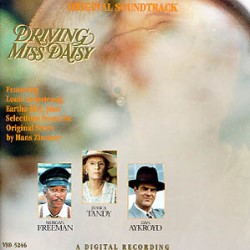
DRIVING MISS DAISY – Hans Zimmer
 THROWBACK THIRTY
Original Review by Jonathan Broxton
Driving Miss Daisy is a story of the unlikely friendship that develops between Daisy Wertham, a retired white Jewish schoolteacher, and Hoke Colburn, an African American driver and handyman, set against the backdrop of racism and prejudice in the American South in the 1950s. When Miss Daisy (Jessica Tandy) crashes her car into her neighbor’s house, her son Boolie (Dan Aykroyd) hires Hoke (Morgan Freeman) to be her driver; despite initial misgivings from both parties, as time passes the unlikely pair grow to become friends and confidants, as both suffer slights and prejudices against them – Hoke for his skin color, and Daisy for her religion. The film was directed by Bruce Beresford, and written by Alfred Uhry, who adapted his own Pulitzer Prize-winning stage play for the big screen. It was a significant critical and commercial success too, winning Academy Awards for Best Picture, Best Adapted Screenplay, Best Makeup, and Best Actress for Tandy, who in doing so became the oldest winner in the history of the category at the age of 81. Read more…
KNIVES OUT – Nathan Johnson
 Original Review by Jonathan Broxton
Knives Out is a super-fun Agatha Christie-style murder mystery, given a contemporary twist by writer-director Rian Johnson. Daniel Craig stars as Benoit Blanc, a master detective with a Foghorn Leghorn accent, who is called to help the police solve the murder of wealthy novelist Harlan Thrombey (Christopher Plummer), who is found dead in his Connecticut mansion on the night of his 85th birthday. Blanc encounters a motley crew of family and staff members – played by an astonishing supporting cast including Chris Evans, Jamie Lee Curtis, Don Johnson, Michael Shannon, Toni Collette, and Ana de Armas – all of whom have sufficient motive and means to want Harlan dead. As the story progresses Blanc discovers an intricate web of lies, deceit, familial in-fighting, blackmail, and so much more, eventually leading to an ending when he deduces the facts of the crime and the guilty parties are revealed. It’s a tremendously entertaining story – less a whodunit, and more of a whydunit – featuring enjoyable performances, clever writing, and plenty of twists and turns. It’s a marked difference from Johnson’s last film – the polarizing Star Wars: The Last Jedi – and reminds viewers why his earlier films, like Brick, The Brothers Bloom, and Looper, were so well-received. Read more…
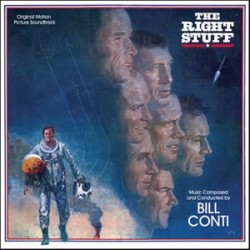
THE RIGHT STUFF – Bill Conti
 MOVIE MUSIC UK CLASSICS
Original Review by Craig Lysy
The 1979 novel The Right Stuff by Tom Woolfe proved to be a hit with the public, which set-off a bidding war for screen rights between Universal Pictures and independent producers Robert Chartoff and Irwin Winkler. Chartoff and Winkler won the day and hired screenwriter William Goldman to adapt the novel to the big screen. Goldman was inspired by the project and was seeking a patriotic Americana tale, which celebrated the Mercury 7 astronauts involved. Philip Kaufman was tasked with directing, but he disliked Goldman’s script, believing it too patriotic, with not enough focus on test pilot Chuck Yeager. Goldman left the project, Woolfe declined to adapt his novel, and so Kaufman wrote the screenplay himself. He related; “if you’re serious about tracing where the future — read: space travel — began, its roots lay with Yeager and the whole test pilot-subculture. Ultimately, astronautics descended from that point.” Kaufman brought in a fine cast, which included Fred Ward as Gus Grissom, Dennis Quaid as Gordo Cooper, Ed Harris as John Glenn, Sam Shepard as Chuck Yeager, Scott Glenn as Alan Shepard, Lance Henriksen as Wally Schirra, Scott Paulin as Deke Slayton, Barbara Hershey as Glennis Yeager and Veronica Cartwright as Betty Grissom. Read more…
FROZEN II – Christophe Beck, Robert Lopez, Kristen Anderson-Lopez
 Original Review by Jonathan Broxton
I don’t think anyone – including the people at Walt Disney – could have predicted just how successful Frozen would be when it was released in the fall of 2013. With it’s winning combination of comedy and action, strong female leads, genuinely beautiful snow-capped animation, and of course *that* song, it quickly became the highest grossing-animated film of all time (although Snow White and the Seven Dwarfs still holds the true crown, adjusted for inflation). It made its two princess protagonists, Anna and Elsa, household names, and made snowmen cool again, but it was as much of a success critically as it was commercially, eventually going to pick up two Oscars, a Golden Globe, a BAFTA, and even two Grammys. Of course, no studio would ever sit on all this success without trying to capitalize on it with a sequel, and so here we are with Frozen II – the first traditional animated Disney sequel to hit theaters since The Rescuers Down Under in 1990. Read more…
Golden Globe Nominations 2019
 The Hollywood Foreign Press Association (HFPA) has announced the nominations for the 77th Golden Globe Awards, honoring the best in film and American television of 2019.
In the Best Original Score category, the nominees are:
- ALEXANDRE DESPLAT for Little Women
- HILDUR GUĐNADÓTTIR for Joker
- RANDY NEWMAN for Marriage Story
- THOMAS NEWMAN for 1917
- DANIEL PEMBERTON for Motherless Brooklyn
This is the first Golden Globe nomination for Guđnadóttir, and the first nomination for a solo female composer at the Globes since Rachel Portman’s nomination for Chocolat in 2000. This is the 11th nomination for Desplat, who previously won the Globe for The Painted Veil in 2006 and The Shape of Water in 2017; the third nomination for Randy Newman; the second nomination for Thomas Newman; and the second nomination for Pemberton.
In the Best Original Song category, the nominees are:
- CYNTHIA ERIVO and JOSHUAH BRIAN CAMPBELL for “Stand Up” from Harriet
- ELTON JOHN and BERNIE TAUPIN for “I’m Gonna Love Me Again” from Rocketman
- BEYONCÉ KNOWLES-CARTER, TIMOTHY McKENZIE (LABRINTH), and ILYA SALMANZADEH for “Spirit” from The Lion King
- ROBERT LOPEZ and KRISTIN ANDERSON-LOPEZ for “Into the Unknown” from Frozen II
- TAYLOR SWIFT and ANDREW LLOYD WEBBER for “Beautiful Ghosts” from Cats
The winners of the 77th Golden Globe Awards will be announced on January 5, 2020.
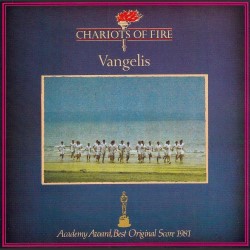
CHARIOTS OF FIRE – Vangelis
 MOVIE MUSIC UK CLASSICS
Original Review by Craig Lysy
Lauded English film producer David Puttnam was seeking a new film project, which offered sports heroism and dealt with matters of conscience. By chance he came upon the story of runner Eric Liddell, and found exactly the tale he wanted to tell. He hired screenwriter Colin Welland to adapt Liddell’s story, and he meticulous in his research of the 1924 Olympics. He crafted an Academy Award winning screenplay that provided the vehicle for Puttnam to realize his vision. Hugh Hudson was hired to direct and he decided early that he would cast young, unknown actors for the film’s major roles, with established actors in the supporting roles. He chose Ian Charleson to play Eric Liddell, Ben Cross as his rival Harold Abrahams, Nicholas Farrell as Aubrey Montague, and Nigel Havers as Lord Andrew Lindsay, while adding Sir John Gielgud, Nigel Davenport, Lindsay Anderson, Ian Holm, and Patrick Magee to the supporting cast. Read more…
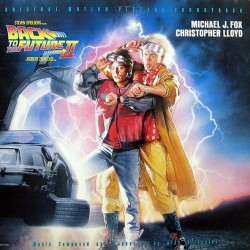
BACK TO THE FUTURE, PART II – Alan Silvestri
 THROWBACK THIRTY
Original Review by Jonathan Broxton
The enormous critical, cultural, and financial success of Back to the Future in 1985 meant that a sequel was inevitable. In the fall of 1989 director Robert Zemeckis returned with the first of not one but two further installments, shot back-to-back and ready to continue the time traveling exploits of Marty McFly, the suburban kid from 1980s California, and his eccentric inventor friend Doc Brown, who built a time machine out of a DeLorean. The ending of the original movie saw Doc picking up Marty and his girlfriend Jennifer literally the following morning after their adventure ended, and whisking them away in his now-upgraded flying automobile, promising them that “where they’re going they don’t need roads.” Where they end up going is the year 2015, to fix a problem with Marty and Jennifer’s future children – however, while they are there, Marty’s now-elderly arch-rival Biff Tannen contrives to steal the time machine himself, resulting in the creation of an alternate-timeline 1985 where Biff is a sleazy multi-billionaire and Marty’s stepfather. To fix things, Marty and Doc must travel even further back in time, once again to 1955, where they must re-restore the original timeline without screwing up the courtship between Marty’s parents Lorraine and George, which is happening at the same time! Read more…
SCL Award Nominations 2019
 The Society of Composers and Lyricists (SCL) has announced the nominations for the first annual SCL Awards, honoring the best in film and television music in 2019. The SCL is the premier professional trade group for composers, lyricists, and songwriters working in the motion picture, television, and game music industry, and is headquartered in Los Angeles. The nominees are:
OUTSTANDING ORIGINAL SCORE FOR A STUDIO FILM
- MICHAEL ABELS for Us
- MICHAEL GIACCHINO for Jojo Rabbit
- HILDUR GUĐNADÓTTIR for Joker
- JOHN POWELL for How to Train Your Dragon: The Hidden World
- ALAN SILVESTRI for Avengers: Endgame
OUTSTANDING ORIGINAL SCORE FOR AN INDEPENDENT FILM
- JEFF BEAL for Biggest Little Farm
- KATHRYN BOSTIC for Toni Morrison: The Pieces I Am
- ALBERTO IGLESIAS for Pain & Glory
- HOWARD SHORE for The Song of Names
- GABRIEL YARED for Judy
THE GOOD LIAR – Carter Burwell
 Original Review by Jonathan Broxton
The Good Liar is a complex thriller based on a popular novel by British author Nicholas Searle. It is directed by Bill Condon and stars Sir Ian McKellen as Roy, an elderly conman who uses his wit and sophistication to swindle women out of their inheritances and savings – a real life romance scam, as it were. For his latest target he chooses Betty McLeish (Dame Helen Mirren), a widowed former history professor who he meets via an online dating app. With the help of his long-time ‘business partner’ Vincent (Jim Carter), and despite the misgivings of Betty’s grandson Steven (Russell Tovey), Roy wheedles his way into Betty’s life, and when he discovers that her bank balance is in excess of £2 million, he redoubles his efforts at wooing her. However, before long, Roy finds himself having to face questions about his past, which lead to some shocking revelations. To disclose more would be a disservice to the story, suffice to say that the final half hour of the film goes in some completely unexpected directions that will either delight or dismay viewers, depending on how willing you are to accept plot twists so far out of left field they basically originate in the stadium parking lot. Read more…
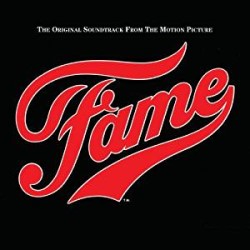
FAME – Michael Gore
 MOVIE MUSIC UK CLASSICS
Original Review by Craig Lysy
David De Silva, a New York City talent manager, happened to take in the 1976 production of “A Chorus Line”. The song “Nothing” triggered a creative spark when it referenced the prestigious New York High School of Performing Arts. He envisioned a film, which would speak to the dreams, trials and tribulations of ambitious young adolescent students trying to break in to the business and launch their careers. De Silva travelled to Florida the next year where he met famed playwright Christopher Gore. The two connected, he pitched his ideas, story and characters, and then hired Gore to draft a script with a working title of “Hot Lunch” for $5,000. De Silva was pleased with the script, sold the project to Metro-Goldwyn-Mayer executives, who authorized $400,000 to acquire the screen rights. De Silva and Alan Marshall would produce with a generous $8 million budget and Alan Parker was hired to direct. Read more…
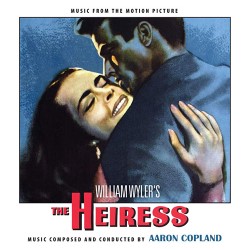
THE HEIRESS – Aaron Copland
 MOVIE MUSIC UK CLASSICS
Original Review by Craig Lysy
The genesis of the film lies with renown actress Olivia de Havilland who one night fell in love with the Broadway play The Heiress (1947). She sought out director William Wyler and pitched the idea of him directing her in a film adaptation of the play. Wyler, who had long admired de Havilland, jumped at the opportunity to direct her in this film. He obtained permission from Paramount studios executives to purchase the film rights from playwrights Augustus and Ruth Goetz for $250,000, and then hired them to adapt their play to the big screen. Wyler would produce and direct the film. Supporting Olivia de Havilland in the titular role would be a stellar cast which included Montgomery Clift as Morris Townsend, Ralph Richardson as Dr. Austin Sloper and Miriam Hopkins as Aunt Lavinia Penniman. The story takes place in New York City circa 1849 and centers on the life of Catherine Sloper, the shy, doting daughter of her recently widowed father Austin Sloper. She lives an insular life in luxury, content with embroidery and dutifully caring for her critical and unloving father. She is an heiress set for life as her mother bequeathed her a $10,000 a year stipend, which would increase to $30,000 once her father passes. Read more…

Shop at the Movie Music UK Store

Member of the

 MOVIE MUSIC UK