Archive
DUNGEONS & DRAGONS: HONOUR AMONG THIEVES – Lorne Balfe
 Original Review by Jonathan Broxton
It’s been surprisingly difficult to make a good adaptation of Dungeons & Dragons. In the years since the classic table-top roleplaying game was released in 1974 there have been several attempts; the 1983 animated TV series was fun, but barely resembled the game itself, while the 2000 live action version starring Justin Whalin was critically reviled and commercially disastrous, although it did spawn a series of straight-to-DVD sequels. This new film, Dungeons & Dragons: Honour Among Thieves, is an attempt to finally – finally – convey the fun, excitement, and imagination of the game for movie audiences; it stars Chris Pine, Michelle Rodriguez, Regé-Jean Page, Justice Smith, Sophia Lillis, and Hugh Grant, and was written and directed by self-proclaimed D&D nerds Jonathan Goldstein and John Francis Daley; it’s a classic fantasy story set in a medieval world full of knights, wizards, rogues and thieves, and features a quest for treasure, numerous battles, and wonderous creatures a-plenty. Read more…
THE LIFE OF EMILE ZOLA – Max Steiner
 GREATEST SCORES OF THE TWENTIETH CENTURY
Original Review by Craig Lysy
In 1936 Warner Brothers Studio executives Hal B. Wallis and Henry Blanke received a proposal from Heinz Herald, a literary agent, that they consider a making a biopic film of Émile Zola and the infamous Dreyfus Affair. Wallis and Blanke were favorably disposed to the idea and hired Harold and Geza Herczeg to write the script. Their 200-page script was accepted, but underwent editing by Herczeg, Wallis, director William Dieterle and actor Paul Muni. The final script was approved in early 1937, and Blanke was assigned production with a budget of $699,000. William Dieterle was tasked with directing, and a fine staff was assembled, including Paul Muni as Émile Zola, Gloria Holden as Alexandrine Zola, Gale Sondergaard as Lucie Dreyfus, and Joseph Schildkraut as Captain Alfred Dreyfus. Read more…
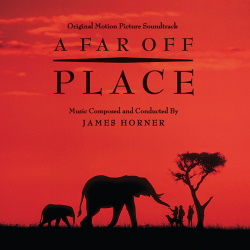
A FAR OFF PLACE – James Horner
 THROWBACK THIRTY
Original Review by Jonathan Broxton
A Far Off Place is a children’s adventure movie directed by Mikael Salomon about a group of teenagers who must survive in the African desert after their families are killed by poachers. It stars a then 17-year-old Reese Witherspoon as Nonnie Parker, a young girl who lives on a game reserve with her father; after the poachers attack and her father is killed, she is forced to flee into the Kalahari with a young African boy named Xhabbo (Sarel Bok), and along the way they are joined by an American teenager named Harry Winslow (Ethan Randall), who is also trying to escape from the poachers and their leader, corrupt ivory smuggler John Ricketts (Jack Thompson). The group faces many dangers in the harsh desert environment, including dehydration, starvation, encounters with dangerous wildlife, and further attacks from Ricketts, but eventually they discover evidence of the poachers’ illegal activities and decide that they must try to put an end to their operation. The film was received as a slightly updated version of the 1971 Australian film Walkabout, and was praised at the time for its beautiful desert cinematography, but it has become somewhat forgotten in the intervening years. Read more…
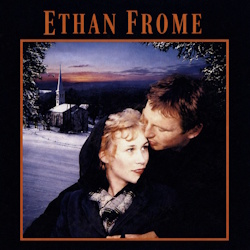
ETHAN FROME – Rachel Portman
 THROWBACK THIRTY
Original Review by Jonathan Broxton
Ethan Frome is a romantic drama directed by John Madden, based on the tragic novel by Edith Wharton. The film is set in snowy Vermont in 1911 and stars Liam Neeson as the titular character, who has been trapped by circumstance and duty his entire life. He is married to a sickly and demanding woman, Zeena (Joan Allen), who has come to live with him and his mother after the death of her own family. The couple is struggling financially, and Ethan is unable to leave the farm to pursue his dream of becoming an engineer. One winter day, a young and vivacious cousin of Zeena’s, Mattie Silver (Patricia Arquette), comes to stay with the Fromes to help care for Zeena. Ethan is immediately drawn to Mattie’s youthful energy and zest for life, and they begin to fall in love, but despite their growing feelings for each other, they are unable to act on them; Zeena is suspicious of their relationship and threatens to send Mattie away. Ethan is torn between his love for Mattie and his duty to Zeena, and in a desperate attempt to escape his unhappy life, considers running away with Mattie. However, their plan is foiled and their decision, and its aftermath, have significant consequences for all. It’s a classic, if somewhat bleak, tale of star crossed lovers, but the film was not a success with either critics or audiences; Roger Ebert famously described it as “the kind of movie they used to show us in high school English class, where it gave literature a bad name.” Read more…
SUPERCELL – Corey Wallace
 Original Review by Jonathan Broxton
Every once in a while I find myself scrolling through my TV’s list of movies-on-demand, agog at the number of films on there that I’ve literally never heard of. Half of them are low-budget action and sci-fi movies, made by former stars who have dropped off the 1980s and 90s A-List and are now hovering somewhere between the C-List and the D-List. A bunch of them star Bruce Willis. A bunch of others all seem to feature Frank Grillo. It’s very easy to just scroll past them mindlessly, until eventually they get lost in the endless streaming void. At first glance, Supercell is one of those movies; it’s an action movie about tornadoes, with a director I’ve never heard of (Herbert James Winterstern) and a pair of leads (Daniel Diemer, Jordan Kristine Seamón) who are similarly unknown to me. Those with a more ghoulish sensibility may stop for a second look because of two of it’s supporting actors: it’s the last film Anne Heche made prior to her grisly death in a car accident in August 2022, and it’s also one of the last films Alec Baldwin completed prior to him starting work filming Rust, the now-notorious project where he shot and killed his cinematographer, Halyna Hutchins, in an on-set accident. Beyond that, however, this film would usually never give me pause – except that, in this instance, one thing IS worth stopping and considering: the score. Read more…
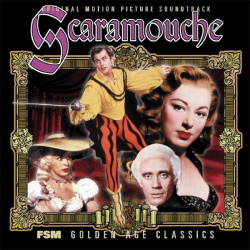
SCARAMOUCHE – Victor Young
 GREATEST SCORES OF THE TWENTIETH CENTURY
Original Review by Craig Lysy
One of Hollywood’s most beloved authors was Rafael Sabatini, whose swashbuckling novels were highly prized and often brought to the big screen, including; Scaramouche (1923), Bardelys The Magnificent (1926), Captain Blood (1935), The Sea Hawk (1940), and The Black Swan (1942). In 1938 MGM decided to remake its 1923 silent version of Scaramouche. It would however take thirteen years for the project to finally go to production under Carey Wilson. Ronald Millar and George Froeschel were hired to adapt the novel for a fresh iteration, and a $3.0 million budget was provided. George Sidney was tasked with directing, and a stellar cast was hired, including; Stewart Granger as Andre Moreau, Eleanor Parker as Lenore, Janet Leigh as Aline de Gavrillac de Bourbon, Mel Ferrer as Noel, Marquis de Maynes, and Nina Foch as Marie Antionette. Read more…
SHAZAM: FURY OF THE GODS – Christophe Beck
 Original Review by Jonathan Broxton
The 2019 superhero film Shazam remains, for me, the best entry into the DC Extended Universe to date. At the time, I wrote that “its playful tone is a far cry from the grim seriousness of the previous Ben Affleck Batman and Henry Cavill Superman movies, it’s much more intelligent and nuanced than Aquaman, and the less said about Suicide Squad the better. What I love about it the most is how it captures the excitement and eagerness of how an actual kid would behave when given super powers, and much of that is down to Zachary Levi’s central performance, which appears to me to be a combination of Christopher Reeve and Tom Hanks from Big.” Unfortunately the response to this sequel, Shazam: Fury of the Gods, has been less effusive, with some critics calling it “more unfocused and less satisfying than its predecessor,” despite it still retaining much of the source material’s “silly charm”. The film again stars Levi as 17-year old Billy Batson, who transforms into a super hero when he utters the titular magic word; this time, Billy/Shazam finds himself in conflict with the three daughters of the Titan Atlas, played by Helen Mirren, Lucy Liu, and Rachel Zegler, who want to re-claim the staff that gives Shazam his power, saying it was stolen from them eons ago. Read more…
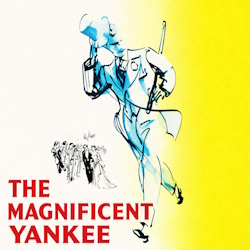
THE MAGNIFICENT YANKEE – David Raksin
 GREATEST SCORES OF THE TWENTIETH CENTURY
Original Review by Craig Lysy
In 1949 MGM studio executives were seeking a biopic of a famous American for their next film. They decided that the 1946 play The Magnificent Yankee by Emmet Lavery, which had a Broadway theatrical run of 159 performances would be their choice. Armand Deutsch was placed in charge of production with a $1.03 million budget, Emmet Lavery was hired to adapt his play for the film, and John Sturges was tasked with directing. Veteran stage and screen actor Louis Calhern was cast as Oliver Wendell Holmes Jr. Joining him would be Ann Harding as Fanny Bowditch Holmes, Eduard Franz as Justice Louis Brandeis, and Philip Ober as Owen Wister. Read more…
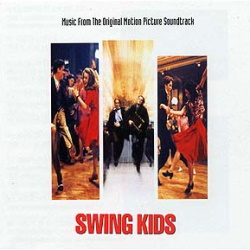
SWING KIDS – James Horner
 THROWBACK THIRTY
Original Review by Jonathan Broxton
Swing Kids is an interesting exploration of a sub-culture that existed in Nazi Germany in the 1930s and 40s. These so-called ‘swingjugend’ were groups of 14- to 21-year-old Germans, mostly middle or upper-class students, who admired the “American way of life” and rebelled against the government by gathering in underground nightclubs in Hamburg and Berlin, and listening to and dancing to swing music – an activity that the Hitler Youth of the National Socialist Party hated, and tried to suppress. The film follows the fortunes of one such group of youths, who grow up surrounded by intolerance and violence, and find the ‘swingjugend’ movement to be a welcome distraction, until the ramifications of their action begins to impact their daily lives. The film is directed by Thomas Carter, stars Robert Sean Leonard, Christian Bale, Frank Whaley, and Barbara Hershey, with an uncredited Kenneth Branagh in especially fine as an unexpectedly sympathetic Nazi SS-Sturmbannführer. Read more…
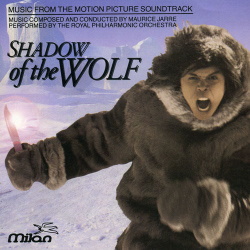
SHADOW OF THE WOLF – Maurice Jarre
 THROWBACK THIRTY
Original Review by Jonathan Broxton
Shadow of the Wolf is a French-Canadian action adventure film directed by Jacques Dorfmann and Pierre Magny, set in the snowy wastes of the Arctic in the 1930s. The film stars Lou Diamond Phillips as Agaguk, an Inuit warrior who has a violent hatred for the white men encroaching on his territory. A series of incidents leads to Agaguk being banished by his shaman father, and he is forced to live in isolation in the most inhospitable parts of northern Quebec with his wife Igiyook. Things get worse for Agaguk when he gets into an altercation with, and accidentally kills, a white fur trader, an incident which brings the might of the Canadian police to bear on his tribal home. The rest of the story intends to be a serious exploration of themes related to the culture clash between white men and the Inuit, dressed up with an action-adventure police manhunt plot, but unfortunately it was hamstrung by terrible dialogue, poor acting performances, and a screenplay that erased all the nuance and subtlety of Yves Theriault’s acclaimed original novel. At the time the film was the most expensive Canadian film ever made, but it sank without a trace at the box office, and is mostly forgotten today. Read more…
WILD ISLES – George Fenton
 Original Review by Jonathan Broxton
For almost 70 years the BBC Natural History Unit has been, in my opinion, the world leader in making nature documentaries. Although it had been making smaller-scale programmes for quite some time, it was the groundbreaking 1979 series Life on Earth that truly cemented its reputation; further entries such as The Living Planet in 1984, The Trials of Life in 1990, and Life in the Freezer in 1993 built on this success, and then more recent things like Blue Planet, Planet Earth, Africa, Life, and their various sequels, have showcased the NHU’s spectacular wildlife footage to millions worldwide. However, despite how majestic and awe-inspiring these massive shows are – and they are tremendous – I have always enjoyed their smaller scale examinations of British nature and found them to be equally rewarding; Wild Isles is one of those. Read more…
THE SNOWS OF KILIMANJARO – Bernard Herrmann
 GREATEST SCORES OF THE TWENTIETH CENTURY
Original Review by Craig Lysy
In 1948 20th Century Studio executive Darryl F. Zanuck made the business decision to adapt another of Ernest Hemingway’s novels for the big screen, The Snows of Kilimanjaro from 1936. He purchased the film rights for a hefty $125,000 and personally took charge of production, allocating a budget of $3.0 million. Casey Robinson was hired to write the screenplay and veteran Henry King was tasked with directing. Zanuck had already decided that Gregory Peck would star as Harry Street, with Ava Gardner playing Cynthia Green. Joining them would be Susan Hayward as Helen, and Hildegard Knef as Countess Elizabeth. Read more…
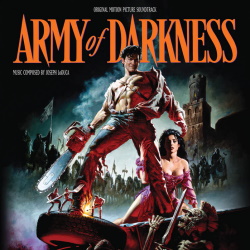
ARMY OF DARKNESS – Joseph Lo Duca
 THROWBACK THIRTY
Original Review by Jonathan Broxton
Army of Darkness is the third instalment of director Sam Raimi’s Evil Dead series, and is a direct continuation of the story of 1987’s Evil Dead II. The plot of that film saw its protagonist, Ash, inadvertently summon a demon after reading passages from an ancient ‘book of the dead’. His girlfriend Linda is possessed by the demon, and attacks him, and in the ensuing battle he has his hand severed at the wrist with a chainsaw. Eventually Ash is able to defeat the demon, but in doing so he accidentally opens a temporal vortex to the Middle Ages, through which he and his car are transported. Army of Darkness follows the story from that point on, as Ash enlists the help of a medieval lord, falls in love with the lord’s daughter, and has to search for another version of the ‘book of the dead’ that will allow him to return home – all while battling more demonic ‘deadites’. The film starred Bruce Campbell, Embeth Davidtz, and Marcus Gilbert, and was a moderate commercial success, but unfortunately was not well-liked by critics, many of whom were disappointed with its campier, less horrific tone. It ultimately ended the Evil Dead franchise for more than 20 years, until it was resurrected and rebooted by director Fede Álvarez in 2013. Read more…
Under-the-Radar Round Up 2023, Part 1
 Original Reviews by Jonathan Broxton
I’m pleased to present the latest instalment in my on-going series of articles looking at the best under-the-radar scores from around the world. This article, the first of 2023, covers five scores for projects from all around the world that especially impressed me during the opening months of the year. The scores include a trio from France – two children’s adventures and a broad comedy – plus another children’s adventure from Finland, and a serious historical epic from Japan.
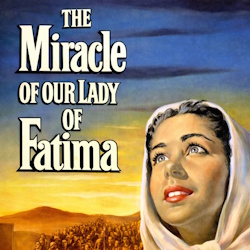
THE MIRACLE OF OUR LADY OF FATIMA – Max Steiner
 GREATEST SCORES OF THE TWENTIETH CENTURY
Original Review by Craig Lysy
It had been eight years since the commercial and critical success of 20th Century Fox’s religious themed film The Song of Bernadette. Warner Brothers Studios executives decided that they wanted to explore the genre and decided that a similar tale, The Miracle of Our Lady of Fatima, would accomplish that end. Their resident producer Bryan Foy was assigned the project, James O’Hanlon and Crane Wilbur were hired to write the screenplay, and John Brahm was tasked with directing. A trio of children were hired to play the roles of the child witnesses of the vision; Susan Whitney as Lúcia dos Santos, Sherry Jackson as Jacinta Marto and Sammy Ogg as Francisco Marto. Joining them would be Gilbert Roland as Hugo de Silva, Angela Clarke as Maria Rosa de Silva, and Richard Hale as Father Ferreira. Read more…

Shop at the Movie Music UK Store

Member of the

 MOVIE MUSIC UK