Archive
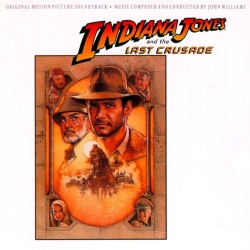
INDIANA JONES AND THE LAST CRUSADE – John Williams
 THROWBACK THIRTY
GREATEST SCORES OF THE TWENTIETH CENTURY
Original Review by Jonathan Broxton
The third movie in director Steven Spielberg’s Indiana Jones series was Indiana Jones and the Last Crusade, and whereas 1984’s Temple of Doom was a prequel to Raiders of the Lost Ark, Last Crusade was a direct sequel, set just two years later in 1938. Harrison Ford returns as the titular archaeologist-adventurer, who is sent off on a globe-trotting escapade when he receives news from American billionaire Walter Donovan (Julian Glover) that his long-estranged father Henry Jones (Sean Connery) has gone missing while searching for the holy grail. Jones teams up with his old friends and colleagues Marcus Brody (Denholm Elliott) and Sallah (John Rhys-Davies) on the quest to find his father, and quickly becomes embroiled in a vast labyrinthine plot involving ancient myths and legends, a brotherhood of religious warriors, way too many Nazis, and a beautiful Austrian art professor named Elsa Schneider (Alison Doody) to whom there is more than meets the eye. The whole thing is a delight from start to finish, with several wonderfully exciting action set pieces, and beautiful location settings, but the cornerstone of the film is the father-and-son chemistry between Ford and Connery, whose outward gruffness and constant bickering masks a deep love and affection. Whereas Ford is an all-action matinee idol hero, Connery is a slightly bumbling academic, more at home with books and libraries than punching Nazis in the face, but who is still able to make his son feel like a 12-year old when he calls him ‘junior’. Read more…
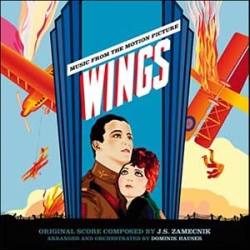
WINGS – J. S. Zamecnik
 GREATEST SCORES OF THE TWENTIETH CENTURY
Original Review by Craig Lysy
John Monk Saunders served in the US Air Corp during WWI as a flight instructor in Florida. He had lifelong regrets that he was never able to serve his country in combat, and so conceived a story, which would allow him to realize that ambition in film. He pitched his idea to producer Jessie Lasky who was unreceptive due to the logistics required to film aerial combat. Yet Saunders would not be denied and secured support from the War Department, which included 220 planes, and airmen, artillery, tanks, trucks and troops. Lasky was impressed and decided to proceed with his Famous Players-Lasky company financing the project and Paramount Studio securing distribution rights. A massive budget of $2 million was budgeted and Louis Lighton and Hope Loring were hired to write the screenplay. Lasky and four others would produce the film, and William Wellman was tasked with directing as he was the only director in Hollywood who had actual combat pilot experience. Securing a cast was an adventure however when Paramount’s greatest star Clara Bow, demanded a rewrite stating “Wings is a man’s picture and I am just the whipped cream on top of the pie”. Her demands were met and the story evolved into a war time romance. She would star as Mary Preston, with Charles “Buddy” Rogers as Jack Powell, Richard Arlen as David Armstrong, Gary Cooper as Cadet White, and Jobyna Ralston as Sylvia Lewis. Read more…
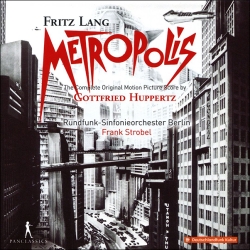
METROPOLIS – Gottfried Huppertz
 GREATEST SCORES OF THE TWENTIETH CENTURY
Original Review by Craig Lysy
Director Fritz Lang had early access to his wife Thea von Harbou’s 1925 novel Metropolis, and was inspired to bring its bold futuristic social commentary to the big screen. The couple worked together to fashion the screenplay and secured financing from the German production company WFA and the German distribution company Parufamet, which was created by investment from Paramount and MGM studios. He pitched his screenplay to Erich Pommer, the most powerful film producer in Germany of the time, and secured his backing to produce the film. A fine cast was assembled which included Alfred Abel as the Master of Metropolis Joh Fredersen, Gustav Fröhlich as Joh Fredersen’s son, Rudolph Klein-Rogge as Rotwang the inventor, and Brigitte Helm as the unforgettable Maria. The film’s narrative offers a potent social commentary, which is set in the far future in the great city of Metropolis. The society is dystopian with an elite ruling class of capitalist industrial oligarchs who live above ground in luxurious skyscrapers and hold power over a lower working class who live impoverished underground, toiling endlessly to operate and maintain the great machines that power the city. They share not in the profits, nor any of the benefits, which go solely to the ruling elite. Freder, who is the son of the Master of Metropolis, bears witness to the misery of the working class and resolves to advocate for them. Freder meets a worker prophetess named Maria who foresees the arrival of a Mediator who will unify the workers and ruling elite of Metropolis in a new Utopia. He falls in love with Maria and aspires to assume the role of Mediator. Against this backdrop the evil inventor Rotwang creates a robot bearing Maria’s likeness to foment dissent and revolution, which will bring him to power. In the end, after much intrigue and fighting, Freder kills Rotwang and fulfills his role as Mediator. Read more…
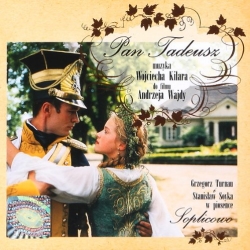
PAN TADEUSZ – Wojciech Kilar
 GREATEST SCORES OF THE TWENTIETH CENTURY
Original Review by Craig Lysy
Poland had a decade earlier thrown off the foreign shackles of Russian domination, yet the country was struggling to regain its identity, and find its place in the world. Against this backdrop, the great Polish director Andrrzej Wajda conceived for his next project a grand tale based on Adam Mickiewicz’s epic 1834 poem Pan Tadeusz. The poem is considered by Poles to be the greatest achievement in Polish literature and by most professors of literature to be the last epic poem in European literature. Wajda describes it as “a great story that focuses on our national characteristics. The Poles in Pan Tadeusz are the same as we are now: sometimes wise, sometimes stupid. It’s basically a picture of how we are now and allows us to look at ourselves and see who we are and where we’re going.” Wajda pitched his idea to several studios and secured funding from a conglomerate of twelve companies. He would direct and write the screenplay, and Lew Rywin would produce. A fine cast was assembled, which included; Boguslaw Linda as Jacek Soplica/Father Robak, Michal Zebrowski as Tadeusz Soplica, Alicia Bachleda-Curus as Zosia Horeszko, Grazyna Szapolowska as Telimena, Andrzej Seweryn as Judge Soplica, and Marek Kondrat as Count Horeszko. Read more…
FIELD OF DREAMS – James Horner
 THROWBACK THIRTY
GREATEST SCORES OF THE TWENTIETH CENTURY
Original Review by Jonathan Broxton
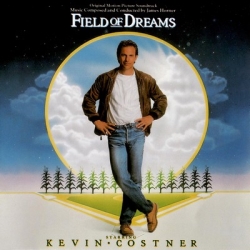
Field of Dreams is a film about baseball, but it’s also about much, much more than that. It’s a film about regret, about missed opportunities, about the relationships we allow to fritter away through petty disagreements and neglect. It’s a film about life, about how the ambitions we had in our youth turn into something completely different in adulthood, and how we deal with that change. It’s a film about hope, about how each of us longs to re-capture that innocence and optimism we once had, and the things we will do to get it. And it’s a film about reconciliation, coming to terms with the mistakes we have made, and making things right. The film is written and directed by Phil Alden Robinson, based on the novel ‘Shoeless Joe’ by W. P. Kinsella; it stars Kevin Costner as Ray, a corn farmer who lives in Iowa with his wife Annie (Amy Madigan), and their young daughter Karen (Gaby Hoffmann), on the property that his late father left him. Ray had been estranged from his father for many years before he died, and the legacy of that relationship weighs heavily upon him. One day, while out in the cornfield, Ray hears a spectral voice whispering the words ‘if you build it, he will come,’ and he is subsequently inspired to build a full-size baseball diamond on his property. This event sends Ray off on a voyage of personal self-discovery involving Shoeless Joe Jackson (Ray Liotta) and the ghosts of the disgraced 1919 Chicago White Sox team, a reclusive political author (James Earl Jones), and a beloved country doctor (Burt Lancaster) who played just a single game in the major leagues for the New York Giants in 1922. Read more…
THE RED VIOLIN – John Corigliano
 GREATEST SCORES OF THE TWENTIETH CENTURY
Original Review by Craig Lysy
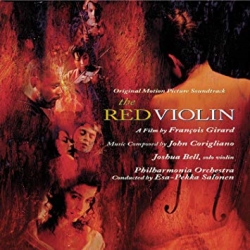
Director Francois Girard had long desired to make a film, which centered on music, and became inspired by the story of one of Antonio Stradivari’s most famous creations – the 1721 Red Mendelssohn, a violin which featured a unique red coloring on its top right side. He hired Don McKellar to write the screenplay and was very happy with the final script. However, he soon had the sober realization of the magnitude and extent of challenges posed by the project; the story stretches over three centuries, from 1681 to 1997, and is set in five different countries, with five different set of actors, each with a different language. He was unable to broker financing from American studios as they would not agree to a film with sub-titles of five different languages. Undeterred, he eventually secured backing from the Canadian firm Rhombus Media. Casting was a challenge as five ensembles needed to be hired one for each of the film’s vignettes. For Cremona 1681 he cast Carlo Cecchi as Nicolò Bussotti and Irene Grazioli as Anna Rudolfi Bussotti. For Vienna 1793 he cast Jean-Luc Bideau as Georges Poussin. For Oxford in the late 1890s he cast Jason Flemyng as Frederick Pope. For Shanghai in the late 1960s he cast Sylvia Chang as Xiang Pei. For Montreal 1997 he cast Samuel L. Jackson as Charles Morritz, Colm Feore as the Auctioneer, and Don McKellar as Evan Williams. This unique story traces the creation of a legendary violin, its lore portended by a fateful tarot card reading, which dooms all that possess it to tragedy. Five vignettes trace its travels and ownership through time, with death, and misfortune coming to all who possess it. The Red Violin was not a commercial success, earning only $10 million, which was insufficient to cover its $14 million production costs. Critical reception was mixed, and the film received one Academy Award nomination, which secured the win – Best Film Score. Read more…
TITANIC – James Horner
 GREATEST SCORES OF THE TWENTIETH CENTURY
Original Review by Craig Lysy
James Cameron had long been fascinated with shipwrecks and conceived to write a love story set on the greatest shipwreck of all time – the RMS Titanic. He believed that telling the story of the sinking of the great ship in and of itself was insufficient, so the addition of a love story as well as an intimate exploration of the lives of the people who died would add a compelling narrative to the tale. He pitched his story to 20th Century Fox executives as ‘Romeo and Juliet on the Titanic’. They bought his idea given his resume of directorial success, as they wanted to secure him for future projects. He was provided with the largest budget ever for a film at that time – $200 million – and took it upon himself to do what had never been done before; to produce, direct, write and edit a film. He brought in a fine cast to support his vision, including Leonardo Di Caprio as Jack Dawson, Kate Winslet as Rose DeWitt Bukater, Billy Zane as Cal Hockley, Frances Fisher as Ruth DeWitt Bukater, Gloria Stuart as the older Rose, Kathy Bates as the Unsinkable Margaret “Molly” Brown, Victor Garber as Thomas Andrews, Bill Paxton as Brock Lovett, David Warner as Spicer Lovejoy, and Danny Nucci as Fabrizio De Rossi. Read more…
CRIMSON TIDE – Hans Zimmer
 GREATEST SCORES OF THE TWENTIETH CENTURY
Original Review by Craig Lysy
Producers Don Simpson and Jerry Bruckheimer happen to view a documentary film titled Submarines: Sharks of Steel, and became inspired to bring a submarine drama to the big screen. The initial screenplay told the story of a Trident submarine crew attempting to stop the ship’s computer from independently launching nuclear missiles and starting World War III. When they pitched their idea to the Department of the Navy they characterized the movie as “The Hunt for Red October meets 2001: A Space Odyssey.” They obtained permission from the U.S. Navy for the creative team to perform research by sailing aboard the Trident missile submarine USS Florida from Bangor, Washington. A few months later they submitted a revised script by Michael Schiffer in which an Executive Officer leads a mutiny against the Captain to prevent a nuclear missile launch. Well, the Navy balked against this assault on its traditions and refused to cooperate further. Undeterred, the production team secured assistance from the French navy to support the film. Jerry Bruckheimer and Don Simpson would produce the film, with Tony Scott tasked with directing. A fine cast was brought in, including Gene Hackman as the imperious Captain Frank Ramsey, Denzel Washington as Executive Officer (XO) Ron Hunter, George Dzundza as Chief of Boat (COB) Walters, Matt Craven as Communications Officer Roy Zimmer, Viggo Mortensen as Weapons Officer Peter Ince, and James Gandolfini as Supplies Officer. Read more…
BRAVEHEART – James Horner
 GREATEST SCORES OF THE TWENTIETH CENTURY
Original Review by Craig Lysy
During a visit to Scotland screenwriter Randall Wallace was inspired by the lore of the Scottish patriot William Wallace. He conceived and wrote a screenplay for a grand historical epic, which would bring this heroic figure to the big screen. MGM producer Alan Ladd Jr. realized he had a winner and purchased the script, which he shared with Mel Gibson. Gibson initially passed on the project, but eventually relented, agreeing to direct, however he declined to star as he felt he was too old at age 40 to play the part of Wallace, who was in his late twenties. Financing constraints led to a reversal as Paramount Studios would only agree to finance the film if he starred in it. Gibson agreed to take on the titular role and brought in a fine cast to support, which included Sophie Marceau as Princess Isabelle, Angus MacFadyen as Robert the Bruce, Patrick McGoohan as King Edward I, Catherine McCormack as Murron, Brendan Gleeson as Hamish, Peter Hanly as Prince Edward, and Ian Bannen as Robert the Elder. Gibson’s final script took significant license with historical accuracy, so as to make the story more intimate, dramatic and grand. The film is set in Scotland the year 1280, when the country is occupied by the forces of English King Edward I, and it tells the story of the rise and fall of the legendary Scottish patriot and freedom fighter. Read more…
APOLLO 13 – James Horner
 GREATEST SCORES OF THE TWENTIETH CENTURY
Original Review by Craig Lysy
Following his retirement from NASA in 1973, Apollo 13 astronaut James Lovell collaborated with journalist Jeffrey Kluger to recount the riveting tale of his failed moon landing, titled ‘Lost Moon: The Perilous Voyage of Apollo 13’. In 1993 director Ron Howard and producer Brian Grazer of Imagine Entertainment received a pre-publication copy of the novel and immediately realized that this story offered classic American heroism, which needed to be brought to the big screen. They secured the film rights and, in partnership with Universal Pictures, undertook the project with a modest budget of $52 million. Howard secured a stellar cast, which included NASA fan Tom Hanks as Commander Jim Lovell, Kathleen Quinlan as his wife Marilyn, Kevin Bacon and Bill Paxton as fellow astronauts Jack Swigert and Fred Haise, Gary Sinise as Ken Mattingly, and Ed Harris as NASA Flight Director Gene Kranz. The story retells the harrowing tale of the Apollo 13 mission, which was intended to bring a third astronaut team to the moon. Read more…
LEGENDS OF THE FALL – James Horner
 GREATEST SCORES OF THE TWENTIETH CENTURY
Original Review by Craig Lysy
Having just finished the comedy Leaving Normal, director Edward Zwick decided to change direction and film an epic historical drama, which showcased the talent of rising star Brad Pitt as a romantic leading man. To that end he found the perfect vehicle in the 1978 novella Legends of the Fall by Jim Harrison. His production company Bedford Falls purchased the film rights with TriStar Pictures agreeing to distribute. Zwick, William Wittliff and Marshal Herskovist would produce the film, with Zwick directing. He hired screenwriters Susan Shilliday and William D. Wittliff to adapt the story for the big screen and brought in an outstanding cast, which included Brad Pitt as Tristan Ludlow, Anthony Hopkins as Colonel William Ludlow, Aiden Quinn as Alfred Ludlow, Henry Thomas as Samuel Ludlow, and Juilia Ormond as Susannah Fincannon. The film is set in the territory of Montana circa 1890 when Colonel William Ludlow resigns his commission, loathe to continue his part in the army’s cruel betrayal and slaughter of native Americans. He settles on a ranch in a remote part of Montana where he and his wife Isabel live a tranquil existence in peace. Isabel bears him three sons – Tristan, Alfred, and Samuel – but ends up leaving him as she is unable to bear the isolation and long harsh winters, which forces William to raise the boys himself. Almost 20 years later, the the now-grown Samuel returns home to the ranch with his fiancé Susannah, but this is a harbinger of sorrow as it precipitates a series of tragic events which fracture the family and set brother against brother as they compete for her affections. Read more…
JURASSIC PARK – John Williams
 GREATEST SCORES OF THE TWENTIETH CENTURY
Original Review by Craig Lysy
Steven Spielberg became aware of Michael Crichton’s novel Jurassic Park as the two collaborated on the television series E.R. A bidding war for the rights ensued, with Spielberg and Universal Pictures prevailing over Warner Brothers and Tim Burton, Columbia Pictures and Richard Donner, James Cameron and Joe Dante. Kathleen Kennedy and Gerald Molen would produce the film with Spielberg directing. Spielberg understood the challenges he faced bring the dinosaurs to life and sought at all costs to not repeat the technical nightmare he experienced in Jaws. He turned to George Lucas’ Industrial Light and Magic Company to create groundbreaking computer –generated imagery and ended up making history. Crichton was hired to adapt his novel to the screen but Spielberg was unsatisfied with the violence. Malia Scotch Marmo was tasked with the rewrite in late 1991, but she also did not satisfy Spielberg’s vision. Universal executives brought in Casey Silver and David Koepp who ultimately crafted the script used in the film. A fine cast was assembled with Sam Neill securing the role of Alan Grant after William Hurt and Harrison Ford both declined. Joining him would be Laura Dern as Ellie Sattler, Jeff Goldblum as Ian Malcolm, Richard Attenborough as John Hammond, Bob Peck as Robert Muldoon, Samuel Jackson as Ray Arnold, B.D. Wong as Henry Wu, and Ariana Richards and Joseph Mazzello as Hammond’s niece and nephew Lex and Tim. Read more…
SCHINDLER’S LIST – John Williams
 GREATEST SCORES OF THE TWENTIETH CENTURY
Original Review by Craig Lysy
The genesis of Schindler’s List lay with holocaust survivor Leopold Pfefferberg, whose tale of Oskar Schindler inspired Thomas Keneally to write his Booker Prize winning novel, Schindler’s Ark, in 1982. It came to pass that studio president Sid Sheinberg saw opportunity in the story and mailed Steven Spielberg a review of the book by the New York Times. Spielberg was deeply moved by the narrative and secured financial backing from Universal Pictures, which purchased the screen rights. Yet the then 37-year-old hesitated and ultimately delayed production ten years as he felt himself too young to take on the pathos of the Holocaust. When the time eventually came to begin production, he tasked Steven Zaillian with writing the screenplay, and the struggled to hire a director, soliciting several including Roman Polanski, Sydney Pollack, Billy Wilder and Martin Scorsese. Ultimately Spielberg took Wilder’s counsel to direct the film himself. For the cast he brought in an outstanding ensemble, which included Liam Neeson as Oskar Schindler, Ben Kingsley as Itzhak Stern, Ralph Fiennes as Captain Amon Göth, Caroline Goodall as Emilie Schindler, Jonathan Sagalle as Poldek Pfefferberg, and Embeth Davidtz as Helen Hirsch. Read more…
BRAM STOKER’S DRACULA – Wojciech Kilar
 GREATEST SCORES OF THE TWENTIETH CENTURY
Original Review by Craig Lysy
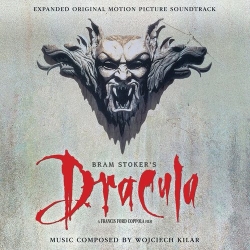
The genesis of the film lay with actress Winona Ryder, who wished to make amends with director Francis Ford Coppola after her late withdrawal from The Godfather Part III. She brought him a script written by James V. Hart, which provided an adaptation of the famous 1897 novel Dracula by Irish author Bram Stoker. Coppola was intrigued by the sensuality and eroticism of Hart’s retelling and immediately moved forward to bring it to the big screen. He would produce the film with Fred Fuchs and Charles Mulvehill using his own production company of American Zoetrope. Coppola had an uncompromising conception of the film and went to great lengths to create his cinematic vision. Indeed, the film shattered the traditional mythos and caricature of the black caped Dracula with a new, stylish, and significantly more erotic rendering. He assembled a fine, but controversial cast with Gary Oldman playing the titular role. Supporting him would be Winona Ryder as Mina, Anthony Hopkins as Professor Abraham Van Helsing, Keanu Reeves as Jonathan Harker, Richard E. Grant as Dr. Jack Seward, Cary Elwes as Lord Arthur Holmwood, Billy Campbell as Quincy Morris, Tom Waits as Renfield, and Sadie Frost as Lucy Westenra. Read more…
DANCES WITH WOLVES – John Barry
 GREATEST SCORES OF THE TWENTIETH CENTURY
Original Review by Craig Lysy
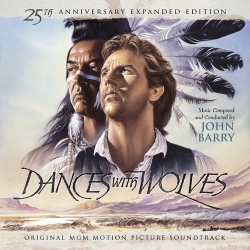
Kevin Costner had long wished to produce and star in a western and, after several years of searching, finally came upon a script by his friend Michael Blake that piqued his interest. Set in the post-Civil War era, the tale explored the clash of civilizations between the indigenous American Indians and the westward expanding white Europeans. Costner asked Blake to expand his script into a novel to improve its chances of being adapted to the big screen. He did so, and Dances With Wolves was published in 1988. Costner immediately purchased the film rights and set his plan into motion, using his own Tig Productions Company to finance the film. He would audaciously produce, direct and star in the film. He began with a production budget of $15 million dollars, which ballooned to $22 million due to his insistence on geographical, linguistic and cultural authenticity. To support him in the lead role of Lieutenant John Dunbar he hired Mary McDonnell as Stands With A Fist, Graham Greene as Kicking Bird, and Rodney A. Grant as Wind In His Hair. Read more…

Shop at the Movie Music UK Store

Member of the

 MOVIE MUSIC UK