Archive
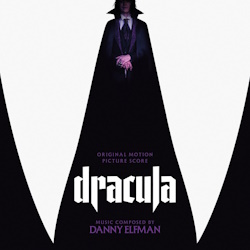
DRACULA – Danny Elfman
 Original Review by Jonathan Broxton
Bram Stoker’s classic 1897 novel Dracula, which introduced the world to the modern concept of the vampire, has been made into films dozens and dozens of times over the years, from the early German expressionist silent version by F.W Murnau, to Bela Lugosi’s classic Hollywood portrayal in 1931, to the Christopher Lee-Peter Cushing British Hammer horrors of the 1950s and 60s, and many more besides. Last year director Robert Eggers made one of the best ever versions of the story with his Nosferatu, which portrayed the undead count as more plague than man, twisted and evil. Now, the latest director to take on the story is French director Luc Besson, but his version of the story is different from Eggers’s, and is instead closer in tone to the luxurious romanticism of Francis Ford Coppola’s Dracula from 1992, which remains my personal favorite of all Dracula films. Besson’s film – which was made entirely by a French crew – was nevertheless shot in English, and stars Caleb Landry Jones in the title role as the blood-sucking count who is both debonair and demonic, with Christoph Waltz, Zoë Bleu, and Matilda De Angelis in major supporting roles. Read more…
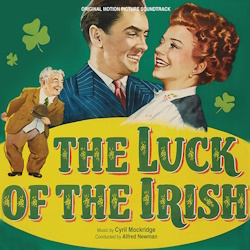
THE LUCK OF THE IRISH – Cyril J. Mockridge
 GREATEST SCORES OF THE TWENTIETH CENTURY
Original Review by Craig Lysy
The husband and wife writing team of Guy and Constance Jones caught the attention of Hollywood studios after Universal successfully adapted their story “Peabody’s Mermaid” for the film Mr. Peabody and the Mermaid, released in August 1948. 20th Century Fox decided to roll the dice and so in July 1947 they purchased the film rights for their second novel “There Was a Little Man” for $50,000, which was adapted into this film, The Luck of the Irish. Fred Kohlmar was placed in charge of production, Henry Koster was tasked with directing, and Philip Dunne would write the screenplay. A fine cast was hired, with Tyrone Power starring as Stephen Fitzgerald, joined by Ann Baxter as Nora, Cecil Kellaway as Horace and Lee J. Cobb as David Augur. The film was made quickly and eventually released just one month later, in September 1948. Read more…
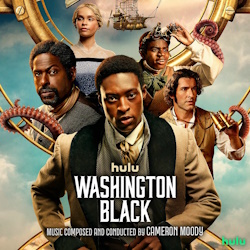
WASHINGTON BLACK – Cameron Moody
 Original Review by Jonathan Broxton
Washington Black is a new Hulu drama-adventure TV series based on the 2018 ‘bildungsroman’ novel of the same name by Canadian-Ghanaian author Esi Edugyan. The story follows the adventures of George Washington ‘Wash’ Black, who is born into slavery on a sugar plantation in Barbados in the early 1800s. When a brutal new overseer named Erasmus Wilde takes charge of the plantation, Wash is unexpectedly chosen to be the assistant to Erasmus’s brother Christopher, nicknamed ‘Titch,’ a kindhearted inventor who is also secretly an abolitionist seeking to end slavery. Titch teaches Wash to read, write, and appreciate scientific exploration, introducing him to a world of wonder. However, a traumatic event forces Titch and Wash to flee Barbados in a flying machine, and their escape sets them on an adventurous globe spanning journey across the Americas to Nova Scotia, the Arctic, then to London, Morocco, and beyond, all with Erasmus’s slave-hunting henchman Willard hot on their trail. The show was written by Selwyn Seyfu Hinds, produced under the auspices of showrunner Kimberly Ann Harrison, and stars Ernest Kingsley Jr. and Eddie Karanja as the younger and older Wash, with Rupert Graves, Tom Ellis, Billy Boyd, and Sterling K. Brown in major supporting roles. Read more…
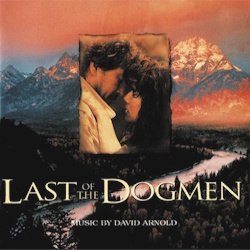
LAST OF THE DOGMEN – David Arnold
 THROWBACK THIRTY
Original Review by Jonathan Broxton
A wilderness action adventure with elements of mystery and historical fantasy, Last of the Dogmen stars Tom Berenger as Lewis Gates, a rugged bounty hunter tracking three escaped convicts in the remote and treacherous wilderness of the Montana Rockies near the Canadian border. During his search, Gates comes across bizarre signs that suggest the presence of a mysterious and elusive group living deep in the mountains – people who shouldn’t exist. After teaming up with anthropologist Professor Lillian Sloan (Barbara Hershey), an expert on Native American history, they investigate the mystery, and discover a hidden valley inhabited by a Native American tribe descended from the Cheyenne Dog Soldiers, fierce warriors who evaded the U.S. Cavalry over a century earlier and have lived in complete isolation ever since. Read more…
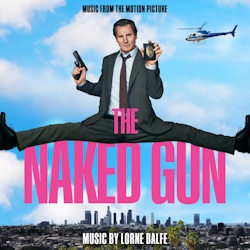
THE NAKED GUN – Lorne Balfe
 Original Review by Jonathan Broxton
Sassafras Chicken in D. Make it extra lumpy, boys.
As much as I enjoy witty repartee and sophisticated but humorous observations about the human condition, there is something enormously satisfying about a comedy that is unashamedly, gleefully stupid. My favorite out-and-out comedy of this type is Airplane! from 1980, which was written and directed by Jim Abrahams, David Zucker, and Jerry Zucker, and my second favorite comedy of all time of this type is The Naked Gun from 1988, which ZAZ co-wrote with Pat Proft. The Naked Gun was itself a spinoff of the short-lived comedy TV series Police Squad, which aired on ABC for one season in 1982, and starred Leslie Nielsen as the inept LAPD detective Lt. Frank Drebin. Over the course of the show and the three subsequent films he investigates various murders, robberies, and extortion rackets – all of which are framing devices on which to hang all manner of goofy one-liners, ridiculous sight gags, and hilarious pratfalls, all centered around Nielsen’s unique brand of comedy. Read more…
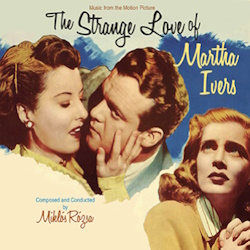
THE STRANGE LOVE OF MARTHA IVERS – Miklós Rózsa
 GREATEST SCORES OF THE TWENTIETH CENTURY
Original Review by Craig Lysy
The Paramount Pictures development team was seeking a new film noir project given that the genre was blossoming in the 1940s, captivating audiences far and wide. They believed they found it in the short story “Love Lies Bleeding” by playwright John Patrick, which was re-titled The Strange Love of Martha Ivers for the big screen. Screenwriter Robert Rossen acquired the film rights for $35,000 and was tasked to write the screenplay. Hal B. Wallis was placed in charge of production and Lewis Milestone would take the reins directing. For the cast Barbara Stanwyck would star in the titular role as Martha Ivers, joined by Van Heflin as Sam Masterson in his comeback role following his discharge from the military, Lizabeth Scott as Toni Marachek, Kirk Douglas in his acting debut as Walter O’Neil, and Judith Anderson as Mrs. Ivers. Read more…
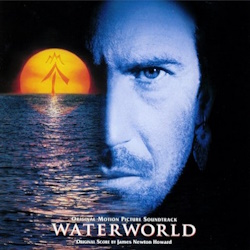
WATERWORLD – James Newton Howard
 THROWBACK THIRTY
Original Review by Jonathan Broxton
For many years in Hollywood Waterworld – the title of Kevin Costner’s 1995 action-adventure movie – was a byword for financial disaster in moviemaking. Originally conceived by screenwriter Peter Rader in the mid-1980s as a low budget ‘Mad Max on water’ the script was eventually rewritten by David Twohy, whose version leaned heavily into the post-apocalyptic sci-fi genre. Costner, then at the height of his fame following hits like Dances with Wolves and The Bodyguard, signed on to produce and star, and he recruited Kevin Reynolds, who directed him in Robin Hood: Prince of Thieves, to helm the film. However, what started as a modestly budgeted film ballooned into a then-record-breaking $175 million production, eventually earning it the industry nicknames “Fishtar” and “Kevin’s Gate,” after notorious flops Ishtar and Heaven’s Gate. The production was plagued by logistical challenges, including destroyed sets, weather delays, crew injuries, and creative clashes between Costner and Reynolds, who eventually left the project entirely during post-production, leaving Costner to oversee the final edit. Read more…
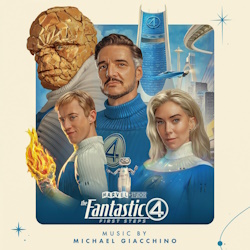
THE FANTASTIC FOUR: FIRST STEPS – Michael Giacchino
 Original Review by Jonathan Broxton
WARNING: THIS REVIEW CONTAINS PLOT SPOILERS. IF YOU HAVE NOT YET SEEN THE FILM, YOU MIGHT WANT TO CONSIDER WAITING UNTIL AFTER YOU HAVE DONE SO TO READ IT.
Marvel have been trying to make the Fantastic Four happen for years. The characters, which first debuted in the comics in 1961, were reportedly favorites of the legendary Stan Lee, and are often referred to as “Marvel’s first family”. The group comprises Reed Richards, also known as Mr. Fantastic, a brilliant scientist who can stretch his body into incredible shapes and lengths; Sue Storm, the Invisible Woman, who can become invisible and generate powerful force fields; Johnny Storm, the Human Torch, who can engulf himself in flames and fly; and Ben Grimm, transformed into the rock-like Thing, whose immense strength contrasts with his gruff but lovable demeanor. The four gained their powers after exposure to cosmic rays during a space mission, and their adventures often blend science fiction with personal drama and epic battles against various supervillains. Read more…
THE MAN IN HALF MOON STREET – Miklós Rózsa
 GREATEST SCORES OF THE TWENTIETH CENTURY
Original Review by Craig Lysy
Paramount Pictures decided that the stage play The Man in Half Moon Street by Barré Lyndon, which opened at London’s New Theatre on March 22, 1939, and ran for 172 performances, would translate well to the big screen. Film rights were purchased, Walter MacEwen was placed in charge of production, and Ralph Murphy was tasked with directing, with Garret Ford and Charles Kenyon writing the screenplay. For the cast, Nils Asther would star as Dr. Julian Karell, joined by Helen Walker as Eve Brandon, Reinhold Schünzel as Dr. Kurt van Bruecken, Paul Cavanaugh as Dr. Henry Latimer, Edmund Breon as Sir Humphrey Brandon, and Matthew Boulton as Detective Inspector Ned Garth. Read more…
BEYOND RANGOON – Hans Zimmer
 THROWBACK THIRTY
Original Review by Jonathan Broxton
Beyond Rangoon is a political drama/thriller directed by John Boorman, inspired by the real events of the 1988 Burmese Uprising, when students and civilians protested against the military regime of then-dictator Ne Win, leading to thousands of deaths. Patricia Arquette stars as Laura Bowman, an American doctor who travels to Burma (now Myanmar) in the late 1980s with her sister Andi (played by Frances McDormand) in an attempt to recover from the traumatic murder of her husband and son. Their vacation unexpectedly coincides with the uprising, and while attempting to leave the country Laura loses her passport, inadvertently becoming trapped in the increasingly volatile nation. As she navigates a dangerous and unfamiliar landscape, Laura becomes a reluctant witness to the government’s violent repression of student demonstrators; however, she is guided by a former university professor turned dissident U Aung Ko (playing a fictionalized version of himself) who helps her understand the political crisis engulfing the country, and to flee to safety. Read more…
I KNOW WHAT YOU DID LAST SUMMER – Chanda Dancy
 Original Review by Jonathan Broxton
A sort-of-sequel, sort-of-remake, this year’s I Know What You Did Last Summer is a slasher horror film directed by Jennifer Kaytin Robinson, and is the fifth instalment in the ‘IKWYDLS’ franchise following the original 1997 film, the first sequel from 1998, the straight-to-DVD third film from 2006, and the short-lived Amazon Prime TV series that aired in 2021. Like all the other entries, the story follows a group of wealthy and privileged teenagers who accidentally kill a man in a car accident, and cover up their involvement to avoid consequences. A year later, as they try to move on with their lives, a stalker sends them taunting messages about their crime, and they soon realize that the stalker is imitating the fisherman serial killer from the events depicted in the first film. The film stars Madeline Cline, Chase Sui Wonders, Jonathan Hauer-King, Tyriq Withers, and Sarah Pidgeon, with Jennifer Love Hewitt and Freddie Prinze Jr. reprising their roles as the survivors of the original massacre. Read more…
DRAGON SEED – Herbert Stothart
 GREATEST SCORES OF THE TWENTIETH CENTURY
Original Review by Craig Lysy
MGM achieved stunning commercial and critical success adapting novelist Pearl S. Buck’s “The Good Earth” 1937 to the big screen. As such they decided to purchase the film rights to Buck’s subsequent novel “Dragon Seed,”, which was also set in 1930’s China. Pandro Berman was placed in charge of production with a $3 million budget, Jack Conway and Harold S. Bucquet would share directing duties, and Marguerite Roberts and Jane Murlin would write the screenplay. For the cast, Katherine Hepburn would star as Jade, joined by Walter Huston as Ling Tan, Aline MacMahon as Ling Tan’s wife, Akim Tamiroff as Wu Lien, Turhan Bey as Lao Er Tan, and Lionel Barrymore providing narration. Read more…
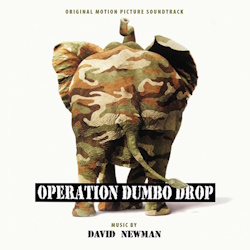
OPERATION DUMBO DROP – David Newman
 THROWBACK THIRTY
Original Review by Jonathan Broxton
Loosely based on a real event that happened during the Vietnam War in 1968, Operation Dumbo Drop is a family-friendly action-comedy-drama written by Jim Kouf and Gene Quintano, and directed by Simon Wincer, who previously helmed titles such as Free Willy and Quigley Down Under. The film is set in a U.S. Army base located close to a small Vietnamese village that is sympathetic to the American cause. When enemy forces discover the village’s alliance with U.S. troops, they retaliate by killing the villagers’ elephant, which is not only vital to their livelihood but also holds significant cultural and ceremonial importance. Wanting to maintain the villagers’ trust and rebuild the alliance, the base’s captain, Sam Cahill, is ordered to procure a new elephant, and so he puts together a reluctant crew to help him locate a brand new pachyderm, transport it through enemy territory, and deliver it to its new home. The film starred Danny Glover, Ray Liotta, and Denis Leary, and had an original score by David Newman. Read more…
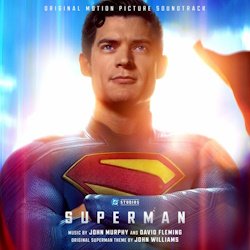
SUPERMAN – John Murphy, David Fleming
 Original Review by Jonathan Broxton
WARNING: THIS REVIEW CONTAINS PLOT SPOILERS. IF YOU HAVE NOT YET SEEN THE FILM, YOU MIGHT WANT TO CONSIDER WAITING UNTIL AFTER YOU HAVE DONE SO TO READ IT.
I was three years old when the Richard Donner Superman movie came out in 1978. It’s one of the first films I remember watching as a child, when it was shown on TV several years later, and it’s one of the first film scores I remember loving. For me Christopher Reeve remains the absolute gold standard when it comes to portraying the man of steel. In the almost 50 years since then we have seen different Supermen on the big screen – Brandon Routh and Henry Cavill – and on the small screen – Dean Cain, Tom Welling, others – all of whom bring a new take and new perspective on the character. This year’s Superman is actor David Corenswet, and the film is simply called ‘Superman’. Thankfully it’s not another origin story, and instead the film jumps right into the action with Superman and his journalistic alter-ego Clark Kent embroiled in battles on multiple fronts: fighting against the machinations of his nemesis Lex Luthor, trying to keep the peace between the fictional warring nations of Boravia and Jarhanpur, and trying to maintain his own sense of self and identity following some shocking revelations about his parentage, while also having a relationship with his colleague, investigative journalist Lois Lane, who knows his secret identity. Eventually all these plot strands converge in a battle to save Metropolis. Read more…
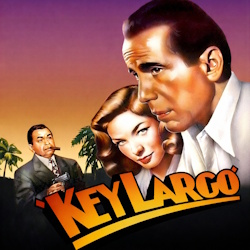
KEY LARGO – Max Steiner
 GREATEST SCORES OF THE TWENTIETH CENTURY
Original Review by Craig Lysy
Warner Brothers had produced four very successful films that paired marquee actors Edward G. Robinson and Humphrey Bogart; Bullets or Ballots (1936), Kid Galahad (1937), The Amazing Dr. Clitterhouse (1938) and Brother Orchid (1940). They decided on yet another collaboration after purchasing the film rights for the 1939 play “Key Largo” by Maxwell Anderson. Jerry Wald was placed in charge of production with a $1.8 million budget, John Huston would direct, and Huston and Richard Brooks would write the screenplay. The cast was stellar with Humphrey Bogart as Major Frank “Soldier” McCloud, Edward G. Robinson as Johnny Rocco, Lauren Bacall as Nora Temple, Lionel Barrymore as James Temple, and Claire Trevor as Gaye Dawn. Read more…

Shop at the Movie Music UK Store

Member of the

 MOVIE MUSIC UK