WATERWORLD – James Newton Howard
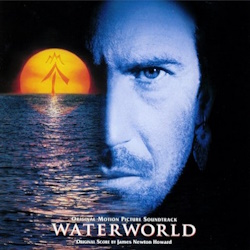 THROWBACK THIRTY
Original Review by Jonathan Broxton
For many years in Hollywood Waterworld – the title of Kevin Costner’s 1995 action-adventure movie – was a byword for financial disaster in moviemaking. Originally conceived by screenwriter Peter Rader in the mid-1980s as a low budget ‘Mad Max on water’ the script was eventually rewritten by David Twohy, whose version leaned heavily into the post-apocalyptic sci-fi genre. Costner, then at the height of his fame following hits like Dances with Wolves and The Bodyguard, signed on to produce and star, and he recruited Kevin Reynolds, who directed him in Robin Hood: Prince of Thieves, to helm the film. However, what started as a modestly budgeted film ballooned into a then-record-breaking $175 million production, eventually earning it the industry nicknames “Fishtar” and “Kevin’s Gate,” after notorious flops Ishtar and Heaven’s Gate. The production was plagued by logistical challenges, including destroyed sets, weather delays, crew injuries, and creative clashes between Costner and Reynolds, who eventually left the project entirely during post-production, leaving Costner to oversee the final edit.
Personally, and while acknowledging its problems, I have always liked the film a great deal, and find that its reputation as a catastrophe is ill-earned. The film is set in a post-apocalyptic future where the polar ice caps have melted and the Earth is entirely covered by water, and follows a mysterious drifter known only as The Mariner (Costner). A mutant with gills and webbed feet, the Mariner survives by scavenging and trading aboard his trimaran sailboat, shunning contact with others. He eventually crosses paths with Helen (Jeanne Tripplehorn), the guardian of a young girl named Enola (Tina Majorino), who has a tattoo on her back that may hold the key to finding the mythical Dryland – a place believed to be the last remaining patch of earth. The trio becomes a target for the Smokers, a ruthless gang of pirates led by the one-eyed Deacon (Dennis Hopper), who believes the map on Enola’s back will lead him to domination over the last refuge on Earth. Reluctantly, the Mariner agrees to protect Helen and Enola, and the three embark on a perilous journey across the waterlogged world, fighting off Smokers and searching for Dryland.
Originally, the film was set to be scored by Mark Isham, but he was dismissed during post-production as a result of ‘creative differences,’ reportedly because his more subtle, ambient approach clashed with Costner’s desire for a more traditional, heroic action score. Isham was replaced by James Newton Howard, who had recently scored Costner’s film Wyatt Earp at the end of 1994, and he delivered a more robust and energetic soundtrack that balanced swashbuckling orchestral adventure and an epic, nautical tone with brooding post-apocalyptic tension. Howard had very little time to write and record the score – reportedly just a few weeks – but despite these pressures he ultimately came up with one of the most enjoyable and satisfying action scores of his career.
 Stylistically, Howard drew from numerous sources of inspiration, ranging from Hugo Friedhofer’s early scores for Errol Flynn swashbucklers like Zorro and Marco Polo, and Michael Kamen’s Robin Hood: Prince of Thieves, to a non-specific Jerry Goldsmith vibe in scenes involving young Enola. The instrumental ensemble comprises a large orchestra, the Los Angeles Master Chorale choir conducted by Paul Salamunovich, specialized percussion textures provided by his old band mate at Toto Steve Porcaro, and electronic samples provided by none other than Hans Zimmer.
One thing that Waterworld doesn’t have in any significant way is thematic depth. There is a rousing and heroic main theme for the Mariner which builds on the stylistics of previous JNH scores like Wyatt Earp and Outbreak, and informs subsequent works like The Postman, Dinosaur, Vertical Limit, and others. There is also the more lyrical theme for Enola, which over the course of the film also develops into a theme for Dryland itself; it is often carried by solo woodwinds, and has a hopeful outlook reminiscent of later scores such as Atlantis: The Lost Empire, or Lady in the Water. There is a rhythmic motif for Deacon and the Smokers that sometimes emerges from the action music, and there are some recurring textural ideas for electronics and voices that appear to represent the ethereal beauty of the open ocean, but beyond that the score is mostly concerned with creating an appropriate atmosphere for each specific scene.
The score actually gets off to a rather low-key start, beginning with tropical percussion, choral textures, and various huffing and puffing ethnic flutes wailing in the background of the “Main Title”. Howard actually does a great job at setting the scene with this music; it’s got a tribal/world music vibe – a little bit African, a little bit Caribbean, a little bit Pacific – and is also sort of futuristic, but also ancient, and the way the different textures in the cue combine is really evocative. Howard would later explore similar sounds in later scores like the aforementioned Dinosaur, as well as scores like Blood Diamond and Snow Falling on Cedars, and it’s interesting to see him playing around with these ideas for the first time here.
As soon as the action begins, in “Escaping the Smokers,” it hardly ever stops. The menacing, stabbing brass motif for Deacon and the Smokers that emerges here runs through a lot of the score, but it is the first full performance of the recurring Mariner Theme motif at the 1:32 mark that is the cue’s highlight – a rousing, bombastic explosion of brass led heroism that is musically thrilling and emotionally satisfying.
Howard’s action music in this cue, as well as subsequent cues like “Smokers Sighted,” “The Skyboat,” “Helen Frees the Mariner,” the ferocious “Slide for Life,” and the more ominous and menacing pair “Arriving at the Deez” and “Deacon’s Speech,” is just tremendous, full of energy. The performances are lively and vivacious, the brass is markedly sharp and fulsome throughout, the orchestrations are thick and dense, and the thematic statements are outstanding when they come. The turbulent rhythmic parts of “The Skyboat,” and the bursts of the Mariner’s theme throughout “Helen Frees the Mariner” and at 2:50 in “Slide for Life,” are especially rewarding.
I also really appreciate how intricate the music is; not just in terms of the symphonic ensemble, or the way the themes for Mariner and Deacon are interpolated, but how Howard combines this with the choir, Steve Porcaro’s specialty percussion, and the electronic textures, resulting in a rich and fascinating sound. The vast array of percussion items – endless different drums, shakers, metallic sounds – give the score a unique flavor that reveals new facets with each listen. Watch out especially for the unusual Australian textures – including a didgeridoo! – in “Haircuts.”
Howard consistently makes excellent use of the haunting tones of the L.A. Master Chorale too, notably in cues like “The Atoll” and the sometimes grandiose “The Bubble,” both of which have a definite mysterious, awe-inspired feel to them. Elsewhere, in the subsequent “Swimming,” a new vocal texture performed by Marisa Chandler emerges, combining beautifully with new-age sounds to create a brief sense of calm and peace. Then, during the action sequences, Howard uses his choir to add a soaring, epic quality that is just spectacular; he has a way of phrasing his choir in waves, which sort of fade in an out, which is wholly unique to him, and although he has used it on multiple works since, this score appears to be the source of that sound.
The lovely theme for the Enola character first emerges in the moody “Prodigal Child,” on child-like woodwinds and innocent-sounding strings; as I mentioned, as the score develops, this theme evolves into a theme representing the concept of Dry Land itself, something that no-one has seen for generations; this is especially noticeable in cues like “National Geographics” and “We’re Gonna Die”. There is an almost religioso sound to all this music that adds a level of wonderment to the score and illustrates the beliefs of the characters – to them, Dry Land is a myth, like Atlantis would be to us, and this clash between Enola’s youthful idealism and Mariner’s dour practicality is at the heart of the film.
The theme for Enola/Dry Land reaches its zenith during “Balloon Flight” and the subsequent “Dry Land,” which begins with a sense of downbeat wistfulness, but then erupts into a glorious celebration of relief and redemption as – spoiler alert! – Michael Jeter’s grizzled navigator character Gregor finally deciphers Enola’s tattoos and leads the heroes successfully to Dryland, revealed in the film’s director cut to be the summit of Mount Everest. The conclusive pair, “Mariner’s Goodbye “ and the “Main Credits,” are initially downbeat and introspective as Helen and Enola bid farewell to the Mariner as he returns to the ocean on his trimaran, and the whole thing ends with redemptively lyrical statements of the Enola/Dry Land theme and Mariner’s theme to close out the score.
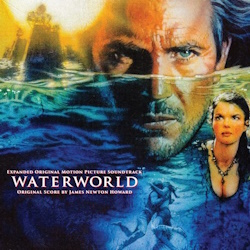 The original 1995 album from MCA Records offered a generous hour-long selection of highlights from Howard’s score, which will satisfy most listeners. For dedicated fans, however, a 2007 expanded edition from La-La Land Records – produced by Dan Goldwasser and Mike Matessino – delivered something more substantial. Limited to 3,000 copies, the album runs over two hours and features previously unreleased material, bonus tracks, and richly informative liner notes by Tim Greiving. The packaging also includes artwork designed by Goldwasser, with a cover based on an unused illustration by the legendary Drew Struzan. Essential for enthusiasts, this edition adds around 30 minutes of new score, including additional statements of the rousing main theme, extended action cues, and – most notably – the inclusion of Mark Isham’s delicate music box motif, the only surviving piece of his original score used in the final film.
In the years since its initial release Waterworld has been re-evaluated by critics and is now considered by most to be an ambitious, if flawed, summer action adventure movie. As for the score itself, I think it’s great. It’s the score that brought together many of the action/adventure/thriller approaches that Howard had been honing for many years through works like Flatliners, The Fugitive, Outbreak, and Wyatt Earp, and presented them as a cohesive personal style that would run through numerous scores over the course of the next decade. When you combine this with the swashbuckling flamboyance of the main Mariner theme, and the lovely ethereal choral representation of Waterworld when it is calm, you have one of Howard’s best scores of the 1990s.
Buy the Waterworld soundtrack from the Movie Music UK Store
Track Listing:
- 1995 ORIGINAL RELEASE
- Main Titles (4:43)
- Escaping The Smokers (3:49)
- The Atoll (1:42)
- Prodigal Child (1:54)
- Smokers Sighted (2:10)
- Swimming (4:15)
- The Skyboat (3:54)
- National Geographics (1:46)
- Speargun (1:44)
- The Bubble (3:23)
- Helen Frees The Mariner (3:27)
- Helen Sews (0:50)
- Slide For Life (4:51)
- Half An Hour (4:36)
- We’re Gonna Die (2:02)
- Arriving At The Deez (4:28)
- Deacon’s Speech (3:52)
- Haircuts (1:32)
- Gills (1:59)
- Why Aren’t You Rowing? (2:38)
- Balloon Flight (0:48)
- Dry Land (1:48)
- Mariner’s Goodbye (3:15)
- Main Credits (2:18)
- 2017 EXPANDED RELEASE
- Main Titles (4:47)
- Escaping the Smokers (3:53)
- The Atoll (1:45)
- Hydroholic (1:02)
- Gills (2:02)
- Prodigal Child (1:58)
- Gregor at Cage (2:59)
- Recycled/Smokers Sighted/Battle/The Balloon (7:12)
- Helen Frees the Mariner (3:32)
- Opening the Gates (3:20)
- She’s Here Somewhere (0:35)
- Three on Deck/Helen’s Offer (1:35)
- Speargun (1:47)
- Helen Sews (0:53)
- Enola Overboard/Can We Outrun Them? (2:59)
- The Skyboat (3:58)
- Haircuts (1:36)
- Half an Hour (4:38)
- Swimming (4:19)
- Slave Colony (4:52)
- The Bubble (3:27)
- Meeting Deacon/Kiss of Life (4:29)
- We’re Gonna Die (2:06)
- National Geographics (1:48)
- Gregor Returns (1:14)
- Arriving at the Deez (4:31)
- Deacon’s Speech (3:55)
- Rowing (1:35)
- Why Aren’t You Rowing (2:42)
- Slide for Life (4:53)
- Bungee (2:33)
- Balloon Flight (0:52)
- Dry Land (1:50)
- Mariner’s Goodbye (3:17)
- Main Credits (2:20)
- Music Box Theme (composed by Mark Isham) (2:18) BONUS
- The Atoll (Alternate) (1:46) BONUS
- Helen Frees the Mariner (Alternate) (2:48) BONUS
- Escaping the Smokers (Demo) (3:29) BONUS
- Helen Frees the Mariner (Demo) (3:49) BONUS
- Three on Deck (Demo) (2:04) BONUS
- Deacon’s Speech (Demo) (3:54) BONUS
- Slide for Life (Demo) (3:37) BONUS
- Thank You/Session Wrap Speech (6:15) BONUS
Running Time: 67 minutes 44 seconds — Original
Running Time: 131 minutes 14 seconds — Expanded
MCA Records MCAD-11282 (1995) — Original
La-La Land Records LLLCD1426 (1995/2017) — Expanded
Music composed by James Newton Howard. Conducted by Artie Kane. Orchestrations by Brad Dechter, Jeff Atmajian, Robert Elhai, Chris Boardman and James Newton Howard. Special vocal performances by Katrin Kern and Marisa Chandler. Recorded and mixed by Bruce Botnick. Edited by Jim Wiedman. Score produced by James Newton Howard and Michael Mason. Expanded album produced by Dan Goldwasser and Mike Matessino.
Leave a reply to MPC Cancel reply

Shop at the Movie Music UK Store

Member of the

 MOVIE MUSIC UK
I do love how Universal Studios uses “Deacon’s Speech” as part of their music loop at their Orlando theme park entrance.