SUPERMAN – John Murphy, David Fleming
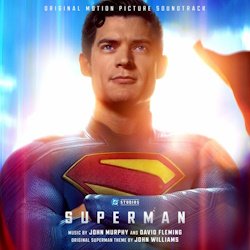 Original Review by Jonathan Broxton
WARNING: THIS REVIEW CONTAINS PLOT SPOILERS. IF YOU HAVE NOT YET SEEN THE FILM, YOU MIGHT WANT TO CONSIDER WAITING UNTIL AFTER YOU HAVE DONE SO TO READ IT.
I was three years old when the Richard Donner Superman movie came out in 1978. It’s one of the first films I remember watching as a child, when it was shown on TV several years later, and it’s one of the first film scores I remember loving. For me Christopher Reeve remains the absolute gold standard when it comes to portraying the man of steel. In the almost 50 years since then we have seen different Supermen on the big screen – Brandon Routh and Henry Cavill – and on the small screen – Dean Cain, Tom Welling, others – all of whom bring a new take and new perspective on the character. This year’s Superman is actor David Corenswet, and the film is simply called ‘Superman’. Thankfully it’s not another origin story, and instead the film jumps right into the action with Superman and his journalistic alter-ego Clark Kent embroiled in battles on multiple fronts: fighting against the machinations of his nemesis Lex Luthor, trying to keep the peace between the fictional warring nations of Boravia and Jarhanpur, and trying to maintain his own sense of self and identity following some shocking revelations about his parentage, while also having a relationship with his colleague, investigative journalist Lois Lane, who knows his secret identity. Eventually all these plot strands converge in a battle to save Metropolis.
The film is directed by James Gunn, who was installed as co-chairman and co-CEO of DC Studios following his success writing and directing the Guardians of the Galaxy movies for Marvel, and who appears intent on taking the franchise away from the Zack Snyder-led Ben Affleck/Henry Cavill Justice League cinematic universe and re-booting it as its own thing entirely. In addition to Corenswet as Superman the film co-stars Rachel Brosnahan as Lois and Nicholas Hoult as Luthor, plus Nathan Fillion, Edi Gathegi, and Isabela Merced as the members of the so-called Justice Gang, and it’s mostly fine. One thing I do appreciate very much about this Superman is its attempt to return to the decent and positive ‘truth, justice, and the American way’ ethos that defined the series for most of its history, but which was mostly abandoned during the murky, joyless, colorless, morally ambiguous Zack Snyder years. This Superman even has a dog, Krypto, to really double down on the wholesomeness factor (although I have to admit I was a bit sick of his antics by the end of the movie).
However, even with that in mind, I found a lot of the film frustrating in terms of how tonally inconsistent it was. A lot of the characters felt odd: Superman is often angry and out of control, which is not his personality at all. Luthor is less of a real danger and more of a petulant tech bro with an inferiority complex, and Hoult is too young to play him. I liked the Justice Gang, but they felt like they had wandered in from their own funnier movie, and I think I want to see that movie more than this one. Worst of all, Jonathan and Martha Kent almost felt like bad parodies of southern hicks, played for cheap laughs, and I disliked this intensely. I did like this film’s version of the Fortress of Solitude, Brosnahan’s Lois Lane was the right amount of spunky, and the references to real world politics that Gunn injected into his screenplay felt valid and important. But, while it is certainly a step in the right direction, overall this felt like an unnecessary reboot of a franchise that didn’t need it yet.
Part of my issue is the fact that I am growing more than a tad weary of all this, as a general concept. To paraphrase what I wrote in my review of Captain America: Brave New World earlier this year, if we consider 2008’s Iron Man to be the film which rekindled the super-hero genre first for Marvel and then for DC, we now have 36 Marvel movies (with two more to come) interwoven with 14 multi-season Marvel TV shows (with four more to come), and 15 movies in the DC extended universe (with one more to come), plus various DC animated films and TV shows, the parallel Arrowverse, and so much more… it’s overwhelming. It’s an onslaught of content which takes serious, purposeful effort to keep on top of and understand, assuming you haven’t given up already.
For me, the films themselves are already starting to blend together into one. There are only so many times you can save Metropolis or Gotham City from aliens and monsters and supervillains. Every film climaxes in the same way, with two CGI characters beating each other to a pulp and throwing each other through buildings, destroying huge swathes of land in the process, but there are never any stakes because you already know that the lead character has to survive in order to feature in its already-announced sequel. I’m not sure how to fix this problem, but in my opinion it is one, and something needs to be done before the whole genre eats itself.
 Moving on, the music for this new Superman is by British electronic composer John Murphy, and American composer David Fleming, who has emerged from Hans Zimmer’s Remote Control group as a fine composer in his own right over the past couple of years. Murphy, who previously worked with director Gunn on The Suicide Squad in 2021 and Guardians of the Galaxy Vol. 3 in 2023, was announced as the composer for Superman in February 2024, and apparently wrote a great deal of music before the film was even shot, so that it could be played on-set for the actors. Fleming’s involvement with the project was not formally revealed until April 2025, and even now it’s not entirely clear when he came in, or why; some people are claiming he had little more than a week to write and record his music, which would be quite extraordinary if true, and would certainly explain the film’s hefty list of additional composers and orchestrators.
Whatever the case may be, what’s true for any composer is that scoring a Superman film means contending with the legacy of John Williams. His score for the 1978 film is utterly iconic, one of the greatest scores of all time, and every composer that has scored this character since then has essentially been faced with two choices: either go your own way entirely and do something completely new, or lean into that legacy and do your best to live up to it. John Ottman did the latter on Superman Returns in 2006, and mostly succeeded. Hans Zimmer did the former on Man of Steel in 2013 and, although in my opinion the fact that Zimmer chose to go in a different direction was entirely the right decision considering the nature of the film itself, the whole project was so fundamentally flawed that for me nothing about it worked.
James Gunn, however, appears to have found a third way for a Superman film to be scored, and this is to try to find some middle ground that quotes Williams’s legacy themes, but then uses them in a way which he thinks will appeal to today’s audiences. To this end, Gunn had his composers inject a distinct rock/pop/punk/electronica edge into a large modern orchestra, while extracting the “DNA” of Williams’s 1978 Superman theme and using it liberally throughout the score. While on paper this might not seem like a bad idea, the execution of it unfortunately fails to serve any audience, and often undermines a lot of what Gunn is trying to do with his film.
As much as I didn’t like the Man of Steel score, this Superman score dramatically underlines why Hans Zimmer was absolutely right when he decided to forge an entirely new path and avoid quoting John Williams when he wrote it. Williams’s theme is for Christopher Reeve, and putting that music against Henry Cavill’s portrayal of the character would have been completely wrong, tonally. Although David Corenswet is closer to Reeve than Cavill was, his Superman is still almost 50 years removed from Reeve, and for me hearing the Reeve theme in this context constantly took me out of the movie. Look; I understand nostalgia. It’s a powerful thing. Children who grew up in the 1970s and 80s, as both Gunn and I did, love being reminded of the innocence of that era, and it’s tempting to wallow in that whenever you get the chance, but sometimes doing that results in an inferior piece of entertainment. Such is the case here. Every time I heard any fragments of Williams’s theme in this Superman, it just reminded me how much this Superman is not, and can never be, that Superman. This Superman isn’t a sequel to that Superman. It’s a completely different take on the character in a different universe, with different political and societal touchpoints. Part of what made the 1978 Superman score great was because it was very clearly and distinctly of its time, whereas this Superman seems to be trying to have one foot in both camps, having it’s super-cake and eating it too.
Another part of what made the 1978 Superman score great was how it was arranged. Not just the core notes of the melody, but the orchestration and the counterpoint and the coloring and, most importantly, the rest of the score around it. That music soared. It felt like flying. It was hopeful and aspirational. And then, when you put that into context with the love theme for Clark and Lois, the bombastic march for Luthor, the wonderfully modernistic music for Krypton and the Fortress of Solitude, and the richly-textured action music, it all made sense as a complete whole – a fully realized film score. In contrast, what Gunn had Murphy and Fleming do was take the absolute bare bones of the Williams theme – sometimes just the underlying ostinato, or just a short sequence of recognizable notes – and force them into a new setting which, frankly, doesn’t work.
Arranging the Williams theme for guitars, on its own terms, isn’t necessarily an awful idea. That instrumental choice fits in with the musical direction Gunn wants for his film, and that of course is the director’s prerogative. It even melds with one of the ideas in the screenplay, which muses on the fact that Superman’s goodness and idealism actually runs contrary to the prevailing social discourse in 2025, and so that makes him the punk rock outsider like the members of his favorite band, The Mighty Crabjoys. Punk rockers use electric guitars, so… sure. Why not?
The problem, however, arises with the fact that, for me, Murphy and Fleming have arranged the theme in such a way that it loses everything that made it great in the first place. By stripping it of all its joy and orchestral flamboyance, they have reduced it to nothing but a bare melodic line carried by a guitar. All the symphonic panache, all the technical excellence, all the emotional power… gone. Just an echo. Then, later, when they try to add the symphonic element back in during some of the film’s action sequences, the arrangements are often indistinguishable from the myriad of other B- and C-level superhero scores that get trotted out each year, written by composers who want to be Hans Zimmer but don’t have his instincts. Someone wrote online how these versions of the theme sound like those Youtube videos where a young kid with a set of samples has created an “epic” re-imagining of a theme, full of simple harmonies, chugging ostinatos, and massive synth choirs, reducing the whole thing to sound like modern trailer music, devoid of any nuance or subtlety or sophistication. It’s pretty apt, to be honest.
 The opening horn statement of the Williams fanfare at the beginning of “Home” briefly offers some hope that it’s all going to be OK, but then the guitars come in and everything is downhill from then on. The ascending chord progression from the middle of the Williams Superman theme is referenced constantly – you first hear it at 0:08 in “Last Son” and then literally dozens and dozens of times thereafter in multiple cues, but shorn of its context it loses its magical power, and comes across instead as the most basic recurring motif. Then, when the full theme appears embedded into action cues like “Eyes Up Here,” “Jailbreak,” “The Rift,” and “Look Up,” there is an initial superficial dopamine hit of recognition, but that quickly goes away, and eventually all it made me do was compare this film to the 1978 film and think how much worse it is. And it’s not like you can just choose not to do that; Gunn’s insistence on constantly referencing the Williams score makes the comparison unavoidable. It’s designed to trigger that nostalgic memory within you, but in my opinion it completely backfires because the two things are just incompatible in this context. Perhaps the nadir of the whole score in this regard is the terrible, cheap and artificial-sounding “Raising the Flag,” which came close to making me laugh out loud in derision in the theater.
The rest of the score, when they are not trying to shoehorn in the Williams themes, fares better, but it’s still tonally and emotionally jarring when you hear the two elements side by side. There’s a new theme for the planet Krypton, written primarily by Fleming, which dominates the second half of “Home” and is a rousing but simplistic fanfare for horns underpinned by snares. The Krypton theme features prominently in “Last Son” with an angelic choral accompaniment, embedded into the action of “Intruders,” imbued with a sense of tragedy in “The Message,” and with an earthy homeliness in “Your Choices, Your Actions,” the latter during a key scene of emotional bonding between Clark and his adoptive Earth father. There is a sense of redemption and determination to the guitar-heavy version of the Krypton theme in the latter half of “Look Up,” and it receives its best statement when it is accompanied by a choir and surrounded by rousing horn triplets during the subsequent “Being Human.”
There’s a theme for Lex Luthor and his evil LuthorCorp, written primarily by Murphy, a sort of proto-grunge march for guitars and rock percussion which sometimes emerges into a sinister fanfare for brass. It is perhaps more serious and tries to be more intimidating than Williams’s 1978 theme for Gene Hackman’s Luthor, but it feels a little obvious to me, functional rather than threatening. It first appears in its full form during “LuthorCorp,” and later features prominently in cues like the propulsive “Intruders,” the throbbing “Secret Harem,” and throughout the sinister “Pocket Universe,” during scenes where Luthor exposition-dumps his plans to his henchpeople, or is otherwise engaging in some dastardly shenanigans. The big statements of the theme in “The Rift” and “Driven By Envy” are perhaps its high points, and then during “Luthor the Traitor” it actually comes across with a touch of anguished poignancy.
There’s a love theme of sorts for Clark and Lois, written primarily by Murphy, but it is somewhat flimsy and ephemeral and never comes close to attaining the lovely heights of ‘Can You Read My Mind’. It first appears on low-key guitars in “Lois & Clark,” reprises in the pretty and intimate but generally insubstantial “The Real Punk Rock,” adds a touch of poignancy to the opening moments of “Take the T-Craft,” and then gives the conclusive pair “Metropolis” and “Walking on Air” a pleasant romantic tone.
There’s a theme for the Justice Gang and its trio of metahumans, Green Lantern Guy Gardner, Mister Terrific, and Hawkgirl, written primarily by Fleming, and it is probably my favorite new theme in the score. It’s modern, appropriately heroic, and for me actually achieves what Gunn failed to achieve with the Williams Superman theme by injecting a sense of crowd-pleasing bravery into his punk rock orchestra. The way it emerges from action cues like “Justice Gang vs. Kaiju” is very satisfying, and then later it features prominently in cues like “Jailbreak, “The River Pi,” “Bases Loaded,” “Speeding Bullet,” and “Driven by Envy,” accompanying the various moments of daring valor by one or more of the gang members with a flash of bravado and confidence. Whether having a Godzilla-like kaiju in a Superman film was a good idea in the first place… that’s another discussion entirely.
Finally, there’s a new theme for the Daily Planet newspaper itself, written primarily by Fleming. It’s a busy and upbeat piece focusing on lively woodwinds underpinned by chugging strings and keyboard pulses, which seeks to capture the hustle-and-bustle of life at a major metropolitan newspaper. Cues like “The Daily Planet” feature the motif prominently, and it also appears during the first half of “The Rift” as its staff evacuate their building to escape the approaching devastation of Luthor’s temporal anomaly.
Many of these ideas come together in action cues like “Hammer of Boravia,” “Eyes Up Here,” “The River Pi,” and “Speeding Bullet,” many of which pound away relentlessly and generate a decent amount of raw power and energy, but often feel desperately simplistic and under-developed, and rely far too much on electronic pulses and sonic distortion for my personal taste – “Remote Control” and “Upgrade” are especially egregious in that regard. Compare this aural onslaught with the intricacy and intelligence of Alexandre Desplat’s recent Jurassic World score, or what Laura Karpman did on her scores for Captain America: Brave New World and The Marvels, and the difference is like night and day.
As a side note the album also includes a couple of songs, including “Punkrocker” performed by the Swedish punk band Teddybears featuring the legendary Iggy Pop, and “The Mighty Crabjoys Theme,” an original song performed by the eponymous Mighty Crabjoys, the in-film punk band that is supposed to be Clark Kent’s favorite band, and which in real life features director James Gunn. Unforgivably, both “Punkrocker” and “The Mighty Crabjoys Theme” play back-to-back over the first five or so minutes of the end credits, which utterly ruins whatever emotional catharsis Gunn created during the film’s finale and would have had me running for the exit had I not wanted to listen to the end credits score, which I think finally kicked in somewhere around the names of the wardrobe department.
I don’t like writing reviews like this. I really don’t. I want this site to be a celebration of all that is good about film music, and tearing down a score doesn’t give me any satisfaction. That goes double for a composer like David Fleming, who is still relatively new to the scene, whose previous scores show him to be a talented and sensitive artist, and who clearly worked VERY hard to give Gunn what he wanted under what appear to have been astonishingly tight pressure deadlines. But, sometimes I feel like I have something to say about a prominent and culturally relevant score that’s negative, and this is one of those times.
Ultimately, and despite both composers providing exactly what was asked of them, I think what James Gunn asked for ultimately harmed his own film. The decision to include, and then completely castrate, the themes from John Williams’s 1978 Superman score, was a disastrous one, for all the reasons I described above. It would have been much better if John Murphy and/or David Fleming had been given the opportunity to put their own stamp on the film without having the unwinnable challenge of competing with the legacy, brilliance, and nostalgic baggage that comes with one of the greatest themes in the history of cinema. Had they been allowed to do that from the get-go, my reaction to this score would have been significantly more positive, because I do like the Krypton theme, I do like the Justice Gang theme, and some of the action is pretty fun. As it is, however, the relationship between this Superman score and the 1978 original feels similar to the one between the Ultraman clone and Superman in the film itself: a bad copy, which is both dumber, and more brutal, and which should be consigned to a black hole for everyone’s benefit.
Buy the Superman soundtrack from the Movie Music UK Store
Track Listing:
- Home (2:02)
- Last Son (2:46)
- Hammer of Boravia (3:02)
- LuthorCorp (1:37)
- The Daily Planet (0:54)
- Lois & Clark (1:08)
- Eyes Up Here (2:22)
- Justice Gang vs. Kaiju (3:23)
- Intruders (3:25)
- The Message (2:43)
- Secret Harem (2:20)
- The Real Punk Rock (1:29)
- Pocket Universe (1:55)
- 5 Years Time (written by Charles Fink, performed by Noah & The Whale) (3:34)
- Something Like a Sun (2:19)
- Jailbreak (1:06)
- The River Pi (3:25)
- Take the T-Craft (1:38)
- Your Choices, Your Actions (2:55)
- Raising the Flag (1:49)
- The Rift (4:53)
- Bases Loaded (3:07)
- Speeding Bullet (2:02)
- Remote Control (3:02)
- Upgrade (1:13)
- Driven by Envy (2:04)
- Look Up (2:45)
- Being Human (1:57)
- Luthor the Traitor (1:51)
- Metropolis (1:17)
- Walking on Air (1:34)
- Punkrocker (written by Klas Åhlund, Joakim Åhlund, Patrik Arve, and James Osterberg, performed by Teddybears feat. Iggy Pop) (4:07)
- The Mighty Crabjoys Theme (written by James Gunn, Eric Nally, and Devin Williams, performed by The Mighty Crabjoys) (1:16)
Watertower Music (2025)
Running Time: 77 minutes 00 seconds
Music composed by John Murphy and David Fleming. Conducted by Pete Anthony. Orchestrations by Stephen Coleman, Geoff Lawson, Michael Lloyd, Andrew Kinney, Tommy Laurence, and Tutti Music Partners (Jonathan Beard, Edward Trybek, Henri Wilkinson, Benjamin Hoff, Sean Barrett, Jamie Thierman). Legacy Superman themes by John Williams. Additional music by Forest Christenson, Jake Boring, Andrew Kawczynski and Halli Cauthery. Featured guitars performed by John Murphy, David Fleming, Andrew Synowiec and Yvette Young. Featured percussion performed by Tyler Barton, Molly Murphy and Hal Rosenfeld. Special vocal performances by Anna Schubert. Recorded and mixed by Tom Hardisty, Gustavo Borner and Justin Moshkevich. Edited by Paul Rabjohns. Album produced by John Murphy, David Fleming and Tyler Barton.
Leave a reply to MPC Cancel reply

Shop at the Movie Music UK Store

Member of the

 MOVIE MUSIC UK
The score is a real mess and your review epitomized my feelings about the music too. The movie is entertaining enough to overcome the mediocre score but I feel that a singular composer could’ve better attained the middle ground Gunn was aiming for… like Brian Tyler.
Danny Elfman did an excellent job incorporating Williams’ theme in his JUSTICE LEAGUE score and arranged in a way that felt appropriate for modern audiences. What Murphy and Fleming did in this movie was sloppy.
I hope Craig Gillespie and his Supergirl composer don’t have this problem for next year’s movie.