KEY LARGO – Max Steiner
 GREATEST SCORES OF THE TWENTIETH CENTURY
Original Review by Craig Lysy
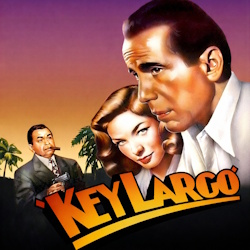
Warner Brothers had produced four very successful films that paired marquee actors Edward G. Robinson and Humphrey Bogart; Bullets or Ballots (1936), Kid Galahad (1937), The Amazing Dr. Clitterhouse (1938) and Brother Orchid (1940). They decided on yet another collaboration after purchasing the film rights for the 1939 play “Key Largo” by Maxwell Anderson. Jerry Wald was placed in charge of production with a $1.8 million budget, John Huston would direct, and Huston and Richard Brooks would write the screenplay. The cast was stellar with Humphrey Bogart as Major Frank “Soldier” McCloud, Edward G. Robinson as Johnny Rocco, Lauren Bacall as Nora Temple, Lionel Barrymore as James Temple, and Claire Trevor as Gaye Dawn.
The film drew inspiration from the 1935 hurricane, one of the worst in U.S. history, that devastated Matacumbe Key. It is set in Hotel Largo where veteran Frank McCloud is visiting the family of his fallen army friend George Temple. George’s father James owns the hotel and George’s widow Nora assists him. Frank joins the six remaining patrons of the hotel as most have checked out due to the approaching hurricane; Gaye Dawn, an aging alcoholic, and four men Curly, Ralph, Angel, and Toots, with another patron yet to leave his room. Soon two fugitive Seminoles, the Osceola brothers, who have evaded the local sheriff also join. Once the storm hits the four men take everyone hostage as their boss, the notorious gangster Johnny Rocco reveals himself. After much intrigue, the storm passes, Rocco completes a huge counterfeit deal and orders Frank, a trained seaman to take them back to Cuba. Gaye surreptitiously hands Frank a gun, and during the voyage he uses his military training and seamanship to take out the gangsters one by one to save the day. The film was another huge commercial success earning a worldwide box office of $4.4 million. Critical reception was universally positive and the film received one Academy Award Nomination for Best Supporting Actress.
Following the completion of “Treasure of Sierra Madre” in 1948, Max Steiner continued his collaboration with director John Huston with “Key Largo”. The story was classic Film Noir psychological drama, a genre Steiner had long ago mastered, which included two of the finest actors of a generation. I believe he understood that although the story is set against a backdrop of a massive hurricane, it really offered an intimate narrative, a milieu with both overt and covert emotions manifests in a tense and confined environment. His music would need to at times flesh out these emotions, but also at other times inform us of what the actor does not voice.
 For his soundscape Steiner offers five themes. The Military Theme supports both Frank, and his fallen comrade George. It offers repeating five-note phrasing by strings maestoso and horns solenne. For Frank we hear nobility and quiet strength in the notes, however for George it is rendered as a poignant elegy as he has fallen on the battlefield. The Love Theme speaks to the love that develops between Frank and Nora. It offers a tender string borne romanza, which germinates with a nascent expression when Frank and Nora first acquaint. Over the course of the film the theme evolves as does their love until it achieves a beautiful articulation by solo violin d’amore during the finale. Rocco’s Theme supports our diabolical villain, and is empowered by an oppressive and descending dire trio of leading notes, which unleash a sinister musical narrative. Kindred is the Gangster Theme, a dire and oppressive repeating two-note empowered identity, which empowers Rocco’s henchmen. The Seminole Theme provides a tribal identity. It is carried with mesmerizing gentility by soft nativist drum rhythms and lyrical flute led woodwinds exotica. Lastly, we have Gaye’s Theme in which Steiner interpolates the song “Moanin’ Low” by Ralph Rainger, lyrics by Howard Dietz. It offers classic Blues, a woe me song of a mistreated woman, beset in love with her mean man.
0:00 “Main Title” offers a score highlight where Steiner immediately establishes the grim tone of the film. We open boldly with Steiner’s iconic Warner Brothers anthem. At 0:06 a descent dramatico launches the flow of the opening credits with the declaration of the oppressive and ominous prelude at 0:13, empowered by Rocco’s Theme which supports the film title. At 0:29 we flow into a molto dramatico rendering of the Love Theme, its repeating six-note phrases portend a fateful encounter as we see the backdrop of U.S. Route 1, and Key Largo. At 1:06 a diminuendo tranquillo takes us into narrative script, which describes the causeway that links the Florida Keys to the mainland. At 1:21 we flow seamlessly into the film proper as we see a police car passing a bus on the causeway. Steiner sow tension as the camera zooms in and the bus is ordered to pull over. Sheriff’s board and perform a search, advising the driver that they are looking for two escaped Indians. At 2:20 the bus resumes its drive to Key Largo, which Steiner supports with a gentile travel motif. This gentility supports the bus’s arrival at the Largo Hotel, and Frank’s stepping off and walking to the entrance.
In 2:40 “The Hotel is Closed”, the gentile music shifts to a subtle, yet foreboding musical narrative as Frank enters the lobby and walks to the empty registration desk. A tough guy (Toots) sitting in the lobby says the hotel is closed. Frank walks into the bar and orders a beer, but is rebuffed, told by the Curly who is tending bar, that the hotel is closed. Frank is saved by the drunk Gaye who barks at the bar tender to “Give him a drink!”, and so Frank is served. At 4:20 sultry music is heard on the radio as a patron ring for a drink. Gaye offers to take it up to him, but Toots tells her you only go when he asks for you. As she and Frank acquaint, Toots returns and tells Gaye that he wants to see her. She straightens herself up and departs, but we see her anxiety. Radio source music plays as Curly says he cannot stay as the hotel is closed. He backs off when Frank says he is here to see the owner, James Temple. He directs him to the dock and Frank walks out to meet him. In an unscored scene Frank introduces himself to James, and when he finds out that he is Major McCloud who served with his son George, he shouts out for Nora, George’s wife, to join them. They all acquaint and James insists he stay over night so they can hear all the war stories of he and George. The Sherriff and his deputy join and ask about the Osceola brothers, which James says he has not seen. He introduces them to Frank, tells them the brothers are not here, and so the deputies depart. Upstairs Gaye screams as the Curly manhandles her, throws her into a room, and locks the door, explaining that she is a lush who needs to sleep it off.
11:00 “Nora Asks About George” opens with a dark, foreboding bass sustain as Norma informs Frank that his room is ready. As she escorts him in, Steiner unsettles us as she relates that a man wanted a room, and when he was told they were closed, he informed them that he would rent all the rooms if they would accommodate him and his party. She says father could not turn down so much money, and so consented. At 11:40 she turns and says Major, were you with George when he died? He says yes, and she asks if he was in pain? He says, he never knew what hit him. Steiner introduces his In Memoriam rendering of the Military Theme, which is very much kindred to the Taps melody. She relates that she is glad that he did not suffer and strings of heartache carry her departure. Yet the mood is lost at 12:06 as a harp misterioso usher in an unsettling musical narrative as Curly stares at her as she walks past him and down the stairs. Curly then joins Frank in his room, introduces himself, and then relates that he overheard his conversation about James’ son getting it in the war. He then apologizes for being rude, explaining how he and his five buddies deep fishing trip here had gone off the rails, thanks to one of them bringing his dame. Frank takes it all in stride and turns down Curly’s offer of a drink.
13:50 “Reminiscence” offers a score highlight, and perhaps its finest piece of music. It reveals Nora taking a phone call, and then relating to Curly and Frank that a hurricane alert has been issued. They go to inform James, who says he has many questions regarding his son, and asks if Franks could answer them. Frank agrees, and goes on and recounts his admiration for the heroism of his friend George, relating personal accounts George told him about both of them. We see Frank too grieves his loss and a profound, shared intimacy of remembrance is achieved. Steiner offers an elegy, one of the finest and most poignant set pieces in his canon, which reveals his genius by adopting the perfect fourth interval on which the military Taps melody is based, using the Taps melody itself as counterpoint. The music transcends its scene, achieving sublimity. James lowers his head in contemplation, and Nora and Frank depart, carried by the elegy, which blossoms as they walk on the dock to secure the boat as the Hurricane winds are starting to buffet the island. 17:11 “Frank Opens Up” reveals him opening up to Nora as they walk down the dock. He relates his love for the sea, and willingness to find a job related to it. We see she is attracted to Frank, and Steiner weaves a subtle romanticism into the narrative. They run into Curly and the imposing Angel and Frank advises that they move their yacht away from the shoals. Slowly the romanticism dissipates and as the music transforms into an impressionist piece atop swirling windswept strings as Frank double ties down the boat. As she watches his seamanship making knots and tying down the boat, her eyes reveal a nascent attraction growing, supported by a return of a now more coalesced Love Theme.
19:12 “The Seminoles Arrive” reveals Nora informing Frank of Charlie Wenoka, prince of the Seminole nation, who row up with his family seeking shelter from the storm.” Steiner introduces his Indian Theme, carried with mesmerizing gentility by soft nativist drum rhythms and lyrical flute led woodwinds exotica. They help Mama Ochobee, the centenarian matriarch of the tribe to the dock, with Frank gifting her a cigarette when she asks for one. John and Tom Osceola also arrive and inform Nora that they will accept James’ advise and turn themselves in to the sheriff. 21:22 “Nora Opens Up” reveals her relating that she met George at a USO dance, and he told her he was lonely and wanted company. She said she was lonely too, and thanks George for giving her roots. Frank stating that she seems very happy here, to which she replies, she is. When George deployed, she came to Key Largo, bonded with James, became accustomed to the Key’s quiet life, and adds she has taken root here like the mangroves. As she tells her story, Steiner offers a tender In Memoriam rendering of the Military Theme for George, who brought her to this new life in the keys. As they approach the hotel, thunder resounds and the winds intensify. She asks Frank to close the shutters, while she prepares the oil lamps, which is scrutinized by Curly, Angel and Toots.
In “Easy Does it Soldier”, inside the lobby Curly becomes increasingly aggressive as James and Frank join. The phone rings, Curly orders Nora not to answer it, and he takes the call. He tells the caller that James and Nora are not here, promising to give them his message. He hangs up, Nora demands the phone, but is shoved back. Music enters ominously at 25:38 as Curly and Toots pull out revolvers, stopping Frank in his tracks. At 25:46 we shift to Rocco bathing with Steiner offering cyclic strings, which mimic the tub side fan revolutions. Rocco’s Theme borne with repeating three-note phrases by woodwinds sinistri and tremolo strings supports him exiting the bath tub. An ominous musical narrative unfolds as Curly arrives and debriefs Rocco on events, saying that they had secured the hotel. As he departs to go to the lobby, he passes by the bloodied, unconscious deputy Clyde Sawyer. Rocco enters and tells everyone that he is in charge, that they are now his guests, and to be patient as they intend to leave in a few hours. He sizes up Frank, and then at 28:51 the music darkens ominously as Toots reports that the deputy has woken up. He derides him, saying; “You still feel tough?” He tells Rocco that he won’t get away with it, and at 29:14 a grim descent motif supports Toots tripping him, causing Sawyer to fall to the ground. James begins to personally attack Rocco, and Frank sees that Rocco is becoming angry. He takes over the conversation, lauding Johnny Rocco for his skilled leadership in forging a criminal empire, the like of which had never been seen before. This attempt at flattery diverts Rocco’s anger as he revels in his greatness to his guys.
“Frank’s Speech” reveals Rocco questioning Frank regarding his military service, his bravery, and why he fought. Frank replies: “But we are not making all this sacrifice of human effort and human lives to return to the kind of world we had after the last world war. We’re fighting to cleanse the world of ancient evils and ancient ills. Music enters at 32:57 with piano misterioso figures attended by bleak woodwinds as James relates that he remembers those words, and again proceeds to vilify Rocco. Steiner unleashes a swelling tempest irato as Rocco challenges his manhood, and in a fury, James rises up out of his wheelchair and makes his way towards him. James swings, misses, and falls to the ground. At 33:34 a crescendo furioso erupts as an angry Nora charges Rocco and pounds his chest. We crest horrifically at 33:48 as he forcefully pulls her in and kisses her. The music dissipates in the aftermath into nebulous dark currents as Ralph call Rocco to the phone, saying Miami is on the line. Rocco confirms that the deal will go through as planned, the hurricane be damned. Afterwards the captain arrives and says the boat must be moved to deep water or it will breakup on the shoal. Rocco says no, they argue, and Rocco ends the argument pointing a pistol at the captain’s face. In the lobby, deputy Clyde relates that they came back looking for the Osceola boys, sensed trouble from these guys, and was pistol whipped unconscious. He woke up recognized Rocco, tried to escape, and was again knocked unconscious. Rocco joins, and he and Clyde engage in taunts with Rocco boasting that no local hick cop is going to take him down.
39:46 “Rocco and Nora” reveals Rocco again focused of this ‘wild cat’ (Nora). He begins whispering in her ear, she moves off, and he follows, continuing to whisper. Steiner sow suspense and unsettling tension. She turns tries to strike him, but is held and a dire chord sounds at 40:19 as she spits in his face. Rocco is simmering with fury as Frank comes and escorts her away. A crescendo of mounting rage commences as James foolishly begins taunting Rocco. Rocco grabs his pistol, but Frank talks him down, saying he cannot kill just Nora, because he would then have to kill everyone to ensure there are no witnesses. Screaming and pounding on the door by Gaye diverts Rocco, and diffuses the situation. In an unscored scene Gaye enters, repeatedly demands a drink, but sits down in fear when she sees Toots cleaning his pistol in the open. Rocco joins and he and Frank begin to engage in repartee, which eventually angers Rocco, when Frank says that what he wants out of life, is a world without Rocco. He pulls out his pistol and gives Frank Curly’s pistol. At 46:27 Steiner slowly ratches up the tension as Rocco repeatedly taunts Frank to shoot, which informs him that his pistol is empty. Frank tosses away the gun saying a world with Rocco is not worth dying for. Muted Taps like horns sound as he mocks Frank, saying; “A live war hero”.
47:35 “Clyde is Killed” opens with a surging run motif as Clyde leaps up and grabs the gun. He moves to the door with the gun pointed at Rocco, with Steiner ratcheting up the tension. He opens the door and is shot by Rocco. Clyde shoots back, but the bullet chamber is empty. Rocco shoots again at 48:19, Gaye screams, and Clyde falls over the banister, carried by a dire death chord and descent motif. Rocco departs, and Frank confides to Nora that he does not care about the Rocco’s of the world and fights his own battles, which earns her rebuke for cowardice. Outside Curly and Ralph dump Clyde’s weighted corpse from a rowboat, while blood stains are cleaned from the floor. “Rocco’s Ultimatum” reveals Rocco being told by fellow mobster Ziggy that they will not be coming out to make the deal during a hurricane. Rocco is furious, saying he risked much coming from Cuba and gives them two hours to come or the deal is off. At 51:33 music enters on ominous low register strings as the lights flicker and the phone goes dead. Steiner mimics a swirling tempest as the shutters unlock and the window opens bringing in blasting winds. A foreboding musical narrative unfolds when the lights fail and Toots orders everyone downstairs at gunpoint.
52:07 “Rocco’s Offer” opens with a sultry saxophone, which supports Gaye descending the stairs and coming face to face with Rocco. The music loses cohesion and takes on a distorted oscillatory effect as she pours a scotch with hand tremors from alcohol withdrawal. In front of everyone he voices disdain for her becoming a lush. She walks away and tries to diffuse the situation, but he persists, telling everyone that she has good looks and singing voice and threw it all away to become a lush. He seizes on an idea, saying she may have a drink, if she sings for everyone. She is wary, tries to refuse, but her withdrawal from alcohol forces her to consent. After hesitating, she begins to sing the woe-is-me blues song of a mistreated woman in love with her mean man, “Moanin’ Low.”
Her once beautiful stage voice wobbles with mediocrity, which elicits Rocco’s disdain. Afterwards he rescinds his promise of a drink because she was so awful. She sits down and weep, and Frank, carried by the song’s melody, goes to the bar, pours a drink, and offers it to her. She guzzles it and the music becomes ominous as Rocco comes over. He looks at her, as she thanks Frank, and then slaps Frank in the face three times. Frank is stoic in his response, say you’re welcome to Gaye, and then walks away supported by grim music as James and Nora look on. The wind begins howling and shaking he hotel, punctuated by thunder claps. Rocco is noticeably anxious and begins pacing after James informs him that the storm of 35 took the lives of 800 people when a tidal wave swept over the island. 1:02:03 “Rocco is Anxious” reveals Nora comforting Frank, and expressing her belief that his aid to Gaye reveals he really does care, and is a hero. As more and more glasses are shaken off the shelf, Steiner sow an escalating tension with a pulsing, low register strings led motif, which mirrors Rocco’s anxiety escalating into panic. James begins praying for God to send a massive wave to rid the world of Rocco, which elicits his anger. Rocco orders him to shut up, he refuses and Franks steps in between. Rocco shoots Frank twice, but the gun is empty. He walks away and at 1:06:09 a palm tree crashes through the window and the storm’s fury sweeps in as they all flee to another room for safety. Steiner unleashes his own tempest with trilling piccolo as we see huge waves overtaking the shore and striking the front of the hotel. At 1:07:17, a diminuendo supports the storm’s fury slowly dissipating.
1:07:32 “James’ Offer” offers a beautiful and evocative score highlight. It reveals Frank gentle caressing a sleeping Nora on the back. She wakes, and James tells Frank he is most welcome to stay, and it would make them happy if he did. Nora asks if he has any family, to which Frank answers, no. James then says we would be proud if you became part of our family. He adds that they could use the help, and that he might find what he has been seeking since the war ended. He adds take your time to think it over. Steiner supports the scene with familial warmth in a beautiful string borne set-piece, which offers a hymn of thankfulness and hope for brighter days. As good as Bacall and Bogart are in this scene, it is Steiner’s music, which emotionally empowers the scene. In 1:08:55 “The Boat is Gone!” the tender moment is shattered as Toots yells to Rocco, that the boat is gone! Steiner offers a dissonant eruption of panic as they race out and find the boat gone. Rocco frets that the captain disobeyed him and won’t come back because he knows he would kill him. Gaye begins laughing, which elicits Rocco to chide back that things are not over sister. He says there is Temple’s boat and turns to Frank and says you are going to take us to Cuba. Frank refuses, and Rocco warns that it would be a shame if Toots made him a cripple. With that, the Sheriff arrives and bangs on the door. Rocco tells Nora to let him in and for everyone to be quiet or end up dead like Sawyer. The Sheriff asks for Sawyer and everyone says they did not see him. He says that is strange since he called him from here at 7pm. He asks that they contact him if he shows up, and as he departs at 1:13:40 a dire statement of Rocco’s Theme sounds, and then dissociates into an impressionistic misterioso. The sheriff starts up the car, but dissonant horns blare at 1:14:24 as he sees a body illuminated by his headlamps. He pulls Sawyer out of the water, and sees that he has been shot. Steiner empowers the sheriff’s rage with an eruption of grotesque dissonance. Rocco joins, says it was those Indians that killed him and an angry two-note hunting motif carries the sheriff’s departure, joined by Rocco’s repeating sinister three-note theme as he approaches the Indians on the dock. He spots the brothers, they bolt propelled by a desperate flight motif, and are shot dead by the sheriff.
1:16:58 “The Sheriff Returns” reveals an enraged sheriff returning and angrily laying blame on James for Sawyer’s murder and for harboring fugitives from the law. He says he intends to charge him as an accessory to murder. When James asks about the brothers, the sheriff says he shot them as they ran away. A dire and foreboding musical narrative unfolds within which is woven Rocco’s Theme as Frank stares at Rocco, realizing that he was the architect of the brothers being shot. The sheriff begins asking everyone for their names and addresses. Rocco and his men all say Hotel Central Milwaukee. Frank’s Theme joins when he is questioned and says he was just passing through. A man arrives seeking a hot meal and the sheriff departs, saying he will be back in the morning. It turns out that the man is the mobster Ziggy, here to complete the deal to buy counterfeit money from Rocco. Rocco walks outside, sees Ziggy’s henchmen, and a grotesque dissonant musical narrative unfolds as the sheriff carries Sawyer’s body to his car. As he drives away, Toots moves everyone into the adjacent room as Ziggy and his henchmen get out of the car. Steiner supports with ominous interplay of the Gangster and Rocco’s Themes. Inside the two mobsters have a happy, and brotherlike reunion.
In 1:20:22 “The Deal” Ziggy says I know you guys are in a hurry. An ominous bass, woodwind and horn sustain supports Rocco ordering Curly to open the suitcase. At 1:20:40 he opens the suitcase, which is full of counterfeit bills. Steiner supports with twinkling, surreal, and otherworldly effects as Ziggy and his expert examine the bills under a magnifier. Dark undertones join as the gang members from each camp watch each other warily. At 1:21:31grim horns declare Rocco’s Theme as he receives his payment. We shift to the adjacent room where Nora and Gaye whisper to Frank that once they reach Cuba, they’ll kill you. The say he should run and hope he can escape them. Frank says his head says to run, but his heart says he has to take a stand against the Rocco’s of the world. 1:24:08 “Gaye’s Gift” Ziggy departs and Rocco orders everyone to get ready to depart. He goes in and asks Frank is he going or not as Toots smiles, and Frank says he is going. Rocco sinister theme sounds as he tosses money to pay for his stay on the table next to James, and then asks Nora if she would like to go. At 1:24:18 the Love Theme joins on strings as Frank and Nora lock eyes. As Rocco and his men prepare to leave, Rocco loads bullets into his pistol and puts it in his suit pocket. Steiner supports with a stepped, foreboding crescendo of tension, which accelerates as Gaye comes to Rocco, asking why he did not bring her bags. He gives her money and says she is not going. The crescendo, within which is woven the song melody of “Moanin’ Low”, becomes frantic as she hugs and begs him to take her, promising to stop drinking. He pushes her aside with disdain into Frank and leaves. She then surreptitiously hands him Rocco’s pistol, which she lifted from his pocket.
1:25:37 “The Departure” reveals Toots ordering Frank to go at gun point, empowered by Rocco’s sinister theme. The theme evolves into a marcia della morte, which in turn transforms into a tempest as they board the boat in stormy seas. Steiner sow a mounting tension as Frank struggles to start the engine as Rocco fidgets. He starts the engine, they cast off lines and a cycling, mechanistic motif propels their departure. At 1:27:47 we descend into a plaintive rendering of the Love Theme as Nora turns away in despair. Gaye frets that he should have run, while James says the telephone lines are dead. A distraught Nora then collapses and lays her head on James’ lap. Later Rocco, Curly and Angel rest in the cabin, as a sea sick Toots, and Ralph sit outside by the stern. Frank checks his pistol, and stops the engine. He tells Ralph to look over the stern to see if the propeller is choaked with kelp. As he does, Frank accelerates and Angel falls in. Toots stands, and Frank shoots him, but is also hit in his abdomen. Curly opens the cabin door and is shot, and then Frank climbs atop the bridge roof. He opens the hatch, which gives him a good look for anyone leaving the cabin. Curly dies inside and Rocco takes his gun after he realizes Gaye lifted his. Rocco orders Angel to go up, but he refuses, saying he’ll be killed. Rocco then shoots him for disobedience.
“Rocco Dies” reveals the duplicitous, and ever resourceful conman Rocco offering Frank a 50-50 partnership, yet Frank remains silent. Rocco becomes anxious, and offers all the money to Frank, tossing the handbag of cash out the cabin door. Yet Frank remains silent with a wry smile as he sees Rocco cracking in desperation under the strain. A rattled and enraged Rocco yells, nobody beats Rocco! He then rethinks, and tries a new tack. He tosses out Angel’s gun and declares that he is now unarmed. He then says he has no gun, and is coming out. He comes into view and Frank sees him holding a pistol. Music enters at 1:35:18 as Frank shoots Rocco. He gets up to shoot and Frank shoots him a second time. Rocco gets up again, and this time Frank kills him. Steiner punctuates each bullet strike, adding a final grim expiration of Rocco’s Theme as he dies. As Frank climbs down and turns the boat around, Steiner empowers with a pulsing mechanistic motif. Frank then ties off the steering wheel to NW on the compass, and the music brightens, offering a narrative of thankfulness as he goes into the cabin. He makes a May Day call, and notifies the coast guard of his name, and location, with his course set for Boot Key. 1:38:35 “Finale” returns us to the hotel. The sheriff apologizes to James, regrets killing those innocent boys, and tells Gaye she will need to testify against Ziggy, who was arrested at the Georgia border. Music enters with a sad rendering of the Love Theme after the sheriff and Gaye depart. The phone rings, and the music brightens as she picks it up, hears Franks voice, and that he is coming home. Her relief is palpable and a violin d’amore takes up the Love Theme as she tells dad, that he is all right and coming back to us. She opens the window to let in the refulgent dawn as their theme blossoms with joy. As we shift back to the boat, Frank’s proud theme empowers his return, swelling to conclude nobly with a flourish as “The End” displays. The film ended with no cast credits.
Unfortunately there is no bona fide commercial release of the score. A 5:12 minute suite is offered on several compilation albums. The best of these was conducted by Charles Gerhardt with the National Philharmonic Orchestra, and appears on the album ‘Casablanca: Classic Film Scores for Humphrey Bogart’.
Steiner understood the challenge of scoring a Film Noir and chose to dynamically use juxtaposition to empower the film’s narrative. Rocco is a diabolical villain, a duplicitous, ruthless, conman beyond redemption. Steiner creates a truly dark, sinister and oppressive identity declared often by its opening trio of descending notes. These three notes are used either as a motif, or to usher in his full theme. Kindred, and also villainous is his Gangster Theme, which empowers his four henchmen. Juxtaposed is the nobility and quiet strength of Frank’s military theme, and the Love Theme for Frank and Nora. Steiner’s masterful thematic interplay intensifies the tension felt by Frank, Nora and James being held hostages in the hotel as a hurricane rages outside. Steiner’s music for the “Reminiscence” scene offers a poignant elegy, and one of the score’s finest moments. Also impressive is how Frank and Nora’s Love Theme germinates, and then develops slowly until the finale when it blossoms as Steiner offers a molto romantico exposition by solo violin d’amore. Folks, this was an intimate film, heavy in dialogue, often staged in a single room. Steiner was repeatedly challenged to support under the dialogue, and flesh out the emotions, many of which are felt, but repressed by fear due to being held hostage at gun point. I believe the confluence achieved through the acting of four of the most gifted actors of the day, the film’s story-telling, and Steiner’s music was sublime. I highly recommend you stream the film to hear an exceptionally well-conceived and well executed film noir score.
For those of you unfamiliar with the score, I have embedded a YouTube link to a five-minute suite; https://www.youtube.com/watch?v=GovxSHkw8NY
Track Listing:
• NOT AVAILABLE
Music composed and conducted by Max Steiner. Orchestrations by Max Steiner and Murray Cutter. Recorded and mixed by XXX. Edited by XXX. Score produced by Max Steiner.
Leave a reply to FilmFan14 Cancel reply

Shop at the Movie Music UK Store

Member of the

 MOVIE MUSIC UK
Another excellent review, Craig. However, I would like to point out that the surviving original recordings from Key Largo were in fact released on BYU-SAE’s “Caged: The Dark Side of Max Steiner” release.
https://www1.screenarchives.com/title_detail.cfm/ID/35255/CAGED-THE-DARK-SIDE-OF-MAX-STEINER-3CD/