SERGEANT YORK – Max Steiner
 GREATEST SCORES OF THE TWENTIETH CENTURY
Original Review by Craig Lysy
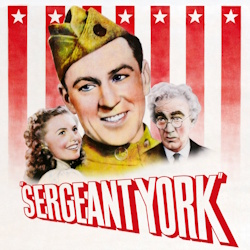
Alvin C. York was an iconic American WWI Medal of Honor hero celebrated in the 1928 biography “Sergeant York: His Own Life Story and War Diary” by Tom Skeyhill and York himself. Producer Jesse L. Lasky approached York several times to allow a movie to be made of his life, but was repeatedly refused, declaring; “this uniform ain’t for sale.” Lasky eventually convinced York that, with war threatening in Europe, it was his patriotic duty to allow the film to proceed. York finally agreed, but only on three conditions. First, his share of the profits would be contributed to a Bible school he wanted to be built. Second, no cigarette-smoking actress could be chosen to play his wife. Third, only Gary Cooper could recreate his life on screen. Cooper at first turned down the role, but when Lasky sent him a letter with a personal plea that included York’s forged signature, Cooper agreed to do the picture. Lasky, Howard Hawks and Hal B. Wallis were placed in charge of production with a $1.7 million budget, Hawks would also direct, and the team of Harry Chandlee, Abem Finkel, John Huston and Howard Koch would adapt York’s biography. Gary Cooper would play the titular role supported by Walter Brennan as Pastor Rosier Pile, and Joan Leslie as Gracie Williams.
Alvin York was a poor rural farmer from Tennessee who overcame drunkenness, frequent fights and arrogance by becoming a born-again Christian. His plea as a conscientious objector was denied and so after much prayer, he decided to do his patriotic duty. He becomes a hero during the battle of Meuse-Argonne (1918) when he audaciously penetrates German lines and from an enfilades position mows down the defenseless Germans, who end up surrendering to him en masse. He receives the Medal of Honor, is lauded by the military and returns home a national hero. The film was a massive commercial success earning $8.3 million. Critical reception was also laudatory and the film received an astounding eleven Academy Award Nominations, includin; Best Picture, Best Director, Best Cinematography, Best Art Direction, Best Original Screenplay, Best Sound Recording, Best Supporting Actor, Best Supporting Actress, and Best Musical Score for a Dramatic Picture, winning two for Best Film Editing and Best Actor.
Max Steiner, who reigned as Warner Brothers premier composer, was awarded the assignment. Director Howard Hawks had a vision for the score and instructed Steiner to use twenty folk songs and hymns to infuse the film with the requisite cultural sensibilities that York’s humble rural life demanded. To that end, Steiner incorporated; “When the Roll Is Called Up Yonder (1892) by James Milton Black, “The Drunkard’s Song”, traditional American folk song, “Give Me That Old Time Religion”, traditional American spiritual, “I’ve Got Rings On My Fingers” (1909) by Maurice Scott, “Oh! You Beautiful Doll” (1911) by Nat Ayer, “I Got a Gal at the Head of the Holler”, traditional American folk song, “Arkansas Traveler” (1850) by Sanford Faulkner, “Turkey in the Straw, traditional American folk song, “In the Sweet Bye and Bye (1868) by J.P. Webster, “Pack Up Your Troubles in Your Old Kit Bag and Smile, Smile, Smile!” (1915) by Felix Powell, “La Marseillaise” (1792) by Claude Joseph Rouget de Lisle, and “The Sidewalks of New York” (1894) by Charles Lawlor.
 For his soundscape, Steiner provided six themes. For Alvin there are two themes. The first supports early in the film prior to his spiritual epiphany. Steiner adapted the folk song melody of “Wild Horse”, as he believed that its syncopated energy fit the bill for his brazen, drunken, raucous, and undisciplined youth. His second theme is the Faith Theme, which rises to prominence with Alvin’s spiritual epiphany and new life as a born-again Christian. The theme is major modal, forthright, and expresses confidence without bravado. Strings and woodwinds maestoso offer a reverential exposition, which in many ways emotes as a processione religioso. Also associated with Alvin is the celebratory melody of the American Spiritual “Give Me That Old Time Religion”, which also speaks to his faith and determination to abide by the book (Bible). Mama York’s Theme speaks to her shame and long-suffering disappointment of Alvin’s godless life. Soft strings delicato, warm with maternal love, speak tenderly of her resolute faith that one day her son will find his path in life. Worth noting is how the theme brightens and gains optimism as she bears witness to Alvin’s embracing the book and becoming a man of faith. Pastor Pile’s Theme speaks to his role as a surrogate father figure in Alvin’s Life. There is a warmth and tranquility to its expression, which offers guidance and paternal love. Gracie’s Theme serves at first as her identity, and later as a Love Theme. Her string borne theme is gentle, tender with a gossamer-like quality, which evolves as their love grows, finally blossoming as the realize a life together.
In terms of national anthems, several are prominent. For the United States Steiner incorporated; “My Country ’tis of Thee”, “You’re In The Army Now” by Isham Jones, lyrics by Tell Taylor and Ole Olsen, “Mess Call”, traditional military bugle call, “Yankee Doodle” traditional, “The Star-Spangled Banner (1814), music based on “The Anacreontic Song” by John Stafford Smith, “(I Wish I Was in) Dixie’s Land” (1860) by Daniel Decatur Emmett, and “The Stars and Stripes Forever” (1896) by John Philip Sousa, and the “National Emblem March” (1902) by Edwin Eugene Bagley. For the British incorporated “God Save the King”, and for the French, “La Marseillaise” (1792) by Claude Joseph Rouget de Lisle. Lastly for the Germans Steiner employed “Das Lied der Deutschen” by Joseph Haydn, to serve as an emblem of the German troops. Although known as the national anthem of Germany, Steiner employs it with sad resignation during scenes where the Germans surrender.
0:00 “Logo” offers the trumpet led “You’re In The Army Now” rendered as a marcia patriottica, which supports the Warner Brothers Pictures logo. At 0:09 we flow into the “Opening Credits” for a reverential exposition of the Faith Theme At 1:06 we segue atop a solemn “My Country ’tis of Thee” which supports narrative script commending the heroic figures of this film. At 1:28 we enter the film proper with narrative script establishing the setting as Valley of the Three Forks in Tennessee atop a brief quote of Alvin’s Theme as we see cattle crossing a river. We move into town down Main Street and at 1:47 “When the Roll Is Called Up Yonder” are taken into the church as the congregation sings the traditional hymn. 3:52 “Rampage” reveals Pastor Pile proceeding with a homily, which is buffeted by a raucous musical narrative as Alvin and his friends Zeb and Ike ride rough shod through town repeatedly hollering and firing their guns. The Pastor struggles to carry on but the congregation is distracted and he ends the service on a grim chord. 5:55 “It Was Alvin” reveals Mrs. York being informed that it was her son and his friends who did this as he points to bullet slugs in a tree that spell out “A” “Y”. Steiner introduces Mama York’s Theme, borne with a tender sadness as she must with shame, accept the bitter truth. At 6:26 we segue into “The Drunkard’s Song” as Alvin and his two drunk buddies sing the traditional song as they ride home.
6:49 “Mailman Song” reveals a mailman riding towards the town on a mule singing a silly song “Froggy Went a-Courtin”, which has gibberish lyrics. He arrives at the Post Office where a traveling salesman tries to peddle his women’s ware to store owner Pastor Pile. 10:33 “Mama York’s Dismay” reveal the conversation turning to the latest rowdy drunkenness of her son Alvin when she enters. Her tender theme borne by strings tristi support as she again bears the shame and disappointment of her boy. She needs salt and supplies and barters with her small basket of eggs. She then asks the pastor to come up to their place and talk some religion into Alvin in hope of changing his ways. He agrees, she thanks him, and as she departs, Steiner drapes her theme with religious auras of hope. At home Mama tasks her younger son George to go to the Kentucky border saloon and fetch Alvin. She gives him some food, and he sets off with his rifle. Steiner supports softly under the dialogue with a sad rendering of Mama’s Theme.
13:32 “I’ve Got Rings On My Fingers” reveals a sign marking the Kentucky-Tennessee border as the camera takes us into a saloon. This traditional song played on a piano set a festive ambiance as Alvin, Zeb and Ike arrive and order drinks at the bar. They buy a bottle of whiskey and Alvin toasts to never again being sober. George arrives and forces Alvin to leave at shotgun point saying Mama wants him home. Alvin submits, but as they walk out a man mocks Alvin as a “mama’s boy”, which elicits a huge brawl, which Steiner supports by revving up the player piano and animating the song “Oh! You Beautiful Doll”. The piano player moves the player piano’s tempo lever to slow as Alvin and his buddies prevail. Alvin and George then depart on a diminuendo of the song.
18:22 “The Journey Home” reveals George leading his drunk brother home on a horse. Steiner supports with a slow trotting travel cadence. A sardonic musical narrative unfolds as a contrite Alvin and George arrive and an aggrieved Mama tasks George to fetch a pail of water. She grabs the bucket and douses Alvin with it supported by a sardonic stinger. Mama serves breakfast and tells the boys that afterwards the south fields need plowing. As Mama leads the family in saying Grace, Steiner softly drapes us with solemn religioso auras. Mama’s Theme’ joins on warm strings as she passes Alvin some salt for his pone. 20:14 “Pastor Pile’s Appeal” reveals Pastor Pile arriving at the York farm carried serenely by his theme. A robust Alvin’s Theme joins to support his hard work plowing the field. The music fades as the pastor dismounts and joins a contrite Alvin. He exhorts Alvin to free himself from Satan’s grasp and trust in the Lord before it is too late. Alvin says he has tried but does not know how to discover his faith. The pastor says if he opens himself up to God then faith will come. It may come slowly like the dawn, or in a flash like a bolt of lightning. Alvin thanks him, and says he needs to return to his plowing and a dispirited Faith Theme closes the scene.
23:40 “The Hunt” opens with warm heraldic French horns as the camera focuses on a famous carving on a beech tree attributed to Daniel Boone; “D. Boon killed a b(e)ar on the tree in year 1760”. Spritely strings propel the brothers out on a hunt with their dogs. An accelerando energico intensifies the hunt as the dogs run through the Williams farm. Gracie points the way to the brothers, but at 24:43 her tender theme elicits Alvin to stop, as he stares at her lovestruck. He sends George on his way, and the two reacquaint. He approaches carried softly by his theme, which is joined by a warm and tender exposition of her theme as they talk. As she sends him off to rejoin the hunt, she says she hopes to see him again. Strings felice and woodwinds of delight carry his departure as we see in her eyes a desire that he return. 26:42 “I Got a Gal at the Head of the Holler” reveals Alvin singing this traditional folk song of a man’s aspirational love. Mama picks up on this and asks if he intends to marry. He says yes, she asks who, and he answers, Gracie Williams. A tender Mama’s Theme joins as she shakes her head and holds her well wishes, as she knows Alvin is not ready to marry until he changes his un-Godly behavior.
28:40 “Alvin and Gracie” reveals Zeb visiting Gracie as she knits on the porch as her uncle reads the bible. He is courting her and asked her to the dance next Saturday, but she defers, saying she needs to think it over. Steiner supports under the dialogue with a soft, folksy danza felice. Alvin arrives and Zeb begins verbally jabbing him with the music slowly becomes foreboding. After Gracie departs to fetch some cider, Alvin grabs Zeb by the collar. Insider her theme happily supports her pouring the cider. She returns as Alvin shakes off his sore hand and when she asks where Zeb is at 32:01, woodwinds sardonica carry his staggering departure. She realizes that they fought and an agitato supports her upset. She begins to admonish him but is stopped cold in her tracks when he says the reason, he dispatched Zeb is that he intends to marry her. A tense musical narrative unfolds as she says “folks say you’re no good except for fighting and Hell-raising. He counters it is because his farm is not located on more fertile bottom land. She insults his pride after he says he can have anything he wants if he puts his mind to it. He departs in a huff carried by an aggrieved rendering of his theme. At 34:00 she runs crying into the house and Steiner imparts an aspirational crescendo magnifico as we see Alvin walking with determination through fertile fields. He bends, picks up the rich bottom land soil as a hopeful and dreamlike rendering of his theme supports. A diminuendo on the theme carries him back home. 34:45 “Mama’s Counsel” reveals her sowing as he enters, supported by her warm theme expressed tenderly with maternal love. He places some of the soil on a plate and she recognizes it, saying people who farm on bottom soil (in the valley) always look down on folks like us that farm on top soil (on the hillsides). She adds it has always been that way and nothing is going to change it. He is however determined, stating that he will not fail like Pa did as his theme swells with confidence.
In an unscored scene Alvin sells everything he has to Mr. Tomkins, including his mule for $50. He then offers this as a deposit bottom land Tomkins has up for sale. He must pay the balance of $70 within sixty days or he loses everything. He agrees and signs a written contract to that effect. 38:40 “Alvin Gets To Work 1” reveals him hiring himself as a day laborer clearing rocks from plough land for 75¢ a day empowered by his confident theme. He returns home late carried by a soft nocturne. A new sparkling Money Theme supports him depositing his money in a money box followed by notation of 75¢/$4.25 on a calendar 3 August 1916. At 40:06 a proud rendering of his theme supports his next job splitting logs with George. We shift at 40:23 atop a warm rendering of Pastor Pile’s Theme as he gives him $3 for a fox pelt. The next day Lavin and George earn money pulling out tree stumps, again empowered by a robust Alvin’s Theme. We shift to a tranquil rendering of his theme as we see Alvin plowing his family’s land. 41:10 “The Kiss” opens on a diminuendo, which supports the arrival of Gracie. He is surprised as he thought she would be at the dance. Slowly her theme rises as she fumbles for words. She moves closer and closer and he gently pulls her closer and kisses her. She pulls back, and then initiates a second kiss as her theme blossoms with love. She then pulls back with embarrassment, and runs away saying that is what she meant to say to him. 41:58 “Alvin Gets To Work 2” offers a montage of him tirelessly working at a number of day jobs, each supported by a resolute and powerful rendering of his theme. At 42:17 the sparkling Money Theme supports his late return home and deposit of today’s wages, followed by notation of 55¢/$44.35 24 August 1916. A diminuendo of weariness takes him to his bed where he collapses from exhaustion. We close on a tender Mama’s Theme as she comes over, pulls up his blanket and asks the Lord to help him get this land.
43:28 “I Can’t Do It” opens with a beleaguered Alvin’s Theme as a wood lever snaps as he and George struggle to dislodge a massive boulder. He tells George, I can’t do it, but George tells him to press on. He screams; “Payment is due tomorrow! “I don’t have the money!” and “How am I going to do it!” with each shout out returning as an echo. After some reflection, he grabs another lever and attacks the boulder empowered by his angry theme. 44:44 “Four Day Reprieve” reveals Alvin pleading with Mr. Tomkins to give him four more days to raise the rest of the money, which he intends to earn at a shooting contest. Tomkins is reluctant as he has another buyer, but relents. Steiner supports with Alvin’s Theme rendered with genuine warmth and stripped of its bravado. 45:50 “The Contest” opens with a crescendo of hope as we are taken to the shooting contest on Saturday. The first contest is the Bird Shoot. A turkey is tied behind a log and the shot afforded is only his head, which rises and falls. The first two men miss, and Alvin is called to the line. He makes a ‘gobbling” sound, which causes the turkey to rise up and he shoots it. The next shoot of the contest is the Beef Shoot, with the five best shots getting portions of a steer. Alvin sells his turkey for five shots as he intends to win all five. The contest is for accuracy with a white “V” being the target. A montage of four rounds follows with Alvin achieving stunning accuracy and first place going into the final round. Tom’s shot is near perfect, and Alvin must beat him to win the whole steer. He does so, and wins. He then offers the steer up as a prize with the men paying him to enter the contest.
51:45 “Tomkin’s Betrayal” reveals Tomkins arriving with Zeb. Alvin offers him the rest of the money but Tomkins declares he just sold the land to Zeb and was paid in full. When Alvin says we had a deal, Tomkins says it was not in writing and he never figured he would win. Steiner sow a narrative of anger as Alvin has to be held back. The Pastor’s Theme joins as he tries to calm Alvin down, saying it was God’s will. At 52:25 Alvin turns as his theme swells with anger. When Gracie says that it makes no difference to her. Alvin replies, “It does to Me!” A dire rendering of Alvin’s Theme carries his departure. 52:50 “Alvin’s Rage” reveals Alvin drunk at the saloon as a thunderstorm rages outside. The festive folk song “Arkansas Traveler” propels the dancing and merriment. Ike tries to cheer Alvin up, but he cannot let the betrayal go. We shift to the equally festive “Turkey in the Straw” folk song as Alvin declares that that land is his and he is going to get it no matter what. Ike and Buck try to stop him, but Alvin grabs his rifle and tells them to stay put as this is something he has to do alone. 54:33 “Alvin’s Epiphany” reveals him riding his mule in a thunderstorm. At 55:01 a lightning bolt knock him off his mule and Steiner bathes us in a stirring religiosity replete with angelic wordless choir. He sees that his rifle barrel has been bent, and the horse shoes shorn off his mule. At 56:01 he hears people singing, and walks to the town chapel where people are singing the aspirational hymn “In the Sweet Bye and Bye”, which speaks to the joy of gaining Heaven. When Pastor Pile sees him, he launches into the celebratory American spiritual “Give Me That Old Time Religion”. At the midway point Alvin joins in the singing and slowly is escorted to the front; he kneels and is warmly received by the pastor.
58:17 “The Power of Forgiveness” reveals Alvin visiting Tomkins. Tomkins is wary because of his treachery and arms himself with a wrench, however Alvin’s disarms him with his pleasant demeanor and request for forgiveness in losing his temper. Alvin makes a request to buy back his mule as his other was hurt by the lightning strike. Tomkins wishes to make amends and so agrees to sell him back for $20, not the $30 he charged Alvin. Steiner supports the scene not with Alvin’s Theme, but instead, softly with the Faith Theme, which plays under the dialogue. This informs us musically of Alvin’s transformation in becoming a reborn Christian. The Faith Theme carries Alvin to his next act of contrition, visiting the Andrew’s farm to make amends with Zeb. Zeb is also wary as he bought the land to spite Alvin for taking Gracie, but he too is soon disarmed by Alvin’s offer to till the land he bought from Tomkins. He agrees, offers a small share crop plot, and a future promise to sell it to him if he does a fine job. 102:16 “Alvin and Gracie” reveals him visiting Gracie who is shucking potatoes. He apologizes for coming between her and Zeb, adding he’s a fine man and if she likes him, he will not stand in the way. Steiner supports softly with her theme until 1:03:11 when it swells as she gets her ire up saying that she kissed him, and the man she kisses is the man she intends to marry. As she waves her knife at him, he slides to the end of the bench, and we end with musical farce as he flips the bench, lands on the ground and is dosed by the bucket of water holding the potatoes! A flabbergasted Gracie then runs into the house.
Alvin is teaching Sunday school to the town’s kids. 1:04:18 “War!” trumpets militare resound as the postman rides furiously into town. The Faith Theme supports as Alvin continues his class, but a shift back to the postman brings back the trumpets buttressed by a grave rendering of “My Country Tis of Thee” as he hands the Pastor a newspaper with news that President Wilson has declared war on Germany and congress has passed a draft for all able-bodied young men 21 – 31 years of age. In an unscored scene Alvin visits the store and relates to the Pastor that he does not intend to register as killing is forbidden by the Book. The Pastor agrees, but counsels that to get an exemption on religious grounds, he needs to write a letter to the draft board. Alvin solicits his help and the Pastor agrees. Later at the District Board his request is denied on technical grounds; his Church is not a recognized creed and its charter does not state its opposition to war.
1:08:11 “Alvin’s Dream House” reveals the two frolicking through the countryside. The cross a dilapidated stream bridge and reach a large field. Alvin points to where he will build their house and then draws the room layout in the dirt. Gracie is ecstatic and Steiner supports the scene with a musical narrative of pastoral happiness and delight. The moment is lost however when George arrives and tell Alvin the Pastor needs to speak to him immediately.
In an unscored scene the pastor informs him that the appeal to both the state and Washington D.C. have failed, and that he will have to report to duty. Alvin is resolute and says he will not go as “killin’ is agin to the Book.” The Pastor warmly, and paternally persuades him that he will have to serve his country and do his duty. 1:11:34 “Alvin Packs” offers a stirring score highlight where Steiner demonstrates the power of music to elevate a scene. Music enters as the Pastor says goodbye to Alvin, and carries over into the next scene where we see Alvin packing at home helped by Mama and his sister Rosie. Steiner weaves a poignant musical narrative with interplay of a sad rendering of “Give Me That Old Time Religion” joined by Mama’s Theme so full of longing as we see her near tears. Gracie’s Theme joins at 1:12:50 as she runs to his arms sobbing, and then hugs and kisses him. As he and George mount the family mule, a solemn Faith Theme empowers his departure. As they ride off Alvin turns back and declares; “I will be back.” 1:14:37 “Camp Gordon Georgia” reveals a panorama of the training base empowered by a trumpet declared “You’re In The Army Now”. The anthem continues as we see cadets digging trenches with the sergeant exhorting them to dig harder. In a side scene the commander orders the sergeant to keep an eye on Alvin York as he is a conscientious objector. In a montage of unscored scenes, the cadets receive and clean their rifles and in each scene the sergeant taunts Alvin as he has contempt for conscientious objectors. Yet later he wins the respect of the sergeant and company when he fires six bull’s eyes during shooting practice.
In “York At A Crossroads” Captain Danforth recommends to Major Buxton that York be promoted to corporal with the assignment to assist in the training of company marksmanship. His conscientious objection is no longer an issue and they recognize his talent. York however declines citing his religious convictions and parries every biblical quote offered by Danforth masterfully. At 1:27:33 music enters softly under the dialogue with “My Country Tis of Thee” as Buxton hands York a copy of “The History of the United States” and extols its virtues and the fact that Tennessee hero Daniel Boone fought for its ideal. At 1:29:27 “Give Me That Old Time Religion” joins. The Major makes a compelling argument and York says he needs to think about it and wishes he was home to clear his mind. The Major grants him ten days leave and says if he still objects, he will recommend his discharge.
1:30:48 “Alvin Searches For Answers” offers an inspiring score highlight. It opens with heraldic hunting French horns as we see the famous Daniel Boone tree. As Alvin walks into the hills in search of answers, a solemn Faith Theme carries his progress. He looks at the valley below and sits with two books; the Bible and “The History of the United States”. Later that night at 1:31:47 Mama’s Theme supports her lighting a lantern in the cabin. Mama, Rosie and George all fret that Alvin has stopped eating and sits all day long at the point in contemplation. At 1:32:34 we return to the point a sundown empowered by an ethereal Faith Theme as we hear in Alvin’s mind an argument with the voice of Pastor Pile exhorting him to put your trust in the book, with several biblical quotes, while the Major argues with several quotes exhorting him to embrace duty, honor and service to your country. A cacophonous crescendo speaks to his internal conflict until a breeze blows several pages of the bible to reveal one, Matthew 22:21, which Alvin recites; “Render therefore unto Caesar the things that are Caesar, and unto God, the things that are God’s”. He has an epiphany and we bear witness to a crescendo magnifico empowered by a joining of the “My Country Tis of Thee” and Faith Themes.
In an unscored scene Private York returns to meet with the Major and declares his intention to serve. The Major is pleased and orders Captain Danforth to expedite his promotion to Corporal.1:35:39 “Sailing to France” reveals narrative script declaring the “All-American Division sailing to France” empowered by an exuberant rendering of “Yankee Doodle”. Back home, Pastor Pile reads aloud Alvin’s letter to his family and Gracie. He describes France and tells Gracie to stop her worrying. Mama tells Gracie not to worry as Alvin is in God’s hands. Steiner offers interplay of the Pastor’s, Gracie’s and Mama’s Themes to support the tender moment. 1:36:47 “The Trenches” reveals the battle-scarred French countryside with barbed wire barriers and Alvin sitting in a trench with his mates as we hear incessant artillery explosions in the distance. Steiner supports unobtrusively with a grim musical narrative. There is banter with their British trench mates and several artillery shells exploding dangerously near raining dirt down upon them. At 1:38:44 a chord of death supports Bert falling over dead from a shrapnel wound. Taps sound as they see his helmet punctured.
1:39:04 “Hell on Earth” offers narrative script, which reveals “The Second Week of the Meuse-Argonne Offensive, October 8, 1918”. Once again, we see the scarred countryside suffering an artillery barrage, which Steiner supports with a shrill and horrific cacophony. In the trenches Captain Tillman explains the mission to take out the Dakolva Railroad, which supplies the German salient holding up the Argonne advance. Their approach will bring them into a withering crossfire, but they must get through. They sync their watches for the attack, which will be proceeded by an artillery barrage. “Yankee Doodle” joins at 1:39:57 as the men wait. Rolling drums and dire bass rise as the Tillman orders the men to prepare to charge, barrage or not. Proceeding in three waves set 100 meters apart. At 1:40:34 a tentative “Give Me That Old Time Religion” joins as Alvin waits. 1:40:51 “Charge!” reveals Tillman ordering a charge empowered by martial drums and “Yankee Doodle Dandy”. Steiner whips his orchestra into a martial frenzy as the German call “Alarm” and reinforce their fortified front lines. Withering machine gun fire begins to take its toll on the allied advance. German artillery joins with devastating effect with the allies taking massive casualties. Throughout we see Alvin relentlessly advancing as everyone around him falls. Tillman orders the advance to halt and for the men to take cover. Tillman then orders a flanking maneuver to take out the machine gun nests, which Alvin joins. They breech the trench and hand to hand fighting ensues. They win and proceed up the trench towards the machine guns. They attack from behind and the German commander surrenders. But as he does a machine gunner turns his gun around and The German commander orders his men to fall to the ground and the machine gun begins withering fire on the allies. York takes the initiative by advancing on the machine gun nest and uses his marksman skills to take them out. He reaches an enfilades position and proceeds to mow down the defenseless Germans.
1:49:55 “Victory” reveals the Germans raising a white flag and surrendering to him en masse. As they march out of the trench a defeated rendering of Joseph Haydn’s “Das Lied der Deutschen” also known as the German Anthem “Deutschlandlied” supports. (This was an inaccuracy as this anthem was only adopted after the war in 1922). A resolute Alvin’s Theme joins as the stunned Germans march out with their hands up. A German however tosses a grenade that kills Pusher, which places York in command. At 1:51:40 strings lamentoso support Pusher’s death as rage rises in Alvin’s eyes. The soldier is shot as he flees and York orders the German Major to order his men to drop their belts, threatening mass casualties for further treachery. Steiner supports with a forthright musical statement of victory. At 1:52:52 the captured Germans are ordered to march, carried by a variant of Das Lied der Deutschen” rendered as a grim march. They reach allied lines under attack and York orders the German Major at gun point to order their surrender. He does so with reluctance, the German bugler sounds the surrender call, and once again the German’s surrender at 1:54:38 with a grim and defeated rendering of Das Lied der Deutschen”. This was truly audacious as York and eight men forced the surrender of 132 Germans. As they proceed through allied lines, the grim march of defeat carries the Germans. The Allied Commander is stunned that eight men captured 132 Germans and agrees to take them off their hands.
1:57:15 “Pack Up Your Troubles in Your Old Kit Bag and Smile, Smile, Smile!” reveals their march back to their assigned battalion position empowered by a confident march rendering of the traditional song. Word is spreading of York’s single-handed capture of 132 Germans, which soon undergoes a series of exaggerations, ending with a horn sardonica as one soldier relates York captured the Kaiser! Later, at the scene of York’s victory he is debriefed by the general and his staff where he describes his actions to the amazement of all. When asked by Major Buxton how he brought himself to kill, he related that he did so to save the lives of his comrades who were being massacred by those machine guns. 2:00:46 “Award Montage” reveals a series of formal medal award ceremonies by allied military, beginning with the French, who award him the French Medal of Honor supported by a solemn rendering of their national anthem, “La Marseillaise”. This is followed by the British award ceremony, which is empowered by a reverential rendering of the British national anthem “God Save the King”. We with “The Star-Spangled Banner” as General Pershing, commander of the American Expeditionary Force awards York the Congressional Medal of Honor.
2:01:56 “America’s Hero!” offers a montage of newspaper headline across the country honoring America’s hero, Sergeant Alvin York, which Steiner supports with a spirited rendering of the Confederate anthem “I Wish I Was in Dixie’s Land”. At New York City harbor York disembarks and is greeted warmly by elected Tennessean officials and cheering crowds. At 2:02:42 the celebratory “National Emblem March” empowers York’s carriage ride in a massive New York City ticker tape parade where the mayor gifts him the key to the city. 2:03:30 “The Waldorf Astoria” reveals Alvin’s visit to the Waldorf Astoria Hotel supported by “a waltz rendering of the classic “The Sidewalks of New York”. He is to the Presidential Suite, and told he may have whatever he desires. He is overwhelmed by the enormity of the suite and at 2:04:00 Mama’s Theme, rendered full of longing joins as he sees a photo of her the hotel had planted on the piano. The phone rings, and Alvin is told it is for him. It’s Mama and she wants to know when he is coming home. Gracie’s Theme joins as she relates how very much, she wants to see him. 2:06:05 “Hero Montage” offers a montage of newspaper headlines honoring America’s Hero of the Argonne supported by a triumphant musical narrative empowered by Alvin’s Theme. In “$250,000”, back at his hotel suite Alvin asks Mr. Hull when he could go home as he wants to get back to work on the farm. 2:08:24 reveals Hull pulls out from his sachel, which contains several contracts from people and organizations wishing to capitalize on his status as America’s Hero. The Faith Theme joins softly with reverence as he says that while the money is tempting, he says he is not proud of what he did over there and to please tell them that he is going home.
2:09:08 “Alvin Returns Home” reveals Alvin returning home where his family, Gracie, and cheering crowds welcome home America’s hero. As the train stops, the band offers a rousing rendering of “The Stars and Stripes Forever”. Gracie fights her way through the crowd and finally joins him in a kissing embrace. Rosie and George join, and then Alvin’s eyes find Mama standing with Pastor Pile. They happily reunite and then drive home in Pastor Pile’s car. He asks to see Tomkins’s bottom land and the Pastor agrees to take him there. 2:11:01 “A New Life Together” reveals the two walking across a reconstructed bridge over the stream. He stops and tells her while the state will offer them a good wedding, it will take a few years for him for them to get the farm going. Steiner offers a pleasant unobtrusive musical narrative that plays under the dialogue. She says, to lower his eyes and let her lead him, and a crescendo felice carries their progress. As she tells him to lift his eyes, he sees a two-story house and barn, which she says sits on 200 acres, a gift of thanks from the people of Tennessee. He is stunned, says that the Lord moves in mysterious ways, and takes her hand as they run to the house. Steiner supports with the Faith Theme, which swells on a crescendo glorioso, culminating with a flourish atop a grand trumpet declaration of “Give Me That Old Time Religion!” 2:13:27 “Cast Credits” is supported by a solemn rendering of the Faith Theme, which culminates with a flourish.
Unfortunately There is no commercial release of Max Steiner’s Academy Awards nominated score. As with “Gone With The Wind”, Steiner was given very clear instructions to infuse his soundscape with a significant amount of source music, which included folk songs, traditional songs, hymns, spirituals, and military anthems. In terms of his themes, five are provided. The nexus of the story follows the fortunes of Alvin York, a simple country boy who experiences a spiritual epiphany, which transforms him, and propels him from a raucous and drunken small-town rabblerouser to America’s iconic war hero. Instructive is how Steiner speaks to this musically. Alvin’s initial syncopated theme musically embodies his brazen, drunken, raucous, and undisciplined youth. Following the lightning strike, which catalyzes his spiritual epiphany a new theme, the religious Faith Theme rises to prominence, offering a major modal, forthright theme, which expresses his faith, and confidence without bravado. His original theme is not abandoned, but instead like him, transformed into a more noble and forthright identity. Themes for Mama and Gracie beautifully give the story heart, maternal love and the requisite romance, covering us like a warm blanket on a cold night. Folks, I believe Steiner masterfully brought Alvin York, a simple and humble man to life with an evocative musical narrative and gifted storytelling. Once again, we see the power a composer’s music to enhance, elevate and empower a film. I do not foresee a re-recording of this score, as such I highly recommend you take in the film on one of the streaming services, as Sergeant York offers a wonderful story.
Editor’s note: Although as stated there is no commercial release of the full score for Sergeant York, there is a superb 6-minute re-recording of the overture performed by the City of Prague Philharmonic Orchestra which has been included on several Silva Screen compilation albums, most notably Hollywood Goes to War released in 2000.
For those of you unfamiliar with the score, I have embedded a YouTube link to an Overture; https://www.youtube.com/watch?v=Lgo72palKLE
Track Listing:
- NOT AVAILABLE
Music composed and conducted by Max Steiner. Orchestrations by Max Steiner and Hugo Friedhofer. Recorded and mixed by XXX. Edited by XXX. Score produced by Max Steiner and Leo F. Forbstein.

Shop at the Movie Music UK Store

Member of the

 MOVIE MUSIC UK