Under-the-Radar Round Up 2024, Part 5
 Original Reviews by Jonathan Broxton
I’m pleased to present the latest instalment in my on-going series of articles looking at the best under-the-radar scores from around the world.
This article, the fifth of 2024, covers another five scores from a wide array of genres and countries, but has a French flavor overall: the scores include a beautiful French animated film about the holocaust by an Oscar-winning favorite, a new French take on a beloved Disney classic, and a French version of Jumanji with werewolves! Plus a music from an acclaimed Korean thriller, and a Polish historical comedy/drama by one of last year’s outstanding breakthrough artists.
BAMBI: L’HISTOIRE D’UNE VIE DANS LES BOIS/BAMBI: A TALE OF LIFE IN THE WOODS – Laurent Perez Del Mar
 Most people don’t realize it, but the classic Disney animated film Bambi from 1942 was actually adapted from a 1923 German-language novel, Bambi: Eine Lebensgeschichte aus dem Walde, by Austrian author Felix Salten. This new French film – Bambi: L’Histoire d’une Vie dans les Bois, directed by Michel Fessler – is an attempt to tell that original story in a more realistic way, without the cutesy songs and characters that caused many viewers to miss the fact that Salten’s work was at its core an allegory about the dangers and persecution faced by Jews in Europe at that time. The story, of course, follows the adventures of a young fawn named Bambi, who grows up with his mother and the animals of the forest, but who gets separated from mother after he ventures out into the open and encounters humans for the first time.
The score for Bambi, l’Histoire d’une Vie dans les Bois is by composer Laurent Perez Del Mar, who many will remember from his excellent work scoring films like The Red Turtle, for which he received an IFMCA Score of the Year nomination in 2016. Anyone used to the friendly, child-like, perhaps overly-cutesy music that Frank Churchill and Edward Plumb wrote for the 1942 Bambi will find this score to be a very different animal (pun intended). It’s a serious, emotional, pastoral orchestral work that leans into two ideas: the first, a gorgeous evocation of the landscape and setting, and the second, a more dramatically potent depiction of Bambi’s life. It’s just outstanding, a tone poem that expresses its story with bold orchestral colors, lovely themes, and a rich variety of emotional textures.
I could list a couple of dozen standout cues – the whole thing is superb – but the best for me begin with the magical opening “Il Était Une Fois…,” especially when the music rises and incorporates a vocalist in its second half. “La Naissance” is almost like a lullaby, and makes beautiful use of cellos combined with a glockenspiel. The main theme for “Bambi” is imbued with innocence and curiosity, and features some especially lovely woodwind textures fluttering around the strings, but then becomes warmer and romantic in the magnificent “Bambi Gambade,” and then in equally lovely variations like “Les Retrouvailles,” the sweeping and elegant “La Traversée,” the sumptuous “Bambi et Faline,” and the majestic “Le Père”.
Elsewhere, “La Pluie et le Jour” perfectly captures Bambi’s confusion and excitement at getting caught in a rainstorm. “Moments de Paix” features a gorgeous soprano solo. “Le Père Sauveur” and “L’Arrivée du Père” have a haunting, almost spiritual element to them, with some notable writing for solo cello. “Après le Coup de Feu” drips with tragedy. “La Guérison” is wholly unique, adopting some quasi-medieval religioso sounds to excellent effect. “Faline a Disparu” is unique for its effective use of voices in combination with strumming guitars.
There are moments of darkness too, of course, as Bambi grows up and starts to experience the dangers inherent with life as an adult deer. “L’Aigle,” “La Fuite,” “Le Chasseur et le Braque,” “Le Loup,” “L’Arrivée des Chiens” and the fantastic “La Chasse” all contain sequences of tension punctuated with exciting and frantic action, accompanying scenes that deal with predators who threaten Bambi’s life – eagles, wolves, and especially human hunters. I especially like Perez’s use of a specific woodwind textures in “Le Chasseur et le Braque” and “La Chasse,” which remind me very much of Alexandre Desplat.
The entire finale, from “La Recherche de Faline” through to the end of “Le Petit Prince de la Forêt,” sees Perez revisiting all his main themes with playful sincerity and a musical twinkle in his eye, building to a gorgeous emotional conclusion full of warmth, positive sentiment, and powerful earnestness. The vocal part of “La Passation” is just spectacular, a real score highlight.
Laurent Perez Del Mar is a wonderful composer with a real talent for eliciting deep emotional responses from his audience through evocative writing for orchestra and choir. It’s also impressive that he was able to tackle this story from a completely original perspective, making it entirely distinct from the famous Disney cartoon version. I cannot recommend it highly enough. Unfortunately there is no physical CD of Bambi available, but the score is available to stream and download from most of the usual online sources, on the Grande Ourse label.
Track Listing: 1. Il Était Une Fois… (2:05), 2. La Naissance (1:25), 3. Le Corbeau (0:53), 4. Bambi (1:55), 5. La Pluie et le Jour (2:05), 6. Bambi Gambade (2:00), 7. Le Lapin (1:50), 8. L’Aigle (1:42), 9. Le Sauvetage (1:08), 10. Où Est Maman (1:26), 11. Les Retrouvailles (2:32), 12. Le Raton Laveur (1:34), 13. L’Hésitation Avant Le Plongeon (1:12), 14. La Traversée (1:27), 15. Bambi et Faline (1:33), 16. La Fuite (0:52), 17. Les Mouches (1:16), 18. Moments de Paix (1:02), 19. Les Lucioles (1:54), 20. Le Chasseur et le Braque (3:35), 21. Le Loup (2:33), 22. Le Père (1:23), 23. Le Petit Matin (1:45), 24. L’Automne (1:10), 25. Le Chasseur et le Lapin (1:11), 26. Le Père Sauveur (1:13), 27. La Bataille des Glands (2:10), 28. L’Arrivée des Chiens (1:29), 29. La Chasse (1:52), 30. Après le Coup de Feu (1:35), 31. L’Hiver (2:22), 32. L’Arrivée du Père (1:32), 33. La Guérison (1:31), 34. Les Cochons (1:02), 35. La Fuite de Faline (0:32), 36. Faline a Disparu (1:29), 37. Le Temps Passe (1:30), 38. La Recherche de Faline (1:26), 39. Bambi Retrouve Faline (1:17), 40. La Libération (2:10), 41. La Passation (2:19), 42. Le Petit Prince de la Forêt (2:01), 43. Après le Coup du Feu (Instrumental) (1:34). Grande Ourse, 70 minutes 32 seconds.
LOUPS-GAROUS/FAMILY PACK – Guillaume Roussel
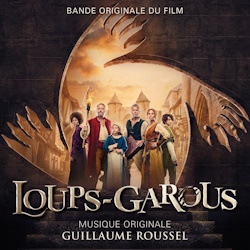 Loups-Garous, or Family Pack, is a French family adventure film directed by François Uzan and written by Hervé Marly and Philippe des Pallières. It is an adaptation of the French card game The Werewolves of Millers Hollow, and stars Franck Dubosc, Jean Reno, and Suzanne Clément; they play members of the Vassier family who, while playing an old card game, are magically transported back in time and lands in a medieval village where they must unmask werewolves in order to return to their own time. It has been described as ‘a French version of Jumanji with werewolves,’ and it has a fantastic score by composer Guillaume Roussel.
Roussel’s score is a quick 30-minute romp, an outstanding orchestral effort that combines action, drama, and light horror with a tuneful family-friendly flair that is really enjoyable across the board. To capture the film’s medieval setting Roussel often uses period instrumental textures, including harpsichords, certain ‘ancient’ woodwinds, and a Japanese shakuhachi flute that will remind listeners of classic James Horner. There are some period compositional touches too, often including dance-like rhythms and homages to regional folk music. However, the bulk of the score is straightforward orchestral writing, and here Roussel really excels.
There’s a terrific, sweeping main theme in the opening “En Route Vers Thiercelieux”. There’s a creepy-beautiful music box theme weaving in and out of the delicious horror textures in “La Petite Fille,” but which then becomes more soothing and inviting in the subsequent “Leur Histoire”. Elswehere, cues like “Terreur Nocturne” and the dark and brooding “A Mort” really embrace the horror movie aesthetic, and often reach some quite imposing orchestral heights.
However, by far my favorite cues are the ones where Roussel lets his orchestra run riot in a bold, melodic action style, and this makes up the bulk of the score. Notable highlights include tracks like “Le Voleur,” “Panique Sur Place,” and the rousing “Les Évadés,” and then the entire finale from the majestic “Tous Pour Un,” through “Face À Face” and “La Sorcière” to the moving “La Touche Finale”. Fans of classic 1980s and 90s orchestral action will love what Roussel doing is here; it’s a bold, enjoyable throwback to that style. There are some moments where Roussel brings out a chorus, and other moments where he weaves his main theme into the fabric of the action. It’s all beautifully composed, richly orchestrated, vigorous, and exciting.
Loups-Garous is a terrific work, bold and exciting, full of impressive action sequences and peppered with little nods to medieval folk music. Guillaume Roussel has really impressed me over the last few years through scores like C’est Magnifique, King, Couleurs de l’Incendie, Marie-Antoinette: Premiers Pas á la Cour, and now Loups-Garous is another one to add to that excellent list. Unfortunately there is no physical CD of Loups-Garous available, but the score is available to stream and download from most of the usual online sources, on the Milan Records label.
Track Listing: 1. En Route Vers Thiercelieux (2:05), 2. La Petite Fille (2:03), 3. Leur Histoire (1:46), 4. Terreur Nocturne (1:04), 5. Le Voleur (1:26), 6. A Mort! (2:15), 7. Dans Le Jeu (2:16), 8. Panique Sur Place (1:36), 9. Childéric (1:02), 10. Les Évadés (0:41), 11. Prisonnière (2:09), 12. Tous Pour Un (2:24), 13. Face À Face (2:08), 14. La Sorcière (3:02), 15. La Touche Finale (1:02), 16. Ciao A Tutti (1:01). Milan Records, 28 minutes 00 seconds.
A NORMAL FAMILY – Sung-Woo Cho
 A Normal Family is Korean thriller drama film directed by Jin-Ho Hur, and starring Kyung-Gu Sol, Dong-Gun Jang, Hee-Ae Kim, and Claudia Kim. The film is adapted from the 2009 Dutch-language novel The Dinner by Herman Koch, and follows two wealthy families who meet for dinner to discuss and decide how to handle a violent crime committed by their children. The film has been acclaimed as one of the best Korean films of 2024, and the score – by veteran composer Sung-Woo Cho – is one of the best from that country this year too.
Despite him having been working in the Korean film industry since the mid-1990s, this is the first of Cho’s scores I have ever heard, and I have to say that if this is a typical example of the quality of his work, I am eager to hear more. The score is a rich, bold, highly classical orchestral score, with heavy emphasis on strings and woodwinds. Based on what I know about the story, Cho seems to be scoring the initial opulence and wealth of the two families with stereotypically ‘upper class’ and ‘sophisticated’ classical music, which slowly becomes darker and more strained as the plot unfolds the secrets of their respective children are revealed.
The main theme, “A Normal Family,” actually sounds like something Nino Rota might have written in the 1950s or 60s than anything from Korean film music; it’s lush and sweeping waltz with a sort of vague hint of Italian classical music. A secondary theme, for the two brothers at the heart of the story, is introduced in the second cue “Two Brothers,” and is an aggressive and powerful but still highly classical string fugue, thrusting forcefully across the instruments.
These two approaches dominate the score; the Family Waltz is present in cues like “The Dinner,” “Academy Street,” “Daily Morning,” the outstanding and flamboyant “Confession,” and all through the more contemporary “Concealment or Punishment,” while the more antagonistic Two Brothers theme is present in cues like the energetic and lithe “The Video Spreads,” “Determination of Yeon Kyung,” and “Determination of Jae Wan,” which brilliantly blends the two ideas together.
I really appreciate how Cho is careful to change the orchestration of his main theme regularly – he uses pianos and almost whimsically comedic metallic percussion in “The Dinner” to add a slight layer of farce, uses oddly discomfiting electronic textures to “Academy Street,” and uses unnerving tick-tock percussion underneath the pianos in “Concealment or Punishment,” for example – and this keeps the score interesting and engaging throughout its 40-minute running time.
By the end of the score the sheen of civility presented by both families has disintegrated entirely, and Cho’s score along with it; “The Birth of a Tragedy” reprises the main waltz theme for a delicate but slightly distraught-sounding piano solo and a bank of haunted-sounding strings, capturing the terrible impact of the events at the center of the story. “Catastrophe” sounds appropriately broken and bitter, and then the pianos in the conclusive “The Extreme Clash” has an air of weary resignation underpinned with sorrow and regret.
This is an excellent score from an unexpected source, which will appeal to anyone who likes composers who take a strongly classical and thematic approach to dark dramas and thrillers like this. The score for A Normal Family is available as an import CD from retailers like YesAsia, and is also available to stream and download from most of the usual online sources.
Track Listing: 1. A Normal Family (4:44), 2. Two Brothers (Intro.) (1:28), 3. The Dinner (1:21), 4. Academy Street (2:01), 5. Daily Morning (2:06), 6. Bad Lawyer (2:15), 7. Dark Alley (0:51), 8. The Video Spreads (1:44), 9. Confession (5:59), 10. You’re Not! (1:33), 11. Determination of Yeon Kyung (0:41), 12. Concealment or Punishment (3:17), 13. Agonizing Jae Kyu (2:04), 14. The Death of a Homeless Man (1:03), 15. The Birth of a Tragedy (3:19), 16. Determination of Jae Wan (1:11), 17. Catastrophe (2:48), 18. The Extreme Clash (4:04). Music & New, 39 minutes 29 seconds.
LA PLUS PRÉCIEUSE DES MARCHANDISES/THE MOST PRECIOUS OF CARGOES – Alexandre Desplat
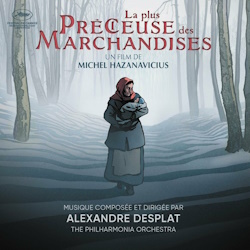 La Plus Précieuse des Marchandises – translated to English as The Most Precious of Cargoes – is a French-language animated drama film, directed by Michel Hazanavicius, with a screenplay by Jean-Claude Grumberg adapted from Grumberg’s 2019 novel of the same name. The story centers on a Holocaust-surviving Jewish girl whose father throws her from a moving train heading to Auschwitz when she is a baby, and who is ultimately found and taken in by a kind woodcutter and his family. It is a beautiful film with a unique artistic look, and which is filled with gorgeous hand-drawn landscapes to frame the moments of poignancy and intimacy.
Michel Hazanavicius directed composer Ludovic Bource to an Oscar for The Artist in 2011, and while the same is very unlikely to happen to composer Alexandre Desplat, his score for La Plus Précieuse des Marchandises nevertheless has all the hallmarks of his career-best dramatic and emotional works. The score sees Desplat returning fully to his lovely, fully orchestral, lushly romantic sound the early to mid-2000s, which was the period where many – myself included – first fell in love with his music.
There are echoes here of so many classics from that golden period; Girl With a Pearl Earring, Lust Caution, Birth, a little bit of The Painted Veil, a little bit of The Luzhin Defense. It has those crystalline, delicate, precise orchestrations that shimmer and sparkle like new fallen snow, layers of glockenspiels and chimes and twinkling metallic sounds. It luxuriates in gorgeous, heartbreaking themes often carried by violins and cellos. When it turns darker, it has those low hooting woodwinds and almost subliminal synth textures that have followed Desplat throughout a lot of his more serious moments.
As one would expect considering the tragic story at the heart of the film, there is an undercurrent of beautiful melancholy running through much of the score, and this is apparent right from the opening cue “Il Était Une Fois,” which is carried by a soft, gentle, but downbeat theme for piano. Several cues are lighter and more playful, capturing the quirks of the woodcutter’s personality, and also adopting some sounds of traditional French folk music, especially the sounds of accordions and mandolins. “Le Bucheron et l’Enfant” is a mischievous circus-like waltz, wholly delightful, and subsequent cues like “Tricot,” the eccentric “L’Enfant et la Neige,” and the endearing “Poupée de Bois” like adopt a similar tone. Once in a while Desplat allows these cues to emerge into warm, luscious arrangements for the full orchestra, and the end result of them is a sheer delight. Even in the darkest times, people have the capacity to find love and joy. Perhaps those times are when it is most important.
Of course, there are moments of tragedy and darkness too, and these are apparent in cues like “Le Cri” and in especially the 10-minute sequence comprising “Mort du Bucheron” and “Extermination”. “Le Cri” and “Extermination” are more abstract and textural, and see Desplat breaking down his orchestrations from elsewhere in the score and presenting them in a distinctly unsettling way. “Mort du Bucheron,” on the other hand, is heartbreak personified, a slow, intimate elegy for piano and strings that underscores the woodcutter’s sad death with depth and sincerity.
Elsewhere, “Course Bucheronne” takes a new setting of the main theme and surrounds it with a dramatic, rolling piano texture that carries throughout the entire cue and adds an unexpected sense of energy and momentum, and is just mesmerizing. This sound continues through subsequent cues like “Gueule Cassée” and “Tu Es Bon,” increasing the sense of anguish that follows the little girl throughout her life. The Jaws homage at the end of “L’Enfant et la Neige” is interesting.
The final two cues, “L’Enfant Retrouvé” and “Nouvelle Vie,” first see Desplat returning to the delicacy of the main theme, finally emerging from the overarching sense of sadness, before the second cue returns to the charming French folk music style and presents something that has a sense of hope and optimism, a chink of light cutting through the pervading darkness of the holocaust and its terrible effect on the little girl at the center of the story.
Anyone who first found themselves drawn to Alexandre Desplat’s music around 2003 and 2004 will find La Plus Précieuse des Marchandises to be a score that recaptures the sound of that period perfectly. I will caution that the overall tone is one of ‘beautiful sadness,’ and if that type of score feels too depressing, I can see it causing some listeners to have a negative response. Personally, I adore that sound, and as such I recommend La Plus Précieuse des Marchandises wholeheartedly. The score is available to purchase as an import CD from Milan Records, and to download and stream from all the usual online sources.
Track Listing: 1. Il Était Une Fois (2:09), 2. Le Bucheron et l’Enfant (3:15), 3. Le Cri (1:58), 4. Course Bucheronne (4:46), 5. Gueule Cassée (1:36), 6. Tu Es Bon (3:21), 7. Tricot (1:30), 8. L’Enfant et la Neige (2:30), 9. L’Enfant Rit (1:21), 10. Poupée de Bois (1:17), 11. La Petite Danseuse (1:57), 12. Mort du Bucheron (5:19), 13. Extermination (5:53), 14. Le Juste (1:35), 15. L’Enfant Retrouvé (5:03), 16. Nouvelle Vie (4:51). Milan, 48 minutes 21 seconds.
SAMI SWOI: POCZĄTEK/OUR FOLKS: THE BEGINNING – Paweł Lucewicz
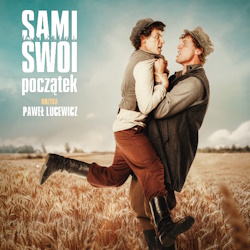 Sami Swoi: Początek – which translates into English as Our Folks: The Beginning – is a Polish comedy-drama film directed by Artur Żmijewski based on the popular novel by Andrzej Mularczyk. It is the fourth film in the long-running ‘Sami Swoi’ series and is a prequel to the acclaimed original 1967 film which had a score by Wojciech Kilar (the first sequel, Nie Ma Mocnych from 1974, and the second sequel, Kochaj Albo Rzuć from 1977, both had scores by Andrzej Korzyński). The film is set pre-WWII in the village of Krużewniki and looks at the early years of the two families are at the center of the story; Adam Bobik and Karol Dziuba play the heads of the two families, Kazimierz Pawlak and Władysław Kargul.
The score for Sami Swoi: Początek is by Polish composer Paweł Lucewicz, who impressed me enormously last year with his breakout score for Znachor, and who continues to impress me here. This score has a similar tone to Znachor; it is pastoral and calming, romantic and beautiful, and often clearly inspired by elements of Polish folk music, all combining to create an evocative portrait of a time and a place, a people and a culture. I’m not familiar enough with the Kilar and Korzyński scores to know how much – if any – of that music influenced what Lucewicz is doing here in terms of melody, but some of the more pastoral sounds Lucewicz uses do seem to have a tone similar to what Kilar wrote in his ‘Czolowka’ main theme in 1967.
Cues like “Kłótnia Sąsiedzka,” the amusingly militaristic “Idź Synku Do,” “Wieszanie,” and “Ty Mnie W Denerwacje Nie Wpędzaj” use traditional regional folk instruments to develop a comedic, occasionally slightly farcical, atmosphere of light-hearted whimsy that I really enjoy. At the other end of the scale there are a couple of brief but intense pieces of action in “Na Ratunek Nechajce,” “Luty 1940,” and “Koguty” which are full of banks of quivering strings, nervous percussion, and darting woodwind figures.
However, for me, the highlight cues are the ones where Lucewicz goes straight for the heartstrings and the tearducts, and pulls out all the emotional stops, running his main theme through a series of superb variations. Cues like “Krużewniki,” “Nechajka,” the more bittersweet “Przeprosiny,” the buoyant but brief “Mamo! Tato!,” “Powrót Do Domu,” the magical “Więzienie,” the deeply moving “Mama,” the wintry “Palmowa Niedziela, “Zima,” and the conclusive “Nasi Tu Są” are awash in tender strings, gentle and pretty woodwinds, intimate pianos, and endless harp waves, all of which cast a beautifully nostalgic glow. The continued use of a clarinet and flutes as a leading instrument in many of these cues delves deep back into the musical traditions of the region, and makes the whole thing wonderfully authentic.
I don’t know what they put in the water in Poland, but something is going on there that results in them having so many amazing film composers. From early exponents like Bronislau Kaper, through Wojciech Kilar, the late great Krzysztof Komeda, Andrzej Korzyński, Zbigniew Preisner, and the sadly missed Jan A. P. Kaczmarek, to current stars like Abel Korzeniowski and Bartosz Chajdecki, not to mention contemporary classical legends like Krzysztof Penderecki, Poland is an international powerhouse when it comes to outstanding film music, and Paweł Lucewicz is the latest composer to earn a place on that list. Sami Swoi: Początek is an outstanding score, moving, amusing, filled with both rich emotion and a love of its country’s musical heritage.
Unfortunately there is no physical CD of Sami Swoi: Początek available, but the score is available to stream and download from most of the usual online sources, on the Magnetic Records label.
Track Listing: 1. Krużewniki (1:24), 2. Kłótnia Sąsiedzka (1:35), 3. Nechajka (1:27), 4. Idź Synku Do Domu (0:31), 5. Nie Będziesz Faraonem (1:29), 6. Przeprosiny (1:29), 7. Faraon (0:24), 8. Mamo! Tato! (0:44), 9. Powrót Do Domu (1:34), 10. Nechaj Bude (0:19), 11. Wieszanie (1:01), 12. Czy Ty Na Mnie Zaczekasz? (0:48), 13. Komisja Wojskowa (0:19), 14. Wyjście Ze Szkoły (0:25), 15. Więzienie (1:40), 16. Na Ratunek Nechajce (0:41), 17. Wicia (1:15), 18. W Drodze Do Nowego Świata (1:07), 19. Luty 1940 (0:42), 20. Mama (1:27), 21. Pojednanie (0:48), 22. Palmowa Niedziela (1:48), 23. Ty Mnie W Denerwacje Nie Wpędzaj (0:55), 24. Kiedy Chcesz Się Żenić? (0:50), 25. Koguty (0:46), 26. Pogrzeb Wuja (1:16), 27. Zima (1:23), 28. Odmowa (0:47), 29. Oczami Mówił (1:32), 30. Nasi Tu Są (2:07). Magnetic Records, 32 minutes 33 seconds.
Leave a reply to Kevin Cancel reply

Shop at the Movie Music UK Store

Member of the

 MOVIE MUSIC UK
Nice review. That reminds me, did you listen to Thomas Newman’s score for White Bird? It’s also set in France.