BEETLEJUICE BEETLEJUICE – Danny Elfman
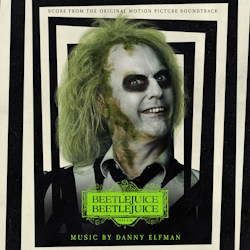 Original Review by Jonathan Broxton
It has taken more than 35 years for it to happen, but director Tim Burton has finally made a sequel to his classic comedy-horror film Beetlejuice. It seems that Burton, and his star Michael Keaton, are keen to recapture the feeling of their 1980s heyday by returning to the projects that made them famous – Keaton himself has already returned to play Batman in The Flash in 2023 – but unfortunately Beetlejuice Beetlejuice, despite some fun moments, is wholly inferior to the original across the board. The film sees Keaton returning with two of his co-stars from the first film, Winona Ryder and Catherine O’Hara, alongside franchise newcomers Jenna Ortega, Justin Theroux, Arthur Conti, Willem Dafoe, and Monica Bellucci, the latter of whom is director Burton’s current paramour.
The film follows Lydia Deetz (Ryder), the now-grown up daughter of artist Delia (O’Hara), who has a career as the host of a supernatural TV talk show, but is estranged from her own teenage daughter Astrid (Ortega), and is still haunted by visions of the ghoulish demon Betelgeuse (Keaton), who terrorized her and her family more than thirty years previously. When Lydia’s father Charles is killed in a gruesome shark-related accident the family returns to New England for the funeral, and for the first time in years everyone is back in the house where the events of the first film transpired. However, when Astrid is transported to the ‘afterlife,’ Lydia finds herself having to call on Betelgeuse himself to help save her daughter and bring her back to the real world.
Although Beetlejuice Beetlejuice is full of nostalgic references to the first movie, and although Burton himself seems to be in his element revisiting his own idiosyncratic visual and comedic style, the film overall is something of a mess. The problem, really, is that the film doesn’t seem to quite know what it wants to be, and has way too many sub-plots competing for time, to the point that none of them are adequately served by the screenplay. In addition to the main ‘saving Astrid’ plot there are several other strands, including a relationship between Lydia and her slimy manipulative boyfriend Rory (Theroux), a whole thing about ghost detective Wolf Jackson (Dafoe) who was an actor who played a detective on TV before he died, and then another bit about Betelgeuse’s former wife Delores (Bellucci) who in life was a soul-sucking witch and was the one who originally killed Betelgeuse – she poisoned him during the Black Plague – and who is now seeking revenge on her ex-husband. It’s all very confusing and unfocused, and each of the story elements get short shrift in an attempt to pack way too much into the finished product.
 Musically, the film is a mixed bag too. While the original film contained its fair share of song placements – notably the two vintage Harry Belafonte songs “Day-O” and “Jump in the Line (Shake, Senora)” – Danny Elfman’s score was front and center most of the time, and was given the space to establish its now iconic playfully macabre sound. Elfman is back for Beetlejuice Beetlejuice, but this time around he has to contend with many more songs; not only are there multiple reprises of “Day-O,” but the film contains several extended sequences built around performances of Donna Summer’s “Macarthur Park,” “Tragedy” by the Bee Gees, and Richard Marx’s “Right Here Waiting,” among several others. While the songs themselves are all decent enough on their own terms, their prominent placement in context means that Danny Elfman was to some extent forced to write around them, and in doing so found his music almost being relegated to second tier importance. A lot of Elfman’s cues are less than a minute in length – a by-product of the short scenes and song placements – which means that he wasn’t really given much time to develop his music in any meaningful way beyond the main titles and the end credits. However, even with this in mind, there is still a lot to enjoy.
Thankfully, Elfman was careful to bring back the majority of the thematic ideas from the first Beetlejuice film, although he does allow himself the opportunity to write some quirky variations on them which acknowledge the way his style has developed and matured over the years. The two main themes for Beetlejuice are back, beginning with the main theme, which again is awash in rampaging pianos, low blatting tubas, sighing vocals, swirling Danse Macabre-style strings, Nino Rota/Fellini-style oompah brasses, and dancing circus clarinets. What’s interesting this time around is that the theme also has an occasionally quite harsh electronic undercurrent that is clearly inspired by his recent return to rock music via his Big Mess album, while some of the vocals are weirder and more abrasive, sometimes drawing on the sound he used in scores like Mars Attacks, sometimes sounding like the chattering oompa-loompas from his Charlie and the Chocolate Factory score, and sometimes sounding like a Russian chorale. Hearing these variations is interesting, and once you get over the initial shock of hearing how much of a new spin Elfman has put on the whole thing, they are a ton of grisly fun.
The bouncy Beetlejuice riff is present in several cues as the score develops, with prominent appearances at the start of “Going to Beetlejuice,” at the end of “Obituary,” and with ghoulish flamboyance during “In the Model,” before exploding fully and with notable power in the excellent “Beetlejuice Returns”. It underpins a lot of the militaristic start of “You Agreed to Swap Lives,” and then is prominent throughout the action of the finale from “Saturn,” through “Delia Calls Beetlejuice,” and “Selfies Gone Wrong,” to the bulbous “Beetlejuice Balloons” with its prominent pipe organ sound.
Beetlejuice’s secondary theme is also back, a bizarre twist on a tango which, again, draws inspiration from Danse Macabre in the string writing, but augments it with the same hooting clarinets from the Main Titles, and church organs to give it a warped religioso feel. It appears briefly in the middle of “Ghost Host” to underscore Lydia’s increasingly disturbing hallucinations of Betelgeuse, dominates “Going to Beetlejuice” amid some vaguely Bolero-style percussive accents, meanders its way through both “Ex-Wife’s Back” and “Obituary,” and then becomes a little more aggressive during the latter part of “The Attic” as Astrid gets her first encounter with the undead trickster.
Interestingly the theme for the Maitlands – the characters played by Alec Baldwin and Geena Davis in the original film – is also back, despite those characters not appearing in the sequel. Elfman seems to have taken that theme and given it a new application here, using it as a recurring marker for the afterlife in general. There are a few brief allusions to it here and there in the first half of the score, but it appears fully for the first time in “The Attic,” underscoring the scene where Astrid discovers Adam Maitland’s scale model of the town from the first film in the attic of her family home.
The two new recurring themes in Beetlejuice Beetlejuice comprise a ‘family theme’ for Lydia and Astrid, and a menacing identity for Dolores, Betelgeuse’s ex-wife and murderer who comes back from the dead seeking revenge. The Family Theme is a rhythmic idea that is often carried by soprano voices, and it appears in scenes featuring both Lydia and Astrid independently, but Elfman often makes idiosyncratic choices in the arrangements, which shows creativity, but unfortunately makes it a little difficult to pin down. You first hear it prominently after the 2:50 mark in the “Main Title Theme,” but thereafter it is played subtly: it appears accompanied by Mars Attacks-style theremins all through “Ghost Host,” is bolstered by some aggressive horror stylings in “Boo,” and then combines with the Maitland theme in “The Attic” in one of the warmest and loveliest statements in the score.
Meanwhile, Dolores’s Theme is a harsh and horrific three-note motif that accompanies the sensuous succubus as she goes around draining the life force from various hapless victims – one of whom is an afterlife janitor played in a cameo by Danny De Vito. It first appears amid the creepy tones of “Ghost That Matters,” before emerging fully during the first half of “Ex-Wife’s Back,” which sees Elfman initially leaning heavily into a sense of twisted romanticism, but eventually becomes dark and menacing by the end with an array of chanted vocals and stark pounding pianos. Later, the cue intertwines with the two Beetlejuice themes in the imposing “You Agreed to Swap Lives,” which underscores the scene of Astrid’s descent into the afterlife, and the subsequent frantic chase through its psychedelic corridors as Lydia and Beetlejuice try to rescue her while avoiding Dolores’s clutches. Finally, in “Dolores Interrupts,” her menacing theme underscores the scene where she gatecrashes Beetlejuice’s second attempt at marrying Lydia, with inevitably morbid results.
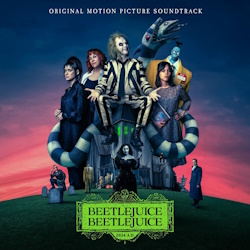 Other cues of note include the chanting light choir and electronic pulses in “Plane Crash,” the distinctly odd combination writing for female voices and percussion in “Gallery Performance,” and the religioso male voice choral parts in “Snake Ceremony”. This film’s version of “Day-O” is performed by Alfie Davis of the Sylvia Young Theatre School Choir with a VERY English accent, and is hilarious in context. I also like the brief hint of Wagner’s bridal chorus in “Selfies Gone Wrong,” and the similar classical allusions to Chopin’s funeral march in “Delia Departs”. As an in-joke, Burton tracked in the theme from Pino Donaggio’s 1976 score for Carrie to underscore the disorientating ‘Beetlejuice baby dream sequence,’ a fun cameo for film music lovers. However, somewhat disappointingly, the soundtrack doesn’t include any of the music Elfman wrote for Willem Dafoe’s Wolf Jackson character, a perfect parody of 1970s Lalo Schifrin-style cop jazz which I really enjoyed in context, and which I would have loved to have heard here.
Overall, the score for Beetlejuice Beetlejuice is about as good as it could have been, given the constraints Danny Elfman faced in terms of the numerous song placements, and taking into consideration the somewhat un-focused nature of the film itself, with all its different competing sub-plots. It revisits all the fiendish fun that so enthralled film music aficionados back in 1988, and blends them with some interesting new textural ideas that acknowledge how Elfman’s style has developed over the years. Unfortunately, the new themes are not especially memorable in and of themselves, and this may be something that is disappointing to listeners who are used to Elfman creating strong new identities in every score he writes. However, even with that in mind, I personally think there is enough here to give Beetlejuice Beetlejuice a cautious recommendation to anyone who has been on this journey with Elfman since the beginning.
Buy the Beetlejuice Beetlejuice soundtrack from the Movie Music UK Store
Track Listing:
- SCORE SOUNDTRACK
- Main Title Theme (3:21)
- Ghost Host (1:45)
- Plane Crash (0:59)
- Boo (1:23)
- Going to Beetlejuice (1:12)
- Day-O (traditional, performed by Alfie Davis and the Sylvia Young Theatre School Choir) (2:53)
- Ghost That Matters (2:00)
- Ex-Wife’s Back (2:34)
- Gallery Performance (0:48)
- Obituary (0:40)
- The Attic (3:22)
- In the Model (0:39)
- Ghost Story (1:27)
- Snake Ceremony (0:56)
- Beetlejuice Returns (2:28)
- You Agreed to Swap Lives (2:50)
- Saturn (1:11)
- Out of Luck (1:09)
- Delia Calls Beetlejuice (1:22)
- Selfies Gone Wrong (0:39)
- Dolores Interrupts (1:01)
- Beetlejuice Balloons (0:59)
- Delia Departs (1:07)
- What’s That? (0:45)
- End Titles (4:36)
- Waiting Room (More of a Dog Person) (1:10)
- Waiting Room (Delia) (0:31)
- Waiting Room (You’re Dead, Ok?) (0:53)
- Waiting Room (Bonus Track) (1:32)
- SONG SOUNDTRACK
- MacArthur Park (Single Version) (written by Jimmy Webb, performed by Donna Summer) (3:55)
- Tragedy (written by Barry Gibb, Robin Gibb, and Maurice Gibb, performed by Bee Gees) (5:01)
- Day-O (traditional, performed by Alfie Davis and the Sylvia Young Theatre School Choir) (2:52)
- Somedays (written and performed by Tess Parks) (2:40)
- Cry, Cry (written by David Roback and Hope Sandoval, performed by Mazzy Star) (3:59)
- Where’s the Man (written and performed by Scott Weiland) (5:12)
- Right Here Waiting (written by Richard Marx and Bruce Gaitsch, performed by Richard Marx) (4:28)
- Svefn-g-Englar (written by Jón Þór Birgisson, Georg Hólm, Kjartan Sveinsson, and Ágúst Ævar Gunnarsson, performed by Sigur Rós) (10:06)
- MacArthur Park (written by Jimmy Webb, performed by Richard Harris) (7:24)
- Main Title from Carrie (written by Pino Donaggio) (2:51)
- Main Title Theme (3:20)
- End Titles (4:35)
Watertower Music (2024)
Running Time: 45 minutes 58 seconds (Score Album)
Running Time: 52 minutes 32 seconds (Song Album)
Music composed by Danny Elfman. Conducted by Rick Wentworth and Pete Anthony. Orchestrations by Steve Bartek, Jonathan Beard, Julian Kershaw, Marc Mann, David Slonaker, Edward Trybek, Henri Wilkinson, Sean Barrett, Benjamin Hoff and Jamie Thierman. Additional music by Chris Bacon. Featured musical soloist Thomas Bowes. Recorded and mixed by Noah Scot Snyder. Edited by Bill Abbott and Cecile Tournesac. Album produced by Danny Elfman.
Leave a reply to Marco Ludema Cancel reply

Shop at the Movie Music UK Store

Member of the

 MOVIE MUSIC UK
To be honest, I was just happy that this score got a release at all, given the lack of hype around it. And as someone who did enjoy the film, it was great to hear those Beetlejuice themes again in context.