BATMAN: CAPED CRUSADER – Frederik Wiedmann
 Original Review by Jonathan Broxton
Despite being a long-time fan of the character as a whole – at least since Michael Keaton donned the mask and cowl in 1989 – for some reason I never really embraced the world of Animated Batman. I never sat down and watched any episodes of Batman: The Animated Series when it premiered in 1992, I have only seen the Mask of the Phantasm movie once, and I have not seen any of the numerous subsequent films or TV shows that have been released in the thirty years since then. I don’t know why; by all accounts they are all well-made, well-written, dramatically interesting stories with a clear internal logic, stylish design, and a whole host of excellent voice actors, notably Mark Hamill and the late Kevin Conroy. Musically, too, composers as talented as Danny Elfman, the late Shirley Walker, and the Dynamic Music Partners trio comprising Kristopher Carter, Michael McCuistion, and Lolita Ritmanis, have all written excellent scores across a myriad of episodes and entries.
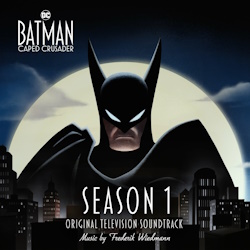
The latest animated series to feature the character is Batman: Caped Crusader, which was developed by legendary animation producer Bruce Timm and premiered on Amazon Prime earlier in August. The show is a sort-of-prequel, sort-of-reimagining of the whole Batman story, which takes some inspiration from director Matt Reeves’s 2022 film The Batman, but reworks the whole thing into a period piece inspired by the comics of the 1940’s by following Bruce Wayne/Batman in the early stages of his crime-fighting career as he clashes with new interpretations of classic villains like Catwoman, Penguin, Clayface, and Harley Quinn. The show features the voice talents of Hamish Linklater and Jason Watkins as Batman and his butler Alfred, plus Jamie Chung, Diedrich Bader, Minnie Driver, and Christina Ricci as some of the recurring antagonists.
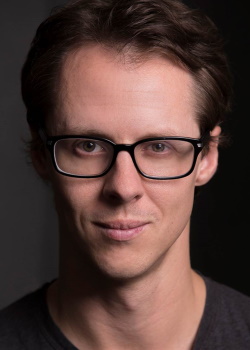 The score for Caped Crusader is by the Los Angeles-based German composer Frederik Wiedmann, who in my opinion has firmly established himself as one of the best television composers working today. Wiedmann has been associated with DC’s animated projects since 2011’s Green Lantern: The Animated Series, and by my count he has written music for more than 15 animated films and series since then. In the past couple of years he has also been writing for shows like the Netflix fantasy animated series The Dragon Prince and the Paramount+ Star Trek spinoff Picard, and his work has been outstanding. Wiedmann is a composer who knows the value of a big orchestra, can coax his ensembles into producing truly impressive and emotional sounds, can write some superb action music, and is pretty handy with a theme or two as well – all the things that, for me, make a score great. Batman: Caped Crusader is another one of those.
Caped Crusader is a superb, evocative, orchestral throwback, one part film noir, one part classic super hero adventure. In an interview with Jeff Ames for comingsoon.net, Wiedmann reveals that he was inspired by the look of the project, the art deco design of Gotham City, and by conversations he had with showrunner Timm. He says: “We talked a lot about old thrillers and monster movies, Mystery of the Wax Museum and Hangover Square, which I absolutely adore. It was a wonderful period of exploration, going back to those old movies and researching the musical sensibilities and filmmaking aesthetics of the time.” However, he was also careful to balance those sensibilities with the requirements of modern filmmaking, saying that “old film scores from the 1940s and 30s tend to have slightly different aesthetics than music has today. Old films are often slightly over-scored, to the point where the music might seem over the top or too on the nose or literal. This is something that audiences in today’s world don’t really accept anymore, as it might feel silly, so the challenge was to avoid this pitfall and stick to storytelling sensibilities that audiences of today can emotionally relate to in the way that best serves the story while still maintaining the sonic landscape of the 1940s film score.”
Of course, as this is a Batman project, Wiedmann was also conscious of not only the looming legacy of both Danny Elfman and Shirley Walker, but also subsequent scores by Elliot Goldenthal, and the Dark Knight trilogy by Hans Zimmer. Wiedmann said “Of course, every time I’m working on a Batman-related product, those names do come up in conversations, and for very good reasons. Few film scores are as iconic for superheroes as from those composers. While the Caped Crusader seems to be the closest show to Batman: The Animated Series in style and mood, we wanted it to be its own unique thing, with our own sound, style, and themes. But I think it goes without saying that any composer writing superhero music is, on some level, inspired by Elfman and Walker, even on a subconscious level.’
As such, taking all that into consideration, Caped Crusader eventually comes across as a classic 1940s film noir score – one part Bernard Herrmann, one part Miklós Rózsa – crossed with the 1990s superhero stylistics of Danny Elfman and Shirley Walker, and Wiedmann’s own personal style from his own previous Batman scores. And it’s brilliant. Wiedmann scored the show in Skopje, Macedonia, with the FAMES Project orchestra, which he augmented with a number of fascinating compositional and orchestration touches that enhance different aspects of the story: church bells and harpsichords to emphasize the Gothic setting, low strings played in the upper register (a viola playing violin lines, a cello playing viola lines) to capture the 1940s feel, special emphasis on low-end woodwinds, and so much more.
Thematically, the score is built around a recurring central theme for Batman, plus numerous individual character themes for the different supervillains. The “Batman: Caped Crusader Main Title Theme” is a darkly heroic fanfare that weaves through almost the entire score, coming and going frequently. It appears to have two guises: a sort of romantic version that accompanies the Bruce Wayne persona, and then a heavier and more ominous version for his Batman alter-ego, which is a clever way of emphasizing the duality of the character. I especially like the statement of the theme that appears during “A New Sunrise,” which somehow treads a fine line between hesitant optimism and inherent, nagging hopelessness.
The various villain themes come and go with equally pleasing regularity, and each of them have an interesting sound and feel specific to their character. There’s a menacing, Machiavellian brass theme for Oswalda Cobblepot/Penguin in “Shadow of the Penguin.” A sinister but beautiful Catwoman theme for elegant high strings and rhapsodic pianos and a hint of film noir jazz runs through “Beautiful Stray,” “Claws of a Thief,” and “Bad Bad Kitty,” giving all three cues a lithe, seductive quality. The Firebug character – with whom I was not previously familiar – has a spooky but tragic motif featuring a music box and a children’s choir that features in both “Fire in His Eyes” and “Flames of Glory”.
The iconic Harley Quinn character has a motif built around a mischievously deranged, slithery detuned violin that can be heard prominently in “A Dreadful Harlequin”. There’s an elegant harpsichord theme for the “Gentlemen Ghost,” a relic of faded beauty, which continues exquisitely through the subsequent “Eliminating the Impossible”. In “Onomatopoeia” Wiedmann cleverly uses his percussion section more prominently, making his percussive textures work like the eponymous sound/text concept, as part of a breathless Trevor Jones-esque chase sequence featuring the character. There’s a vaguely Eastern European-inflected theme for Natalia Night in “Natalia,” all morose velvety strings and descending woodwind textures.
Finally the theme for Harvey Dent’s tragic politician character Two-Face mirrors the arc of the character himself, starting out as an optimistic and patriotic Americana theme at the beginning of “Harvey’s Descent,” but then slowly collapsing into minor key tragedy through subsequent tracks like the wonderfully atmospheric “Gotham by Night,” and the saxophone-rich “Asking Questions”.
In amongst all this intricate thematic development Wiedmann also finds time to write a number of terrific action sequences, all flashing strings and brooding brass passages and rhythmic, rat-a-tat percussion. Cues like the aforementioned “Shadow of a Penguin,” “Born to Be the Villain,” the second half of “Beautiful Stray,” the second half of “Eliminating the Impossible,” the outstanding “Possessed,” and “Sounds Like Revenge” are just superb, exciting and intense.
Elsewhere, both “Transformation and Rebirth” and “I Gotta Leave Town for a While” reach some powerfully dramatic heights, often by way of a gorgeous violin solo in combination with some deeply ominous low woodwind writing. The opening moments of “Roughhouse” have a dynamic, dance-like, rhythmic quality in the strings that is really compelling, an idea that comes back later in a different guise in the equally scintillating “Resolution”. There’s even some time for swooning romance, in the gorgeous “Renee and Barbara,” in which Wiedmann arranges his writing for strings and woodwinds like John Barry did in the 1990s.
I think that the one final thing I really appreciate about Batman: Caped Crusader is how sophisticated it is, and how much love and care and attention Wiedmann and his team have put into crafting the sound, style, and thematic architecture. Nothing is phoned in here; everything has purpose, everything is steeped in that overarching sheen of Gothic film noir, and all the emotions are pitched perfectly. If one was to make any sort of criticism it might be to say that the main Caped Crusader theme, despite it being deeply embedded into the fabric of the score, doesn’t have the instant ear-worm memorability that Danny Elfman’s Batman theme did, or indeed that Shirley Walker’s theme for the second season of Batman: The Animated Series did, and that’s a shame. Shows like these need an iconic musical hook, and I hope that if the show continues on with a Season 2 or a Season 3, Wiedmann can flesh that out.
Beyond that, though, everything else about Caped Crusader is top notch. The gloriously rich sound of the orchestra, the clear influence of everyone from Danny Elfman to Bernard Herrmann, the multitude of villain themes, the dexterity and energy of the action music, the depth and panache of the arrangements… it’s all just fantastic. Frederik Wiedmann has impressed me enormously over the last few years, with his Star Trek work and his Dragon Prince fantasy series, and now with this score he has really cemented his status as one of the best composers working in genre TV today.
Buy the Batman: Caped Crusader soundtrack from the Movie Music UK Store
Track Listing:
- Batman: Caped Crusader (Main Title Theme) (0:36)
- Precious Little Angels (4:03)
- Shadow of the Penguin (5:06)
- The Big Scene (2:16)
- Transformation and Rebirth (5:44)
- Born to Be the Villain (2:49)
- Beautiful Stray (3:58)
- Claws of a Thief (3:21)
- Bad Bad Kitty (4:05)
- Fire in His Eyes (2:09)
- Flames of Glory (3:25)
- A Dreadful Harlequin (3:19)
- Roughhouse (2:39)
- I Gotta Leave Town for a While (3:50)
- Gentlemen Ghost (1:59)
- Eliminating the Impossible (2:50)
- Possessed (4:05)
- Renee and Barbara (1:21)
- Onomatopoeia (3:14)
- Resolution (3:46)
- Natalia (1:48)
- A New Sunrise (4:45)
- Harvey’s Descent (1:55)
- Gotham by Night (2:44)
- Asking Questions (2:01)
- Sounds Like Revenge (2:56)
- The Fog (2:20)
- Twisted by Ambition (5:25)
Watertower Music (2024)
Running Time: 88 minutes 28 seconds
Music composed by Frederik Wiedmann. Conducted by Oleg Kondratenko. Performed by the FAMES Orchestra. Orchestrations by Gemma Hyesu Wiedmann. Recorded and mixed by XXXX. Edited by XXXX. Album produced by Frederik Wiedmann.
Leave a reply to Rich Sims Cancel reply

Shop at the Movie Music UK Store

Member of the

 MOVIE MUSIC UK
Can you please review the soundtrack for Picard season 3? I really want to hear your in depth thoughts on that.
An exceptional review, Jon. Frederik Wiedmann’s score is magnificent, authentically creating and capturing the sonic landscape of 1940’s Gotham City!
Check out Daniel Schweiker’s compelling interview with Wiedmann on this score: https://www.youtube.com/watch?v=Da-inErAVq8&t=11s