BEVERLY HILLS COP: AXEL F – Lorne Balfe
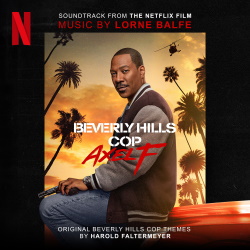 Original Review by Jonathan Broxton
The 1984 action comedy Beverly Hills Cop was one of the cinematic cultural touchstones of the 1980s, a fish-out-of-water story about a motor-mouthed Detroit-based detective who comes to Los Angeles to investigate the death of a friend, and causes havoc amid the more straight-laced members of the Beverly Hills police department. It helped launch its star Eddie Murphy to global superstardom, grossed $234 million at the domestic box office – the highest-grossing film released that year – and spawned several sequels (although the less said about the risible Beverly Hills Cop III in 1994 the better). Now, thirty years later, director Mark Molloy and screenwriters Will Beall, Tom Gormican, and Kevin Etten bring us a third sequel, Beverly Hills Cop: Axel F.
The film again stars Eddie Murphy as Axel Foley, who is still tearing up the city of Detroit with his unconventional police work. When Axel learns that his estranged daughter Jane (Taylour Page)’s life has been threatened, he returns to Beverly Hills – where she lives – to investigate. Jane and Axel team up with her ex-boyfriend, BHPD detective Bobby Abbott (Joseph Gordon-Levitt), as well as Axel’s old pals Sergeant John Taggart (John Ashton) and Billy Rosewood (Judge Reinhold), to uncover a conspiracy. The film co-stars Kevin Bacon, Paul Reiser, and Bronson Pinchot, the latter pair returning to the franchise in their original roles as Jeffrey and Serge, and debuted on Netflix on July 3.
One of the other iconic elements of the Beverly Hills Cop world is its music, specifically the score by German electronic composer Harold Faltermeyer. He scored the first two films in the franchise (Beverly Hills Cop III was scored by Nile Rodgers), and left an indelible mark on 1980s film music, most via notably the main theme “Axel F”. Faltermeyer’s famous synth palette – a Roland Jupiter-8 for the dance-like lead melody, a Moog modular synthesizer for the bass, the brassy stabs of a Roland JX-3P, a Yamaha DX7 making the marimba sounds, and a LinnDrum drum machine – combined with a trio of thematic ideas to make one of the most memorable, popular, and enduring pieces of film music of the entire decade.
 A lot of people don’t like this era of film music. Faltermeyer, alongside contemporaries like Vangelis, Giorgio Moroder, Sylvester Levay, Brad Fiedel, and others, was largely responsible for a significant shift away from ‘traditional’ orchestral film music during that period; they all riffed off the chart popularity of disco, and brought that high-energy sound to the Hollywood scoring stage. The success of that sound resulted in a lot of established orchestral composers trying to bring electronic tonalities into their work too, with varying degrees of success, and it could be argued that Faltermeyer, Moroder, and co. were more or less responsible for the hybrid sound that was eventually taken into the stratosphere by Hans Zimmer. Personally, and perhaps in spite of myself, I have always had a soft spot for many of these scores, and Beverly Hills Cop is one of the ones I have always loved the most.
For this fourth film, the Beverly Hills Cop sound has been taken up by composer Lorne Balfe, who with this score is adding yet another beloved franchise to his belt, having already brought his skills to bear on Top Gun, Mission Impossible, Bad Boys, and The Terminator, among others. As has been the case on virtually all his work over the last five years or so, Beverly Hills Cop: Axel F is an absolute blast, a loving homage to the sound of the 80s, but which has also been brought roaring up to date with some of Balfe’s outstanding fully orchestral wizardry. Tonally, what Balfe is doing here reminds me of what he did on his score for Tetris in 2023, and anyone who enjoyed that musical trip down memory lane will find themselves doing so again here.
The score is awash in Faltermeyer’s sound, and almost all the themes from Beverly Hills Cop are reprised here, as are some unexpected allusions to the sexier, sweatier score he wrote for Beverly Hills Cop II in 1987. To help round out the sound Balfe brought in a number of solo artists to collaborate: legendary bare-chested saxophonist Tim Cappello, who brings the same macho energy to this score as he brought to his work with Tina Turner and the soundtrack for The Lost Boys; British pop and synthwave music producer Edward Gamper, aka The Sunglasses Kid, who specializes in recreating the 80s sound; and legendary producers and remixers Phil Harding and Ian Curnow. It’s a complete blast from start to finish, with highlights a-plenty.
The opening cue, “Beverly Hills Cop: Axel F,” is a fantastic update of the classic theme, remixed by Curnow and Harding (complete with the unmistakable hit-swoosh of a Fairlight CMI), and which features a throbbing Cappello sax solo riff in its second half that couldn’t be more 80s if it was wearing a pastel-colored suit and legwarmers. “Junior Bollinger” opens with a reprise of the first score’s secondary theme, Axel’s ‘mischievous’ theme, with its stabbing electric pulses and marimba sound, before moving into a clever action/suspense sequence built around the stripped down chords of the main Axel F theme. “Meet Jane” initially has a more contemporary hip-hop vibe, but then switches to a new version of another one of the first score’s secondary themes, Axel’s punchy ‘investigation’ theme, which uses a fascinating watery vocal sample to counterpoint the melody.
“Wilshire Boulevard” initially makes excellent use of the nervous ticking sound that permeates the more serious scenes in all of the Beverly Hills Cop movies, but then in its second half goes into a terrific, updated version of the sultry ‘Alphabet Crimes’ theme that accompanied Brigitte Nielsen and her heists all through Beverly Hills Cop II. “Bribe Chalino” is another version of the Axel F theme, gritty and a little dirty, which emerges frequently from the electronic suspense pulses that dominate the rest of the cue. This core approach – existing theme, new arrangement – drives most of the rest of the score, through cues like “Rooftop Escape,” “Rescue Rosewood,” and “Mansion Shootout”.
 Balfe’s entirely original contributions are excellent too, though. “Snowplough Chase” and “Bad Helicopter” are fabulous action cues which blend an orchestra and vocals with an array of driving, bubbling electronic beats. “Trackers” is a low key and more understated groove that again features the unusual watery vocal sample as a marker, emerging from the slightly edgy and lo-fi sound of the rest of the cue. However, for me, the best new element of the score is the cue “Axel’s Return,” a superb new theme that features contributions from both Tim Cappello and Sunglasses Kid; it has the same sound palette as the rest of the score, and it subtly alludes to the thematic ideas from both original scores, but then it heads off in its own direction, a driving, relentless pulse that blends a vast array of sounds, textures, and percussion patterns into a hugely entertaining end product. The screaming electric guitars and wailing saxophones are just the cherry on top.
“Axel’s Return” is a perfect encapsulation of everything that Lorne Balfe is doing right these days. The music has a nostalgic quality, referencing its roots and its heritage, but it’s also so much more than that. Balfe and his collaborators are just having too much fun, being expressive and energetic, adding new ideas and embellishments for no other reason than they are cool, and because they can. Whether he is writing for large scale orchestras or tight, complicated synths, Balfe is expressing so much joy and freedom in his music these days, and you can’t help but just be carried along with it.
The penultimate cue, “Team Talk,” is at times surprisingly dramatic and intense, and features some elegiac combo writing for strings and choir, but becomes quirkier in its second half. Then the conclusive “90210” is an rich orchestral and choral arrangement of the Axel F theme, similar in approach to his ‘Terminated’ arrangement of the Terminator theme at the end of Terminator Genisys, and is the most epic way Balfe could have ended things. It’s just superb.
You probably have to be a Beverly Hills Cop fan, and a fan of the type of crowd-pleasing synth-pop scores that Harold Faltermeyer wrote, to properly appreciate what Beverly Hills Cop: Axel F is all about. Appreciating all the different ways that Lorne Balfe has brought Faltermeyer’s sound into the 2020s with his new arrangements and new settings is half the fun; as such, if that sound has never appealed, then you’re probably going to be scratching your head wondering what all the fuss is about. Personally, I had an absolute blast with the whole thing; it’s a loving homage to 80s synth music as a whole, an excellent example of Balfe’s talent at taking these sounds and making them contemporary and relevant, and of course it works as a standalone film score in its own right. I loved it from start to finish.
Buy the Beverly Hills Cop: Axel F soundtrack from the Movie Music UK Store
Track Listing:
- Beverly Hills Cop: Axel F (Curnow Harding Remix) (2:56)
- Snowplough Chase (2:12)
- Junior Bollinger (1:32)
- Meet Jane (2:14)
- Trackers (4:02)
- Wilshire Boulevard (3:02)
- Bribe Chalino (2:41)
- Axel’s Return (4:11)
- Rooftop Escape (3:55)
- Bad Helicopter (3:43)
- Rescue Rosewood (2:11)
- Mansion Shootout (4:09)
- Team Talk (3:26)
- 90210 (1:17)
Netflix Music (2024)
Running Time: 41 minutes 23 seconds
Music composed by Lorne Balfe. Conducted by Raphaela Correa Lacerda. Orchestrations and arrangements by Jeremy Earnest, Yaron Eigenstein, Ethan Gillespie, Stuart Michael Thomas, Max Aruj, Daniel Alm, Steven Davis, and Brandon Campbell. Original Beverly Hills Cop themes by Harold Faltermeyer. Featured musical soloists Tim Cappello, Stuart Michael Thomas, Edward Gamper (The Sunglasses Kid), Hex Cougar, and Luka Djurasic. Recorded and mixed by Dennis Sands. Edited by Allegra de Souza and Rudy Brynac. Album produced by Lorne Balfe.
Leave a comment

Shop at the Movie Music UK Store

Member of the

 MOVIE MUSIC UK
I loved this soundtrack, so much so that I’ll happilly listen to it by itself