THE BOYS IN THE BOAT – Alexandre Desplat
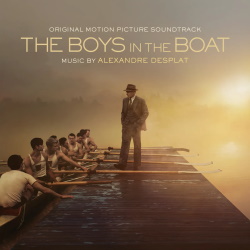 Original Review by Jonathan Broxton
The Boys in the Boat is an inspirational real life sports drama which tells the story of the University of Washington’s eight-oared rowing crew, who overcame enormous physical and social obstacles – not least the impact of the Great Depression – to represent the United States at the 1936 Summer Olympics in Berlin, and win the gold medal ahead of the heavily fancied and Hitler-backed German crew. The film focuses specifically on Joe Rantz, a kid from a poor background who was essentially homeless before he went to university, and initially saw his rowing career as a means to an end to put food on the table more than he did a chance to achieve sporting greatness. The film stars Callum Turner as Rantz, and Joel Edgerton as the college’s rowing coach Al Ulbrickson; it was written by Mark L. Smith, adapting the non-fiction novel of the same name by Daniel James Brown, and is directed by global movie star and filmmaker George Clooney.
The Boys in the Boat is the fifth film Clooney has made with composer Alexandre Desplat, after The Ides of March in 2011, The Monuments Men in 2014, Suburbicon in 2017, and The Midnight Sky in 2020. It’s also the second sporting drama that Desplat has scored this year, following on from Nyad, which is unusual considering that this is not a genre that Desplat usually tackles – although in this instance I’m delighted he has, because the score is just outstanding. Think of all the best Desplat scores over the years, and all the best things about them – the precise and almost metronomic rhythms, the crisp and clear orchestrations, the elegant writing for strings – and then add in an enormous amount of sporting triumph, patriotic heroism, and strong positive emotion, and that’s what you have in The Boys in the Boat.
Thematically the score is fairly simple, and there are two major ones that run through the score. Rather than being related to specific people or places, the themes are more conceptual, with one appearing to relate to the nature of rowing itself, and the other appearing to be a more general theme for ‘overcoming adversity to achieve sporting triumph’. Truthfully, the thematic density of the music isn’t where the score’s appeal lies, at least for me; instead, it’s in the colors and the harmonies, the instrumental combinations and the compositional complexity, and in the myriad of emotions that Desplat allows to come through.
 The score is fully orchestral, and each section gets is moment to shine. I especially love the use of muted brass, which is present throughout the score, and the way that Desplat offsets that against dainty, twittering woodwinds, lyrical strings, and poignant piano writing. There are also several cues in which Desplat works in some more contemporary sounds, including electric guitars, a more rock-inflected drum kit, and some synth keyboard textures. Desplat used some of these same sounds on Nyad too earlier this year, and it’s nice to hear him playing in the same environment here.
The other thing that’s very important about The Boys in the Boat is rhythm. Throughout the score, in almost every cue, Desplat underpins the music with constant prominent rhythmic ideas that drive the music forward in a variety of ways. Conceptually, this is clearly Desplat’s way of illustrating the notion that, in order to be successful, a rowing crew has to be in perfect synchronization, pushing and pulling the oars with absolute precision to drive their boat forward. You can almost see Desplat’s rhythmic underbelly as being the musical equivalent of a coxswain, keeping time for the music the same way one does for the rowers. It’s a clever idea, brilliantly realized, and perfectly in keeping with the central concept of the entire film.
These themes, instrumental textures, and conceptual ideas occur in multiple different combinations throughout the score, and several specific cues stand out. The opening cue, “The Boys in the Boat,” has an elegant, hopeful, slightly playful sound to the initial piano melody, while the tinkling metallic percussion textures, hooting brasses and woodwind accents are delightfully whimsical. The whole thing has a slight air of privilege that matches with the stereotypical image of college rowers being ‘elites’ from wealthy families, rather than the rough and ready working class kids the film actually focuses on, and it’s interesting to see Desplat playing around with those preconceptions. I also wonder whether the Chariots of Fire-esque electronic pulse that runs through much of the cue is an intentional homage to the late Vangelis.
This ‘air of privilege’ is undermined almost immediately in the subsequent “Coaches,” which offers a different thematic identity, noble, warm, and patriotic, featuring smooth strings underpinned by a determined tremolo sound. The slight edge of jazz that Desplat provides through the use of muted trumpets is appropriate for the film’s 1930s setting, while the unexpected use of electric guitars and light rock percussion also speaks to the working class heritage of the protagonists. “Joe’s Solitude” is intimate and introspective, featuring some excellent dramatic scoring for piano and strings, while “Oars” features enticing orchestral textures with a prominent harp, which gives the whole cue a nostalgic, almost magical feel that treats the entire concept of rowing and crew with a sort of respectful reverence.
“Getting Stronger” and “Training” are two halves of a montage; both pieces are vibrant and energetic, and feature brasses and pianos layered against lightly dancing flutes and vivacious percussion. A lot of the music here reminds me of the music Desplat was writing for scores like Birth back in the early 2000s, albeit without the undertones of sexual deviance, and it’s very good. After the training comes the “First Win,” which is a little gritty and a little dirty at the outset, but becomes more triumphant as it develops, and is full of energy and movement. Of course, the road to Berlin can never be plain sailing, and “Joe Out of Sync” underscores some of the setbacks the team faces with darkly insistent music full of bleating muted trumpets and urgent string and piano figures. This wonderfully dramatic music reminds me very much of the thriller scores Desplat wrote for films like Firewall and Hostage in 2005 and 2006, and I very much appreciate the throwback.
A love theme for Joe and his girlfriend Joyce first appears in “Boat Ride,” which is full of lilting piano textures and swooning strings, and is delightfully romantic; in the subsequent “Love Letter” Desplat takes these romantic tones a step further with the addition of a tender harp. However, these amorous diversions don’t last for long, and the score is soon back into the swing of the rowing action at the “Pacific Regatta”. For this sequence Desplat creates a sense of anticipation and urgency in the way he phrases his strings, which are layered to create an interesting sense of tension and musical conflict, and he then combines that with some subtle pageantry in the brass acknowledging the importance of the competition. The race itself – which the University of Washington team wins to qualify for the Olympics – is underscored in the showstopping “We Were Never Eight,” which runs a gamut of emotions. After the aggressive opening, which features electronic pulses under the orchestra and more of that powerful staccato action music, Desplat gradually increases the tempo, following the team as they pull in front of their rivals and head for the finish line. The second half of the cue has a terrific full-orchestra sound, with some notably excellent interplay between woodwinds, heavy strings, and brass triplets, before everything comes to a head in its celebratory finale, where the main theme for brass is backed with an array of wondrous cascading strings. Just outstanding.
As Joe and the boys arrive in “Berlin” there is an understandable sense of slight trepidation in how the strings and percussion is used, adding a layer of nervous tension to the sprightly melody from the opening cue. How could there not be, considering that this is the biggest moment of their sporting lives? The “Qualifications” have a sense of breathless energy, and have some wonderful writing for solo trumpets backed with snares, which give the cue an almost militaristic sound – again, perhaps an intentional reflection of the political situation of the time, and the fact that the rowers are competing in a city filled with Nazis, in stadiums bedecked by swastikas, with Hitler himself watching from the stands.
The cue that underscores the “Olympic Final” is unexpectedly dark for most of its length, sort of like a musical struggle, and the subsequent “Talk With Dad” is sentimental and emotional, and sees its jazz-like piano chords underpinned with a clear element of sadness. However, this sadness is swept away in the glorious “USA Rowing Team,” which is triumphant, emotionally direct, and full of positive nostalgia related to sporting success. Desplat makes outstanding use of wonderful fanfare flourishes in the horns, backed by timpani rumbles and sweeping strings. This is Desplat at his most rousing and celebratory, and in my opinion he is at his best when he makes direct, straightforward, un-ironic connections with the audience like this. There are two versions of this cue, a “Film Version” and an “Alternate Version,” and both are superb.
The final cue, “Poughkeepsie,” is the 10 minute conclusion to the score, and is essentially a summation of most of Desplat’s main ideas, from the sentimental and dream-like strings that have an almost mystical sound, to the lyrical writing for woodwinds, and the wonderful explosions of kinetic action and dynamic movement.
The Boys in the Boat is a real return to form for Alexandre Desplat after a few years of ups and downs. While he has certainly had some moments of excellence since he won his last Oscar for The Shape of Water in 2017 – I especially liked Little Women, Eiffel, The Lost King, Pinocchio, and Nyad – he has also had some rather unfortunate misfires and lackluster disappointments, with Asteroid City from earlier this year being perhaps the most annoying score of his entire career to date. My hope is that The Boys in the Boat re-ignites the love for his music that I had between 2007 and 2015, but which has waned a little bit in recent years; it contains all the things I have always loved about his music, but with the ‘sporting drama/Americana’ dials turned way up to the max, and that makes all the difference.
Buy the Boys in the Boat soundtrack from the Movie Music UK Store
Track Listing:
- The Boys in the Boat (4:21)
- Coaches (5:14)
- Joe’s Solitude (3:24)
- Oars (3:11)
- The Team (1:42)
- Getting Stronger (2:06)
- Training (0:56)
- First Win (4:31)
- Joe Out of Sync (3:17)
- Boat Ride (3:03)
- Love Letter (2:17)
- Pacific Regatta (3:11)
- We Were Never Eight (5:46)
- Check from Cal (1:37)
- Broke (2:14)
- Berlin (1:48)
- Qualifications (5:10)
- Olympic Final (2:38)
- Talk With Dad (4:19)
- USA Rowing Team (Film Version) (4:04)
- USA Rowing Team (Alternate Version) (4:03)
- Poughkeepsie (9:30)
Running Time: 78 minutes 35 seconds
Sony Classical (2023)
Music composed and conducted by Alexandre Desplat. Orchestrations by Jean-Pascal Beintus and Nicolas Charron. Recorded and mixed by Peter Cobbin and Kirsty Whalley. Edited by Gerard McCann and Michael Alexander. Album produced by Alexandre Desplat.
Leave a reply to Enrico Argentieri Cancel reply

Shop at the Movie Music UK Store

Member of the

 MOVIE MUSIC UK
Hi Jonathan!
I love Desplat.
And when I said that I love him I mean I have all his possible CDs available, met him in Ravello 10 years ago and so on…
Sad to not have this album on CD, yet…
I enjoyed a lot reading your review, but I wanted to make a little point here: I was expecting some “Americana” sound in here…and I don’t want to sound basic or predictable with the comment.
And I’m not criticizing the score, is gorgeous and very well written.
But wanted to share with you that maybe I was waiting for some different sound palette…I was thinking to “The Emperor’s Club” from James Newton Howard, you know?
Like when Desplat wrote “The Imitation Game” I remembered that I liked the sound of kind of “Britishish” to it…
Thanks for reading!