RUDY – Jerry Goldsmith
 THROWBACK THIRTY
GREATEST SCORES OF THE TWENTIETH CENTURY
Original Review by Jonathan Broxton
Arguably one of the most inspiring and beloved sporting drama films ever made, Rudy tells the story of Daniel “Rudy” Ruettiger, a working class kid from Chicago who harbors dreams of playing American football at the University of Notre Dame despite significant obstacles – notably, his lack of good academic grades, his family’s financial struggles, and his diminutive stature. However, Ruettiger’s persistence and positive nature eventually results in him making the team, earning the respect of his college teammates, and even being interviewed for the college newspaper, which makes him a cult figure in South Bend. Eventually Rudy convinces the stubborn head coach to put him on the field for the last ten seconds of the final game of his final year at the college – his first and last appearance – whereupon he sacks the opposition quarterback, and is carried from the field in glory while the stadium chants his name. Much of the story is apocryphal and embellished for dramatic purposes, but it’s a feelgood tale nevertheless. The film is directed by David Anspaugh from a screenplay by Angelo Pizzo, and stars Sean Astin as Rudy, along with Ned Beatty, Jason Miller, Robert Prosky, and Charles S. Dutton in supporting roles, as well as Jon Favreau and Vince Vaughn making their acting debuts.
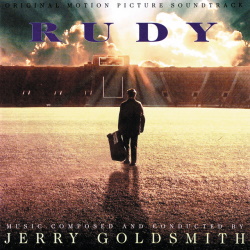
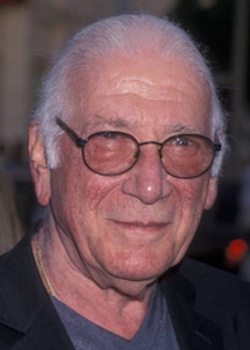
The score for Rudy was by the great Jerry Goldsmith, who was re-teaming here with director Anspaugh after they worked together on another inspirational sports drama, Hoosiers, in 1986. Hoosiers earned Goldsmith an Academy Award nomination, and so he was a natural choice to score Rudy, but I doubt even they could have anticipated just what a tremendous work Rudy turned out to be. In several interviews towards the end of his career Goldsmith cited Rudy as one of his own favorite scores, explaining that he always appreciated the chance to write lyrical, emotional music over the more intense action he was often approached to provide. As such, the one thing Rudy has in spades is lyricism and emotion – in fact, it’s one of the most overtly sweeping and sentimental scores of his entire career, but rather than this being a pejorative, this is exactly what makes me love it as much as I do.
 There are two themes that dominate the score for Rudy; one which Goldsmith colloquially called his ‘Irish’ theme (not because Rudy himself was Irish, but because the University of Notre Dame’s sports teams are nicknamed the Fighting Irish), and then a more aspirational fanfare-like theme for Rudy himself which can itself be broken down into a four-note A-phrase, and then a longer extrapolation from those opening four notes. Other, smaller motifs appear here and there, but for the most part the score is comprised of variations on these two or three ideas. In works by other, lesser composers, this may result in a somewhat boring listening experience, but Jerry Goldsmith being Jerry Goldsmith, there are so many variations in instrumentation, tempo, and counterpoint, that they never outstay their welcome, and instead gradually coalesce into one of the greatest finale cues of the composer’s entire illustrious career.
The Irish theme is clearly inspired by a pre-existing Celtic song called ‘The Last Rose of Summer,’ but that doesn’t matter because it’s absolutely gorgeous. The theme is introduced in the opening cue, “Main Title,” and is initially carried by a beautiful lilting solo flute backed by harp, before it is eventually picked up by the full orchestra accented by solo piano and even a soft choir. It’s just effortlessly beautiful – in my opinion one of the best single melodies Goldsmith ever wrote – and Goldsmith himself thought so too; he got so carried away during the recording session that you can actually hear him singing ‘la la lee’ from the conductor’s podium along with the orchestra at 3:07, a mistake that actually somehow makes the cue more emotionally impactful. The Irish theme is then heard throughout the rest of the score in numerous variations; with a sense of wistful melancholy during the first half of “A Start,” with tenderness and depth in the concluding moments of “To Notre Dame,” accompanied by playful fluttering flutes during the opening moments of “Tryouts,” and with a sense of poignancy in the lovely “The Plaque,” some of the harmonies in which remind me a little of the score he would write for Powder in 1996.
The secondary theme appears during the second half of “A Start,” where warm horns carry the four-note deconstructed version of the melody, and then in the subsequent “Waiting” the melody is extrapolated out into a more fulsome version that resembles a traditional Irish jig, upbeat and playful and built around a swaying, rhythmic idea carried by clarinets, before switching to horns accompanied by clanging tubular bells. Both elements of the theme are then enunciated fully in the stirring “Back on the Field,” a battery of rousing brass fanfares and stirring string phrases backed by percussion and more tubular bells. Many commentators have noted the similarity between this version of the theme and the end title theme from Goldsmith’s 1978 disaster movie score The Swarm, and there are indeed similarities, but the Rudy version has a more overt emotional core which I like immensely.
The extended version of the secondary theme comes back again in the superb “Tryouts,” which juxtaposes the main melodic idea against an increasingly robust and rapid underlying string-and-percussive ostinato, before exploding into life in its second half. The use of tambourines in the percussion section is quintessential Goldsmith, and then when he brings back the Irish theme too, it’s here that you see Goldsmith the dramatist at work. For the first time, all the elements of Rudy’s life are coming together – his dreams of playing football, his near-mythical love of the University of Notre Dame, and the actual act of playing football itself – and in this moment Goldsmith brings all his main themes together for the first time too. It’s outstanding. A further full statement of this theme can also be heard prominently in the magnificently rousing “Take Us Out.”
One other cue of note includes the lengthy “To Notre Dame” sequence, which contains some of the score’s more subtle and low-key music that looks at Rudy’s aspirations to attend the university, while simultaneously addressing the issues to do with his relative poverty and his academic failings, all of which could have stopped Rudy’s dreams dead in their tracks. There’s some lovely intimate writing for strings and harp, some allusions to the Irish theme in the flutes, and a lilting, impressionistic passage for clarinet, strings, and choir which Alan Silvestri clearly used as inspiration for his score for Forrest Gump the following year.
However, nothing can top the finale cue “The Final Game,” which underscores the famous game between Notre Dame and the Georgia Institute of Technology in November 1975 when Rudy’s dreams are realized. This cue is one of my favorite Goldsmith cues of all time; he starts with some portentous, dramatic drums, then adds a sense of destiny and grandeur with the four note motif from Rudy’s theme. These chords grow in power and stature, and then with a flick of the tambourine the rhythmic part of Rudy’s theme begins. String accents, brass harmonies, and dancing flutes, all combine to add to the sense of breathless anticipation, and then more martial percussion licks really drive the piece forward. A brief statement of the Irish theme accompanies Rudy as he finally enters the field for the first time in his life, but then the more intense rhythmic ideas return as play continues and a slightly bewildered Rudy tries to figure out what he has to do. In a moment of triumph against all the odds, Rudy incredibly sacks the Georgia Tech quarterback – sending the crowd into raptures – and then, finally, right at 4:44, at the exact moment that the game ends and Rudy is hoisted onto the shoulders of his teammates, Goldsmith pauses, imperceptibly, for a micro-second, in breathless suspense, before launching into the most rousing, inspiring statement of the Irish theme. The timpani rolls, the cymbals crash, the strings soar, and then the final refrain is accompanied by a choir. It’s glorious. Utterly glorious. Film music just doesn’t get any better. I have a lump in my throat as I’m typing this.
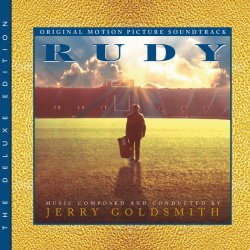 The score for Rudy was released on an excellent 30 minute album by Varese Sarabande in 1993 and, honestly, it contains everything good in the score. I listen to the album frequently. However in 2022, ostensibly in recognition of the film’s thirtieth anniversary, Varese released a deluxe edition of the soundtrack featuring more than half an hour of additional music, including some alternates, and two pieces of source music comprising the University of Notre Dame ‘fight songs’ “Hike, Notre Dame!” and the “Notre Dame Victory March,” both performed by the Notre Dame Glee Club. It’s a good album, and highly recommended to fans of the score, but honestly I have always been satisfied with Goldsmith’s original curated programme.
Film music lore states that Jerry Goldsmith was given repeated standing ovations by the Hollywood studio musicians after the Rudy recording sessions, and it’s not difficult to see why. This is a tremendous Goldsmith score, one of my all-time favorites in his vast canon. Sure, it’s not as complex as The Wind and the Lion, its not as challenging as Planet of the Apes, and it’s not as innovative as Star Trek: The Motion Picture, but what Rudy does have is heart and beauty and tenderness and pure, unbridled positive emotion, and often that’s exactly what I want out of my film scores. The fact that it was overlooked at the Academy Awards is, in my opinion, a travesty, because without Goldsmith’s music the film would be just another run-of-the-mill sports drama. With it, however, it comes close to poetry, a near-religious experience for college football fans in general, and the Fighting Irish of Notre Dame in particular.
Buy the Rudy soundtrack from the Movie Music UK Store
Track Listing:
- 1993 ORIGINAL RELEASE
- Main Title (3:34)
- A Start (2:28)
- Waiting (2:36)
- Back on the Field (2:07)
- To Notre Dame (6:54)
- Tryouts (4:25)
- The Key (3:55)
- Take Us Out (1:52)
- The Plaque (2:36)
- The Final Game (6:12)
- 2022 DELUXE EDITION
- Main Title (3:26)
- No Catch (1:07)
- The Speech/Last Game/Be Grateful (1:35)
- The Jacket (1:39)
- To Notre Dame (6:55)
- A Start (2:26)
- More Girls (0:44)
- Hike, Notre Dame! (written by Vincent Fagan and Joseph J. Casasanta, performed by The Notre Dame Glee Club) (1:25)
- The Plaque (2:35)
- Empty Stadium/The Key (3:41)
- Training (1:26)
- More Training (1:28)
- Accepted (1:44)
- Tryouts (4:27)
- Notre Dame Victory March (written by John F. Shea and Michael J. Shea, performed by The Notre Dame Glee Club) (1:37)
- For Father (0:48)
- Waiting (2:34)
- Back On The Field (2:06)
- Team Play/Ready Champ? (1:48)
- Take Us Out (1:50)
- The Final Game (6:19)
- Tryouts (Original Soundtrack Version) (4:27)
- The Key (Original Soundtrack Version) (3:53)
- To Notre Dame (Original Soundtrack Version) (6:56)
Running Time: 36 minutes 44 seconds – Original
Running Time: 66 minutes 56 seconds – Expanded
Varèse Sarabande VSD-5446 (1993) – Original
Varese Sarabande CD Club VCL 0922 1221 (1993/2022) – Expanded
Music composed and conducted Jerry Goldsmith. Orchestrations by Arthur Morton and Alexander Courage. Recorded and mixed by Bruce Botnick. Edited by Kenneth Hall. Album produced by Jerry Goldsmith. Expanded album produced by Cary E. Mansfield and Chas Ferry .

Shop at the Movie Music UK Store

Member of the

 MOVIE MUSIC UK