Archive
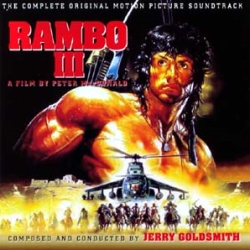
RAMBO III – Jerry Goldsmith
 THROWBACK THIRTY
Original Review by Jonathan Broxton
Sylvester Stallone’s position as one of the decade’s most bankable Hollywood stars continued in 1988 with Rambo III, the third film about the exploits of John Rambo, a bitter and damaged Vietnam-era Special Forces veteran who keeps getting dragged back into war zones no matter how much he tries to live a quiet life. Directed by Peter MacDonald and written by Stallone himself with Sheldon Lettitch, Rambo III begins with Rambo being visited by his old army colonel Sam Trautman (Richard Crenna), who tries to recruit him for a covert special ops mission to bring weapons to mujahedeen freedom fighters battling the Soviets in Afghanistan. Rambo refuses, but is eventually drawn into the conflict anyway weeks later when he learns that the mission was a disaster, and Trautman is now being held captive by a the sadistic Soviet colonel Alexei Zaysen (Marc de Jonge). Vowing to rescue his friend and bring him home, Rambo travels to the region alone, intending to wage a one-man war on the kidnappers. Read more…
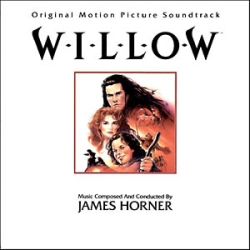
WILLOW – James Horner
 THROWBACK THIRTY
GREATEST SCORES OF THE TWENTIETH CENTURY
Original Review by Jonathan Broxton
Willow is a high fantasy film, which takes well-loved genre tropes from Lord of the Rings and elsewhere, and casts them in an adventure filled with magic, monsters, evil queens, beautiful princesses, soaring romance, daring sword fights, and much much more. Written by Bob Dolman from a story by George Lucas, and directed by Ron Howard, Willow is the story of a newborn baby prophesized to bring about the downfall of the evil witch Queen Bavmorda; to prevent the prophecy from coming to pass Bavmorda imprisons all expectant mothers, but after it is born, the baby is smuggled out of Bavmorda’s castle by a midwife, and eventually finds its way into the hands of Willow Ufgood, a Nelwyn (dwarf) farmer and aspiring magician. Determined to protect the baby, Willow journeys far from his home, and eventually finds himself in the company of a roguish swordfighter named Madmartigan, the good witch Fin Raziel, and a pair of mischievous woodland sprites. As the story progresses they all become involved in a large scale war between Bavmorda’s army and those who oppose her, while Bavmorda’s daughter Sorsha and the fearsome General Kael continue to hunt for the baby. The film stars Warwick Davis, Val Kilmer, Joanne Whalley, and Jean Marsh, and has a spectacular original score by James Horner. Read more…
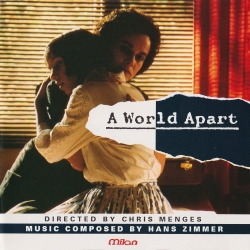
A WORLD APART – Hans Zimmer
 THROWBACK THIRTY
Original Review by Jonathan Broxton
As I wrote in my review for James Newton Howard’s Russkies last year, one of my favorite things about the Throwback Thirty series is the opportunity it gives me to take a look back at the very beginnings of certain composers’ careers, and examine how they started and where they came from. But first, a little background on the movie: A World Apart is an anti-Apartheid drama from the acclaimed cinematographer Chris Menges, who was making his directorial debut; it was written by Shawn Slovo, and loosely based on the lives of her parents, Ruth First and Joe Slovo. Set in South Africa in 1963, the film tells the story of Diana and Gus Roth, who are strong and determined anti-Apartheid activists. Despite being white and wealthy the Roths are frequently involved in public demonstrations and high profile political activism against the racist South African government, and as a result are often subjected to police brutality, violence, and societal ostracism – something which their pre-teen daughter Molly struggles to understand. The film stars Barbara Hershey, Jeroen Krabbé, a young Tim Roth, and a then 10-year-old Jodhi May, and was a significant critical success in Europe, winning a BAFTA for Best Screenplay, and receiving commendations at the 1988 Cannes Film Festival. Read more…
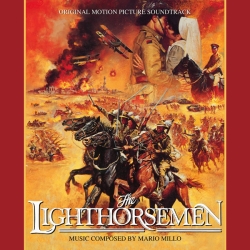
THE LIGHTHORSEMEN – Mario Millo
 THROWBACK THIRTY
Original Review by Jonathan Broxton
The Lighthorsemen was one of a series of critically acclaimed Australian films in the 1980s which looked at the experiences of that country’s soldiers during World War I and World War II, while also commenting specifically on the emergence of an Australian national culture and identity as it moved from being a British colony to attaining full independence. Capitalizing on the success of 1980’s Breaker Morant and 1981’s Gallipoli, which launched the international careers of directors Bruce Beresford and Peter Weir, The Lighthorsemen was directed by Simon Wincer and followed the experiences of four young and inexperienced Australian soldiers in a mounted brigade, fighting for the British against the Ottoman Empire in the Middle East as part of World War I. The movie culminates with an extraordinary depiction of the Battle of Beersheba, which has since come to be regarded as one of the greatest mounted infantry charges in history, and one of the finest moments of Australian military success. Read more…
BEETLEJUICE – Danny Elfman
 THROWBACK THIRTY
GREATEST SCORES OF THE TWENTIETH CENTURY
Original Review by Jonathan Broxton
Beetlejuice is an irreverent supernatural comedy, one of the best of the 1980s, and is the film which introduced the world to one of the most iconic characters of the period – the ghoulish, disgusting, undead horror-for-hire played by Michael Keaton at his most madcap. The film is set in an idyllic New England town, where blissful newlyweds Adam and Barbara Maitland are renovating their dream home; unfortunately, they are killed in a car crash on their way back from the hardware store, and become ghosts, stuck haunting their home for 125 years. Some time later the home is sold to a new family, the Deetzes, comprising the insufferable and talentless artist Delia, her henpecked developer husband Charles, and his goth daughter Lydia; immediately, Delia begins ripping out the country charm of the house, replacing it with garish modern art. Desperate to save their home, the Maitlands travel to the afterlife – a dreary netherworld set up like the universe’s worst DMV office – where they are advised that they can scare out the Deetzes if they so desire. To accomplish this, the Maitlands find and hire a ‘bio-exorcist’ named Betelgeuse, who can be summoned by saying his name three times – but the perverted, irreverent ghost quickly causes more chaos then he cures. Not only that, but it quickly becomes apparent that the introverted and sensitive Lydia can actually see the ghosts… Read more…
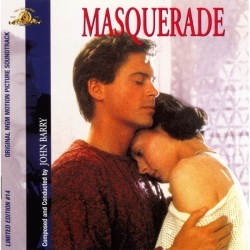
MASQUERADE – John Barry
 THROWBACK THIRTY
Original Review by Jonathan Broxton
Masquerade is a now long-forgotten mystery-thriller directed by Bob Swain and written by Dick Wolf, just before he took over television with his expansive Law & Order franchise. The film is set in and around an elite New England yachting community, and tells the story of Olivia, a naïve, recently orphaned millionairess who returns home after many years away, and falls in love with a dashing young yacht racing captain named Tim. However, Olivia soon becomes embroiled in a labyrinthine plot of lies, deceit, and murder, the scope of which apparently extends to the entire community. The film stars Rob Lowe and Meg Tilly as the central pair, features Kim Cattrall, John Glover, Dana Delany, and Doug Savant in supporting roles, and has a lovely original score by John Barry. Read more…
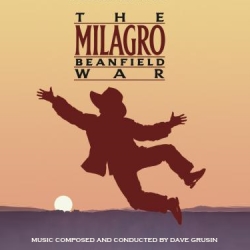
THE MILAGRO BEANFIELD WAR – Dave Grusin
 THROWBACK THIRTY
Original Review by Jonathan Broxton
In the annals of recent film music history, there is perhaps no more obscure a winner of the Academy Award for Best Original Score than Dave Grusin’s The Milagro Beanfield War. Even the film itself is virtually forgotten today, despite it being directed by Robert Redford and having a cast that includes Rubén Blades, Sônia Braga, Melanie Griffith, John Heard, Daniel Stern, and Christopher Walken. It’s a political comedy-drama – as Redford’s films often are – about the residents of a rural New Mexico town who find themselves in an ever-escalating confrontation with a group of unscrupulous businessmen. The businessmen want to buy tracts of land in order to invest in a series of lucrative property developments, but before they can do so they need the local residents to leave, so they divert the local water supply, leaving the farmers unable to irrigate their crops. It’s a very 1980s story about how the financial concerns of the wealthy ignore, and sometimes intentionally destroy, the rights of working class people. Read more…
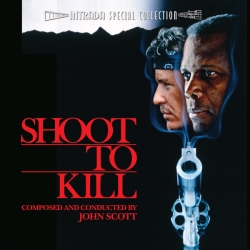
SHOOT TO KILL – John Scott
 THROWBACK THIRTY
Original Review by Jonathan Broxton
Shoot to Kill is a fun, enjoyable action thriller directed by Roger Spottiswoode, starring Sidney Poitier as FBI agent Warren Stanton, who is on the trail of a brutal jewel thief who killed two people during his last heist. Stanton discovers that the murderer is trying to escape north to Canada by joining a group of sports hunters on a guided expedition in the mountains of the Pacific Northwest; unbeknownst to the guide, Sara (Kirstie Alley), he has killed one of the hunters, and is now pretending to be him. In order to stop the killer before he crosses the border, Stanton hires Jonathan (Tom Berenger), a local outdoorsman – and Sarah’s boyfriend – to help guide him through the wilderness, and they set off in hot pursuit. The film has two quirks which make it stand out from other films of its type. The first is the constant bickering between the hardy Berenger and city boy Poitier, who don’t like each other but have to rely on each other to survive in true buddy cop fashion. The second is the fact that the audience doesn’t find out which of the group of sports hunters is the killer until well into the second half of the movie – a conceit made cleverer due to the producers casting four men known for playing ruthless movie villains as the hunters: Clancy Brown, Frederick Coffin, Richard Masur, and Andrew Robinson. Read more…
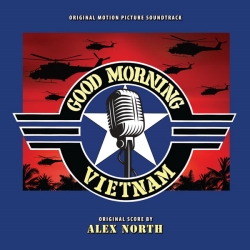
GOOD MORNING VIETNAM – Alex North
 THROWBACK THIRTY
Original Review by Jonathan Broxton
Good Morning Vietnam was one of the greatest critical and commercial successes over the winter of late 1987 and early 1988. A showcase for the improvisational talents of the late great comedian and actor Robin Williams, the film tells the (mostly) true life story of Adrian Cronauer, a motor-mouthed DJ working for the United States Armed Services at the height of the Vietnam War in 1965. From his booth on an army base in Saigon, Cronauer uses his caustic wit and love of classic rock and roll to raise the morale of the troops – despite the misgivings of his superiors, who disapprove of his irreverent antics. The film was directed by Barry Levinson, co-starred Forest Whitaker and Bruno Kirby, and went on to bag Williams his first Academy Award nomination for Best Actor. Read more…
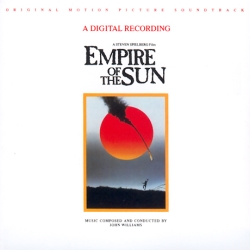
EMPIRE OF THE SUN – John Williams
 THROWBACK THIRTY
GREATEST SCORES OF THE TWENTIETH CENTURY
Original Review by Jonathan Broxton
By the end of 1986, Steven Spielberg was probably the most famous and financially successful director in Hollywood. However, although he had directed a handful of the highest grossing films of all time – Jaws, Close Encounters of the Third Kind, Raiders of the Lost Ark, E. T. The Extra-Terrestrial, Indiana Jones and the Temple of Doom –he privately expressed a desire to make more serious films. The comparative failure of The Color Purple in 1985 just magnified that desire, so in 1987 he decided to try again, by making a movie based on J. G. Ballard’s semi-autobiographical coming-of-age novel Empire of the Sun. The film starred the then 13-year-old Christian Bale as Jim Graham, an upper class English schoolboy living with his diplomat parents in Shanghai in 1941, whose life is shattered by the outbreak of World War II, and who ends up desperately trying to survive in a Japanese prisoner of war camp. Unfortunately for Spielberg, the film – which also starred John Malkovich, Miranda Richardson, and Nigel Havers – did not ignite the passions of audiences like his popcorn blockbusters did, and it was only a moderate critical and commercial success; Spielberg would have to wait another five years for his breakthrough into cinematic respectability with Schindler’s List in 1993. In addition, the film was largely overlooked at the Academy Awards, receiving only six technical nominations, but not winning any. Read more…
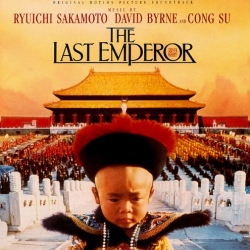
THE LAST EMPEROR – Ryuichi Sakamoto, David Byrne, Cong Su
 THROWBACK THIRTY
Original Review by Jonathan Broxton
They don’t make movies like The Last Emperor anymore. A lavish historical epic directed by the great Italian filmmaker Bernardo Bertolucci and starring John Lone, Joan Chen, and Peter O’Toole, the film tells the life story of Pu Yi, the last monarch of the Chinese Qing dynasty prior to the republican revolution in 1911. It is set within a framing story wherein the adult Pu Yi – a political prisoner of communist leader Mao Zedong – looks back on his life, beginning with his ascent to the throne aged just three in 1908, and continuing through his early life growing up in the Forbidden City in Beijing, and the subsequent political upheaval that led to his overthrow, exile, and eventual imprisonment. It’s an enormous, visually spectacular masterpiece that balances great pageantry and opulence with the very personal story of a man trying to navigate his life as a figurehead and monarch, and how he balances that with his private life and his political and social importance. It was the overwhelming critical success of 1987, and went on to win nine Oscars, including Best Picture, Best Director, and Best Adapted Screenplay, as well as a slew of technical awards for Art Direction, Cinematography, Editing, Costume Design, and Score. Read more…
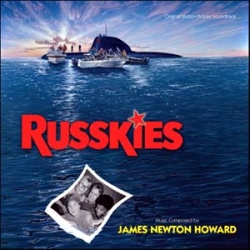
RUSSKIES – James Newton Howard
 THROWBACK THIRTY
Original Review by Jonathan Broxton
One of my favorite things about the Throwback Thirty series is the opportunity it gives me to take a look back at the very beginnings of certain composers’ careers, and examine how they started and where they came from. In 1987 James Newton Howard was still very new to the film scoring world. After studying at the Music Academy of the West in Santa Barbara, and at the University of Southern California, he started out as a session musician for various pop artists, which eventually led to him touring with Elton John as a keyboardist during the late 1970s and early 1980s. He arranged the strings for several of John’s most popular songs of the period, and subsequent collaborations with pop artists such as Cher, Bob Seger, Randy Newman, and Olivia Newton-John, led to him becoming one of the most sought-after arrangers in the music business. The film world started calling Howard’s name in 1985 when he was asked to score director Ken Finkleman’s comedy Head Office; he enjoyed some minor box office success in 1986 with the Goldie Hawn vehicle Wildcats, and the Burt Lancaster/Kirk Douglas comedy Tough Guys, but it was not until the end of 1987 that he would score a film that also had an accompanying score album released at the same time. Read more…
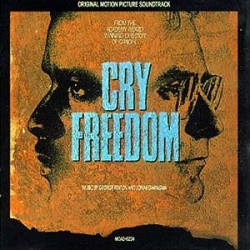
CRY FREEDOM – George Fenton, Jonas Gwangwa
 THROWBACK THIRTY
Original Review by Jonathan Broxton
It’s difficult to look back at South Africa in the 1970s and 80s and remember that, for decades following the end of World War II, the country operated under a legal political system called apartheid, whereby white South Africans held all the power and black South Africans were second class citizens, subjugated by a minority in their own country. This systematic racism was decried all over the world until 1991, when the policy was formally abolished. Director Richard Attenborough’s film Cry Freedom is a look at one of the most notorious events of the apartheid era: the death of activist Steve Biko at the hands of the local police in Pretoria, and the complicity of the South African government, who tried to cover it up. The film starred Kevin Kline and Denzel Washington, and was a major critical success in the winter of 1987, eventually receiving three Academy Award nominations: one for actor Washington, and two for the music by George Fenton and Jonas Gwangwa. Read more…
HOPE AND GLORY – Peter Martin
 THROWBACK THIRTY
Original Review by Jonathan Broxton
Hope and Glory is a semi-autobiographical film written and directed by John Boorman, which takes a look at the experiences of a young boy and his family living through the Blitz, the nightly bombing of London by the Nazi German Luftwaffe air force at the height of World War II. Despite the very serious subject matter, Hope and Glory is a quite wonderful film due to its perspective; much like Steven Spielberg’s Empire of the Sun, it is told from the point of view of a young boy who sees the world with an idealized innocence, and for whom the terrors of air raids are an adventurous game. It’s a clever and effective mix of a coming-of-age drama, a children’s action film, a social and familial comedy, and a nostalgic celebration of the resilience of wartime London, and was a huge critical success, being nominated for five Oscars, including Best Picture. The film starred David Hayman, Sarah Miles, Sammi Davis, Ian Bannen, and young Sebastian Rice-Edwards as the lead character Bill, and has an original score by British composer Peter Martin. Read more…
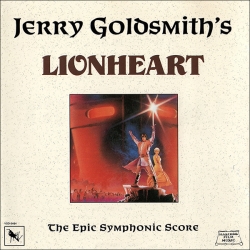
LIONHEART – Jerry Goldsmith
 THROWBACK THIRTY
Original Review by Jonathan Broxton
Lionheart is a perfect example of how a film studio can utterly ruin a film’s commercial success with poor distribution. A rousing historical action-adventure, the film is loosely based on the story of the Children’s Crusade of the year 1212, in which children from all over Europe adopted the cause of King Richard the Lionheart to protect Christianity from Muslim invaders. This story concentrates specifically on a young knight named Robert (Eric Stoltz), who finds himself becoming the protector of a group of children who are being threatened by the evil ‘Black Prince’ (Gabriel Byrne), a former crusader who became disillusioned with his cause and is now selling children into slavery. The film was an epic and lavish production – it was directed by the great Franklin Schaffner, was written by Menno Meyjes, and executive produced by Francis Ford Coppola – but it was hamstrung by its own production company, Orion Pictures, who delayed and delayed the film and eventually only released it in cinemas in Canada in the late summer of 1987 (it didn’t play in the United States at all). As a result, the film is virtually unknown these days, and is likely best remembered for Jerry Goldsmith’s rousing, epic score. Read more…

Shop at the Movie Music UK Store

Member of the

 MOVIE MUSIC UK