Archive
E.T. THE EXTRA-TERRESTRIAL – John Williams
 GREATEST SCORES OF THE TWENTIETH CENTURY
Original Review by Craig Lysy
Steven Spielberg, like most kids, suffered with the divorce of his parents. He was 14, and to cope with his circumstances, he created an imaginary alien friend, who became a surrogate brother. Over time this evolved into a story, which his sought to film called “Growing Up”. After the success of Raiders of The Lost Ark, he returned to fashioning his childhood story, which would now incorporate elements from another story he had written called “Night Skies,” where aliens terrorize a family. He brought in screenwriter to Melissa Mathison to craft a story of a special needs child bonding with a friendly alien. The result was a story to be called “E.T. and Me,” which Spielberg pitched to Columbia Studios. Remarkably they rejected the project, believing that it would only appeal to small kids. Well, Spielberg was undeterred, and approached Sid Sheinberg of MCA, who saw the success of Raiders of the Lost Ark, and agreed to fund the project. They bought back the script from Columbia Pictures for $1 million dollars and granted 5% of the film’s net profits. Spielberg and Kathleen Kennedy would produce the film, with Spielberg also directing. For his creative team, he brought in Carlo Rambaldi, who had created the aliens seen in Close Encounters of the Third Kind. The story required Spielberg to cast child actors, and he screened hundreds. His patience and hard effort paid off as he managed to secure a perfect cast, which included; Henry Thomas as Elliot, Drew Barrymore as Gertie, Dee Wallace as Mary, Peter Coyote as Keys, and Robert MacNaughton as Michael. Read more…
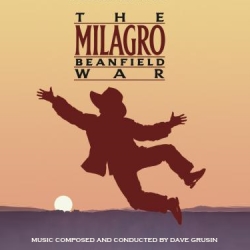
THE MILAGRO BEANFIELD WAR – Dave Grusin
 THROWBACK THIRTY
Original Review by Jonathan Broxton
In the annals of recent film music history, there is perhaps no more obscure a winner of the Academy Award for Best Original Score than Dave Grusin’s The Milagro Beanfield War. Even the film itself is virtually forgotten today, despite it being directed by Robert Redford and having a cast that includes Rubén Blades, Sônia Braga, Melanie Griffith, John Heard, Daniel Stern, and Christopher Walken. It’s a political comedy-drama – as Redford’s films often are – about the residents of a rural New Mexico town who find themselves in an ever-escalating confrontation with a group of unscrupulous businessmen. The businessmen want to buy tracts of land in order to invest in a series of lucrative property developments, but before they can do so they need the local residents to leave, so they divert the local water supply, leaving the farmers unable to irrigate their crops. It’s a very 1980s story about how the financial concerns of the wealthy ignore, and sometimes intentionally destroy, the rights of working class people. Read more…
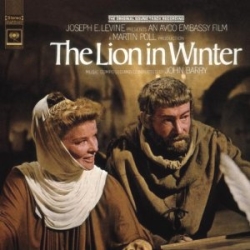
THE LION IN WINTER – John Barry
 GREATEST SCORES OF THE TWENTIETH CENTURY
Original Review by Craig Lysy
Producer Joe Levine had a contract with Peter O’Toole and was looking for a film to again showcase his talent. He found the vehicle in the Broadway play “The Lion In Winter” by James Goldman that offered dramatic dialogue, which would play to O’Toole’s thespian strengths. Anthony Harvey was brought in to direct the film and they hired an amazing cast to support Peter O’Toole (King Henry II), which included Katherine Hepburn (Queen Eleanor of Aquitaine), their three sons, Anthony Hopkins (Richard), John Castle (Geoffrey), and Nigel Terry (John). Also joining was Jane Morrow (Henry’s mistress Alais) and Timothy Dalton (King Philip II of France). Hopkins and Dalton were both making their screen acting debuts. Read more…
BLACK PANTHER – Ludwig Göransson
 Original Review by Jonathan Broxton
The utter dominance of comic book action movies at the American box office continues with the success of Black Panther, the 18th film in the Marvel Cinematic Universe. It’s the origin story of a character who appeared for the first time in Captain America: Civil War in 2016, and explores the history of the fictional African nation of Wakanda, which is the most technologically advanced civilization on Earth thanks to its unlimited supplies of the metal vibranium, but pretends to be a poor third world country to hide its power. Chadwick Boseman plays T’Challa, the new King of Wakanda, who takes up the mantle of the Black Panther after his father’s death in Captain America: Civil War; returning home to begin leading his country, T’Challa finds himself facing a threat in the shape of Eric Killmonger (Michael B. Jordan), a mercenary with ties to Wakanda, whose actions send the entire country into a civil war of its own. The film co-stars Lupita Nyongo, Danai Gurira, Martin Freeman, Daniel Kaluuya, Letitia Wright, Angela Bassett, Forest Whitaker, Sterling K. Brown, and Andy Serkis, and is directed by Ryan Coogler. Read more…
THE SHAPE OF WATER – Alexandre Desplat
 Original Review by Jonathan Broxton
The Shape of Water is a science fiction fairy tale written and directed by Guillermo del Toro, starring Sally Hawkins, Richard Jenkins, Octavia Spencer, Michael Shannon, Michael Stuhlbarg, and Doug Jones. It’s an odd mishmash of a film – it’s one part romantic drama, one part monster movie, one part spy thriller, and it explores additional themes that range from one character’s closeted homosexuality to another’s love of classic Hollywood musicals – but somehow it all works beautifully. Hawkins plays Elisa, a shy mute woman who works as a cleaner on the night shift at a military research facility in the 1960s. One night Elisa meets a mysterious but highly intelligent amphibious humanoid creature (Jones) that has been captured in a remote part of the Amazon and brought to the facility for study by the ruthless Colonel Strickland (Shannon). Unexpectedly, Elisa and the Amphibious Man meet and begin to bond, and form the beginnings of an almost romantic relationship; however, when she hears of the government’s plans to kill and dissect the Amphibious Man to study it’s biology, Elisa vows to save him, and with the help of her sassy co-worker Zelda (Spencer) and her next door neighbor Giles (Jenkins), comes up with a plan to break him out. Read more…
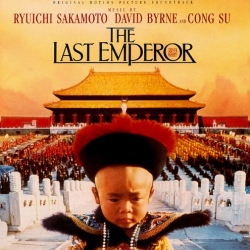
THE LAST EMPEROR – Ryuichi Sakamoto, David Byrne, Cong Su
 THROWBACK THIRTY
Original Review by Jonathan Broxton
They don’t make movies like The Last Emperor anymore. A lavish historical epic directed by the great Italian filmmaker Bernardo Bertolucci and starring John Lone, Joan Chen, and Peter O’Toole, the film tells the life story of Pu Yi, the last monarch of the Chinese Qing dynasty prior to the republican revolution in 1911. It is set within a framing story wherein the adult Pu Yi – a political prisoner of communist leader Mao Zedong – looks back on his life, beginning with his ascent to the throne aged just three in 1908, and continuing through his early life growing up in the Forbidden City in Beijing, and the subsequent political upheaval that led to his overthrow, exile, and eventual imprisonment. It’s an enormous, visually spectacular masterpiece that balances great pageantry and opulence with the very personal story of a man trying to navigate his life as a figurehead and monarch, and how he balances that with his private life and his political and social importance. It was the overwhelming critical success of 1987, and went on to win nine Oscars, including Best Picture, Best Director, and Best Adapted Screenplay, as well as a slew of technical awards for Art Direction, Cinematography, Editing, Costume Design, and Score. Read more…
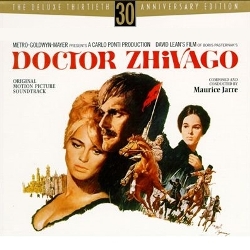
DOCTOR ZHIVAGO – Maurice Jarre
 GREATEST SCORES OF THE TWENTIETH CENTURY
Original Review by Craig Lysy
Doctor Zhivago was adapted by screenwriter Robert Bolt from the famous novel written by Boris Pasternak. The original manuscript was smuggled out of the Soviet Union in 1957 and awarded the Nobel Prize for Literature in 1958. Director David Lean recruited a stellar cast for his film that included Omar Shariff as Yuri Zhivago, Geraldine Chaplin as his wife Tonya, Rod Steiger as Viktor Komarovsky, Tom Courtenay as General Pasha Strelnikov, Alec Guinness as Yuri’s half-brother Yevgraf and finally, Julie Christie as Lara Guishar. This timeless and epic film tells the tale of young lovers drawn together by fate, caught in the cruel currents of war, clinging desperately to each other to survive amidst the clash of empires, as they bear witness to a grand romantic age succumbing to a cruel and violent new order. It is a magnificent film of sweeping and poetic grandeur for which I am eternally grateful. The film was a critical success earning 10 Oscar nominations, winning five including Best Score for Jarre. It was also a commercial success earning $112 million, more than sufficient to cover its production costs of 11 million. Read more…
LAWRENCE OF ARABIA – Maurice Jarre
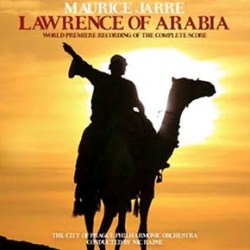 GREATEST SCORES OF THE TWENTIETH CENTURY
Original Review by Craig Lysy
David Lean and Sam Spiegel purchased the film rights to T. E. Lawrence’s book “The Seven Pillars of Wisdom” and hired Robert Bolt to write the screenplay on the enigmatic war hero. A stellar cast was hired that included Peter O’Toole (T.E. Lawrence), Alec Guiness (Prince Feisal), Anthony Quinn (Auda Abu Tayi), Jack Hawkins (General Allenby) and Omar Sharif as Sherif Ali. The film centers on Thomas Edward Lawrence, a complex and insolent British Lieutenant assigned to Cairo during World War I. He is ordered to assess the possibility of recruiting Prince Feisal of Arabia as an ally in their struggle against the Ottoman Turks. On his own initiative he instead chooses to rally the recently defeated Arab army for an audacious trans desert assault against the port city of Aqaba. He succeeds and returns to Cairo in triumph where he is promoted and ordered to return and lead the Arab revolt. His guerrilla army harasses the Turks with surprise desert raids and train line assaults that disrupt their command and control. Along the way the war violence and his complicity in a massacre serves to plague his conscience and forever scar him. Eventually, he leads his army northward captures Damascus and helps end the control of the Ottoman Empire. With his mission complete, he is sent back to England only to die young at the age of 46 in a motorcycle accident. The film was a stunning success winning seven Academy Awards including Best Score for Maurice Jarre. Read more…
BREAKFAST AT TIFFANY’S – Henry Mancini
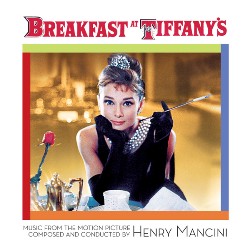 GREATEST SCORES OF THE TWENTIETH CENTURY
Original Review by Craig Lysy
Hollywood producers Martin Jurow and Richard Shepherd saw opportunity beckoning with Truman Capote’s controversial 1958 novella Breakfast at Tiffany’s, and convinced Paramount Studios to purchase the film rights. They hired George Axelrod to write a screenplay that “softened” Capote’s edgy narrative, and Blake Edwards was given the director reigns. Edwards assembled a fine cast, which included Audrey Hepburn as Holly Golightly, George Peppard as Paul Varjak, Patricia Neal as Emily Eustace, Buddy Ebsen as Doc Golightly, Martin Balsam as O. J. Berman, and Mickey Rooney as Holly’s landlord Mr. Yunioshi. For the 1950’s, this truly sordid story broke all the sensibilities of the day – Holly was a foul-mouthed, bisexual, social-climbing and gold-digging prostitute, who has had an abortion and smokes marijuana! The fact that the story’s narrator was gay only added to the controversy. Jurow and Shepherd knew the story as written would never fly, so they chose not to make a modern and edgy social drama. They astutely recast the story’s narrative into a more conventional, and emotionally accessible direction – a romantic comedy. Well, Holly’s love affair with struggling writer Paul succeeded on all counts and won audience hearts worldwide. The film was also a critical success, earning five Academy Award Nominations, winning two for best Original Song and Best Score. Read more…
EXODUS – Ernest Gold
 GREATEST SCORES OF THE TWENTIETH CENTURY
Original Review by Craig Lysy
In 1958 Otto Preminger and United Artists studio purchased the film rights to Leon Uris’s forthcoming novel, “Exodus”. Preminger, who would both produce and direct the film, felt that this was a story that needed to be told, and for him it became a passion project. He hired Dalton Trumbo who had been blacklisted as a communist by the infamous McCarthy Committee to write the screenplay. From day one he had Paul Newman in mind to play the lead role of Ari Ben Canaan. The stellar cast rounded off with Eva Marie Saint as Kitty Fremont, Ralph Richardson as General Sutherland, Peter Lawford as Major Caldwell, Lee Cobb as Barak Ben Canaan, Sal Mineo as Dov Landau, and John Derek as Taha. The story is based on the actual historical events in 1947, which began with the ship Exodus, and the lead up to the founding of the modern state of Israel in 1948. Nurse Kitty’s fate becomes entwined with Ari Ben Canaan a Hagannah rebel who obtains a cargo ship and smuggles 611 Jewish inmates out of the Cypriot internment camp for passage to Israel. In Israel, the British are preparing to leave, and the unfolding partition of Palestine into separate Jewish and Arab states portends war. Read more…
THE ROBE – Alfred Newman
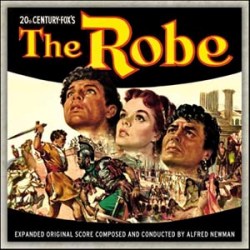 GREATEST SCORES OF THE TWENTIETH CENTURY
Original Review by Craig Lysy
20th Century Fox Studio chief Darryl Zanuck chose to use “The Robe” to introduce his new creation Cinemascope to the world. Cinemascope used an anamorphic lens that allowed the filming process to create an image of up to a 2.66:1 aspect ratio, almost twice as wide as the industry standard. He hired veteran Henry Koster to direct and adapted the script from the novel by Lloyd Douglas, which he had envisioned for years. “The Robe” is a Biblical epic, a love story and a tale of a man’s struggle for redemption. Marcellus (Richard Burton) is a Roman military tribune from a noble family who offends Caligula, heir to the Roman throne. In retribution he is deployed to Palestine, thus separating him from his life of luxury and his lover Diana (Jean Simmons). Upon his arrival he is given command of the unit charged with executing Jesus Christ, which he dutifully discharges. While drunk he happens to win in a craps game Jesus’ homespun robe after the crucifixion. The death of Jesus affects Marcellus profoundly, and henceforth he is tormented by recurring nightmares, delusions and guilt for his role in his crucifixion. On orders from Tiberius he returns to Palestine in search of the robe, which he believes has bewitched him. He thus begins a personal journey that will lead him to discover faith, forgiveness and ultimately redemption. The film was a huge critical success, winning two Oscars and a Golden Globe for Best Picture. The film and Cinemascope were also a huge commercial success, earning profits seven times that of its production costs. Read more…
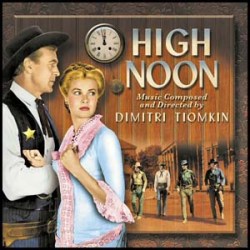
HIGH NOON – Dimitri Tiomkin
 GREATEST SCORES OF THE TWENTIETH CENTURY
Original Review by Craig Lysy
Producers Stanley Kramer and Carl Foreman had long sought to film a Western and saw their opportunity when they came across an inspiring short story “The Tin Star” by John Cunningham. Foreman adapted it for the big screen as High Noon, and hired European director Fred Zinnemann to direct. Veteran actor Gary Cooper was given the lead role of Will Kane. He was joined by Grace Kelly (Amy Fowler), Ian MacDonald (Frank Miller) and Lloyd Bridges (Harvey Pell). The story is set in 1880 in the New Mexico Territory. It is a classic morality play regarding personal honor, civic duty, and a man’s struggle to overcome his fears. Read more…
SUNSET BOULEVARD – Franz Waxman
 GREATEST SCORES OF THE TWENTIETH CENTURY
Original Review by Craig Lysy
Director Billy Wilder and producer Charles Brackett created a brilliant film noir screenplay for Sunset Boulevard, which told the story of a once proud but now aged Hollywood actress who wished to end her seclusion and regain past glory. For the principle actors, after considering Mae West and Mary Pickford for the leading role Gloria Swanson was given the part of Norma Desmond. A young William Holden was selected for Joe Gillis and Erich von Stronheim was cast as Norma’s former husband and now butler Max von Mayerling. The story tells the tale of Joe Gillis, a young screenwriter down on his luck that drives into Desmond’s estate while fleeing a car repo man. Norma, who has written a script to propel her comeback, hires Joe to create a screenplay. She lavishes her wealth and affection on him, which he freely and shamelessly accepts. Ultimately she falls in love with Joe and when he rejects her she shoots him. The story ends as a now elegantly dressed yet mad Norma descends her grand staircase to greet the police. Halfway down she pauses and announces proudly that she is happy to be making films again, ending with “All right, Mr. DeMille, I’m ready for my close-up.” The movie was both a commercial and critical success earning eleven Academy Award nominations, winning three for Best Screenplay, Best Art Direction and Best Film Score. Read more…
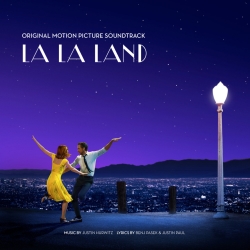
LA LA LAND – Justin Hurwitz, Benj Pasek, Justin Paul
 Original Review by Jonathan Broxton
There has been so much cynicism and negativity in the news in 2016, that a film like La La Land is not so much a breath of fresh air, but a necessary antidote to the political and social upheaval that has swept across far too much of the world. It’s a sincere, optimistic love letter to the power of dreams and the joy of romance, an homage to classic Hollywood musicals, and a celebration of art and dance and music that wears its heart on its sleeve and looks you straight in the eye as it does so. Directed by Damien Chazelle, it stars Ryan Gosling and Emma Stone as Sebastian and Mia, two struggling artists trying to make it in contemporary Los Angeles. Sebastian is a jazz pianist frustrated by his lack of opportunities and the fact that no one seems to love the music he loves any more; Mia is an aspiring actress working in a coffee shop on a studio lot whose dreams are continually crushed by an endless parade of failed auditions. A series of chance meetings between the two slowly leads to a romantic relationship, and together the pair seeks to find a way through the perils and pitfalls of being young and creative in the City of Angels. Read more…
THE BEST YEARS OF OUR LIVES – Hugo Friedhofer
 GREATEST SCORES OF THE TWENTIETH CENTURY
Original Review by Craig Lysy
In making The Best Years of Our Lives, Famous producer Samuel Goldwyn became inspired to make a film that spoke to challenges facing our returning servicemen after reading an article in Time magazine, which described the difficulty experienced by Marines returning to civilian life. He hired war correspondent MacKinlay Kanto to write the story; a novella titled “Glory for Me”, and then brought in director William Wyler and Robert Sherwood, his go to playwright, to adapt it for the big screen. They assembled a first class ensemble of actors, which included Fredric March (Al Stephenson), Myrna Loy (Milly Stephenson), Dana Andrews (Fred Derry), Virginia Mayo (Marie Derry), Cathy O’Donnell (Wilma Cameron), and for authenticity, newcomer Harold Russell (Homer Parrish), a real life serviceman who had lost both his hands in the war. The story follows the reintegration struggles of three soldiers into civilian life. Read more…

Shop at the Movie Music UK Store

Member of the

 MOVIE MUSIC UK