Archive
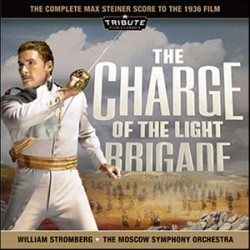
THE CHARGE OF THE LIGHT BRIGADE – Max Steiner
 MOVIE MUSIC UK CLASSICS
Original Review by Craig Lysy
Warner Brothers Studio executives saw the success of Paramount Studio’s Lives of a Bengal Lancer in 1935 and decided to cash in on the British Empire Adventure Tales genre. It was decided that their vehicle would be a retelling of the epic charge of the Light Brigade during the Crimean War. Screenplay writer Michael Jacoby’s script for the story found favor with the studio and was purchased, although Rowland Leigh was brought in to make some edits. Samuel Bischoff and Hal Wallis were given the reigns to produce the film with a generous $1.33 million budget. Michael Curtiz was tasked with directing and a stellar cast was assembled, including Errol Flynn as Major Geoffrey Vickers, Olivia de Havilland as Elsa Campbell, Patric Knowles as Captain Perry Vickers, Henry Stephensen as Sir Charles Macefield, Nigel Bruce as Sir Benjamin Warrenton, Donald Crisp as Colonel Campbell, David Niven as Captain Randall, Robert Barrat as Count Igor Volonoff, and C. Henry Gordon as Surat Khan. Read more…
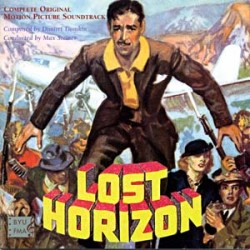
LOST HORIZON – Dimitri Tiomkin
 MOVIE MUSIC UK CLASSICS
Original Review by Craig Lysy
During the filming of It Happened One Night in 1934 director Frank Capra read and became inspired by the 1933 novel Lost Horizon by James Hilton. He was determined to adapt it to the big screen but had to delay production when his starring actor Ronald Coleman was contractually committed to another project. He eventually received the green light to proceed from Columbia Pictures executive Harry Cohn who provided a very generous budget of $1.25 million. The film was a passion project that Capra would produce and direct. The novel was adapted to the screen by screenwriter Robert Riskin, and a stellar cast was brought in led by Ronald Coleman as Robert Conway. Joining him would be Jane Wyatt as Sondra Bizet, H. B. Warner as Chang, Sam Jaffe as the High Lama, John Howard as George Conway, Edward Everett Horton as Alexander Lovett, Thomas Mitchell as Henry Barnard and Margo as Maria. The story centers on Robert Conway a writer and soldier set to return to England to assume the Foreign Secretary position in 1935. He is currently posted to China and ordered to evacuate 90 westerners lest they be captured by approaching Chinese revolutionaries. As they depart, the plane’s pilot has been replaced and they are hijacked, which ends with them running out of fuel and crashing deep in the Himalayas mountains. They are rescued by a mysterious man called Chang who leads them to a hidden and verdant valley called Shangri-La, where people live in idyllic peace and harmony, free of disease and blessed with unnatural long life. Read more…
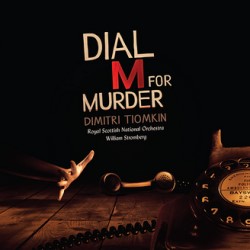
DIAL M FOR MURDER – Dimitri Tiomkin
 MOVIE MUSIC UK CLASSICS
Original Review by Craig Lysy
English playwright Frederick Knott introduced his story “Dial M For Murder” in 1952 as a play for television. Its popularity led to stage productions in London and New York that were also successful. Renowned producer Alexander Korda saw opportunity and purchased the film rights, and after the success of the stage productions sold them to Warner Brothers for a handsome profit. Warner Brothers Studios had Alfred Hitchcock under contract and when his effort to film “The Bramble Bush” failed to get off the ground they directed him to begin production on “Dial M For Murder”. Hitchcock would produce and direct the film with a modest budget of $1.4 million. His first choices for the lead roles did not pan out. Cary Grant would not accept the role of a villain, and Olivia de Havilland demanded too much money for his modest budget. Despite these setbacks he never the less secured a fine cast which included Ray Milland as Tony Wendice, Grace Kelly as Margot Mary Wendice, Robert Cummings as Mark Halliday, John Williams as Chief Inspector Hubbard, and Anthony Dawson as Alexander Swann. Read more…
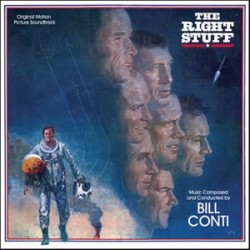
THE RIGHT STUFF – Bill Conti
 MOVIE MUSIC UK CLASSICS
Original Review by Craig Lysy
The 1979 novel The Right Stuff by Tom Woolfe proved to be a hit with the public, which set-off a bidding war for screen rights between Universal Pictures and independent producers Robert Chartoff and Irwin Winkler. Chartoff and Winkler won the day and hired screenwriter William Goldman to adapt the novel to the big screen. Goldman was inspired by the project and was seeking a patriotic Americana tale, which celebrated the Mercury 7 astronauts involved. Philip Kaufman was tasked with directing, but he disliked Goldman’s script, believing it too patriotic, with not enough focus on test pilot Chuck Yeager. Goldman left the project, Woolfe declined to adapt his novel, and so Kaufman wrote the screenplay himself. He related; “if you’re serious about tracing where the future — read: space travel — began, its roots lay with Yeager and the whole test pilot-subculture. Ultimately, astronautics descended from that point.” Kaufman brought in a fine cast, which included Fred Ward as Gus Grissom, Dennis Quaid as Gordo Cooper, Ed Harris as John Glenn, Sam Shepard as Chuck Yeager, Scott Glenn as Alan Shepard, Lance Henriksen as Wally Schirra, Scott Paulin as Deke Slayton, Barbara Hershey as Glennis Yeager and Veronica Cartwright as Betty Grissom. Read more…
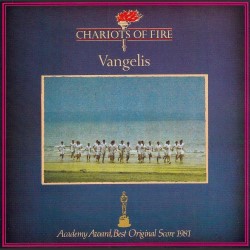
CHARIOTS OF FIRE – Vangelis
 MOVIE MUSIC UK CLASSICS
Original Review by Craig Lysy
Lauded English film producer David Puttnam was seeking a new film project, which offered sports heroism and dealt with matters of conscience. By chance he came upon the story of runner Eric Liddell, and found exactly the tale he wanted to tell. He hired screenwriter Colin Welland to adapt Liddell’s story, and he meticulous in his research of the 1924 Olympics. He crafted an Academy Award winning screenplay that provided the vehicle for Puttnam to realize his vision. Hugh Hudson was hired to direct and he decided early that he would cast young, unknown actors for the film’s major roles, with established actors in the supporting roles. He chose Ian Charleson to play Eric Liddell, Ben Cross as his rival Harold Abrahams, Nicholas Farrell as Aubrey Montague, and Nigel Havers as Lord Andrew Lindsay, while adding Sir John Gielgud, Nigel Davenport, Lindsay Anderson, Ian Holm, and Patrick Magee to the supporting cast. Read more…
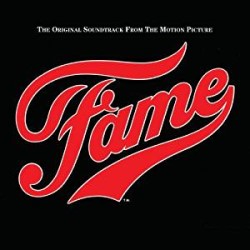
FAME – Michael Gore
 MOVIE MUSIC UK CLASSICS
Original Review by Craig Lysy
David De Silva, a New York City talent manager, happened to take in the 1976 production of “A Chorus Line”. The song “Nothing” triggered a creative spark when it referenced the prestigious New York High School of Performing Arts. He envisioned a film, which would speak to the dreams, trials and tribulations of ambitious young adolescent students trying to break in to the business and launch their careers. De Silva travelled to Florida the next year where he met famed playwright Christopher Gore. The two connected, he pitched his ideas, story and characters, and then hired Gore to draft a script with a working title of “Hot Lunch” for $5,000. De Silva was pleased with the script, sold the project to Metro-Goldwyn-Mayer executives, who authorized $400,000 to acquire the screen rights. De Silva and Alan Marshall would produce with a generous $8 million budget and Alan Parker was hired to direct. Read more…
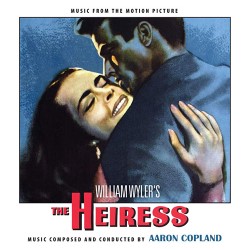
THE HEIRESS – Aaron Copland
 MOVIE MUSIC UK CLASSICS
Original Review by Craig Lysy
The genesis of the film lies with renown actress Olivia de Havilland who one night fell in love with the Broadway play The Heiress (1947). She sought out director William Wyler and pitched the idea of him directing her in a film adaptation of the play. Wyler, who had long admired de Havilland, jumped at the opportunity to direct her in this film. He obtained permission from Paramount studios executives to purchase the film rights from playwrights Augustus and Ruth Goetz for $250,000, and then hired them to adapt their play to the big screen. Wyler would produce and direct the film. Supporting Olivia de Havilland in the titular role would be a stellar cast which included Montgomery Clift as Morris Townsend, Ralph Richardson as Dr. Austin Sloper and Miriam Hopkins as Aunt Lavinia Penniman. The story takes place in New York City circa 1849 and centers on the life of Catherine Sloper, the shy, doting daughter of her recently widowed father Austin Sloper. She lives an insular life in luxury, content with embroidery and dutifully caring for her critical and unloving father. She is an heiress set for life as her mother bequeathed her a $10,000 a year stipend, which would increase to $30,000 once her father passes. Read more…
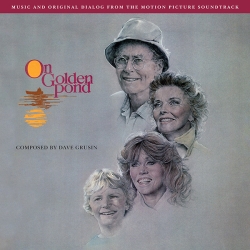
ON GOLDEN POND – Dave Grusin
 MOVIE MUSIC UK CLASSICS
Original Review by Craig Lysy
Jane Fonda was an avid reader, and happened to come across the novel On Golden Pond by Ernest Thompson. She was captivated by the story and bought the film rights, intending for her father Henry Fonda to play the lead role of Norman Thayer. She secured financial backing for the film from Lord Grade, of the British studio ITC Entertainment. Bruce Gilbert was assigned to produce the film, and Mark Rydell was tasked with directing. Jane Fonda had always intended that this film would be a father-daughter endeavor, and so her father Henry Fonda was hired to play Norman Thayer, while she would play the estranged daughter Chelsea. The story’s father-daughter estrangement mirrored the real-life relationship of Jane and her father and ultimately proved to be cathartic, in that it restored their relationship. Joining them would be Katherine Hepburn as Ethel Thayer, Doug McKeon and Billy Ray, Dabney Coleman as Bill Ray, and William Lanteau as Charlie Martin. Read more…
RAISE THE RED LANTERN – Zhao Jiping
 MOVIE MUSIC UK CLASSICS
Original Review by Craig Lysy
Following the enormous international critical success of his film Ju Dou in 1990, director Zhang Yimou sought a new collaboration with its beautiful star Gong Li. He was intrigued by the 1990 novel Wives and Concubines by Su Tong, and hired screenwriter Ni Zhen to adapt it to the big screen. Zhang’s vision was to provide a stunning visual beauty, which bathed the viewer with crimson auras, graced with Gong Li as the film’s focal point. He submitted the finished screenplay, entitled Dahong Denglong Gaogao Gua or Raise the Red Lantern, to Chinese censors, which gave the project the green light without edits. Zhang proceeded to assemble a splendid cast anchored by the gorgeous Gong Li as Fourth Mistress Songlian, and who, after this film, would rise to become China’s leading film star. Read more…
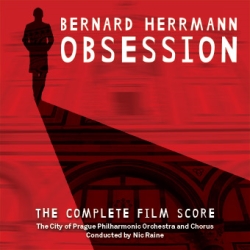
OBSESSION – Bernard Herrmann
 MOVIE MUSIC UK CLASSICS
Original Review by Craig Lysy
Brian De Palma had long admired Alfred Hitchcock’s masterwork Vertigo, and resolved to revisit its themes with a new rendering. He convinced Paramount studio executives of his vision for a retelling, and brought in trusted writer Paul Schrader to create a screenplay. Schrader’s crafted a fine original screenplay, titled Déjà Vu, but it was so voluminous that De Palma judged it to be unfilmable. As such he truncated the third act, which was set ten years in the future to achieve a more cogent and filmable storyline. Well, Schrader was outraged, refused to make the requested changes, and the two friends had a falling out, but development of the film continued regardless, ultimately resulting in Obsession. De Palma brought is a seasoned cast, which included Cliff Robertson as Michael Courtland, Geneviève Bujold as Elizabeth Courtland/Sandra Portinari, John Lithgow as Robert Lasalle, and Stocker Fontelieu as Dr. Ellman. Read more…
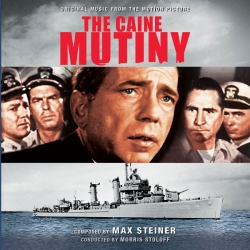
THE CAINE MUTINY – Max Steiner
 MOVIE MUSIC UK CLASSICS
Original Review by Craig Lysy
Producer Stanley Kramer of Columbia Pictures found inspiration for a compelling military drama within the pages of Herman Wouk’s 1951 novel, “The Caine Mutiny”. He purchased the film rights and tasked Edward Dmytryk with directing, and Wouk to write the screenplay. All did not begin well as controversy arose regarding the script. Dmytryk was dissatisfied with Wouk’s effort, which would have required a ten-hour film, so he relieved him and hired veteran writer Stanley Roberts. While Roberts was successful in his mission, he resigned when further cuts were ordered to keep the film’s running time under two hours. As such Michael Blankfort was brought in and cut 50 pages from the script, to achieve its final incarnation. More problems arose, as the navy was initially resistant to support the film due to its narrative of an unhinged Captain and mutiny aboard a US naval vessel. The final script however won over Naval command and ship resources were dedicated to the film. There was more controversy to come as casting also got off on the wrong foot. Columbia President Harry Cohn leveraged Humphrey Bogart’s desire for the lead role of Captain Queeg to reduce his customary $200,000 salary, which caused the actor great consternation and bitterness. In the end he accepted the role and provided one of the finest acting performances of his career. He would be supported by a fine cast, which included; Jose Ferrer as Lieutenant Barney Greenwald, Van Johnson as Lieutenant Steve Maryk, Fred McMurray as Lieutenant Tom Keefer, Robert Francis as Ensign Willie Keith, Tom Tully as Lieutenant Commander William De Vriess, May Wynn as May Wynn, and E. G. Marshall as Prosecutor Lieutenant Commander John Challee. Read more…
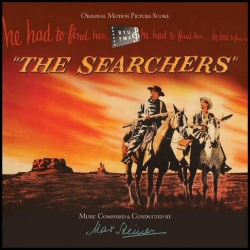
THE SEARCHERS – Max Steiner
 MOVIE MUSIC UK CLASSICS
Original Review by Craig Lysy
Renowned director John Ford had long been recognized as a master of the Western genre with successes, which included Stagecoach (1939), My Darling Clementine (1946), Fort Apache (1948) and Wagon Master (1950). He came upon a novel The Searchers (1954) by Alan Le May that he believed offered a powerful narrative, which needed to be brought to the big screen. Warner Brothers Studio approved the project, purchased the film rights and tasked Ford with bringing his vision to fruition. Frank Nugent was hired to write the screenplay and Ford assembled a stellar cast, which included; John Wayne as Ethan Edwards, Jeffrey Hunter as Martin Pawley, Vera Miles as Laurie Jorgensen, Ward Bond as Reverend Captain Samuel Clayton, Natalie Woods as Debbie Edwards and Henry Brandon as Scar. The story was set in Texas and inspired by a real life event, the 1836 kidnapping of Cynthia Ann Parker by Comanche Indians. She would spend twenty-four years of her life among them, bearing and raising three sons with her Comanche husband. Read more…
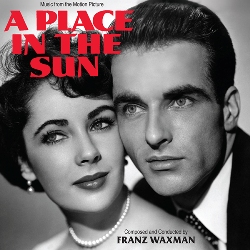
A PLACE IN THE SUN – Franz Waxman
 MOVIE MUSIC UK CLASSICS
Original Review by Craig Lysy
The film was adapted from a 1925 novel “An American Tragedy” by Theodore Dreiser. Director George Stevens hired Michael Wilson and Harry Brown for the screenplay, and assembled a stellar cast to at last bring this tragic story to life. George Stevens (Montgomery Clift), Angela Vickers (Elizabeth Taylor) and Alice Tripp (Shelley Winters) were hired as the principles and paired with a great cast of supporting players. The film centers on George Eastman, a poor man raised by an evangelical mother, who is tragically undone by his own actions. He leaves Chicago dirt poor, determined to make a name for himself working in the company of his wealthy Uncle in California. While there he begins dating Alice, a girl he met in the plant. All seems fine until he becomes completely enamored with Angela, a drop dead gorgeous socialite whom he meets at a party. He abandons Alice without a thought and begins dating Angela. The two fall in love, yet things begin to unravel when Alice discloses to George that she is pregnant. When she threatens a public disclosure if he does not marry her, George feels cornered and so devises a plot to murder her. When the time comes to strike through a staged boat accident, his conscience prevails and he relents only to see Alice drown anyway by accident. He survives, but inexplicably fails to report her death to the authorities. As such, although innocent, circumstantial evidence and his own guilty behavior make authorities suspicious. His arrest comes just as Angela’s father grants him permission to marry his daughter. He is then tried and sentenced to death in the electric chair. Read more…
PARIS BRÛLE-T-IL?/IS PARIS BURNING? – Maurice Jarre
 MOVIE MUSIC UK CLASSICS
Original Review by Craig Lysy
Is Paris Burning? is based on the bestselling novel Paris brûle-t-il? by Larry Collins and Dominique Lapierre. Producer Paul Graetz liked the novel and secured film rights as he felt the story had to be brought to the big screen. For his passion project he hired a remarkable team to write the screenplay, which included Gore Vidal, Francis Ford Coppola, Claude Brulé, Jean Aurenche, and Pierre Bost. Graetz then brought in respected director René Clément to manage the project, and they assembled a stellar cast for the ages, which included Alain Delon as Jacques Chaba-Delmas, Jean-Paul Belmondo as Morandat/Pierrelot, Charles Boyer as Monod, Gert Fröbe as Gen. Dietrich von Choltitz, Leslie Caron as Francoise Labe, Orson Wells as Consul Raoul Nording, Kirk Douglas as General Patton, Anthony Perkins as Sergeant Warren, Simone Signoret as Café Owner, Glenn Ford as General Omar Bradley, Robert Stack as General Edwin Sibert, Billy Fick as Adolph Hitler and Yves Montand as Marcel Versini. Read more…
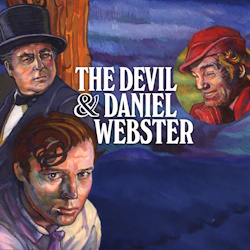
THE DEVIL AND DANIEL WEBSTER – Bernard Herrmann
 MOVIE MUSIC UK CLASSICS
Original Review by Craig Lysy
1941 would prove to be a banner year for Bernard Herrmann as he was honored with two Academy Award nominations. Having completed Citizen Kane, what many believe to be his Magnum Opus, RKO Studios tasked him with a new project The Devil and Daniel Webster for director William Dieterle. Note that the studio later changed the title to “All That Money Can Buy”. From both Herrmann’s and Dieterle’s perspectives, the collaboration was collegial, and in the end, The Devil and Daniel Webster triumphed over Citizen Kane, earning Herrmann his only Academy Award win. Herrmann’s entry into the realm of film score music atop two nominated scores and an Oscar win was an outstanding achievement. Herrmann would later relate that he believed Citizen Kane was a superior score in that it was more original and better integrated into the film’s narrative – your author agrees. Read more…

Shop at the Movie Music UK Store

Member of the

 MOVIE MUSIC UK