Archive
MIKLÓS RÓZSA – Fathers of Film Music, Part 6
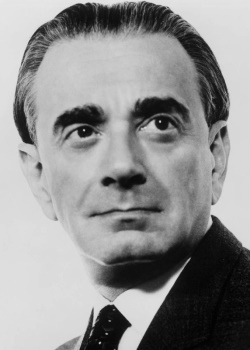 Article by Craig Lysy
Born: 18 April 1907, Budapest, Hungary.
Died: 27 July 1995
Miklós Rózsa was born to upper class parents who resided in Budapest during the waning years of the Austro-Hungarian Empire. His mother, Regina Berkovits, was an accomplished pianist who had studied with pupils of Franz Liszt, while his father, Gyula, was a prominent industrialist. Both had a love for classical music, traditional folk songs and instilled in Miklós a love of music. His maternal uncle Lajos Berkovits, an accomplished violinist with the Budapest Opera, presented him with his first instrument, a violin at the age of five. Rózsa began formal study under Lajos Berkovits (a pupil of Hubay), which also included training with both the viola and piano. By age eight he was already composing original works and performing in public, which included a movement from a Mozart violin concerto where he dressed as Mozart, and also as conductor of a children’s orchestra where he turned in a splendid performance of Haydn’s Toy Symphony. Read more…
PROVIDENCE – Miklós Rózsa
 MOVIE MUSIC UK CLASSICS
Original Review by Craig Lysy
Providence served as the first English-language film from renowned French director Alain Resnais. True to form Resnais provides us with a drama about an unsympathetic, spiteful, alcoholic novelist, which again features his trademark playful surrealist touches and recurring use of characters shackled by recurrent memories. The story reveals Clive Langham (Sir John Gielgud) spending a painful night in his bed suffering from age ending health problems, vainly trying to create a final story based on his family played by Ellen Burstyn (Sonia), Dirk Bogarde (Claude) and David Warner (Kevin). He is an incredibly bitter man, drunken and tormented, who reveals through a series of flashbacks an unsympathetic, spiteful, conniving family. Clive makes each of his family members interact in a variety of bizarre settings – courtrooms, mortuaries and werewolf-haunted forests. It is apparent that his perceptions are distorted by a terrible bitterness and guilt, the full extent of this is not made clear until the end, when his “real” family members come to his house to celebrate his 78th birthday. The film was both a commercial and a critical success, earning the 1978 César Award for Best Film. Read more…
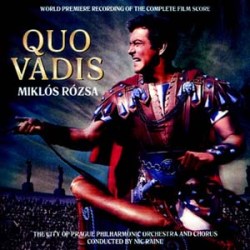
QUO VADIS – Miklós Rózsa
 GREATEST SCORES OF THE TWENTIETH CENTURY
Original Review by Craig Lysy
Producer Sam Zimbalist and director Mervyn LeRoy saw an opportunity to create a grand epic by adapting Henryk Sienkiewicz’s 1896 novel Quo Vadis. They hired a fine cast, which included Robert Taylor (Marcus Vinicius), Deborah Kerr (Lygia), Peter Ustinov (Nero) and Leo Glenn (Petronius). Set in imperial Rome during the reign of the maniacal emperor Nero (54 – 68 C.E.) we see a love story unfold between the pagan Marcus and the Christian Lygia. Our lovers are caught in the tide of history as an increasingly mad Nero terrorizes his court and ultimately sets Rome aflame in a stunning horrific conflagration. To cover his guilt Nero falsely blames the Christians and unleashes a reign of terror with gruesome executions in the Coliseum. Through their ensuing travails, Marcus converts and our lovers manage an escape to Sicily as an avenging mob, now aware that Nero burned Rome, storms the palace and brings Nero to a well-deserved end. The film was both a commercial and critical success, earning eight Academy Award nominations. Read more…
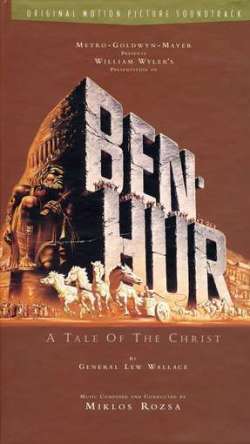
BEN-HUR – Miklós Rózsa
 MOVIE MUSIC UK CLASSICS
Original Review by Craig Lysy
This 1959 film version of General Lew Wallace’s best-selling novel achieved Oscar legend as it went on to win 11 Academy Awards including Best Score for Miklós Rózsa. The film tells the tale of Jewish prince Judah Ben-Hur, played in exemplary fashion by Charlton Heston, who lives in Judea with his family during the time of Jesus Christ circa 33 C.E. Judah’s childhood Roman friend Messala returns to Judea as an ambitious Tribune intent on achieving fame and his destiny at any cost. When Judah refuses to provide Messala with the names of local Jewish dissidents, an offended Messala contrives a pretext to exact a terrible revenge. Messala orders the arrest of Judah and his family on patently false charges. Judah is then condemned to certain death on the Roman galleys, while his mother and sister are given life imprisonment.
Doomed to die chained to a galley oar, Judah’s hatred and the desire for vengeance fuels his will to live. Soon the hand of fate intervenes and he gains his freedom. Empowered with the help of a Roman General and a wealthy Arab sponsor he returns to Judea and challenges Messala to a chariot race. In an epic struggle Judah emerges triumphant while Messala lays defeated on the track, his body mangled irreparably by horses that trampled him. Meeting for a last time as surgeons wait to amputate Messala’s legs, Judah realizes the hollowness of his victory, of how unquenching it is to drink from the cup of revenge. He leaves Messala to death and rescues his family from a leper colony. Later he sees them cured as the pounding rains born of the crucifixion storm cleanses the sores from their bodies. Read more…
Remembering Miklós Rózsa, 1907-1995
Composer Miklós Rózsa died ten years ago today, on July 27, 1995, at his home in Los Angeles, California, due to complications from a series of strokes. He was 88.
Born in Budapest in April 1907, Rózsa was a child prodigy who studied violin and composition from an early age. He completed his formal training in Leipzig, Germany, and initially made his name as a composer of concert music. In the 1930s he moved to Paris, and later London, having been encouraged by his friend, Swiss composer Arthur Honegger, to supplement his income writing music for cinema. His entry into film scoring came with Knight Without Armour (1937), produced by his fellow Hungarian Alexander Korda, and his success in British cinema led to a contract with MGM and a move to Hollywood in 1940.
Rózsa quickly distinguished himself in America with powerful, emotionally charged scores for films such as The Thief of Bagdad (1940), Lydia (1940), Sundown (1941), That Hamilton Woman (1941), Jungle Book (1942), Double Indemnity (1944), and Spellbound (1945), the latter of which earned him the the first of his three Oscar wins for Best Original Score. He was acclaimed for his ability to seamlessly blend traditional symphonic writing with dramatic storytelling, and often conducted extensive historical and ethnomusicological research to bring authenticity to his scores, resulting in a style that helped define the sound of Hollywood’s Golden Age.
He won his second Oscar for A Double Life (1947), and then a third for Ben-Hur (1959), which at time was heralded as one of the most ambitious film scores ever written, and which subsequently became a benchmark of epic film music. His other acclaimed and popular scores included such titles as The Lost Weekend (1945), The Killers (1946), The Red Danube (1949), Quo Vadis (1951), Ivanhoe (1952), Julius Caesar (1953), Knights of the Round Table (1953), Young Bess (1953), Valley of the Kings (1954), Lust for Life (1956), El Cid (1961), King of Kings (1961), Sodom and Gomorrah (1963), and The Golden Voyage of Sinbad (1974). Read more…

Shop at the Movie Music UK Store

Member of the

 MOVIE MUSIC UK