Archive
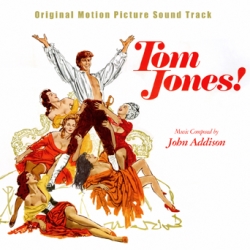
TOM JONES – John Addison
 GREATEST SCORES OF THE TWENTIETH CENTURY
Original Review by Craig Lysy
Producer and director Tony Richardson drew inspiration from an 18th century English novel “A History of Tom Jones, a Foundling”, by Henry Fielding. He hired John Osborne to adapt it to the big screen and cast the film audaciously, selecting rising star Albert Finney for the titular role. Rounding out the cast was Susannah York (Sophie Western), Edith Evans (Miss Western), Joan Greenwood (Lady Ballaston), Hugh Griffith (Squire Western) and making his film debut, David Warner as the villain Blifil. The story offers a classic period piece full of drama, treachery, seduction and intrigue. Squire Allworthy discovers an infant on his bed and chooses to raise little Tom Jones as if he were his own son. Tom’s grows up to become an attractive, dashing, and very popular young man with the ladies, It comes to pass that he falls madly in love with Sophie, who returns his affections. Yet there is an insurmountable impediment – Tom is stigmatized as a bastard, and Sophie’s father forbids her to wed a man below her station. Blifil who seeks Allworthy’s estate engineers Tom’s dishonor and dismissal by Squire Allworthy. An irrepressible Tom however is not to be denied, and he travels far and wide, all the time enjoying a multiplicity of women, fine food and drink along the way! As fate would have it he ultimately triumphs, overcoming all obstacles set against him, and earns Sophie’s hand in marriage when his true identity as Bridget’s Allworthy’s illegitimate son and Allworthy’s nephew is finally revealed. The film was both a commercial and critical success, earning an amazing ten Academy Award nominations, winning four, for Best Picture, Best Director, Best Screenplay and Best Score. Read more…
John Addison, 1920-1998
 Composer John Addison died on December 7, 1998, at his home in Bennington, Vermont, after a short illness. He was 78.
John Mervyn Addison was born in Chobham, Surrey, England, in March 1920, and studied composition at the Royal College of Music. His education was interrupted by service in World War II, where he served with distinction in the British Army, seeing action in Normandy and the Netherlands, and participating in Operation Market Garden. The experience would later inform one of his best-known works: the rousing score to A Bridge Too Far (1977), a film about the Allied operation that Addison survived.
Addison’s breakthrough in film came in 1950 with the British thriller Seven Days to Noon, and over the course of the subsequent decade he wrote scores for popular British films such as The Man Between (1953), The Cockleshell Heroes (1955), Reach for the Sky (1956), Three Men in a Boat (1956), Lucky Jim (1957), A Taste of Honey (1961), and The Loneliness of the Long Distance Runner (1962).
It was Addison’s sparkling, Oscar-winning score for Tony Richardson’s Tom Jones in 1963 that brought him international recognition. The music’s vivacious period stylings, full of energy and wit, became a defining element of the film’s success. Following his Oscar win Addison split his time between the UK and Hollywood, and in the years thereafter he composed scores for films such as Smashing Time (1967), The Honey Pot (1967), The Charge of the Light Brigade (1968), Sleuth (1972, his second Oscar nomination), Swashbuckler (1976), and The Seven-Per-Cent Solution (1976), earning both critical acclaim and popular success. Notably, Addison also composed the replacement score for Alfred Hitchcock’s film Torn Curtain in 1966, which is now remembered as the film which ended Hitchcock’s relationship with Bernard Herrmann. Read more…

Shop at the Movie Music UK Store

Member of the

 MOVIE MUSIC UK