Archive
LEGENDS OF THE FALL – James Horner
 GREATEST SCORES OF THE TWENTIETH CENTURY
Original Review by Craig Lysy
Having just finished the comedy Leaving Normal, director Edward Zwick decided to change direction and film an epic historical drama, which showcased the talent of rising star Brad Pitt as a romantic leading man. To that end he found the perfect vehicle in the 1978 novella Legends of the Fall by Jim Harrison. His production company Bedford Falls purchased the film rights with TriStar Pictures agreeing to distribute. Zwick, William Wittliff and Marshal Herskovist would produce the film, with Zwick directing. He hired screenwriters Susan Shilliday and William D. Wittliff to adapt the story for the big screen and brought in an outstanding cast, which included Brad Pitt as Tristan Ludlow, Anthony Hopkins as Colonel William Ludlow, Aiden Quinn as Alfred Ludlow, Henry Thomas as Samuel Ludlow, and Juilia Ormond as Susannah Fincannon. The film is set in the territory of Montana circa 1890 when Colonel William Ludlow resigns his commission, loathe to continue his part in the army’s cruel betrayal and slaughter of native Americans. He settles on a ranch in a remote part of Montana where he and his wife Isabel live a tranquil existence in peace. Isabel bears him three sons – Tristan, Alfred, and Samuel – but ends up leaving him as she is unable to bear the isolation and long harsh winters, which forces William to raise the boys himself. Almost 20 years later, the the now-grown Samuel returns home to the ranch with his fiancé Susannah, but this is a harbinger of sorrow as it precipitates a series of tragic events which fracture the family and set brother against brother as they compete for her affections. Read more…
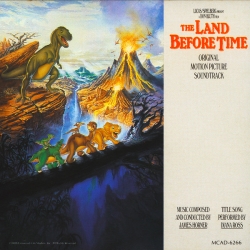
THE LAND BEFORE TIME – James Horner
 THROWBACK THIRTY
GREATEST SCORES OF THE TWENTIETH CENTURY
Original Review by Jonathan Broxton
The Land Before Time is an animated feature film for children, directed by Don Bluth and produced by Steven Spielberg and George Lucas. It’s set in the late cretaceous period, and follows the adventures of a group of orphaned dinosaurs searching for a fabled oasis where there is food, water, and safety. The main character is Littlefoot, a young Apatosaurus, who along with his friends – each of whom is a different species, such as a triceratops or a pteranodon – find themselves having to escape from numerous dangers, not least of which is a deadly ‘sharptooth’ Tyrannosaurus Rex that is hunting them. The film was incredibly popular at the time, and it works on multiple levels. Firstly, it is a fun story for children, with playful characters and a friendly cartoonish animation style. However, it also has some deeper meaning, addressing issues of racism (some of the adult dinosaurs are prejudiced against different species), climate change (the dinosaurs don’t know it, but they are living through a famine that heralds the beginning of their extinction event), friendship, and family. There is also some surprisingly dark material too, including some quite intense and frightening sequences involving the Tyrannosaurus, as well as character deaths which left real emotional scars on an entire generation of kids. Amazingly, the film spawned an incredible thirteen direct-to-video sequels and even a TV series, although none of them reached the level of acclaim the original had. Read more…
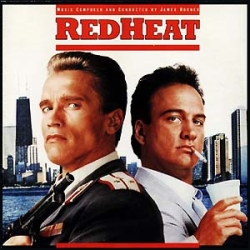
RED HEAT – James Horner
 THROWBACK THIRTY
Original Review by Jonathan Broxton
The action comedy buddy-cop movie reached new heights in the summer of 1988 with the release of Red Heat, which was a vehicle for the increasing box office power of action star Arnold Schwarzenegger. In this film directed by Walter Hill, Schwarzenegger plays Ivan Danko, a captain in the Moscow police, whose partner is killed by drug dealer and crime boss Rostavili (Ed O’Ross). Rostavili flees to the United States and disappears into the Chicago underworld; he is arrested by local cop Art Ridzik (Jim Belushi) in connection with several murders, and Danko arrives from Moscow to oversee his extradition back to the Soviet Union. However, when Rostavili escapes again, Danko and Ridzik are paired with each other as partners and tasked with catching him again and bringing him to justice. In addition to the usual fight scenes where Schwarzenegger was able to show off his impressive physique, Red Heat was interesting because of its Cold War overtones. In 1988 the Berlin Wall was still up, the Soviet Union was still a world superpower, and the idea of pairing a traditional wise-cracking donut-munching beat cop with a stoic, by-the-book Soviet detective allowed the filmmakers to use them as a microcosm to explore the political tensions of the era, as well as to inject some fish-out-of-water social commentary as Danko observes and criticizes American consumerism and decadence from a communist point of view. Read more…
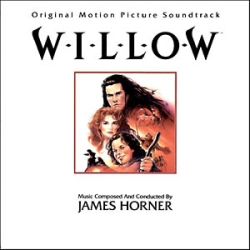
WILLOW – James Horner
 THROWBACK THIRTY
GREATEST SCORES OF THE TWENTIETH CENTURY
Original Review by Jonathan Broxton
Willow is a high fantasy film, which takes well-loved genre tropes from Lord of the Rings and elsewhere, and casts them in an adventure filled with magic, monsters, evil queens, beautiful princesses, soaring romance, daring sword fights, and much much more. Written by Bob Dolman from a story by George Lucas, and directed by Ron Howard, Willow is the story of a newborn baby prophesized to bring about the downfall of the evil witch Queen Bavmorda; to prevent the prophecy from coming to pass Bavmorda imprisons all expectant mothers, but after it is born, the baby is smuggled out of Bavmorda’s castle by a midwife, and eventually finds its way into the hands of Willow Ufgood, a Nelwyn (dwarf) farmer and aspiring magician. Determined to protect the baby, Willow journeys far from his home, and eventually finds himself in the company of a roguish swordfighter named Madmartigan, the good witch Fin Raziel, and a pair of mischievous woodland sprites. As the story progresses they all become involved in a large scale war between Bavmorda’s army and those who oppose her, while Bavmorda’s daughter Sorsha and the fearsome General Kael continue to hunt for the baby. The film stars Warwick Davis, Val Kilmer, Joanne Whalley, and Jean Marsh, and has a spectacular original score by James Horner. Read more…
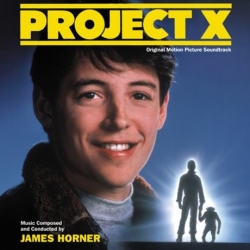
PROJECT X – James Horner
 THROWBACK THIRTY
Original Review by Jonathan Broxton
Project X was a genre-defying film – part action, part sci-fi, part-comedy, part drama – directed by Jonathan Kaplan from a screenplay by Lawrence Lasker and Stanley Weiser. Matthew Broderick starred as young US Air Force researcher Jimmy Garrett, who is assigned to a top secret project that involves teaching chimpanzees to fly planes. He bonds with one of the chimps, Virgil, after he discovers that it was taught sign language by its previous owner, graduate student Teri MacDonald (Helen Hunt). When Jimmy realizes that Virgil, along with all the other chimps, is supposed to die as part of the project’s research into the effects of radiation poisoning, he finds and contacts Teri; appalled by what the government is going to do to the animals, they agree to work together to rescue Virgil, and stop the project. The film co-stars William Sadler, Jonathan Stark, Stephen Lang, and Jean Smart, and was well received by critics at the time, who praised it as a ‘young person’s morality tale’ that tackles the important subject of animal welfare. Read more…
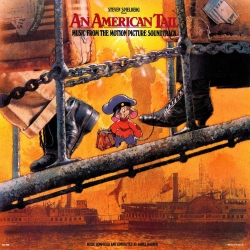
AN AMERICAN TAIL – James Horner
 THROWBACK THIRTY
Original Review by Jonathan Broxton
In the wake of the success of The Secret of NIMH in 1982, master animator Don Bluth began a collaboration with Steven Spielberg and Universal Pictures, who wanted to capitalize on NIMH’s popularity and produce their own animated film, the studio’s first since 1965. The result was An American Tail, the story of a family of Russian-Jewish mice who emigrate to the United States in the late 1800s, having been lured there on the promise of there being ‘no cats in America’. During their ocean crossing the family’s youngest son, Fievel Mousekewitz, is swept overboard and feared drowned; upon their arrival in New York, the remaining Mousekewitzes resign themselves to having lost their son, and sadly begin their new lives. However, Fievel has miraculously survived and makes his way to New York on his own, and the plucky young rodent embarks on a quest to reunite with his family, engaging in numerous adventures on the way. The film features the voices of Nehemiah Persoff, Erica Yohn, Dom DeLuise, Christopher Plummer, and the then-8-year-old Phillip Glasser as Fievel; it was a huge success at the box office, especially with children, who loved the film despite its dark tone. Read more…
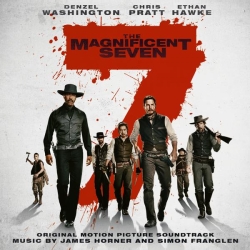
THE MAGNIFICENT SEVEN – James Horner, Simon Franglen
 Original Review by Jonathan Broxton
The death of James Horner in June 2015, in a plane crash at the age of 61, was one of the most shocking events to hit the film music community in many, many years. It wasn’t just the fact that Horner was seemingly on the verge of a comeback, having written several classical pieces and new scores in the preceding year, and having signed to write several new works (Mel Gibson’s Hacksaw Ridge, Zhang Yimou’s The Great Wall, and several Avatar sequels among them); it was the suddenness, the randomness of it all, coming completely out of the blue with no time to prepare for a film music world without him. At the time, once the immediate grief and concern for his family had been addressed, thoughts naturally turned to his musical legacy, and all the great music he was yet to write, and which we would now never get to hear. As it turns out, Horner had one last gift to share – the score for director Antoine Fuqua’s remake of the great western The Magnificent Seven, starring Denzel Washington, Chris Pratt, and Ethan Hawke as three members of a gang of gun-slinging heroes who team up to protect a town from ruthless industrialist Peter Sarsgaard, who is forcibly removing the inhabitants of a small Old West community for his own nefarious purposes. Read more…
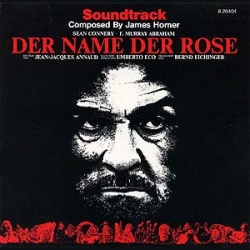
THE NAME OF THE ROSE – James Horner
 THROWBACK THIRTY
Original Review by Jonathan Broxton
The Name of the Rose is a murder mystery with a difference. Directed by Jean-Jacques Annaud, and adapted from the enormously popular 1980 novel by Umberto Eco, it stars Sean Connery as William, a 14th century monk who journeys to a Benedictine monastery in northern Italy to attend a religious conference with other scholars. However, the conference is disturbed by several unexplained deaths, and the monastery’s abbot (Michael Lonsdale) assigns William to investigate them. With the help of his young student Adso (Christian Slater), William quickly uncovers a hotbed of secrets, hidden desires, and political and religious skullduggery among the monks, leading to more murders as the perpetrator seeks to maintain hidden. The film, which co-stars F. Murray Abraham, Helmut Qualtinger, Feodor Chaliapin, and Ron Perlman, was unfortunately not a successful one in financial terms, but it has gone on to be something of a cult film in some circles, with critics likening Connery to a medieval Sherlock Holmes who uses ingenuity and intellect to uncover the truth, in stark comparison to Abraham’s fiery and superstitious bishop, who as a member of the Spanish inquisition sees witchcraft and devilishness under around every corner. Read more…
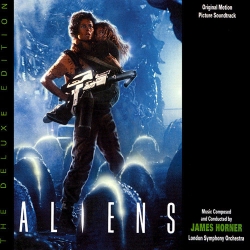
ALIENS – James Horner
 THROWBACK THIRTY
GREATEST SCORES OF THE TWENTIETH CENTURY
Original Review by Jonathan Broxton
Ridley Scott’s 1979 sci-fi horror masterpiece Alien was a watershed landmark, a seminal film that forever changed the genre, so it was something of a surprise that a sequel was not forthcoming straight away. With behind-the-scenes wrangling between executives at 20th Century Fox, and a script that languished in development hell, it actually took almost seven years for Aliens to hit the big screen, but with hindsight it was more than worth the wait. For me, Aliens is one of the greatest action films ever made; a blockbuster war movie allegory about the Vietnam War, inspired by several seminal works in classic sci-fi literature, written and directed by the young and hungry auteur behind the 1984 hit The Terminator. In James Cameron’s capable hands, Aliens became a masterpiece of tension and horror, pulsating adventure, and noble sacrifice. Read more…
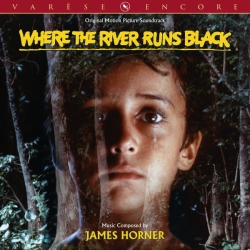
WHERE THE RIVER RUNS BLACK – James Horner
 THROWBACK THIRTY
Original Review by Jonathan Broxton
In 1986, despite having achieved a great deal of popularity and success for his large scale orchestral scores, James Horner entered what many call his ‘experimental synth’ phase, such was the film music zeitgeist at the time. It lasted several years, in parallel with many of his more traditional symphonic works, and encompassed such scores as The Name of the Rose, Red Heat, Vibes, My Heroes Have Always Been Cowboys, and Thunderheart, but appears to have begun in earnest with this one: a little-known drama called Where the River Runs Black. The film was directed by Christopher Cain (father of TV Superman Dean Cain), and tells the story of a young orphan boy named Lazaro, who grows up feral in the Amazon jungle, but is eventually found and sent to live at a Catholic mission with a kind priest, Father O’Reilly, played by Charles Durning. O’Reilly cares for the boy, and teaches him to speak, and for a while it seems as though Lazaro’s life is settled; however, through a set of coincidental circumstances, Lazaro meets a local businessman and recognizes him as the man who murdered his mother when he was just six years old. Read more…
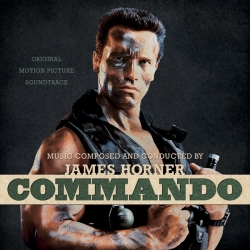
COMMANDO – James Horner
 THROWBACK THIRTY
Original Review by Jonathan Broxton
Arnold Schwarzenegger and Sylvester Stallone were cinematic rivals throughout the 1980s, going toe-to-toe through a series of increasingly spectacular action movies, as they tried to out-shoot, out-fight, and out-muscle each other to the top of the box office charts. 1985 was arguably the year their battle commenced, as it saw the release of Stallone’s Rambo: First Blood Part II, and Schwarzenegger’s Commando, the first movie in which the Austrian Oak starred as a contemporary human being, after playing a fantasy warrior in the Conan series, and an unstoppable cyborg in The Terminator. Directed by journeyman Mark L. Lester, Commando saw Schwarzenegger playing John Matrix, a retired elite Black Ops commando who is forced back into action when Arius, the exiled South American dictator he helped depose, kidnaps his daughter, intending to blackmail Matrix into restoring Arius to power. The film, which also starred Rae Dawn Chong, Dan Hedaya, Vernon Wells, and an 8-year-old Alyssa Milano, was critically lambasted, but was a commercial success, and helped initiate Schwarzenegger’s career as a heroic leading man. Read more…
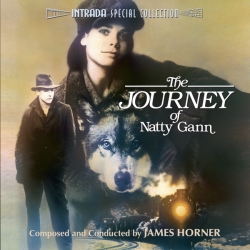
THE JOURNEY OF NATTY GANN – James Horner
 THROWBACK THIRTY
Original Review by Jonathan Broxton
Following his breakout year in 1982, when he wrote music for the box-office smashes Star Trek II and 48 HRS., James Horner spent the next several years solidly entrenched as one of the newest, most exciting young members of the Hollywood studio system, scoring several successful and popular features. After he proved his reliability when asked to replace Georges Delerue on Something Wicked This Way Comes in 1983, the executives at Walt Disney turned to Horner again in the fall of 1985, when they asked him to write a last-minute replacement for Elmer Bernstein’ score for the film The Journey of Natty Gann. Directed by Jeremy Kagan from an original screenplay by Jeanne Rosenberg, and set during the darkest days of the Great Depression in 1935, the film starred 12-year old Meredith Salenger as the eponymous Natty, a tomboy who sets off on a cross-country trek to find her father Sol (Ray Wise) after he leaves their Pacific Northwest home for Chicago in a desperate attempt to find work. En route she is befriended by a wolf, who travels with and protects her for much of her voyage, and even has a brief, innocent romance with another young traveler named Harry, played by a young John Cusack. Read more…
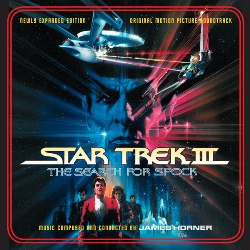
STAR TREK III: THE SEARCH FOR SPOCK – James Horner
 MOVIE MUSIC UK CLASSICS
Original Review by Craig Lysy
Star Trek II: The Wrath of Khan achieved tremendous critical and commercial success, and so Paramount quickly authorized the making of a third film. However, director Nicholas Meyer refused to return in protest over changes made to the prior film’s ending without his consent. When Nimoy was asked to reprise the role of Spock, he said yes, with the caveat that he wanted to direct the film. The studio hesitated, but ultimately agreed, and Harve Bennett was again hired to produce and write the script. The original crew ensemble returned including; William Shatner as Captain Kirk, Leonard Nimoy as Spock, DeForest Kelly as Dr. McCoy, James Doohan as Scott, George Takei as Sulu, Walter Koenig as Chekov and Nichelle Nichols as Uhura. Joining the cast was Christopher Llyod as the villain Captain Kruge, Robin Curtis replacing Kirstie Alley as Lieutenant Saavik, Mark Lenard as Sarek, Merritt Buttrick as Dr. David Marcus, and the renowned Dame Judith Anderson as the Vulcan high priestess T’Lar. Nimoy wanted the film to be operatic with a transpersonal exploration of the themes of life, death and rebirth. Yet he also wanted to explore on a more personal level, the deeper meaning of friendship. Nimoy relates: “What should a person do to help a friend? How deeply should a friendship commitment go? And what sacrifices, what obstacles, will these people endure?” Read more…
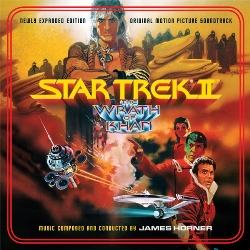
STAR TREK II: THE WRATH OF KHAN – James Horner
 GREATEST SCORES OF THE TWENTIETH CENTURY
Original Review by Craig Lysy
James Horner won my heart in 1982 with his score to Star Trek II: The Wrath of Khan and he quickly became my favorite composer. His tragic and untimely death was personally devastating to me and I to this day continue to mourn his passing. I realized that I was about to reach a milestone, my 100th review, and thought what could be more fitting than to use this special occasion to celebrate his legacy with a heart-felt homage to one of his greatest scores.
Although disappointed by the lukewarm reception of Star Trek: The Motion Picture in 1979, Paramount was committed to continuing with its enormous investment in resurrecting the franchise, albeit with different leadership. Gene Roddenberry was assigned blame for the lethargic and plodding Star Trek: The Motion Picture and ‘promoted’ to executive consultant. Harve Bennett was given creative control and tasked with writing a better and more memorable story, which recaptured the spirit of the TV series. Bennett quickly realized that he faced a serious challenge in developing the new Star Trek movie, as remarkably, he was unfamiliar with its history, having never seen the television show! He studiously watched all the episodes, and had an epiphany after viewing “Space Seed”. He correctly reasoned that what was needed to make Star Trek successful again, was a villain worthy to serve as Kirk’s foil. The fierce and indomitable Khan Noonian Singh fully embodied the coveted perfect adversary for the film. Read more…
COCOON – James Horner
 THROWBACK THIRTY
GREATEST SCORES OF THE TWENTIETH CENTURY
Original Review by Jonathan Broxton
Cocoon was one of the major box-office successes of 1985, a winning combination of science fiction adventure and family drama directed by Ron Howard. The film stars Don Ameche, Wilford Brimley and Hume Cronyn as three old-timers living in a retirement community in Florida; part of their daily routine is to sneak into an unoccupied house next door and swim in its swimming pool. One day they find a number of strange, rock-like objects at the bottom of the water, but after checking them out, decide to swim there anyway; following their swim, the three geezers suddenly find themselves rejuvenated with a vigorous, youthful energy, and they share their discovery with their respective wives and lady friends, played by Gwen Verdon, Maureen Stapleton, and Jessica Tandy. However, much to the shock of the senior citizens, the ‘rocks in the pool’ turn out to be cocoons containing dozens of sick aliens, left behind by friendly extra-terrestrials centuries ago, and which were about to be returned to their home planet by their leader, Brian Dennehy, with the help of a local ship captain, played by Steve Guttenberg – until the pool was drained of its life force by the old folks. As such, the sextet of retirees must work with the aliens to help them find a way home, without revealing the secret of the pool. The film earned two Academy Awards – one for Best Supporting Actor for Don Ameche, and one for Best Visual Effects – and boasted a magnificent score by the then 32-year-old James Horner. Read more…

Shop at the Movie Music UK Store

Member of the

 MOVIE MUSIC UK