Archive
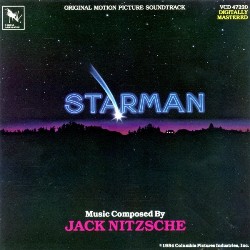
STARMAN – Jack Nitzsche
 THROWBACK THIRTY
Original Review by Jonathan Broxton
Starman is a science fiction romance movie, directed by John Carpenter at the height of his studio powers, from a screenplay by Bruce A. Evans and Raynold Gideon, who would later collaborate on the classic coming-of-age drama Stand By Me. The film stars Jeff Bridges as an alien who, in response to the message of peace from the Voyager II probe, is sent to Earth on a scouting mission prior to a planned ‘first contact’ meeting between humanity and the rest of his species. Unfortunately, the alien’s craft is shot down by the military and it crash lands in rural Wisconsin, next to a farm owned by the recently-widowed Jenny Hayden (Karen Allen). The alien takes the form of Jenny’s late husband, and convinces her to drive him to Arizona to rendezvous with his mothership; on the journey, Jenny and the alien bond, initially due to his physical resemblance to her husband, but later due to the alien’s child-like curiosity regarding Earth, and his genuine goodness and compassion. Unfortunately, the US government – personified by NSA colonel Fox (Richard Jaeckel) and a compassionate scientist named Shermin (Charles Martin Smith) – has found out about the alien, and wants to capture him for their own ends. Read more…
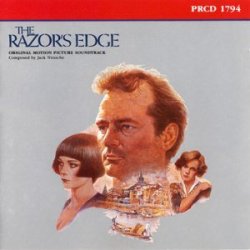
THE RAZOR’S EDGE – Jack Nitzsche
 THROWBACK THIRTY
Original Review by Jonathan Broxton
The Razor’s Edge is an epic poetic drama film, written and directed by John Byrum, adapted from the acclaimed 1944 novel by W. Somerset Maugham. It tells the story of Larry Darrell, played by Bill Murray, an American pilot traumatized by his experiences in World War I, who journeys through Asia in search of some transcendent meaning in his life after the war has ended. The film was the first dramatic leading role of Murray’s career, who prior to this was known almost exclusively as a comedic actor, through his work on Saturday Night Live, and films such as Caddyshack and Stripes. Murray and director Byrum had trouble finding a studio to finance it, such was the incredulity that Murray could pull off such a demanding dramatic leading role, and the film was only put into production when Dan Aykroyd suggested a deal to Columbia Pictures whereby Murray would appear in Ghostbusters if the studio subsequently greenlit The Razor’s Edge. However, despite the presence of such luminaries as Theresa Russell, Denholm Elliott and Peter Vaughan in the supporting cast, and unlike Ghostbusters, The Razor’s Edge was a critical and commercial flop, taking just $6.5 million at the US box office in 1984. Apparently, Columbia was right, and audiences didn’t buy Murray as a tortured, sensitive man undergoing an existential crisis. Read more…
Jack Nitzsche, 1937-2000
 Composer Jack Nitzsche died on August 25, 2000, in hospital on Los Angeles, of cardiac arrest brought on by a recurring bronchial infection. He was 63.
Bernard Alfred Nitzsche was born in Chicago, Illinois, in April 1937, the son of German immigrants, and raised on farm in Michigan. He moved to Los Angeles in the late 1950s with aspirations of becoming a jazz saxophonist, but soon found his calling in arranging and studio work. He initially worked for Sonny Bono, but later found his niche working as an arranger for producer Phil Spector. He played a pivotal role in shaping Spector’s the “Wall of Sound,” and was an important contributor to legendary recordings by pop and rock artists including The Ronettes, The Righteous Brothers, Jackie De Shannon (‘Needles and Pins’), and Ike and Tina Turner (‘River Deep Mountain High’).
Later, in the 1960s and ’70s, he collaborated with a wide array of artists, including The Rolling Stones – contributing keyboards and orchestration on several albums, especially songs such as ‘Paint It, Black’ and ‘You Can’t Always Get What You Want’ – and Neil Young, with whom he had a long and occasionally volatile creative partnership.
Nitzsche’s film work was equally distinguished. His first important score was for the 1970 thriller Performance starring Mick Jagger, and he provided ‘uncredited contributions’ to the soundtrack for The Exorcist in 1973. He received his first Oscar nomination for One Flew Over the Cuckoo’s Nest in 1975, and he won an Oscar for the song “Up Where We Belong” from An Officer and a Gentleman in 1982, which he co-wrote with Buffy Sainte-Marie and Will Jennings.
His other important scores include Cruising (1980), Starman (1984), The Razor’s Edge (1984), The Jewel of the Nile (1985), 9½ Weeks (1986), Stand By Me (1986), Revenge (1990), Mermaids (1990), and Blue Sky (1994). His last major score was the for the Sean Penn-director drama The Crossing Guard in 1995; he suffered a stroke in 1998 which ended his scoring career. Read more…

Shop at the Movie Music UK Store

Member of the

 MOVIE MUSIC UK