Archive
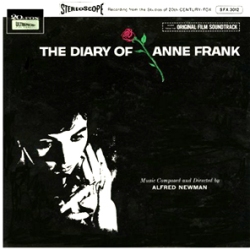
THE DIARY OF ANNE FRANK – Alfred Newman
 GREATEST SCORES OF THE TWENTIETH CENTURY
Original Review by Craig Lysy
Francis Goodrich and Albert Kackett successfully adapted the novel Anne Frank: The Diary of a Young Girl for the Broadway stage. When it secured both a Tony award and a Pulitzer prize Warner Brothers bought the film rights and hired George Stevens to produce and direct a film adaptation. Unknown Millie Perkins was hired for the title role and was supported by Otto Schilkraut (her father Otto), Gusti Huber (her mother Edith), Richard Beymer (her boyfriend Peter Van Daan) and Shelly Winters (Petronella Van Daan). The story is set in Nazi occupied Holland where Otto Frank and his family have decided to go into hiding, because of the increasing persecutions against Jews. A sympathetic local businessman Kraler and his assistant Miep prepare a hiding place in the rooms above their place of business, and arrange for the Franks and another family, the Van Daans, to stay there. Later on, they are joined by the dentist Dussel. Together, living in isolation, they try to avoid detection while praying for Holland to be liberated by the Allies. This poignant story explores the life of persecuted people living in constant fear as seen through the eyes of Anne. The film was a stunning commercial success and won critical acclaim, securing eight Academy nominations including best score for Alfred Newman, who lost to Rozsa’s magnificent effort Ben-Hur: A Tale of the Christ. Read more…
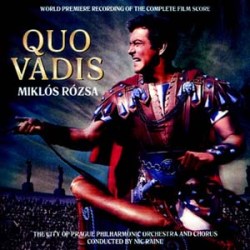
QUO VADIS – Miklós Rózsa
 GREATEST SCORES OF THE TWENTIETH CENTURY
Original Review by Craig Lysy
Producer Sam Zimbalist and director Mervyn LeRoy saw an opportunity to create a grand epic by adapting Henryk Sienkiewicz’s 1896 novel Quo Vadis. They hired a fine cast, which included Robert Taylor (Marcus Vinicius), Deborah Kerr (Lygia), Peter Ustinov (Nero) and Leo Glenn (Petronius). Set in imperial Rome during the reign of the maniacal emperor Nero (54 – 68 C.E.) we see a love story unfold between the pagan Marcus and the Christian Lygia. Our lovers are caught in the tide of history as an increasingly mad Nero terrorizes his court and ultimately sets Rome aflame in a stunning horrific conflagration. To cover his guilt Nero falsely blames the Christians and unleashes a reign of terror with gruesome executions in the Coliseum. Through their ensuing travails, Marcus converts and our lovers manage an escape to Sicily as an avenging mob, now aware that Nero burned Rome, storms the palace and brings Nero to a well-deserved end. The film was both a commercial and critical success, earning eight Academy Award nominations. Read more…
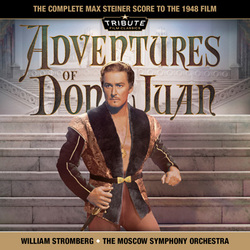
THE ADVENTURES OF DON JUAN – Max Steiner
 GREATEST SCORES OF THE TWENTIETH CENTURY
Original Review by Craig Lysy
Warner Brothers had long been attracted to the idea of filming a tale of the legendary lover Don Juan. After six years and countless revisions, screenwriter George Oppenheimer finally completed a script that satisfied Warner Brothers executives. Director Vincent Sherman was able to secure a fine cast that included the mercurial Errol Flynn (Don Juan de Maraña), Viveca Lindfors (Queen Margaret), Alan Hale (Leporello) and Robert Douglas (Duke de Lorca). The story concerns Don Juan de Maraña, Spain’s ambassador to the English court, who has damaged the prestige of the Spanish King with his blatant and insatiable womanizing. Discredited in diplomatic circles, Don Juan attempts to restore his standing after he meets the beautiful Queen Margaret, with whom he falls in love for the first time of his life. Although Margaret is trapped in a loveless marriage with King Philip III, she strives to resist Don Juan’s alluring and seductive advances. In a bold move to restore his honor Don Juan uncovers a plot by the King’s ruthless minister Duke de Lorca, to usurp the King’s authority. Regretfully he is outmaneuvered after De Lorca intimidates the cowardly king into compliance and threatens to execute the Margaret. Yet all is not lost as Don Juan with the assistance of his servant Leporello, fencing master Don Serafino, and court jester Sebastian have the last word. In a series of fierce battles he saves the day with an epic final sword duel with Duke de Lorca. The film was a critical success earning two Oscars, but only a modest commercial success. Read more…
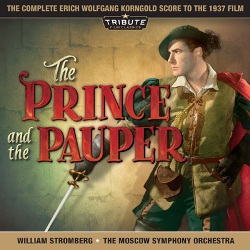
THE PRINCE AND THE PAUPER – Erich Wolfgang Korngold
 GREATEST SCORES OF THE TWENTIETH CENTURY
Original Review by Craig Lysy
The Prince and the Pauper was Mark Twain’s first effort to write a historical fiction novel. Director William Keighley had screenwriter Laird Doyle adapt the tale for film and hired swashbuckler star Errol Flynn (Miles Hendon) to head his cast, which included Claude Raines (Lord Hertford) and the twins Billy and Bobby Mauch. The story involves the birth of two boys who share both an uncommon resemblance and destiny: the pauper Tom and prince Edward. As a kid, Tom would often sneak into the palace garden and play with the prince. One day they change clothes with each other and are discovered by the guards, which eject the prince who they assumed, was a pauper. As the two boys struggle with their new lives, King Henry VIII dies leaving Tom under the malevolent control of Lord Hertford the duty of assuming the throne. With the assistance of mercenary Miles Hendon, Edward succeeds in interrupting the coronation and regaining his standing as rightful heir. The film did not achieve critical success but was never the less a commercial success. Read more…
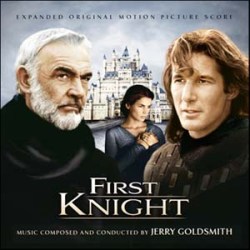
FIRST KNIGHT – Jerry Goldsmith
 GREATEST SCORES OF THE TWENTIETH CENTURY
Original Review by Craig Lysy
First Knight is a retelling of the classic legendary tale “The Knight of the Cart” first penned in the late 12th century by Chrétien de Troyes. Screenwriter William Nicholson stripped the tale of its magic and mythos of the Grail quest, instead focusing his lens on an intimate exploration of the passions, foibles and tragedy borne of intimate human relationships. Sean Connery succeeds in providing a sympathy and gravitas to the role of King Arthur with solid performances provided by Richard Gere as Lancelot, Julia Ormond as Guinevere and Ben Cross as the evil villain Malagant. The film was a critical failure but achieved commercial success taking in 134 million, more than sufficient to cover its 55 million production costs. Read more…
Movie Music UK presents the Greatest Scores of the Twentieth Century
 A new series by Craig Lysy
As part of Movie Music UK’s tradition of innovation, I have decided launch a new series charting the Greatest Scores of the Twentieth Century. I had always wanted to undertake this daunting challenge, and after 35 years of procrastination, finally summoned up the resolve and courage necessary to bring it to fruition. So, every Monday, over the course of the next several years, I will list my choices for the Greatest Scores of the Twentieth Century, initially in reverse chronological order, but thereafter with a little more leeway in terms of timing.
In regards to rankings, I was not successful after numerous attempts to listen them in order of merit. Ranking these scores would seem to be an exercise in futility, so instead, I have chosen with this series to take you on a journey through time. I will relate to you why I believe each score merits inclusion, and my hope is to provide an insightful and enjoyable journey.
I believe simplicity of criteria was needed to be successful. Firstly, the score must have achieved a masterful synergy with the story’s imagery, characters, setting and narrative, which served to elevate the film. Secondly, the score must have provided an exceptional and memorable listening experience within both film context and as a CD/MP3. Finally, the score must have made an indelible and lasting impression due to its creativity, innovation, sophistication, or thematic beauty.
I freely admit that this is but one man’s opinion, that I like everyone has certain biases, and that these manifest in my choices. But we must be authentic, and true to ourselves. So I offer my voice to the chorus of voices that have preceded me, and hope to achieve some degree of consonance.
All the best!

Shop at the Movie Music UK Store

Member of the

 MOVIE MUSIC UK