Archive
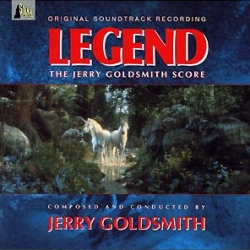
LEGEND – Jerry Goldsmith, Tangerine Dream
 THROWBACK THIRTY
GREATEST SCORES OF THE TWENTIETH CENTURY
Original Review by Jonathan Broxton
Capitalizing on the enormous commercial success of Alien in 1979, and the critical acclaim afforded to Blade Runner in 1982, director Ridley Scott left the world of hard science fiction for his next film, Legend, which instead embraced the mystical world of high fantasy. A sylvan story of elves and goblins, unicorns and fairies, princesses and demons, Legend was a hugely ambitious exploration of northern European folk tales and myths, woven together by screenwriter William Hjortsberg. The film starred Tom Cruise as Jack, a forest-dwelling young boy who is chastely in love with a young princess, Lili, played by Mia Sara. Together they explore their beautiful woodland home, but all is not well in the world; the Lord of Darkness (Tim Curry) has sensed the presence of two unicorns in the forest, and sent three of his goblin minions to kill them and steal their horns. Circumstances result in Lili inadvertently leading the goblins to the unicorns, and when their horns are stolen, the world is plunged into a dark, wintry nightmare from which there appears to be no return – but Jack has other ideas, and resolves to infiltrate the evil palace where Darkness resides and restore the world to its former glory. Read more…
Edgar Froese, 1944-2015
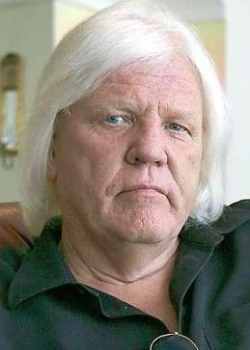 Composer, musician and electronic-music pioneer Edgar Froese died in Vienna, Austria, on January 20, 2015, at the age of 70, after suffering a pulmonary embolism.
As the founder and only constant member of Tangerine Dream, Froese helped transform the possibilities of synthesizer-based music and became an important figure in film scoring, contributing to more than 60 soundtracks including Sorcerer, Thief, Risky Business, Firestarter, Legend and Miracle Mile.
Edgar Willmar Froese was born in Tilsit, East Prussia, on June 6, 1944, and grew up in West Berlin. He studied painting and sculpture at the Academy of Arts while pursuing music, initially concentrating on guitar. After encounters with Salvador Dalí and the experimental culture of the late 1960s, Froese founded Tangerine Dream in Berlin in 1967 and increasingly turned toward synthesizers, tape manipulation and electronic sequencers.
Tangerine Dream’s international breakthrough came with Phaedra (1974), recorded by Froese, Christopher Franke and Peter Baumann. Its hypnotic sequencer patterns, vast electronic textures and slowly evolving melodies became a landmark of the so-called Berlin School of electronic music. Albums including Rubycon, Stratosfear and Force Majeure consolidated the group’s reputation and attracted the attention of director William Friedkin. Read more…

Shop at the Movie Music UK Store

Member of the


