Archive
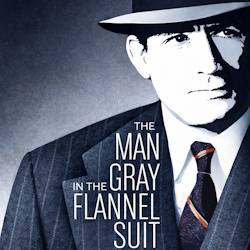
THE MAN IN THE GRAY FLANNEL SUIT – Bernard Herrmann
 GREATEST SCORES OF THE TWENTIETH CENTURY
Original Review by Craig Lysy
The best-selling 1955 novel “The Man in the Gray Flannel Suit” by Sloan Wilson caught the imagination of Nunnally Johnson, a producer, director, screenwriter, and playwright. He believed that its story of a man and wife struggling to find life meaning and purpose following WWII would resonate with the public. He sold his conception to Darryl F. Zanuck of 20th Century Fox, the film rights were purchased, and Zanuck would personally oversee production with a $2.6 million budget. Johnson would direct and also write the screenplay. A fine cast was hired, with Gregory Peck starring as Tom Rath. He would be joined by Jennifer Jones as Betsy Rath, and Fredric March as Ralph Hopkins. Read more…
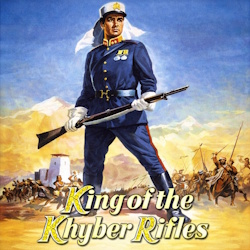
KING OF THE KHYBER RIFLES – Bernard Herrmann
 GREATEST SCORES OF THE TWENTIETH CENTURY
Original Review by Craig Lysy
In 1938 20th Century Fox decided to remake its 1929 film “The Black Watch,” which itself was adapted from the 1916 novel “King of the Khyber Rifles” by Talbot Mundy. However, the onset of WWII caused the studio to shelve the project until 1951 when it was selected to finally move into pre-production. Frank P. Rosenberg was placed in charge of production with a budget of $2.19 million, Ivan Goff and Ben Roberts wrote the screenplay drawing from a story by Harry Kleiner, and Henry King was tasked with directing. The cast included Tyrone Power as Captain Alan King, Terry Moore as Susan Maitland, Michael Rennie as Brigadier General J. R. Maitland, and Guy Rolfe as Karam Khan. Read more…
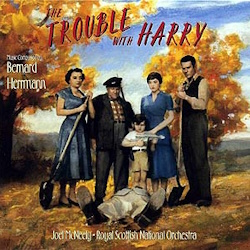
THE TROUBLE WITH HARRY – Bernard Herrmann
 GREATEST SCORES OF THE TWENTIETH CENTURY
Original Review by Craig Lysy
Director Alfred Hitchcock took a liking to the 1950 black comedy novel “The Trouble With Harry” by Jack Trevor Story and purchased the film rights for $11,000. Hitchcock used his own production company to finance the film, with him overseeing production with a $1.2 million budget. He would also direct and hired John Michael Hayes to write the screenplay. For casting, Hitchcock embarked on an experiment – not hiring any established stars as he believed that many times a big star can hinder the narrative flow of his movie. As such, the cast included; Edmund Gwenn as Captain Albert Weiss, John Forsythe as Sam Marlowe, Shirley MacLaine in her acting debut as Jennifer Rogers, Mildred Natwick as Miss Ivy Gravely, Mildred Dunnock as Mrs. Wiggs, James Mathers as Arnie Rogers, and Royal Dano as Deputy Sheriff Calvin Wiggs. Read more…
THE KENTUCKIAN – Bernard Herrmann
 GREATEST SCORES OF THE TWENTIETH CENTURY
Original Review by Craig Lysy
Actor Burt Lancaster was approaching forty years of age in 1952 and decided that he wanted to expand his career options. He came across the 1953 novel The Gabriel Horn by Felix Holt and decided it would be an excellent vehicle to showcase his talent. He formed a production company Hecht-Lancaster Productions with friend and producer Harold Hecht, purchased the film rights, hired A. B. Guthrie Jr. to write the screenplay, and for the first time in his career, personally took the reins to direct. Lancaster’s application to the Director’s Guild was rejected due to his past public criticism of the profession, however they granted him a waiver so he could make the film. For the cast, Burt Lancaster would play the lead role of Elias Wakefield, joined by Diane Foster as Hannah Bolen, Diana Lynn as Susie Spann, Donald MacDonald as “Little Eli” Wakefield, and Walter Matthau as Stan Bodine. Read more…
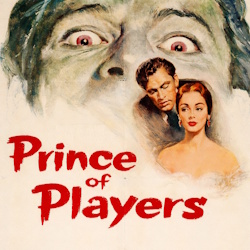
PRINCE OF PLAYERS – Bernard Herrmann
 GREATEST SCORES OF THE TWENTIETH CENTURY
Original Review by Craig Lysy
In February of 1953, 20th Century Fox studio executive Daryl F. Zanuck came upon the novel “Prince of Players” by Eleanor Ruggles. He decided that a film adaptation of the biographical story of thespians Edwin “Ned” Booth and his notorious brother John Wilkes Booth would be an excellent vehicle for their rising star Richard Burton, who had just signed a seven film contract. Philip Dunne was placed in charge of production and provided a budget of $1.57 million, Moss Hart was hired to write the screenplay, and Dunne would also direct. The cast included; Richard Burton as Edwin “Ned” Booth, Maggie McNamara as Mary Devlin, John Derek as John Wilkes Booth, and Raymond Massey as Julius Brutus Booth. Read more…
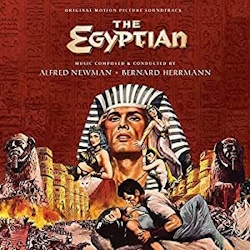
THE EGYPTIAN – Alfred Newman, Bernard Herrmann
 GREATEST SCORES OF THE TWENTIETH CENTURY
Original Review by Craig Lysy
Following the commercial success of “The Robe” in 1953, 20th Century Fox executive Daryl F. Zanuck decided to cash in with another lavish religious epic set in ancient Egypt. He was inspired by the 1945 novel “The Egyptian” by Mika Waltari, which was itself based upon the ancient 2,000-year-old Egyptian tale “Story of Sinuhe”. Zanuck purchased the film rights and personally took charge of production with a massive $3.9 million budget. He also decided that he would film with CinemaScope and DeLuxe Color. Philip Dunne and Casey Robinson were hired to write the screenplay and Michael Curtiz was borrowed from Paramount Studios to direct. A stellar cast was assembled, which included Jean Simmons as Merit, Edmund Purdom (a late replacement for Marlon Brando who quit one week before filming) as Sinuhe, Victor Mature as Horemheb, Bella Darvi as Nefer, Gene Tierney as Baketamon, Michael Wilding as Pharoah Akhenaten, and Peter Ustinov as Kaptah. Read more…
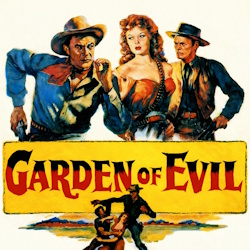
GARDEN OF EVIL – Bernard Herrmann
 GREATEST SCORES OF THE TWENTIETH CENTURY
Original Review by Craig Lysy
CinemaScope technology with its anamorphic lens transformed film-making in 1953, by allowing Hollywood studios to shoot widescreen pictures to offer big screen visuals that could not be duplicated by the emerging TV market. 20th Century Fox studio executive Daryl F. Zanuck decided that he wanted to use the new technology to bring a Western to the big screen as never seen before. Writers Fred Freiberger and William Turnberg were hired to write an original screenplay, Charles Brackett was assigned production with a $2.1 million budget, and Henry Hathaway was tasked with directing. A fine cast was assembled, including; Gary Cooper as Hooker, Susan Hayward as Leah Fuller, Richard Widmark as Fiske, Cameron Mitchell as Luke Daly, Hugh Marlowe john Fuller, and Victor Manuel Mendoza as Vincente Madariaga. Read more…
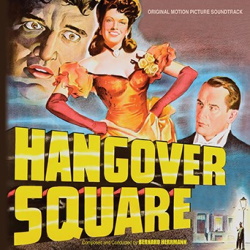
HANGOVER SQUARE – Bernard Herrmann
 GREATEST SCORES OF THE TWENTIETH CENTURY
Original Review by Craig Lysy
Actor Laird Cregar saw opportunity for a film adaptation of the popular 1941 novel “Hangover Square,” a murder melodrama by Patrick Hamilton. He convinced 20th Century Fox executive Darryl F. Zanuck to purchase the film rights, Robert Bassler was assigned production with a budget of $1.145 million, Barré Lyndon was hired to write the screenplay, and John Brahm was tasked with directing. A fine cast was recruited, including Laird Cregar as George Harvey Bone, Linda Darnell as Netta Langdon, George Sanders as Dr. Allan Middleton, Faye Marlowe as Barbara Chapman and Alan Napier as Sir Henry Chapman. Read more…
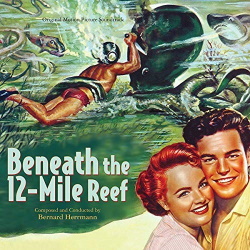
BENEATH THE 12-MILE REEF – Bernard Herrmann
 GREATEST SCORES OF THE TWENTIETH CENTURY
Original Review by Craig Lysy
20the Century Fox revolutionized the film industry in 1953 with Stereophonic Cinemascope, which was used for “The Robe” and “How to Marry a Millionaire”. To further capitalize on the new technology Darryl F. Zanuck, who was in charge of film production envisioned taking it underwater. A.I. Bezzerides was hired to write the screenplay, which would incorporate an underwater narrative and feature a love story inspired by Shakespeare’s play “Romeo and Juliet” (1597). Robert Bassler was assigned production, provided a $1.56 million budget, and Robert D. Webb was tasked with directing. The film cast would include; Robert Wagner as Tony Petrakis, Terry Moore as Gwyneth Rhys, Gilbert Roland as Mike Petrakis, Angela Clarke as Mama Petrakis, and Peter Graves as Arnold Dix. Read more…
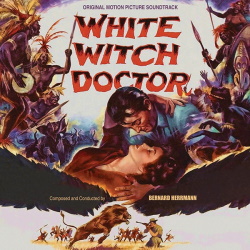
WHITE WITCH DOCTOR – Bernard Herrmann
 GREATEST SCORES OF THE TWENTIETH CENTURY
Original Review by Craig Lysy
20th Century Fox executive Darryl F. Zanuck was fond of adapting novels for the big screen and when he came across the 1950 work White Witch Doctor by Louise A Stinetorf he purchased the film rights and assigned Otto Land to production with a $2.02 million budget. Ivan Goff and Ben Roberts were hired to adapt the novel, but Zanuck instructed them to deviate from a literal retelling of the novel, insisting that they infuse the tale with romance, sex, physical excitement, and physical violence set against beautiful African vistas. Roy Ward Baker was tasked with directing, but was replaced by Henry Hathaway when he fell ill in Africa. A fine cast was assembled, including Robert Mitchum as Lonni Douglas, Susan Hayward as Ellen Burton, Walter Slezak as Huysman, Timothy Carey as Jarrett and Mashood Olabisi as Jacques. Read more…
ON DANGEROUS GROUND – Bernard Herrmann
 GREATEST SCORES OF THE TWENTIETH CENTURY
Original Review by Craig Lysy
In 1951 director Nicholas Ray had just wrapped up shooting the WWII action film “The Flying Leathernecks” and decided that his next project would a film noir melodrama based on the 1945 novel “Mad With Much Heart” by Gerald Butler. RKO Pictures executives were initially resistant, finding the novel “unpleasant and uncommercial”, but were ultimately persuaded by Ray’s vision and passion. John Houseman was assigned production and A. I. Bezzerides was tasked with adapting Butler’s novel and writing the screenplay. For the cast, Ray hired Ida Lupino as Mary Malden, Robert Ryan as Jim Wilson, and Ward Bond as Walter Brent. Read more…
THE MAN WHO KNEW TOO MUCH – Bernard Herrmann
 GREATEST SCORES OF THE TWENTIETH CENTURY
Original Review by Craig Lysy
Alfred Hitchcock had directed in England, the film “The Man Who Knew Too Much” (1934). In 1941 he decided on a new American incarnation, but it did not come to fruition until 1956 when Paramount Pictures agreed it was a movie that could be well-adapted to the new decade. Filwite Productions joined with Paramount and provided a $1.2 million budget. Hitchcock would manage production and direct, and Charles Bennett and D. B. Wyndham-Lewis were tasked with writing the screenplay. A fine cast was assembled with James Stewart as Dr. Benjamin McKenna, Doris Day as Josephine Conway McKenna, Bernard Miles as Edward Drayton, Brenda de Banzie as Lucy Drayton Christopher Olsen as Henry McKenna, and Daniel Gélin as Louis Bernard. Read more…
THE SNOWS OF KILIMANJARO – Bernard Herrmann
 GREATEST SCORES OF THE TWENTIETH CENTURY
Original Review by Craig Lysy
In 1948 20th Century Studio executive Darryl F. Zanuck made the business decision to adapt another of Ernest Hemingway’s novels for the big screen, The Snows of Kilimanjaro from 1936. He purchased the film rights for a hefty $125,000 and personally took charge of production, allocating a budget of $3.0 million. Casey Robinson was hired to write the screenplay and veteran Henry King was tasked with directing. Zanuck had already decided that Gregory Peck would star as Harry Street, with Ava Gardner playing Cynthia Green. Joining them would be Susan Hayward as Helen, and Hildegard Knef as Countess Elizabeth. Read more…
ANNA AND THE KING OF SIAM – Bernard Herrmann
 GREATEST SCORES OF THE TWENTIETH CENTURY
Original Review by Craig Lysy
Margaret Landon wrote her 1944 novel Anna and the King of Siam based on the fictionalized diaries of Anna Leonowens, a mixed-race woman who claimed to have been the British governess to the children of King Mongkut of Siam. The novel became a public sensation, which caught the eye of 20th Century Fox Studios executive Darryl F. Zanuck. He purchased the film rights, assigned production to Louis D. Lighton, hired Talbot Jennings and Sally Benson to write the screenplay, and provided a generous budget of $2.2 million. John Cromwell was tasked with directing, and a stellar cast was assembled, including; Rex Harrison in his Hollywood debut as King Mongkut, Irene Dunne as Anna Owens, Linda Darnell as Tuptim, Lee J. Cobb as Kralahome, Gale Sondergaard as Lady Theiang, Tito Renaldo as Prince Chulalongkorn, and Richard Lyon as Louis Owens. Read more…
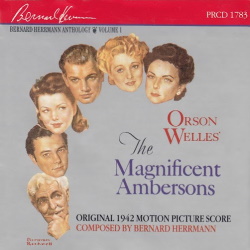
THE MAGNIFICENT AMBERSONS – Bernard Herrmann
 GREATEST SCORES OF THE TWENTIETH CENTURY
Original Review by Craig Lysy
Director Orson Welles had for some time desired to bring Booth Tarkington’s 1918 novel The Magnificent Ambersons to the big screen, a story that offered a wistful view of a dying American aristocracy. In order to gain RKO studio backing, he renegotiated his contract and granted the studio final cut rights. With their blessings, he oversaw production with a $854,000, which ballooned to over $1.18 million. He would also write the screenplay, and personally direct the film. A fine cast was assembled, which included Joseph Cotton as Eugene Morgan, Dolores Costello as Isabel Amberson Minafer, Anne Baxter as Lucy Morgan, Tim Holt as George Amberson Minafer, Agnes Moorhead as Fanny Minafer, and Orson Welles as the narrator. Read more…

Shop at the Movie Music UK Store

Member of the

 MOVIE MUSIC UK