Archive
Academy Award Winners 2017
 The Academy of Motion Picture Arts and Sciences (AMPAS) have announced the winners of the 90th Academy Awards, honoring the best in film in 2017.
In the Best Original Score category composer Alexandre Desplat won the award for his score for director Guillermo del Toro’s romantic fantasy film The Shape of Water. In accepting his award, Desplat said:
Merci, c’est fantastique. I‘m very grateful to the Academy. My mother is also turning 90 this year so I think she’ll be very happy tonight! Yes, she’s Greek, by the way! Now, Guillermo, thank you, you know, thank you for the letting the music be the voice of your characters and convey the beautiful melancholy of love. That’s for you. I wish to thank Miles Dale, Fox Searchlight, and the music department at Fox. All the musicians who played on the score and those downstairs here, and I wish to thank queen Renee Fleming, Laura Engel, Ray Costa, my friend Katz, and Solrey you elevate my music, everything I write by your musical genius, thank you, but this is not for you, it’s for our daughters Ninou and Antonia. Thank you!
The other nominees were Carter Burwell for Three Billboards Outside Ebbing Missouri, Jonny Greenwood for Phantom Thread, John Williams for Star Wars: The Last Jedi, and Hans Zimmer for Dunkirk.
In the Best Original Song category, the winners were Kristin Anderson-Lopez and Robert Lopez their song “Remember Me” from Coco.
The other nominees were Mary J. Blige, Raphael Saadiq, and Taura Stinson for “Mighty River” from Mudbound; Benj Pasek and Justin Paul for “This Is Me” from The Greatest Showman; Sufjan Stevens for “Mystery of Love” from Call Me By Your Name; and Diane Warren and Lonnie Lynn Jr. (Common) for “Stand Up For Something” from Marshall.
BAFTA Winners 2017
 The British Academy of Film and Television Arts (BAFTA) have announced the winners of the 71st British Academy Film Awards, honoring the best in film in 2017.
In the Best Original Score category composer Alexandre Desplat won the award for his score for director Guillermo del Toro’s romantic fantasy film The Shape of Water. In accepting his award, Desplat said:
“Yes, what a venue for music! Thank you, it’s… it’s marvelous. Guillermo, your film is unique, and the poetry you’ve given us is amazing, and for music there’s always a good bonding between music and poetry, so thank you, thank you very much. Thanks to Fox Searchlight. This music was recorded here in London by the London Symphony Orchestra at Abbey Road [applause] Marvelous musicians! Many of them, one of them is here tonight, Solrey, the best musician I have ever met and… [applause] and, Antonia, my daughter. Hi, Antonia! And… I thank you. It’s marvelous. Thank you.”
The other nominees were Jonny Greenwood for Phantom Thread, Dario Marianelli for Darkest Hour, Benjamin Wallfisch and Hans Zimmer for Blade Runner 2049, and Hans Zimmer again for Dunkirk.
Golden Globe Winners 2017
 The Hollywood Foreign Press Association (HFPA) have announced the winners of the 75th Golden Globe Awards, honoring the best in film and American television of 2017.
In the Best Original Score category composer Alexandre Desplat won the award for his score for director Guillermo del Toro’s romantic fantasy The Shape of Water. This is Desplat’s second Golden Globe, him having won previously for The Painted Veil in 2006. In his acceptance speech, Desplat said:
“Thank you, merci, merci beaucoup. Different color from the previous one! Thank you Hollywood Foreign Press. Thanks to Fox Searchlight, to Miles Dale the producer, and Guillermo… you moved me. Your movie has moved me so much, inspired me so much, because it’s made of your humanity, your passion. I thank you also for all the dinners we have in Paris, and the ones to come. I want to thank all the musicians who recorded the score, they are marvelous. All the crew and cast: Richard [Jenkins], Sally [Hawkins], Doug [Jones]. The music department at Fox Searchlight, Queen Renee Fleming, Laura Engel, Ray Costa, my friend Katz, and Solrey – this is for you. Thank you very much!”
The other nominees were Carter Burwell for Three Billboards Outside Ebbing Missouri, Jonny Greenwood for Phantom Thread, John Williams for The Post, and Hans Zimmer for Dunkirk.
In the Best Original Song category, the winners were Benj Pasek, and Justin Paul for their song “This Is Me” from the screen musical The Greatest Showman.
The other nominees were Kristin Anderson-Lopez and Robert Lopez for “Remember Me” from Coco; Mariah Carey and Marc Shaiman for “The Star” from The Star; Nick Jonas, Justin Tranter, and Nick Monson for “Home” from Ferdinand; and Raphael Saadiq, Mary J. Blige, and Taura Stinson for “Mighty River” from Mudbound.
THE SHAPE OF WATER – Alexandre Desplat
 Original Review by Jonathan Broxton
The Shape of Water is a science fiction fairy tale written and directed by Guillermo del Toro, starring Sally Hawkins, Richard Jenkins, Octavia Spencer, Michael Shannon, Michael Stuhlbarg, and Doug Jones. It’s an odd mishmash of a film – it’s one part romantic drama, one part monster movie, one part spy thriller, and it explores additional themes that range from one character’s closeted homosexuality to another’s love of classic Hollywood musicals – but somehow it all works beautifully. Hawkins plays Elisa, a shy mute woman who works as a cleaner on the night shift at a military research facility in the 1960s. One night Elisa meets a mysterious but highly intelligent amphibious humanoid creature (Jones) that has been captured in a remote part of the Amazon and brought to the facility for study by the ruthless Colonel Strickland (Shannon). Unexpectedly, Elisa and the Amphibious Man meet and begin to bond, and form the beginnings of an almost romantic relationship; however, when she hears of the government’s plans to kill and dissect the Amphibious Man to study it’s biology, Elisa vows to save him, and with the help of her sassy co-worker Zelda (Spencer) and her next door neighbor Giles (Jenkins), comes up with a plan to break him out. Read more…
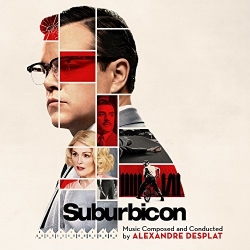
SUBURBICON – Alexandre Desplat
 Original Review by Jonathan Broxton
The idea of taking a peek behind the white picket fences of American society is not a new one, but few have taken it as far as director George Clooney in his new film, Suburbicon. It’s a highly stylized, bizarrely comical drama set in the 1950s in a planned community, the epitome of white middle class utopia, a fantasy of manicured lawns and pristine shopping malls. However, things start to change in Suburbicon when a quiet African-American family moves in; despite them doing literally nothing to provoke any sort of reaction, the town erupts into a frenzy of racially-driven anger and violence. Against this backdrop, the story of Gardner Lodge unfolds – to the world, he is a mild-mannered middle class husband and father, but in private his life is falling apart in an increasingly nightmarish spiral of betrayal and murder. The film stars Matt Damon, Julianne Moore, and Oscar Isaac, and was co-written by Clooney and Grant Heslov with Joel and Ethan Coen. Despite this star lineup, the film was roundly panned by critics, who couldn’t fathom its uneven tone, heavy handedness, and odd mix of genres. Read more…
VALERIAN AND THE CITY OF A THOUSAND PLANETS – Alexandre Desplat
 Original Review by Jonathan Broxton
When French director Luc Besson debuted his film The Fifth Element in 1997, it was hailed as a masterpiece of European science fiction, a visual feast for the senses. What people didn’t realize at the time was that, as good as The Fifth Element was, Besson was actually making that film because cinematic technology was not yet sophisticated enough for him to make what was his true passion project: a big screen adaptation of the French-language comic book series Valérian et Laureline, which Besson had grown up reading. Although most people outside of France will not have heard of it, Valérian et Laureline is actually very influential, and many commentators knowledgeable about the subject have noted that the original Star Wars, Conan the Barbarian, and Independence Day all contain visual and conceptual similarities to the comic, which pre-dates all of them. In hindsight, it is clear that The Fifth Element was Besson’s ‘dry run’ for this film, as it too shares ideas and design elements with Valérian. Read more…
Under-the-Radar Round Up 2016, Part 2
 Original Reviews by Jonathan Broxton
The second installment in my annual series of articles looking at the best “under the radar” scores from around the world concentrates on music from films from Western Europe – in this instance, France, Italy, Germany, and the Netherlands (Spain & Portugal, and the UK will get their own pages later!). The film music covered in this installment includes several outstanding dramatic works, animated films, fantasy action adventures, and more!
THE LIGHT BETWEEN OCEANS – Alexandre Desplat
 Original Review by Jonathan Broxton
The Light Between Oceans is a romantic drama set in Australia in the 1920s. Based on the novel by M. L. Stedman and directed by Derek Cianfrance, it stars Michael Fassbender as Tom Sherborne, a veteran of World War I, now working as a lighthouse keeper off the western coast of the country with his wife, Isabel (Alicia Vikander). One day, Tom rescues a baby girl, who he finds washed up in a rowboat on the rocks near his home; assuming she is the only survivor of a shipwreck, Tom and Isabel decide to informally adopt the baby – whom they name Lucy – as their own. However, years later, when they return to the Australian mainland for a brief time, the once-happy family discovers that their decision to keep Lucy on that fateful day may result in terrible repercussions for all. The film also stars Rachel Weisz and Bryan Brown, and has been the recipient of a great deal of critical acclaim in the period leading up to its release. Read more…
THE SECRET LIFE OF PETS – Alexandre Desplat
 Original Review by Jonathan Broxton
The Secret Life of Pets is the latest animated film from Illumination Entertainment, the successful studio behind the smash hits Despicable Me and Minions. Directed by Chris Renaud and Yarrow Cheney, it follows the escapades of Max, a terrier who lives a life of luxury in an upscale New York tenement building with his owner. However, Max’s perfect life is spoiled when his owner adopts a new dog: Duke, a large and accident prone mongrel mutt who quickly makes Max’s life a misery. Before long, Max and Duke are involved in all manner of escapades, including a trip to the pound, a jailbreak masterminded by a streetwise bunny named Snowball, and a devilish plan to get revenge on the former owners of the city’s abandoned animals. The film features the voice talents of Louis CK, Eric Stonestreet, and Kevin Hart, among others, and has a score from an unlikely source: Oscar-winning French composer Alexandre Desplat. Read more…
Under-the-Radar Round Up 2015, Part 3
Original Reviews by Jonathan Broxton
The third installment in my series of articles looking at the best “under the radar” scores from around the world concentrates on music from films from mainland Europe. I know this is a very ‘broad brush’ description, but there are a number of countries this year where there are just one or two standout works which couldn’t justify an entire article to themselves, so I decided to present you with this bumper crop from across the entire continent instead! The scope is quite wide-ranging, and includes everything from French documentaries to Polish serial killer thrillers, Russian adventure movies, and Greek romantic dramas, by written Oscar-winners and exciting newcomers alike.
THE DANISH GIRL – Alexandre Desplat
 Original Review by Jonathan Broxton
Gender identity issues have been a major social topic in 2015, encompassing everything from Caitlin Jenner to the acclaimed TV series Transparent, so it is perhaps unsurprising that a film like The Danish Girl should be released this year. Directed by Oscar-winner Tom Hooper (The King’s Speech), it looks at the life of Einar Wegener, a young Danish man living in Copenhagen in the 1920s, who became the first ever recipient of male-to-female sex reassignment surgery. Lead actor Eddie Redmayne is heavily tipped for a second consecutive Academy Award for his performance as Einar and his alter ego, Lili, and he is ably supported by Alicia Vikander as his wife, Gerda. Also receiving a great deal of critical acclaim has been the score, written by French composer Alexandre Desplat, who has already received Golden Globe and Satellite Award nominations for his work. This is the fifth and final Desplat score of 2015, whose output in general has been disappointing compared to his usual stellar standards: Suffragette came and went without much fanfare, Everything Will Be Fine was barely released in the United States, and neither Il Racconto dei Racconti nor Une Histoire de Fou have been released outside their native countries at all. Read more…
SUFFRAGETTE – Alexandre Desplat
 Original Review by Jonathan Broxton
Women in the United Kingdom did not receive the right to vote until 1928. The issue of universal suffrage had been a parliamentary hot potato since at least 1872, and had dominated the political lives of several of the country’s leaders at the time, most notably King George V, and prime ministers David Lloyd George and Herbert Henry Asquith, all of whom were vehemently opposed to it. Things came to a head following the formation of the influential Women’s Social and Political Union, which had shifted sentiments in favor of women’s suffrage by 1906, but was equally criticized for its militant and sometimes violent campaign. Most commentators credit two women with changing the minds of British politicians: Emmeline Pankhurst, the leader of the WSPU (and the British equivalent of Susan B. Anthony), and Emily Davison, who intentionally walked in front of, and was subsequently trampled and killed by, the King’s horse Anmer during the running of the 1913 Epsom Derby horse race. Director Sarah Gavron’s film Suffragette tells the story of the movement from the point of view of the fictional Maud Watts, who joins the WSPU at the height of its influence, and becomes deeply involved in its activities. It stars Carey Mulligan, Helena Bonham-Carter, and Meryl Streep as Pankhurst, and is the first real ‘Oscar bait’ film of 2015. Read more…
Academy Award Winners 2014
 The Academy of Motion Picture Arts and Sciences (AMPAS) have announced the winners of the 87th Academy Awards, honoring the best in film in 2014.
In the Best Original Score category French composer Alexandre Desplat won the award for his score for directed Wes Anderson’s quirky period comedy The Grand Budapest Hotel. In his acceptance speech, Desplat said:
“Merci. Merci beaucoup. Wes [Anderson], you’re a genius. This is good! You offered me a great view from the Grand Budapest. Thank you. It’s been a beautiful decade for me in Hollywood. I’ve worked with great directors and producers, and I’m very grateful. I need to thank Laura Engel, Mark Graham, Katz, my Greek mother. Solrey [Lemonnier], I met you long ago, for my first session, you played a violin, and you made everything happen for me. So, this is for you. Thank you”
The other nominees were Desplat again for The Imitation Game, Jóhann Jóhannsson for The Theory of Everything, Gary Yershon for Mr. Turner, and Hans Zimmer for Interstellar.
In the Best Original Song category, the winners were John Legend and Lonnie ‘Common’ Lynn for their song “Glory” from critically acclaimed civil rights film Selma.
The other nominees were Gregg Alexander and Danielle Brisebois for “Lost Stars” from Begin Again, Glenn Campbell and Julian Raymond for “I’m Not Gonna Miss You” from Glenn Campbell: I’ll Be Me, Shawn Patterson for “Everything Is Awesome” from The Lego Movie, and Diane Warren for “Grateful” from Beyond the Lights.
BAFTA Winners 2014
 The British Academy of Film and Television Arts (BAFTA) have announced the winners of the 68th British Academy Film Awards, honoring the best in film in 2014.
In the Best Original Score category composer Alexandre Desplat won the award for his score for director Wes Anderson’s critically acclaimed quirky comedy The Grand Budapest Hotel. In his acceptance speech, Desplat said:
“Thank you. Merci beaucoup, I am very moved and honored to be here. It all goes back to Wes [Anderson]. Wes is unique. His world looks like nobody else’s. He is not here tonight but I am sure he is watching TV. I am not sure actually. But we will send him a video. There are many people involved, of course, the great musicians, Mark Graham, my agent Laura Engel, but I would like to share it with the best musician I have ever met, Solrey [Lemonnier], this is for you.”
The other nominees were Jóhann Jóhannsson for The Theory of Everything, Mica Levi for Under the Skin, Antonio Sanchez for Birdman, and Hans Zimmer for Interstellar.
THE IMITATION GAME – Alexandre Desplat
 Original Review by Jonathan Broxton
Alan Turing was a British mathematician who was highly influential in the development of computer science and artificial intelligence. During World War II, Turing worked for the British Government Code and Cypher School at Bletchley Park, and was responsible for creating ‘Christopher’, an electromechanical machine that cracked the codes of the German Enigma machine, and in turn enabled the Allies to defeat the Nazis in several crucial battles. Winston Churchill said that Turing made the single biggest contribution to the Allied victory in the war against Nazi Germany, and that his work shortened the war in Europe by as many as four years. The Imitation Game is the story of Turing’s life, and follows him through his work in WWII and beyond, where it is revealed that, in addition to unearthing German secrets, Turing had some secrets of his own. The film is directed by Danish director Morten Tyldum, stars Benedict Cumberbatch and Keira Knightley, and has an original score by the ever-busy Alexandre Desplat, the fourth of his five scores written in 2014. Read more…

Shop at the Movie Music UK Store

Member of the

 MOVIE MUSIC UK