PETE’S DRAGON – Daniel Hart
 Original Review by Jonathan Broxton
Pete’s Dragon is a new Disney remake of its own original 1977 film, a musical which starred Helen Reddy, Jim Dale, Mickey Rooney, and an entirely cartoon dragon, and which was nominated for an Oscar for its iconic original song, “Candle on the Water.” The new version, written and directed by David Lowery, is a very different, less comical take on the story. It follows the adventures of a young boy named Pete (Oakes Fegley), whose parents are killed in a car accident on a road trip, but who escapes without injury and flees into the woods. Pete spends the next six years living in the wild, where he is looked after by a huge, green, friendly dragon, a local legend in the area, whom Pete names Elliott. However, Pete’s idyllic life in the forest is interrupted when he is discovered by the young daughter of a forestry service ranger and taken back into civilization; meanwhile Elliott, who misses his young friend, ventures out of the woods and into town, where his existence risks being revealed to the townsfolk. It’s a lovely, sentimental, heartwarming film about childhood friendships, families, and respect of nature; it co-stars Bryce Dallas Howard, Wes Bentley, Karl Urban, Oona Laurence, and Robert Redford, and has been lauded by critics as a warm and appealing family film. Read more…
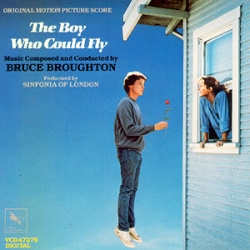
THE BOY WHO COULD FLY – Bruce Broughton
 THROWBACK THIRTY
Original Review by Jonathan Broxton
The Boy Who Could Fly was a popular family drama, written and directed by Nick Castle, about a friendship that helps two children overcome deep emotional wounds. Lucy Deakins stars as Millie, a 14-year old girl who makes friends with Eric (Jay Underwood), the similarly-aged boy next door, after the suicide of her terminally ill father. Eric has autism, and lives with his alcoholic uncle (Fred Gwynne), because both his parents were killed in a plane crash when he was much younger. Despite Eric’s verbal inability to communicate, the two teenagers nevertheless seem to help each other deal with their personal issues, but before long a series of unusual events lead Millie to think that, somehow, Eric has the ability to fly. The film was both a critical and popular success at the box office in the late summer of 1986 (it subsequently won the prestigious Saturn Award for Best Fantasy Film); it co-starred Bonnie Bedelia, Fred Savage, and Colleen Dewhurst, and had its sense of magic enhanced immeasurably by Bruce Broughton’s gorgeous score. Read more…
STRANGER THINGS – Kyle Dixon, Michael Stein
 Original Review by Jonathan Broxton
Nostalgia for the 1980s appears to have peaked during the summer of 2016. Mainstream films, TV shows, and their musical accompaniments are all relishing their trips down amnesia lane, digging up thirty years worth of long-forgotten pop culture references, busting out with outdated lingo, and embracing the questionable fashion choices that defined the decade. Children’s adventure movies were especially popular in the 1980s, and it is that sub-genre that the Netflix original series Stranger Things lovingly emulates. Set in suburban Indiana in 1983, the show begins with the disappearance of a 12-year-old boy named Will Byers (Noah Schnapp); as his mother Joyce (Winona Ryder) panics, the local police department led by Sheriff Jim Hopper (David Harbour) begins a formal investigation. Meanwhile, Will’s nerdy Dungeons-and-Dragons-playing friends (Finn Wolfhard, Gaten Matarazzo, Caleb McLaughlin) begin their own investigation – and before long the boys are knee-deep in an extraordinary mystery involving top-secret government experiments, terrifying supernatural forces, and a strange little girl named Eleven (Millie Bobby Brown) who appears to display psychokinetic abilities. Read more…
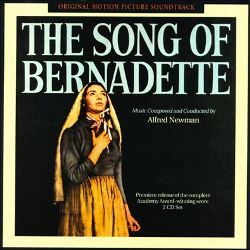
THE SONG OF BERNADETTE – Alfred Newman
 GREATEST SCORES OF THE TWENTIETH CENTURY
Original Review by Craig Lysy
Producer William Perlberg of 20th Century Fox saw opportunity for the studio after reading the novel 1942 novel The Song of Bernadette by Franz Werfel, and so resolved to bring this inspired and miraculous story to the big screen. Henry King was hired to direct and veteran screenwriter George Seaton tasked with writing the screenplay. For the actors, a nationwide talent search found 24 year old Jennifer Jones, who was selected to play the title character of Bernadette Soubirous. Supporting actors included Vincent Price in perhaps his finest performance as (Prosecutor Vital Dutour), Aubrey Mather (Mayor Lacade), Charles Dingle (Chief of Police Jocomet), Charles Bickford (Dean of Lourdes) and Gladys Cooper (Sister Therese Vauzous). Read more…
HUNT FOR THE WILDERPEOPLE – Moniker
 Original Review by Jonathan Broxton
Hunt for the Wilderpeople is the latest film from Kiwi writer-director Taika Waititi, who enjoyed popular success with his previous films Boy and What We Do in the Shadows, and is now hard at work on his latest film, the marvel super hero sequel Thor Ragnarok. Based on the iconic 1986 book ‘Wild Pork and Watercress’ by bestselling New Zealand author Barry Crump, the film stars young Julian Dennison as Ricky Baker, a rebellious and delinquent teenage boy who has bounced around from foster home to foster home in New Zealand’s social services system, and has now found himself placed at a rural farm belonging to the kindly Bella (Rima te Wiata) and her grizzled, crotchety husband Hec (Sam Neill). Ricky, who is sarcastic and defiant and fancies himself as a gangster rapper, is initially reluctant to embrace his new life on the edge of the wilderness, but soon finds himself becoming happy in his new home. However, a tragic event forces Ricky and Hec to flee from the farm and into the bush, where Hec’s survival skills allow them to remain safe, despite Ricky’s near-constant complaining. Unfortunately, the police mistakenly believe that Hec – who has a mysterious past – has kidnapped Ricky, and soon the pair are on the lam, running from the authorities who don’t understand that the unlikely pair are changing each other for the better. Read more…
THE FLY – Howard Shore
 THROWBACK THIRTY
Original Review by Jonathan Broxton
The Fly is one of the greatest horror films ever made, a masterpiece of so-called ‘body horror’ and a cautionary tale about science gone wrong. Based on a short story by George Langelaan and directed by David Cronenberg, the film stars Jeff Goldblum as Seth Brundle, a brilliant but desperately eccentric scientist working on a teleportation device in an attempt to solve the world’s transportation problems. Brundle meets reporter Veronica Quaife (Geena Davis) when she comes to his laboratory to interview him, and the two develop a mutual attraction which blossoms into a romantic relationship. However, Brundle is frustrated with his lack of progress with the device, and rushes into trying new and increasingly dangerous experiments in order to speed up the process. One day, despite Veronica’s protestations, he tests the device on himself; after successfully jumping from one teleportation pod to another, he declares his machine a triumph – but, unknown to Brundle, a common house fly found its way into the machine with him. Now, having had his human DNA merged with that of the fly at a cellular level, Brundle begins to slowly, grotesquely, mutate, with terrible consequences for all. Read more…
SUICIDE SQUAD – Steven Price
 Original Review by Jonathan Broxton
It’s looking increasingly likely that, in future years, we will be able to pinpoint the summer of 2016 as the moment the super hero genre reached its tipping point. After years of success and box office gold, especially from Marvel’s stable of characters, this year’s entries have been almost unanimously slammed from a critical point of view. Although they continued to resonate financially, and although Deadpool was fun, films like Batman v Superman: Dawn of Justice, Captain America: Civil War, and X-Men Apocalypse bore the brunt of the jabs and barbs from professionals, who criticized each film’s poor writing, over-reliance on CGI fight sequences, and over-stuffed casts. Suicide Squad, the latest in the Warner Brothers/DC series of movies is, from my point of view, the nadir: a boring, badly-written, clichéd mess of a film that suffered from so much post-production tinkering that it rendered the final cut virtually incomprehensible. Written and directed by David Ayer, and set in the same universe as Zack Snyder’s new Batman and Superman films, it follows the fortunes of a group of incarcerated super-villains who are brought out of imprisonment by a shadowy government agency and forced to work together to battle an existential threat to humanity. The film stars Will Smith as crack assassin Deadshot, Jared Leto as the psychotic Joker, and Margot Robbie as his equally deranged paramour Harley Quinn, plus Joel Kinnaman, Jai Courteney, Jay Rodriguez, Cara Delevingne, and Viola Davis in supporting roles. Read more…
CASABLANCA – Max Steiner
 GREATEST SCORES OF THE TWENTIETH CENTURY
Original Review by Craig Lysy
In January of 1942 story editor Irene Diamond became enamored with the unproduced stage play “Everybody Comes to Ricks” by Murray Burnett and Joan Alison. She convinced Warner Brothers producer Hal B. Wallis to purchase the film rights, and brothers Julius and Philip Epstein were brought in to write the screenplay. Wallis was unable to secure William Wyler to direct, and so turned to his friend Michael Curtiz to manage the project. They brought in one of the most notable casts of the day with Humphrey Bogart as Rick Blaine, Ingrid Bergman as Ilsa Lund, Paul Henreid as Victor Laszlo, Claude Reins as Captain Louis Renault, Conrad Veidt as Major Henrich Strasser, Sydney Greenstreet as Signor Ferrari, Peter Lorre as Signor Ugarte and Dooley Wilson as Sam. Read more…
RUDOLF THE BLACK CAT – Naoki Sato
 Original Review by Jonathan Broxton
Rudolf the Black Cat is a Japanese animated family adventure film directed by Kunihiko Yuyama and Motonori Sakakibara. It follows the adventures of a suburban ‘indoor kitten’ named Rudolf, who has always longed to roam the streets of his little neighborhood. However, when Rudolf gets his wish and is accidentally abandoned miles away from his home in an unfamiliar big city by his owner, he must team up with a street cat called Gottalot in order to find his way back home. Read more…
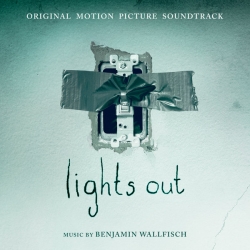
LIGHTS OUT – Benjamin Wallfisch
 Original Review by Jonathan Broxton
There has been a trend in recent years towards more thoughtful, creative, innovative horror films. Acclaimed works like The Babadook, It Follows, Under the Skin, and others, have begun to push the boundaries of the genre, blending art and terror together, while remaining cognizant of many of the classics that preceded it. Lights Out is another one of those films which may soon join that list of outstanding contemporary chillers by playing on one of the most innate and universal fears of them all: fear of the dark. Directed by Swedish filmmaker David Sandberg – remaking his own acclaimed 3-minute Youtube short film – the film stars Maria Bello, Teresa Palmer, and Gabriel Bateman as members of a family who are terrorized by a supernatural being which only appears when the lights are out. Read more…
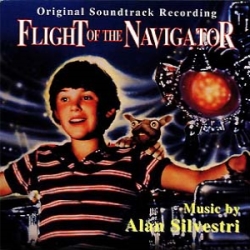
FLIGHT OF THE NAVIGATOR – Alan Silvestri
 THROWBACK THIRTY
Original Review by Jonathan Broxton
A science fiction film for children, Flight of the Navigator was a popular hit at box offices during the late summer of 1986. Directed by Randal Kleiser, the film starred 12-year old Joey Kramer as David, a young boy who lives in Florida in 1978 with his parents and young brother. After accidentally falling into a ravine near his home on the evening of the fourth of July, David awakes to find that eight years have passed, but he has not aged a day; he returns home to his shocked parents, who believed he was dead. Before long, various government agencies come knocking on David’s door, revealing that he was apparently abducted by an alien spaceship on the night of his disappearance, and that the spaceship – which subsequently crashed, and is now being held by NASA – appears to be trying to communicate with him telepathically. The film co-stars Cliff De Young, Veronica Cartwright, Howard Hesseman, a young Sarah Jessica Parker, features the voice of Paul Reubens, and has an original score by Alan Silvestri. Read more…
JASON BOURNE – John Powell, David Buckley
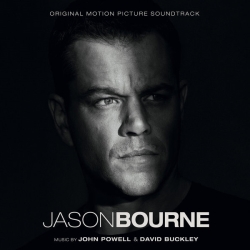 Original Review by Jonathan Broxton
Jason Bourne is the latest film in the series of action-espionage films based on the novels by Robert Ludlum, after the original Bourne Identity in 2002, The Bourne Supremacy in 2004, The Bourne Ultimatum in 2007, and the spin-off Bourne Legacy in 2012. Paul Greengrass returns to the director’s chair and Matt Damon returns to play one of his iconic roles one more time; this time, the plot revolves around Bourne, a former CIA assassin, finding out more about his past, how he was first recruited into the ultra-secret black ops Treadstone programme in the first place, and how these things relate to the death of his father. The film co-stars Oscar-winner Alicia Vikander, Tommy Lee Jones, Bourne veteran Julia Stiles, Vincent Cassel, and Riz Ahmed, and allows Bourne to trek across the globe from Athens to Berlin to London and Las Vegas, as he searches for answers about his past. Read more…
KINGS ROW – Erich Wolfgang Korngold
 GREATEST SCORES OF THE TWENTIETH CENTURY
Original Review by Craig Lysy
In 1940 the publication of Henry Bellamann’s provocative novel “Kings Row” took the American public by storm, soaring to #1 on the best seller list. Producer Hal Wallis of Warner Brothers saw a powerful social narrative after reading the novel and immediately purchased the film rights for $35,000. Sam Wood was brought in to direct and Casey Robinson was given the unenviable Herculean task of adapting the massive 674-page novel to the screen. He rose to the task, and when compared to the novel, the film is tame, as the Joseph Breen, director of the Hays Code censored most of the more sordid and controversial elements of the plot, including all references to incest, nymphomania, euthanasia, sadism, homosexuality, casual sex and nude bathing. Wood brought in a stellar cast which included; Ann Sheridan as Randy Monaghan, Robert Cummings as Parris Mitchell, Ronald Reagan as Drake McHugh, Betty Field as Cassandra Tower, Charles Coburn as Dr. Henry Gordon, Claude Rains as Dr. Alexander Tower, Judith Anderson as Mrs. Harriet Gordon and Maria Ouspenskaya as Madame von Ein. Read more…
LEAGUE OF GODS – John Debney
 Original Review by Jonathan Broxton
League of Gods is an epic Chinese action fantasy film, directed by Koan Hui, based on a novel by Xu Zhonglin. It tells the story of King Zhou (Tony Leung), the last ruler of the Shang dynasty, who as a young man was bewitched by his concubine Daji (Fan Bingbing), an evil ‘vixen spirit’ in disguise as a beautiful woman. Zhou oppresses his people and persecutes those who oppose him. Ji Fa (Andy On), a rival king, assisted by his strategist Jiang Ziya (Jet Li), rallies an army to overthrow the tyrant and restore peace and order. Throughout the story, battles are waged, with both sides calling upon various supernatural beings – deities, immortals, demons, spirits, and humans with magical abilities – to aid them in the war. Read more…
THE SECRET LIFE OF PETS – Alexandre Desplat
 Original Review by Jonathan Broxton
The Secret Life of Pets is the latest animated film from Illumination Entertainment, the successful studio behind the smash hits Despicable Me and Minions. Directed by Chris Renaud and Yarrow Cheney, it follows the escapades of Max, a terrier who lives a life of luxury in an upscale New York tenement building with his owner. However, Max’s perfect life is spoiled when his owner adopts a new dog: Duke, a large and accident prone mongrel mutt who quickly makes Max’s life a misery. Before long, Max and Duke are involved in all manner of escapades, including a trip to the pound, a jailbreak masterminded by a streetwise bunny named Snowball, and a devilish plan to get revenge on the former owners of the city’s abandoned animals. The film features the voice talents of Louis CK, Eric Stonestreet, and Kevin Hart, among others, and has a score from an unlikely source: Oscar-winning French composer Alexandre Desplat. Read more…

Shop at the Movie Music UK Store

Member of the


