Archive
JULIA – Rachel Portman
 Original Review by Jonathan Broxton
There are so many cookery shows, chef competitions, and other food-related programs on American television these days that there are entire channels dedicated to the genre, but as wide and broad as they are they can all trace their lineage back to one person: Julia Child. It was she who basically introduced the concept of French haute cuisine to the American public following the publication of her first book, Mastering the Art of French Cooking, in 1961, which in turn led to her first appearances on television in the mid-1960s. Through the 1970s and 1980s she was the pre-eminent TV cooking personality in the country, and her way of cooking food influenced generations of home chefs and restauranteurs alike. A dramatic film about her life, Julie & Julia, was released in 2009 with Meryl Streep playing Child, but this new film Julia is a straightforward biographical documentary. It is directed by Julie Cohen and Betsy West, with Brian Grazer and Ron Howard as executive producers, and has an original score by Rachel Portman. Read more…
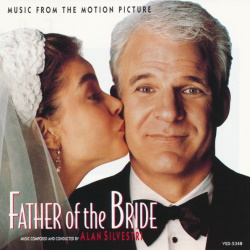
FATHER OF THE BRIDE – Alan Silvestri
 THROWBACK THIRTY
Original Review by Jonathan Broxton
Father of the Bride is charming remake of the classic 1950 Spencer Tracy-Elizabeth Taylor comedy, written by Nancy Meyers and directed by Charles Shyer. Steve Martin takes over the Tracy role as George Banks, a middle-aged father who finds himself suffering both a midlife crisis and a nervous breakdown when his only daughter Anne (Kimberly Williams) announces she is getting married. What follows is a comedy of errors as George – who is reluctant to see his daughter as a grown-up woman – suffers all manner of mishaps, mixed messages, and physical pratfalls as he supervises the organization of the wedding he does not want to happen. The film co-stars Diane Keaton and George Newbern, and features a hilarious cameo from Martin Short as Franck the wedding planner, and is one of those feelgood movies that is funny and heartwarming all at the same time. Read more…
WEST SIDE STORY – Leonard Bernstein, Stephen Sondheim, Gustavo Dudamel, David Newman
 Original Review by Jonathan Broxton
When Stephen Sondheim died aged 91, just a couple of weeks ago, the world of musical theater lost one of its best and most beloved practitioners. Although he was well-known for many of the scores he wrote himself – A Funny Thing Happened on the Way to the Forum, Company, A Little Night Music, Sweeney Todd, Into the Woods, many others – possibly his most beloved work by the general public was the one on which he “only” wrote the lyrics: West Side Story. On it Sondheim collaborated with the legendary composer and conductor Leonard Bernstein, creating a then-contemporary version of Romeo & Juliet transposed from renaissance-era Italy to 1950s New York, replacing the Montagus and the Capulets with street gangs, the Jets and the Sharks. It debuted on stage in 1957, and then was turned into a screen musical in 1961 by co-directors Robert Wise and Jerome Robbins. That film went on to become one of the most successful and popular Hollywood musicals in history, and eventually won ten Oscars, including Best Picture. And now, 60 years later, we have a new version of the same story, directed by the legendary Steven Spielberg. Read more…
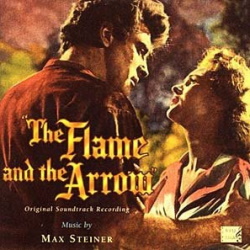
THE FLAME AND THE ARROW– Max Steiner
 GREATEST SCORES OF THE TWENTIETH CENTURY
Original Review by Craig Lysy
In 1949 Warner Brothers Studios had renewed interest in revisiting the swashbuckler genre, hoping to recapture the success of two of its greatest triumphs; 1935’s Captain Blood and 1940’s The Sea Hawk. Development and production of the film was given to producers Harold Hecht and Frank Ross who were provided with a budget of $1.61 million. Waldo Salt was hired to write the screenplay, and Jacques Tourneur was tasked with directing. Errol Flynn, Warner Brothers previous swashbuckler star was at age 41 beyond his prime and unable to handle the physicality demanded by the script. As such the popular Burt Lancaster who was a prior circus acrobatic performer was cast in the lead role of Dardo Bartoli. Joining him would be Virginia Mayo as Anne de Hesse, Robert Douglas as the Marchese Alessandro de Granazia, Gordon Gebert as Rudi Bartoli, Frank Allenby as Count Ulrich, and Nick Cravat as Dardo’s sidekick Piccolo. Read more…
COPPELIA – Maurizio Malagnini
 Original Review by Jonathan Broxton
A wonderful combination of live action ballet, animation, science fiction, and sweeping orchestral music, Coppelia is a film quite unlike anything I’ve ever seen. It’s a contemporary updating of the 1870 stage ballet by Léo Delibes, which was itself based on a story by the famed German fantasy author Ernst Hoffmann, whose work also inspired Offenbach’s The Tales of Hoffmann and Tchaikovsky’s The Nutcracker, among others. The film follows the story of Swan and Franz, two young lovers who live in a pretty European town. One day a sinister scientist and inventor named Doctor Coppelius comes to town; he promises the townspeople that he can make them handsome, beautiful, and strong through cosmetic surgery, and entices them to come to his laboratory. However, what the townspeople don’t realize is that the Doctor is actually on a personal quest to build the perfect “robot woman,” and he is using the ‘essence’ of the townspeople to bring his robot creation, named Coppelia, to life, while simultaneously turning the townspeople into mindless zombies who do nothing except stare at their own reflection. When the Doctor realizes that the love Franz has for Swan is the missing ingredient he needs to fully bring Coppelia to life, he kidnaps him – motivating Swan and their friends to break into the lab, rescue Franz, stop the Doctor, and save the town. Read more…
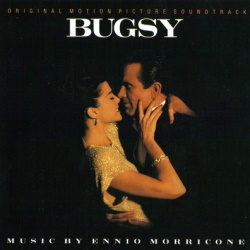
BUGSY – Ennio Morricone
 THROWBACK THIRTY
Original Review by Jonathan Broxton
Looking at the city of Las Vegas today, it’s difficult to see past its opulent hotels, gourmet restaurants, popular shows, beautiful weather, and frivolous excess, and remember that this world center of entertainment has its origins in organized crime. Director Barry Levinson’s film Bugsy explores these origins, specifically looking at the life and death of New York gangster Benjamin ‘Bugsy’ Siegel, who travels to Los Angeles in the early 1940s, gets involved with tough-talking Hollywood actress Virginia Hill, and makes a lot of friends and a lot of enemies in California’s criminal underworld, before he has the world-changing idea of building a luxury casino – the Flamingo – in the sun-baked Nevada town of Las Vegas as a way to launder money. The film is a fascinating look at the birth of one of the world’s most popular vacation spots; it stars Warren Beatty as Bugsy, Annette Bening as Hill, and features a supporting cast including Harvey Keitel, Ben Kingsley, and Elliott Gould. The film was also a critical success, picking up ten Academy Award nominations – including Best Picture – and eventually winning for Art Direction and Costume Design. Read more…
SPENCER – Jonny Greenwood
 Original Review by Jonathan Broxton
The death of Diana, Princess of Wales, in a car accident in Paris in August 1997 was a turning point in British contemporary culture. It shifted the perception of Diana in the public eye permanently – from fairytale princess to working royal, to wronged woman, to something approaching a martyr – while simultaneously changing the opinion of the royal family as a whole. The air of untouchable mystique that surrounded Queen Elizabeth, Prince Philip, Prince Charles, and the others, was irreparably shattered in the weeks after Diana’s death, mostly because of the apparent callousness and emotionlessness of their response to it all; the family’s tradition of keeping their personal opinions to themselves came across as cold, and the British public – who were grieving ‘the people’s princess’ – felt let down in a time when comfort from a monarch was needed by many. The repercussions of all this are still felt today, not least in terms of the contrasting press coverage of Diana’s sons William and Harry, and their respective spouses Kate Middleton and Meghan Markle, and much of this is what forms the backbone of the film Spencer, directed by Chilean filmmaker Pablo Larraín. Read more…
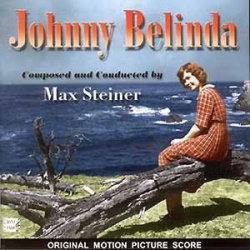
JOHNNY BELINDA – Max Steiner
 GREATEST SCORES OF THE TWENTIETH CENTURY
Original Review by Craig Lysy
Author Elmer Blaney Harris wrote a story titled “Johnny Belinda” in 1934 and tried unsuccessfully to secure studio backing to bring his creation to the big screen. Thwarted, he opted to instead pursue a Broadway production and the play had a successful run from 1940 – 1941. This rekindled his hope and he again approached MGM to advocate for a film adaptation, but executives were still wary of its subject matter, which involved rape. Subsequent efforts to obtain support from independent film producers also failed, but in 1946 Warner Brothers Studio producer Jerry Wald took renewed interest in the play and convinced CEO Jack Warner to purchase the film rights for $50,000. He was given the reins to produce the film with a $1.6 million budget, Jean Negulesco was hired to direct, and Allen Vincent and Irma von Cabe were tasked with writing the screenplay. A fine cast was hired with Jane Wyman as Belinda MacDonald, Lew Ayres as Dr. Robert Richardson, Stephen McNally as Locky McCormick, Charles Bickford as Black “Mac” MacDonald, and Agnes Moorehead as his sister Aggie MacDonald. Read more…
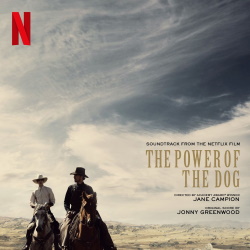
THE POWER OF THE DOG – Jonny Greenwood
 Original Review by Jonathan Broxton
The Power of the Dog is the latest film by acclaimed director Jane Campion. It’s adapted from the 1967 novel of the same name by Thomas Savage, and is ostensibly a western – it’s set on a remote cattle ranch in Montana in 1925 – but that’s not really what the film is about. It’s a film about relationships; between brothers, between lovers, between mothers and sons. It’s also a film about toxic masculinity – what it means to be a man in those times, and the lengths to which one will go to prove your masculinity to others. It’s a film about loneliness and isolation – both physically in terms of geography, but also emotionally, and what that does to a person. And, ultimately, it’s an exploration of gender and sexuality in that harsh, bleak setting, and how all those things manifest in the inter-personal dynamics of the people experiencing them. Read more…
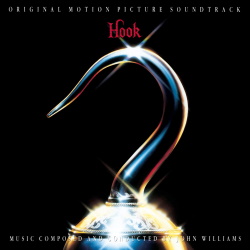
HOOK – John Williams
 THROWBACK THIRTY
GREATEST SCORES OF THE TWENTIETH CENTURY
Original Review by Jonathan Broxton
There have been dozens of theatrical and cinematic adaptations of J. M. Barrie’s classic fairy tale Peter Pan in the years since it was first published in the early 1900s, but it wasn’t until Steven Spielberg came along that there was a sequel. Hook was written by Jim Hart, Nick Castle, and Malia Scotch Marmo, and is set many years after the original story. Peter Pan has grown up and forgotten all about his adventurous childhood; he is now Peter Banning, and a successful lawyer in San Francisco, but he neglects his wife Moira and his children Jack and Maggie. In a last ditch attempt to save his marriage he agrees to a family vacation in London with Moira’s grandmother Wendy – the same Wendy who loved Peter when she was a girl, and who is now an old woman. However, everything changes when Peter’s old nemesis Captain Hook kidnaps his children, and Peter is forced to return to Neverland, reunite with Tinker Bell and the Lost Boys, and remember his birthright, in order to save them. Read more…
Under-the-Radar Round Up 2021, Part 5
 Original Reviews by Jonathan Broxton
2021 is almost over and, as the world of mainstream blockbuster cinema and film music continues to recover from the COVID-19 Coronavirus, we must again look to smaller international features not as reliant on massive theatrical releases to discover the best new soundtracks. As such I am very pleased to present the next installment in my ongoing series of articles looking at the best “under the radar” scores from around the world. The five titles included here represent some of the best film music heard this year to date, and include a sweeping religious-themed biopic from Spain, two historical epics from China (scored by American composers), a Japanese murder-mystery sequel, and an emotional drama score from Poland set in Auschwitz.
HAMLET – William Walton
 GREATEST SCORES OF THE TWENTIETH CENTURY
Original Review by Craig Lysy
Producer, director, and actor Laurence Olivier had achieved critical acclaim and commercial success with his film adaptation of Shakespeare’s play Henry V in 1944. He decided to adapt another of the Bard’s plays and chose Hamlet for his second film. He would produce, direct and star in the film and secured the necessary financing from the British production company Two Cities, who provided a budget of £527,530. For the cast, joining him as Hamlet, would be Basil Sydney as Claudius, Eileen Herlie as Gertrude, Norman Wooland as Horatio, Felix Aylmer as Polonius, Terrence Morgan as Laertes, and Jean Simmons as Ophelia. Olivier also provided the voice of the ghost King. Read more…
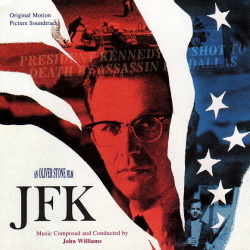
JFK – John Williams
 THROWBACK THIRTY
Original Review by Jonathan Broxton
The assassination of US president John F. Kennedy in Dallas, Texas, in November 1963 was one of the defining moments of twentieth century American history. History books state that he was killed by a lone gunman, Lee Harvey Oswald, who was himself murdered by local Dallas businessman Jack Ruby while in custody just a day or so later. Oswald’s true motive has never been categorically established, and in the years since the event a series of conspiracy theories have emerged – that Oswald was a ‘patsy’ working for the Russians, that there were additional shooters who have never been identified located on a nearby ‘grassy knoll,’ and even that Kennedy’s vice president Lyndon Johnson was somehow involved as part of a coup for him to seize power. Many of these theories are examined in great detail in director Oliver Stone’s film JFK, which looks at the events leading up to, during, and after the assassination, and then focuses deeply on the subsequent investigation by former district attorney Jim Garrison, as well as the official congressional commission led by chief justice Earl Warren. The film is a dense, complicated, intricate film that offers plenty of theories, conjecture, and opinion, but never really settles on a decision as to what really happened, although Stone heavily implies that he believes that the conspiracy goes much deeper than the official investigation concluded. Read more…
GHOSTBUSTERS: AFTERLIFE – Rob Simonsen
 Original Review by Jonathan Broxton
WARNING: THIS REVIEW CONTAINS PLOT SPOILERS. IF YOU HAVE NOT YET SEEN THE FILM, YOU MIGHT WANT TO CONSIDER WAITING UNTIL AFTER YOU HAVE DONE SO TO READ IT.
Despite the critical and commercial failure of the female-led reboot in 2016, the Ghostbusters franchise that began in 1984 continues to show a surprising amount of longevity. This latest film, Ghostbusters: Afterlife, essentially ignores everything that happened in the 2016 film and is a direct sequel to 1989’s Ghostbusters II. The film stars Carrie Coon as Callie, a single mom who moves with her two precocious kids Phoebe (McKenna Grace) and Trevor (Finn Wolfhard) to a dilapidated house in rural Oklahoma following the death of her father. Phoebe meets and bonds with local high school science teacher Gary Grooberson (Paul Rudd), who is investigating unusual seismic activity under the town, and makes friends with a nerdy kid named Podcast (Logan Kim) who… um… makes podcasts. Eventually it is revealed that Callie’s father was Egon Spengler, one of the original ghostbusters, and that he moved to Oklahoma as the town appeared to be the epicenter of significant ghostly activity. Picking up her grandfather’s mantle, Phoebe makes some shocking discoveries of her own, and vows to continue his work and save the world. Read more…
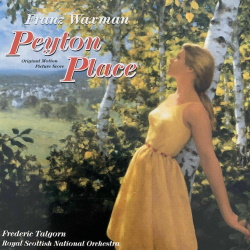
PEYTON PLACE – Franz Waxman
 GREATEST SCORES OF THE TWENTIETH CENTURY
Original Review by Craig Lysy
20th Century Fox producer Jerry Wald observed the enormous popularity of the novel Peyton Place by Grace Metalious, which sold 60,000 copies in the first ten days and soared to the top of the New York Times best sellers list, where it would remain for over a year. He convinced studio executives to back a film adaptation and purchased the film rights for $250,000. John Michael Hays was hired to adapt the novel, which ended up causing great controversy with the author. The story offers a sordid tale of moral hypocrisy and turpitude, which features scandals, murder, suicide, and incest. Hays was forced to sanitize the novel’s most lurid elements due to content restrictions imposed by the notorious Hayes Code. This “sanitation” enraged Metalious who would publicly deride the film, while taking her $400,000 share of the profits. Mark Robson was tasked with directing and provided a budget of $2.0 million. An excellent cast was assembled, which included Lana Turner as Constance MacKenzie, Diane Varsi as Allison MacKenzie, Hope Kange as Selena Cross, Arthur Kennedy as Lucas Cross, Lee Philips as Michael Rossi, Lloyd Nolan as Dr. Matthew Swain, Russ Tamblyn as Norman Page and Terry Moore as Betty Anderson. Read more…

Shop at the Movie Music UK Store

Member of the

 MOVIE MUSIC UK