Archive
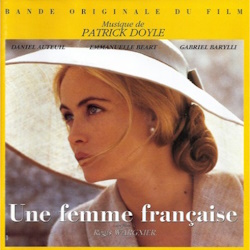
UNE FEMME FRANÇAISE – Patrick Doyle
 THROWBACK THIRTY
Original Review by Jonathan Broxton
Une Femme Française is a French romantic drama film co-written and directed by Régis Wargnier, starring Emmanuelle Béart and Daniel Auteuil. The story follows Jeanne (Béart), a passionate and free-spirited woman, who marries Louis (Auteuil), a devoted but rigid French army officer, in the early 1940s. Soon after their marriage, Louis is sent off to fight in World War II, leaving Jeanne alone for several years; she struggles with loneliness and eventually engages in various torrid romantic and sexual affairs, seeking love and companionship in his absence. When Louis finally returns, he discovers Jeanne’s infidelities but remains deeply in love with her, and they attempt to rebuild their marriage, but the emotional wounds and social constraints of the time make it difficult. Over the course of several decades their relationship is tested by Louis’ military deployments, societal expectations, and Jeanne’s unrelenting desire for independence and passion – including an extensive affair a wealthy industrialist in post-war Berlin – all of which combined to offer a deeply emotional portrayal of a woman torn between personal fulfillment and societal norms. Read more…
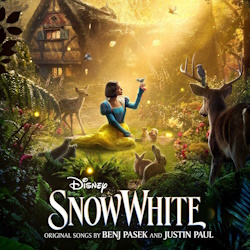
SNOW WHITE – Jeff Morrow, Benj Pasek, Justin Paul
 Original Review by Jonathan Broxton
In 1937 producer Walt Disney and his team of artists made history when they released Snow White and the Seven Dwarfs, the world’s first ever feature-length animated motion picture. It was based on the famous fairy tale ‘Schneewittchen’ by Jacob and Wilhelm Grimm, and tells the story of a kind and beautiful princess who is abused by her wicked stepmother, the Queen. When the Queen’s magic mirror announces that Snow White, and not the Queen, is the ‘fairest of them all,’ the jealous and vengeful Queen banishes Snow White to the forest to be killed by a huntsman; however, the huntsman takes pity on Snow White and secretly releases her, and she eventually begins a new life with seven dwarf miners who live nearby. However, when the Queen learns that Snow White is still alive, she hatches a plan: to poison Snow White with an enchanted apple, which will place her in a death-like sleep, from which she can be awakened only by true love’s kiss. Read more…
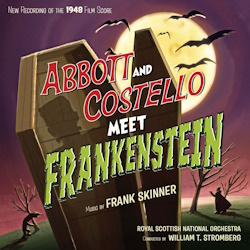
ABBOTT AND COSTELLO MEET FRANKENSTEIN – Frank Skinner
 MOVIE MUSIC UK CLASSICS
Original Review by Craig Lysy
Studio executives at Universal conceived of an audacious new film featuring their star comedians Abbott and Costello, which would bring them into contact with Frankenstein’s monster, Dracula, the Wolfman, the Mummy and the Invisible Man. Lou Costello was singularly unimpressed with the script, but relented when he was offered $50,000 and informed that his friend Charles Barton would be directing. Robert Arthur was placed in charge of production with a $759,524 budget, Charles Barton would direct, and Robert Lees, Frederic Rinaldo and John Grant were tasked with writing the screenplay. For the cast, Bud Abbott would play Chick Young and Lou Costello would play Wilbur Grey. Joining theme would be Lon Chaney as Lawrence Talbot (The Wolfman), Béla Lugosi as Dr. Lejos (Dracula), Glenn Strange as Frankenstein’s monster, and Lenore Aubert as Sandra Mornay. Read more…
THE ELECTRIC STATE – Alan Silvestri
 Original Review by Jonathan Broxton
There are a lot of similarities between The Electric State and Ready Player One. Both are based on highly respected and popular written source material – The Electric State is adapted from a graphic novel by Simon Stålenhag, Ready Player One was adapted from a novel by Ernest Cline. Both stories feature a great deal of period pop culture nostalgia seen from a point in a dystopian future. Both movies are directed by filmmakers with tremendously successful records at the box office: Ready Player One by the legendary Steven Spielberg, The Electric State by Anthony Russo and Joe Russo, whose films include MCU blockbusters Captain America: The Winter Soldier, Captain America: Civil War, Avengers: Infinity War, and Avengers: Endgame. And both films have received scathing reviews, from critics and audiences alike; one recent review in The AV Club eviscerated The Electric State, saying that the Russos had “crafted a crass commercialist product that both misunderstands and betrays its source material.” Read more…
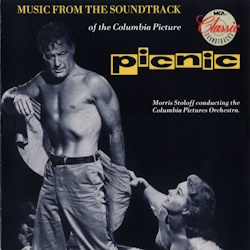
PICNIC – George Duning
 GREATEST SCORES OF THE TWENTIETH CENTURY
Original Review by Craig Lysy
Columbia Pictures took notice of the enormous success of the Broadway play “Picnic” by William Inge, which opened on February 19, 1953 at the Music Box Theater, ran for 477 performances, and won the Pulitzer Prize in Drama in 1953. The studio purchased the film rights in 1953 for $350,000, Fred Kohlmar was placed in charge of production with a budget of $3 million, Joshua Logan, the director of the Broadway stage production was tasked with directing, and Daniel Taradash joined William Inge in writing the screenplay. For the cast, the studio made the controversial decision to cast 37 year old William Holden, their marquee star, as 21 year old Hal Carter, joining him would be Kim Novak as Madge Owens, Rosalind Russel as Rosemary Sydney, Betty Field as Flo Owens, Cliff Robertson as Alan Benson, Nick Adams as Bomber, and Susan Strasberg as Millie Owens. Read more…
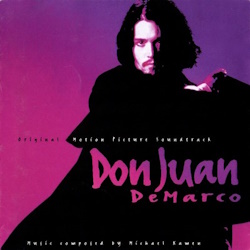
DON JUAN DEMARCO – Michael Kamen
 THROWBACK THIRTY
Original Review by Jonathan Broxton
Don Juan DeMarco is a romantic drama written and directed by Jeremy Leven, based on his own short story, Don Juan DeMarco and the Centerfold. The plot follows a mysterious young man who believes he is Don Juan, the figure from Spanish literature who presents himself as the world’s greatest lover. After a dramatic suicide attempt, he is placed in a psychiatric hospital under the care of Jack Mickler, a caring doctor nearing retirement. Mickler is intrigued by the young man’s passionate and elaborate tales of romance, seduction, and adventure, and as he listens to his stories rather than dismissing them outright he is encouraged to rediscover the passion in his own life, particularly in his marriage to his wife Marilyn. As the film unfolds, it becomes ambiguous whether Don Juan is truly delusional or if there is some deeper truth to his claims; either way, his influence ultimately revitalizes not only Mickler’s marriage but also the lives of others around him, and ultimately ‘Don Juan’ is allowed to leave to continue his life as an enigmatic and romantic figure. Read more…
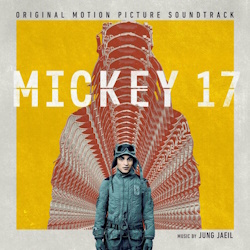
MICKEY 17 – Jae-Il Jung
 Original Review by Jonathan Broxton
After Korean director Joon-Ho Bong won multiple Oscars for his film Parasite in 2019 many people wondered what he would do as a follow-up to that success. The answer is Mickey 17, a genre-defying sci-fi/action/comedy based on the novel by Edward Ashton. Set in a dystopian future, the plot follows a man named Mickey who joins a space colony expedition to a distant planet called Niflheim where he is employed as an “expendable” – a disposable human worker who is intentionally allowed to die for research purposes, but who is immediately ‘re-born’ as a clone of himself the next day, with all his memories and personality intact. The film stars Robert Pattison as Mickey, Naomi Ackie as Mickey’s girlfriend Nasha, and Steven Yeun as Mickey’s friend Timo, and features Toni Collette and Mark Ruffalo in major supporting roles as the sinister husband-and-wife leaders of the Niflheim expedition. Read more…
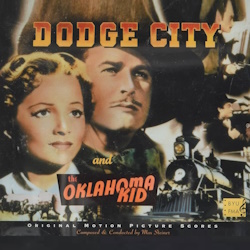
DODGE CITY – Max Steiner
 GREATEST SCORES OF THE TWENTIETH CENTURY
Original Review by Craig Lysy
In 1937 Studio executive Jack Warner decided to join the Western genre bandwagon following Paramount Pictures commercial success with “The Texas Rangers” (1936) and “The Plainsman (1936). In 1938 they believe that they had struck gold when they came across a story “Dodge City” by screen writer Robert Buckner. They purchased the film rights, Hal B. Wallis was assigned production with a $1.06 million budget, Michael Curtiz was tasked with directing, and Buckner would write the screenplay. Wallis struggled to find a leading man for the role of Wade Hutton, and decided to roll the dice with thirty-year-old Errol Flynn. Joining Flynn would be a fine cast, which included Olivia de Haviland as Abbie Irving, Ann Sheridan as Ruby Gilman, Alan Hale as Rusty, Henry O’Neill as Colonel Greenville M. Dodge, Bruce Cabot as Jeff Surrett, Victor Jory as Yancy, and Frank McHugh as Joe Clemens. Read more…
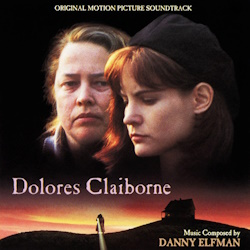
DOLORES CLAIBORNE – Danny Elfman
 THROWBACK THIRTY
Original Review by Jonathan Broxton
Dolores Claiborne is a psychological drama-thriller directed by Taylor Hackford, adapted by Tony Gilroy from the 1992 novel by Stephen King. The story centers on the titular character, played by Kathy Bates, who is accused of murdering Vera Donovan, her wealthy, elderly employer on a remote Maine island. The investigation brings Dolores’s estranged daughter, Selena St. George (Jennifer Jason Leigh), back to the island. Selena is a troubled New York journalist with a complicated history with her mother, marked by years of resentment. As the investigation unfolds, the film shifts between the present day and flashbacks to the 1970s, gradually revealing the dark events that shaped Dolores and Selena’s relationship – specifically, the horrific abuse that Dolores endured at the hands of her alcoholic husband, Selena’s father. Read more…
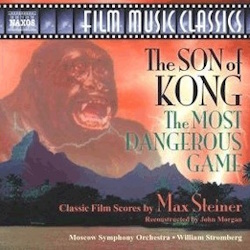
THE SON OF KONG – Max Steiner
 GREATEST SCORES OF THE TWENTIETH CENTURY
Original Review by Craig Lysy
Given the tremendous commercial success of King Kong in 1933, RKO executives decided to milk the cash cow and make an immediate sequel. Merian C. Cooper and Ernest B. Schoedsack, the producers and directors of the first film were asked to again manage production, however Cooper’s enthusiasm was dampened when he was provided with a budget of only $269,000, which was half the budget of original, with the caveat that they had to have it in theaters within six months, for a Christmas 1933 release. Ruth Rose was tasked with writing the screenplay. She decided that the sequel could not duplicate the success of the first film, and so she made a creative decision; “If you can’t make it bigger, make it funnier”. The cast would include Robert Armstrong, who would reprise his role as Carl Denham. Joining him would be Helen Mack as Hilda Petersen, Frank Reicher as Captain Englehorn, John Marston as Nils Helstrom, Victor Wong as Charlie, and Ed Brady as Red. Read more…
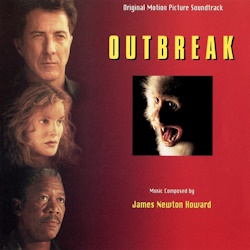
OUTBREAK – James Newton Howard
 THROWBACK THIRTY
Original Review by Jonathan Broxton
Outbreak is a medical disaster thriller directed by Wolfgang Petersen, inspired by Richard Preston’s 1994 nonfiction book The Hot Zone. The story begins when a highly contagious and lethal virus, named Motaba, is discovered in Zaire in 1967. The U.S. military secretly destroys the infected village to prevent its spread but keeps the virus as a potential bioweapon. Years later, the virus resurfaces when an illegally smuggled monkey carrying Motaba is brought into the United States. The monkey ends up in a small California town, where the virus mutates into an airborne strain, making it even deadlier; the disease spreads rapidly, causing severe hemorrhagic fever and killing its victims within days. U.S. Army virologist Colonel Sam Daniels (Dustin Hoffman) and his team, including his ex-wife Dr. Roberta Keough (Rene Russo), race against time to find a cure. However, their efforts are hindered by General Donald McClintock (Donald Sutherland), who wants to suppress the outbreak to protect the military’s bioweapons program. As the town is placed under martial law and the military considers firebombing it, Daniels and his team try to track down the host monkey and develop a cure just in time to prevent mass destruction. Read more…
PRESENCE – Zack Ryan
 Original Review by Jonathan Broxton
Presence is the latest film from the highly eclectic filmmaker Steven Soderbergh, whose efforts over the years have veered from the mainstream (Out of Sight, Erin Brockovich, Ocean’s Eleven, Ocean’s Twelve, Magic Mike), to the arthouse (Sex Lies and Videotape, Solaris), to the boldly experimental (The Girlfriend Experience). Presence sort of blurs the lines between all three; essentially a meditation on death and grief dressed up with horror/thriller overtones, the film is told from the point of view of ‘the presence,’ a spectral poltergeist-like figure that haunts a house that has just become the new home of a suburban family – mom Lucy Liu, dad Chris Sullivan, and their children Callina Liang and Eddy Maday. To reveal more about the plot would be an injustice, suffice to say that the film has been broadly praised for its technical elements, its performances, and for the philosophical undertones of writer David Koepp’s screenplay. Read more…
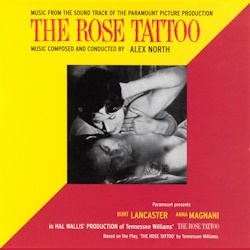
THE ROSE TATTOO – Alex North
 GREATEST SCORES OF THE TWENTIETH CENTURY
Original Review by Craig Lysy
Renowned director Hal Wallis saw opportunity with the Broadway production of “The Rose Tattoo” by Tennessee Williams, which opened at the Martin Beck Theater in New York on February 3, 1951, ran for 306 performances, and won four Tony Awards. He stated in his memoirs that he saw its premiere and “knew at once that I had to buy it. It was sure to be a great success. Audiences would identify with its earthiness, its sexuality, its deeply felt emotions and naturalistic dialogue.” He purchased the film rights, and sold his vision to Paramount Pictures, who placed him in charge of production. Daniel Mann was hired to direct, and author Tennessee Williams would write the screenplay. For the cast, Williams was insistent on Italian actress Anna Magnani playing Serafina Delle Rose, and this would be her first English speaking role. Joining her would be Burt Lancaster as Alvaro Mangiacavallo, Marissa Pava as Rosa Delle Rose, and Ben Cooper as Jack Hunter. Read more…
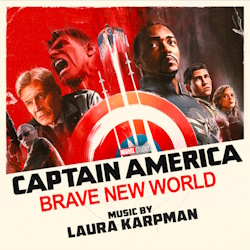
CAPTAIN AMERICA: BRAVE NEW WORLD – Laura Karpman
 Original Review by Jonathan Broxton
WARNING: THIS REVIEW CONTAINS PLOT SPOILERS. IF YOU HAVE NOT YET SEEN THE FILM, YOU MIGHT WANT TO CONSIDER WAITING UNTIL AFTER YOU HAVE DONE SO TO READ IT.
Somehow, over the course of some 17 years, we have now racked up an astonishing 35 films in the Marvel Cinematic Universe, the enormously ambitious interlocking series of super-hero films that first began with Iron Man back in 2008. If you also include the 15 or so multi-season live action TV shows, plus the various animated shows and one-off specials, we are now at a point where viewers have to keep track of more than 100 hours of story in order to understand what is happening – and, to be frank, it’s starting to become a chore. Read more…
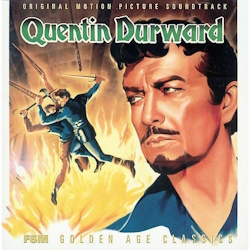
QUENTIN DURWARD – Bronislau Kaper
 GREATEST SCORES OF THE TWENTIETH CENTURY
Original Review by Craig Lysy
In 1951 MGM sought to capitalize on the huge commercial success of Robert Taylor in “Ivanhoe” with him starring in another period piece. To that end they chose to adapt the 1823 novel “Quentin Durward” by Sir Walter Scott. Pandro S. Berman was again assigned production with a $2.47 million budget, Robert Ardey and George Frooeschel were hired to write the screenplay, and Richard Thorpe was tasked with directing. For the cast, Robert Taylor would star in the titular role as the hero Quentin Durward, with Kay Kendall as Isabelle, Countess of Macroy, Robert Morley as King Louis XI, George Cole as Hayraddin, Alec Clunes as Charles the Bold, Duke of Burgundy and Duncan Lamont as Count Philip De Creville. Read more…

Shop at the Movie Music UK Store

Member of the

 MOVIE MUSIC UK