Archive
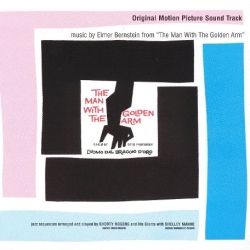
THE MAN WITH THE GOLDEN ARM – Elmer Bernstein
 GREATEST SCORES OF THE TWENTIETH CENTURY
Original Review by Craig Lysy
Actor John Garfield came across Nelson Algren’s novel The Man with the Golden Arm (1949) and was inspired to bring it to the big screen. He purchased the film rights and planned to take on the lead role of Frankie. He immediately ran into censoring problems as the Production Code Authority (PCA) and the Catholic National League of Decency (NLD) would not sanction the film because it featured drug trafficking and drug addiction. The film’s fate passed to renowned director Otto Preminger after he was bequeathed the film rights following Garfield’s death in 1952. Preminger related that he was attracted to the story because “I think there’s a great tragedy in any human being who gets hooked on something, whether it’s heroin or love or a woman or whatever.” Like Garfield, Preminger ran into a wall with the PCA and NLD, but he was determined to overcome all obstacles to fulfill his vision. He brought in Algren to adapt his novel, but personality clashes led to Algren’s replacement with screenwriter Walter Newman. Significant changes to the story were made, which led Algren to sue Preminger for the film rights, however the suit was later dropped as Algren could not afford the legal expenses. Read more…
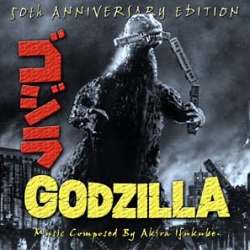
GODZILLA – Akira Ifukube
 GREATEST SCORES OF THE TWENTIETH CENTURY
Original Review by Craig Lysy
Toho studio producer Tomoyuki Tanaka was greatly impressed by the film The Beast From 20,000 Fathoms (1953) and resolved to create a Japanese version. He penned his own script and pitched it to Toho Studio executive Iwao Mori, who signed off on the project. Renowned special effects director Eiji Tsuburaya was hired and affirmed that it was financially and technologically feasible to create the monster, suggesting the use suitmation (an actor in a costume suit) over stop motion animation. Ishirō Honda was given the reigns to direct the film and he selected a fine cast which included Akira Takarada as Captain Hideto Ogata, Momoko Kochi as Emiko Yamane, Akihiko Hirata as Daisuke Serizawa and Takashi Shimura as Dr. Kyohei Yamane. The screenplay underwent several incarnations, evolving over time with contributions from many writers including Tsuburaya, science fiction writer Shigeru Kayama, Takeo Murata, and Honda. Read more…
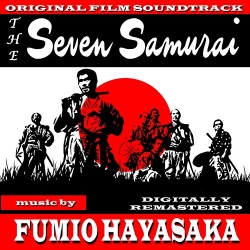
THE SEVEN SAMURAI – Fumio Hayasaka
 GREATEST SCORES OF THE TWENTIETH CENTURY
Original Review by Craig Lysy
Groundbreaking Japanese director Akira Kurosawa was researching samurai lore for a planned film that would focus on a single day in a samurai’s life. He abandoned this idea when Toho Studio producer Sōjirō Motoki presented him with a tale, which intrigued him – aggrieved farmers hiring samurais to protect their village from bandits. He crafted a script with the assistance of Shinobu Hashimoto and Hideo Oguni, and secured Motoki’s blessings to proceed. This would mark Kurosawa’s first foray into a samurai film and he recruited a fine cast to realize his vision. He meticulously researched historical samurai to create identities for each of the seven. For his seven samurai he brought in Takashi Shimura as Kanbei Shimada, a war-weary ronin who leads the group; Yoshio Inaba as Gorōbei Katayama, a master archer and second in command; Daisuke Katō as Shichirōji, Shimada’s former lieutenant; Sejii Miyaguchi as Kyūzō, a skilled swordsman; Minoru Chiaki as the amiable Heihachi Hayashida; Isao Kimura as Katsushiro Okamoto, a young and untested warrior; and lastly Toshiro Mifune as the comic Kikuchiyo, a commoner pretending to be a samurai who eventually earns the right to be called one. Read more…
ON THE WATERFRONT – Leonard Bernstein
 GREATEST SCORES OF THE TWENTIETH CENTURY
Original Review by Craig Lysy
Director Elia Kazan and novelist/playwright Arthur Miller sought to bring to the big screen a tough and gritty tale of New Jersey longshoremen who struggled to make a living in the late 1940s against mobsters and corrupt union officials. When they could not find any traction with the studios, Miller moved on, but Kazan never gave up on the idea. When he came upon a new screenplay by Budd Schulberg based upon a series of Pulitzer Prize winning articles “Crime on the Waterfront” by Malcolm Johnson, his hopes were rekindled. Well Kazan purchased the film rights and he and Schulberg pitched the screenplay to studio executive Darryl Zanuck of 20th Century Fox, but were rebuffed, with him saying, “Who’s going to care about a bunch of sweaty longshoremen?” Undeterred, Kazan sought out independent producer Sam Spiegel who managed to strike a deal with Columbia Pictures. For the film Kazan brought in a cast for the ages with Marlon Brando as Terry Malloy, Karl Malden as Father Barry, Lee Cobb as Johnny Friendly, Rod Steiger as Charlie Malloy, and Eve Marie Saint as Edie Doyle. Read more…
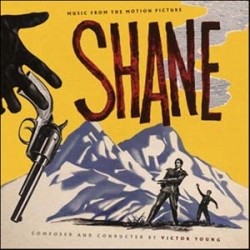
SHANE – Victor Young
 GREATEST SCORES OF THE TWENTIETH CENTURY
Original Review by Craig Lysy
Director George Stevens of Paramount often relied on his son to screen material for future projects. One night George Jr. brought him the novel “Shane” by Jack Schaefer, which he thought was “a really good story”, and counseled him to read it. Well, the storytelling was indeed exceptional and Stevens resolved to bring it to the big screen. He hired A. B. Guthrie Jr. to write the screenplay based on his familiarity with Western lore, and then set out to recruit his cast. His initial choices for the lead roles of Montgomery Clift, William Holden and Katherine Hepburn did not pan out, and so Alan Ladd was cast in the titular role and joined with a fine supporting cast, which included Jean Arthur as Marian Starrett, Van Heflin as Joe Starrett, Brandon deWilde as Joey Starrett, Emile Meyer as Rufus Ryker, and Jack Palance as Jack Wilson. Read more…
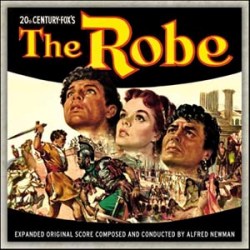
THE ROBE – Alfred Newman
 GREATEST SCORES OF THE TWENTIETH CENTURY
Original Review by Craig Lysy
20th Century Fox Studio chief Darryl Zanuck chose to use “The Robe” to introduce his new creation Cinemascope to the world. Cinemascope used an anamorphic lens that allowed the filming process to create an image of up to a 2.66:1 aspect ratio, almost twice as wide as the industry standard. He hired veteran Henry Koster to direct and adapted the script from the novel by Lloyd Douglas, which he had envisioned for years. “The Robe” is a Biblical epic, a love story and a tale of a man’s struggle for redemption. Marcellus (Richard Burton) is a Roman military tribune from a noble family who offends Caligula, heir to the Roman throne. In retribution he is deployed to Palestine, thus separating him from his life of luxury and his lover Diana (Jean Simmons). Upon his arrival he is given command of the unit charged with executing Jesus Christ, which he dutifully discharges. While drunk he happens to win in a craps game Jesus’ homespun robe after the crucifixion. The death of Jesus affects Marcellus profoundly, and henceforth he is tormented by recurring nightmares, delusions and guilt for his role in his crucifixion. On orders from Tiberius he returns to Palestine in search of the robe, which he believes has bewitched him. He thus begins a personal journey that will lead him to discover faith, forgiveness and ultimately redemption. The film was a huge critical success, winning two Oscars and a Golden Globe for Best Picture. The film and Cinemascope were also a huge commercial success, earning profits seven times that of its production costs. Read more…
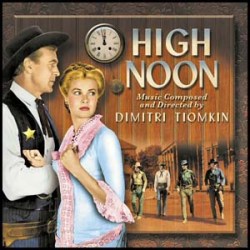
HIGH NOON – Dimitri Tiomkin
 GREATEST SCORES OF THE TWENTIETH CENTURY
Original Review by Craig Lysy
Producers Stanley Kramer and Carl Foreman had long sought to film a Western and saw their opportunity when they came across an inspiring short story “The Tin Star” by John Cunningham. Foreman adapted it for the big screen as High Noon, and hired European director Fred Zinnemann to direct. Veteran actor Gary Cooper was given the lead role of Will Kane. He was joined by Grace Kelly (Amy Fowler), Ian MacDonald (Frank Miller) and Lloyd Bridges (Harvey Pell). The story is set in 1880 in the New Mexico Territory. It is a classic morality play regarding personal honor, civic duty, and a man’s struggle to overcome his fears. Read more…
THE DAY THE EARTH STOOD STILL – Bernard Herrmann
 GREATEST SCORES OF THE TWENTIETH CENTURY
Original Review by Craig Lysy
Producer Julian Blaustein had long sought to make a film that would serve as a metaphor for the dark pall of fear and suspicion, which had fallen over humanity following the onset of the Atomic Age. Unfortunately after reviewing over 200 scripts he was unable to find one that suited him. He managed to obtain backing from Fox Studio Executive Darryl F. Zanuck to hire screenwriter Edmund North to adapt the short story Farewell to the Master (1940) by Harry Bates. From the story Blaustein saw opportunity arise for thoughtful moral commentary against armed conflict. He also hoped that the story’s nuanced subliminal parallels between the alien visitor Klaatu and Jesus Christ would help drive home the message. Veteran director Robert Wise was brought in to manage the project, and a fine cast was selected, including; Michael Rennie as Klaatu, Patricia Neal as Helen Benson, Billy Gray as Bobby Benson, Hugh Marlowe as Tom Stephens and Sam Jaffe as Professor Jacob Barnhardt. Read more…
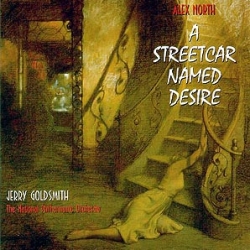
A STREETCAR NAMED DESIRE – Alex North
 GREATEST SCORES OF THE TWENTIETH CENTURY
Original Review by Craig Lysy
Elia Kazan had achieved widespread critical acclaim while directing Tennessee Williams’ play “A Streetcar Named Desire” on Broadway. At the bidding of Williams, he was exhorted to duplicate this success on the big screen. Warner Brothers bought into the idea and purchased the film rights with the proviso that Williams himself write the screenplay. Since Kazan was already quite familiar and comfortable with the Broadway cast, most of them were brought in to reprise their roles, including Marlon Brando as Stanley Kowalski, Kim Hunter as Stella Kowalski and Karl Malden as Harold “Mitch” Mitchell. Studio executives however vetoed the talented Jessica Tandy from the Broadway cast for the lead actress role of Blanche DuBois, preferring to add the star power of Vivian Leigh. Read more…
SUNSET BOULEVARD – Franz Waxman
 GREATEST SCORES OF THE TWENTIETH CENTURY
Original Review by Craig Lysy
Director Billy Wilder and producer Charles Brackett created a brilliant film noir screenplay for Sunset Boulevard, which told the story of a once proud but now aged Hollywood actress who wished to end her seclusion and regain past glory. For the principle actors, after considering Mae West and Mary Pickford for the leading role Gloria Swanson was given the part of Norma Desmond. A young William Holden was selected for Joe Gillis and Erich von Stronheim was cast as Norma’s former husband and now butler Max von Mayerling. The story tells the tale of Joe Gillis, a young screenwriter down on his luck that drives into Desmond’s estate while fleeing a car repo man. Norma, who has written a script to propel her comeback, hires Joe to create a screenplay. She lavishes her wealth and affection on him, which he freely and shamelessly accepts. Ultimately she falls in love with Joe and when he rejects her she shoots him. The story ends as a now elegantly dressed yet mad Norma descends her grand staircase to greet the police. Halfway down she pauses and announces proudly that she is happy to be making films again, ending with “All right, Mr. DeMille, I’m ready for my close-up.” The movie was both a commercial and critical success earning eleven Academy Award nominations, winning three for Best Screenplay, Best Art Direction and Best Film Score. Read more…
THE RED PONY – Aaron Copland
 GREATEST SCORES OF THE TWENTIETH CENTURY
Original Review by Craig Lysy
In the 1940s Republic Pictures was struggling to find its place in the sun, and so made a concerted effort to gain equal status with the major studios of the day. To that end they began to take on serious dramas with renowned directors. Producer-Director Lewis Milestone was hired to bring George Steinbeck’s short story series The Red Pony to the big screen. Steinbeck himself was hired to write the screenplay as the multiple story lines had to be blended into a cogent narrative. Milestone brought in a splendid cast which included Myrna Loy as Alice Tiflin, Robert Mitchum as Billy Buck, Louis Calhern as Grandfather, Sheppherd Strudwick as Fred Tiflin, Peter Miles as Tom Tiflin, and Margaret Hamilton as Teacher. The story is classic Americana, set in the 1930s, and takes place in the Salinas Valley ranching communities of central California. A young boy Tom is gifted a red pony colt by his father Fred. The two are not close and Fred hopes that the gift will strengthen the father-son bond. But instead of seeking help from his father, Tom instead asks stableman Billy to help assist him in caring for the pony and in its training. Read more…
THE THIEF OF BAGDAD – Miklós Rózsa
 GREATEST SCORES OF THE TWENTIETH CENTURY
Original Review by Craig Lysy
Renowned director Alexander Korda had long envisioned embarking on a remake of the 1924 fantasy adventure The Thief of Bagdad. He set his plans into motion early in 1939, selecting German director Ludwig Berger to manage the project. Creative differences however led to Berger’s replacement as well as his composer Oscar Straus. British director Michael Powell was brought in, however when World War II began, he was transferred to the War Office to begin work on a morale-boosting documentary. Because of the Nazi Blitz, Korda was forced to move film production to Hollywood and American director Tim Whelan was tasked with salvaging the film. The original cast was retained, which included; Conrad Veidt as Jaffar, Sabu as Abu, June Duprez as the Princess, John Justin as Ahmed, Rex Ingram as Djinn, Miles Malleson as the Sultan. The story takes inspiration from the classic Arabian tale One Thousand and One Nights, as well as the novel The Tower and the Elephant by Robert Howard, and offers a classic villain, the love story of a handsome young prince and princess, a heroic young boy, magic, and adventure. Read more…
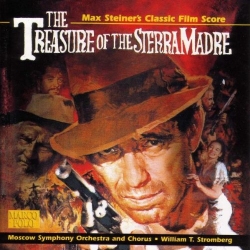
THE TREASURE OF THE SIERRA MADRE – Max Steiner
 GREATEST SCORES OF THE TWENTIETH CENTURY
Original Review by Craig Lysy
Writer-Director John Huston saw an opportunity with the novel Treasure of Sierra Madre (1935) by B. Traven to bring a timeless tale to the big screen. He convinced Warner Brothers studio executives of his vision and purchased the film rights for $6,500 from the reclusive author. He himself wrote the screenplay and he secured a first class cast for the project, which included; Humphrey Bogart as Fred Dobbs, Walter Huston as Howard, Tim Holt as Bob Curtin, Bruce Bennett as James Cody, Barton MacLane as Pat McCormick, Alfonso Bedoya as Gold Hat, and Arturo Soto Rangel as El Presidente. The theme of the story is as old as time itself – a study in human greed explored through the lives of three gold prospectors. Read more…
CAPTAIN FROM CASTILE – Alfred Newman
 GREATEST SCORES OF THE TWENTIETH CENTURY
Original Review by Craig Lysy
20th Century studio executive Darryl F. Zanuck came across the novel Captain From Castile (1945) by Samuel Shellabarger and was captivated by its love story and grand adventure. He paid an astounding $100,000 for the film rights and hired trusted director Henry King to manage the project. Lamar Trotti wrote the screenplay, which had to go through several incarnations to appease the Hayes Commission and the Catholic Church who objected to the novel’s critical portrayal of the Spanish Inquisition. King brought in a fine cast, which included; Tyrone Power as Pedro de Vargas, Jean Peters as Catana Pérez, Cesar Romero as Hernán Cortéz, Lee J. Cobb as Juan García, John Sutton as Diego de Silva, Antonio Moreno as Don Francisco de Vargas, and Thomas Gomez as Father Bartolomé de Olmedo. The story is set in Spain circa 1518 CE and offers a classic romance and adventure. Our hero Pedro de Vargas and his family are opposed to the Spanish Inquisition, which is directed by the diabolical Diego de Silva. Read more…
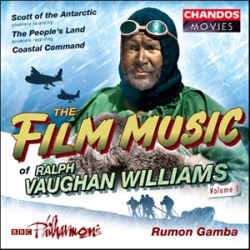
SCOTT OF THE ANTARCTIC – Ralph Vaughan-Williams
 GREATEST SCORES OF THE TWENTIETH CENTURY
Original Review by Craig Lysy
Producer Michael Balcon of Ealing Studios resolved to tell the story of the famous British explorer Robert Falcon Scott, and his ill-fated journey to discover the South Pole. Charles Frend was hired to direct and he brought in a splendid cast which included Sir John Mills as the titular character, James Robertson Justice as Petty Officer Taff Evans, Derek Bond as Captain Oates, Kenneth More as Lieutenant Teddy Evans, John Gregson as Petty Officer Crean, James McKechnie as Surgeon Lieutenant Atkinson, Barry Letts as Apsley Cherry-Garrard, and Christopher Lee as Bernard Day. The screenplay drew by Major Walter Meade and Ivor Montagu extensively from Scott’s personal diaries, while additional dialogue was adapted from novelist Mary Hayley Bell (John Mills’s wife). The expedition takes place in 1911–1912. Scott, who in 1904 initially explored Antarctica, resolved to organize an expedition to discover the South Pole. Initially he is unable to secure adequate funds for the expedition, as the British business class is skeptical. He ultimately manages to secure government funds after an appeal to British pride. Regretfully Scott chose to forgo the traditional method of relying exclusively on dogs, instead choosing to augment his dogs with ponies and motorized sleds. This decision would ultimately contribute to his demise. Read more…

Shop at the Movie Music UK Store

Member of the

 MOVIE MUSIC UK