SPIDER-MAN: BRAND NEW DAY – Michael Giacchino
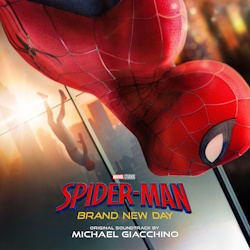 Original Review by Jonathan Broxton
WARNING: THIS REVIEW CONTAINS PLOT SPOILERS. IF YOU HAVE NOT YET SEEN THE FILM, YOU MIGHT WANT TO CONSIDER WAITING UNTIL AFTER YOU HAVE DONE SO TO READ IT.
Spider-Man: Brand New Day is the 38th film in the Marvel Cinematic Universe and the fourth to focus on Spider-Man as the lead character since the reboot prior to Spider-Man: Homecoming in 2017. It again stars Tom Holland as the web-slinging superhero and is a direct sequel to Spider-Man: No Way Home, although it also contains plot strands from Thunderbolts, the Disney+ movie The Punisher: One Last Kill, and (to a lesser extent) Shang-Chi and the Legend of the Ten Rings. The story follows Peter Parker, five years after the events of No Way Home, when Dr. Strange cast a spell that made the world forget that he is Spider-Man – including his girlfriend MJ Watson (Zendaya) and best friend Ned Leeds (Jacob Batalon).
Peter/Spider-Man is now focused on anonymously protecting New York City from street-level crime, but he deeply misses his friends. Things change when a new threat unexpectedly emerges – a telepath who can apparently control minds, has the ability to ‘body hop’ from the consciousness of one person to another, and is apparently fixated on the Department of Damage Control (DODC) prison containing many of the supervillains Spider-Man previously defeated. The film co-stars Sadie Sink, Jon Bernthal, and Tramell Tillman, with special cameos by Florence Pugh, Marisa Tomei, and Mark Ruffalo. It is directed by Destin Daniel Cretton and, at the time of writing, has just broken the record for the biggest opening weekend in US box office history, taking in over $360 million in three days.
The score for Spider-Man: Brand New Day is again by Michael Giacchino, who scored all three previous Spider-Man MCU movies, as well as Doctor Strange, Thor: Love and Thunder, and last year’s standout The Fantastic Four: First Steps. Considering how much music he has written for the MCU in general, and for Spider-Man in particular, over the last decade or so, I would imagine it is quite difficult to come up with new ideas that feel fresh and interesting, but that is exactly what he has done with this score. The biggest change between the Spider-Man we saw in No Way Home and the Spider-Man we see here in Brand New Day has to do with loss; Aunt May has died, MJ and Ned have forgotten him, and he has no remaining connection to any of his friends in the Avengers – so he is, for all intents and purposes, alone.
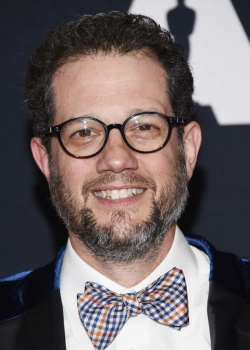 To capture these new circumstances, Giacchino has said in interviews that he set out to write “a sad Spider-Man score,” and while that sounds flippant out of context, Giacchino is accurately describing his musical perspective rather than literally defining the whole film as depressing. The idea was to strip down the musical identity he’d built across the previous three films and make Peter’s isolation audible, and to achieve that he deliberately removed notes from his established Spider-Man theme to represent what Peter has lost after No Way Home. His thinking is essentially that Peter’s life now has significant pieces missing, so the theme itself should feel incomplete too.
As such, in virtually every statement of the Spider-Man theme, it plays in this new truncated version. It’s a clever idea, but as you’re watching the film it’s not something that is immediately obvious, except in the way it gives you the vague feeling that something is ‘off’ about the music in context. It’s only when you actually realize what Giacchino has done that the intellectual thought process behind the score properly reveals itself, and when you listen to it independently, the emotional impact of the change becomes clear. The performances of the theme in the opening cue “Web Letter Days,” and then in numerous subsequent cues, really reveal this emotional depth, with excellent renditions often focused on a solo piano backed by tremolo strings and warm French horns.
However, Giacchino does not rest on this single element of the score, and instead introduces several other themes into the mix to create a surprisingly rich tapestry of music. The main ‘new’ theme is a sort-of love theme that in reality represents Peter’s fractured relationship with MJ and Ned, and the dilemma he faces over whether or not to reintroduce himself to them, knowing that doing so could put them in danger. This new theme is structurally similar to the existing Spider-Man theme – so much so that they can easily be mistaken for one another – and is introduced in “Ned Man Walking,” before appearing later on undulating pianos in “Quick as Flashback”. However, the theme really comes fully to the fore in “Come Fly With Me” and in the first minute or so of “Kiss of the Spider-Man”. The first cue underscores a scene where Peter and MJ web-fly across the city in a sequence that mirrors one from an earlier film where the two characters first fall in love, whereas the latter underscores the moment when MJ and Peter kiss on a rooftop – only for it all to turn out to be a ruse by the film’s main antagonist.
Another idea that Giacchino explores is a motif related to the notion that Peter’s heightened emotional state throughout the film is starting to make his spider mutation stronger, resulting in him developing the ability to produce organic webs inside his body, as well as – more disturbingly – having bouts of rage and anger that cause him to lose control of his emotions and seriously hurt people. This idea is introduced on curious, lightly prancing strings backed by hooting woodwinds in “Peter’s Walk of Shame,” and is explored further with an odd tango-adjacent rhythm in “Strong First Expressions,” while also featuring prominently in the action sequences where Spider-Man fights the Scorpion (“Settling Old Scorpions”) and the Hand ninjas (“Fight the Hand That Bleeds You”).
The aforementioned main antagonist – and here be major spoilers – is Jean Grey, a mutant with psionic abilities including telekinesis and telepathy, who previously appeared in the X-Men franchise, portrayed by Famke Janssen and then by Sophie Turner. This version of Jean, as portrayed by Sadie Sink, exists in a different multiverse timeline from the established X-Men version, and here she is trying to infiltrate and destroy the Department of Damage Control as revenge for its role in killing her sister, Sara, who was also a strong mutant telepath. Jean is not a typical antagonist because, in many ways, her actions are justified, if not necessarily the methods she uses; as such, Giacchino addresses her character musically by having both a ‘Good Jean’ theme and a ‘Bad Jean’ theme, and using one or the other depending on what the character is doing or feeling.
The ‘Bad Jean’ theme is an unusual electro-acoustic whine that has a sense of both danger and mystery to it; you can hear it throughout “Possession is Nine-Tenths of the Brawl” and “The Speed of Thought,” with dissonant harshness in the second half of “Kiss of the Spider” when the possessed MJ trick is revealed, prominently in the dramatic “To the V-Max,” in an excellent action variant in “Fight the Hand That Bleeds You” when Peter is fighting the Hand ninjas while they are being possessed, and then throughout “I Spider with My Little Eye”. The performance in “Kiss of the Spider-Man” is especially interesting because it intentionally warps and corrupts the powerful emotions Peter feels as he thinks, for a moment, that he has genuinely reconnected with MJ, only for that connection to be cruelly ripped away from him. Parts of that cue remind me of the theme Danny Elfman wrote for Michelle Pfeiffer’s Catwoman in Batman Returns – a seductive romance that goes all wrong.
Meanwhile, the ‘Good Jean’ theme deals empathetically with her sense of loss over her sister, and sees Giacchino invert notes and change the key of the motif to give it a more sympathetic tone. The ‘Good Jean’ theme appears prominently in “The Morning Aftermath,” throughout “Big Sister Energy” as part of a flashback to happier times between Jean and Sara, and then in “Mi Cabeza Su Cabeza,” where the theme combines beautifully with an appropriately poignant statement of the Aunt May Loss Motif from No Way Home.
The final cool new theme is for Jon Bernthal’s character, The Punisher, who becomes Spider-Man’s reluctant ally later in the film. The Punisher has appeared in several MCU projects before, but Giacchino doesn’t appear to quote any of the music that John Paesano, Tyler Bates, or Kris Bowers wrote for the character, instead giving him a whole new musical identity here. The Punisher theme appears mostly embedded in action cues, accompanying significant things the character does; you can hear it prominently from 2:24 onwards in “A Good Day to Dive,” at 1:02 in “Always Hulking About,” and at the beginning of “A Brave Neural World,” and it’s always a fun moment when it appears – a dark, menacing, brassy motif perfect for a vigilante anti-hero.
Speaking of action music, Giacchino’s work here is as rich, dense, and complicated as it always is, with cues like “A Good Day to Dive,” “Possession is Nine-Tenths of the Brawl,” the guttural “Settling Old Scorpions,” the nervous and jittery “The Speed of Thought,” the sometimes quite brutal “Always Hulking About,” the spiky and aggressive “Damage Control to Major Bomb,” and then the entire finale from “A Brave Neural World” onwards all being very impressive. The music is fast and intricate, full of flashing string runs, powerful brass clusters, and thunderous percussion hits, and Giacchino embeds numerous references to all the major character themes throughout these cues, often writing contrapuntally when two characters are facing off one-on-one. The action versions of the new truncated Spider-Man theme actually feel more ominous here, and are especially satisfying when they appear.
As the score builds to its climax, and Peter/Spider-Man starts to come to terms with his new reality – and even embrace it – Giacchino suddenly abandons the entire ‘deconstructed Spider-Man’ idea and returns to the full theme in all its glory. The sweeping, stirring performance of the full main theme at the beginning of “I Spider with My Little Eye” is rousing and anthemic, especially as the orchestra is framed by the sparkling electronics of the ‘Good Jean’ theme. There is an unusual electronic texture and pulsating tone to the sound of “Say Hero to My Little Friend,” and then, in the conclusive “Better Off Ned,” Giacchino adds a sheen of string-based optimism to the pianos in the final scene where Ned and Peter properly reconnect inside a coffee shop.
The end credits actually begin with a performance of the song “Oh Yeah?” by Steve Lacy (which is not on the soundtrack album), but this quickly gives way to the elongated “Suite New Day,” which – somewhat unexpectedly – embraces a distinct electronic/synth vibe that feels like something a composer like Vangelis, Angelo Badalamenti, or 1980s Maurice Jarre might have written for a movie like this, expanding on the sound heard in “Say Hero to My Little Friend.” The suite runs through several minutes of this intimate, quietly reflective electronic groove, including some passages that make prominent use of electric guitars and a rock drum kit, but gradually it becomes more symphonic, climaxing with a superb full rendition of the ‘normal’ Spider-Man theme that sets the scene for the upcoming Avengers: Doomsday in December.
Overall, Spider-Man: Brand New Day is another excellent entry in Michael Giacchino’s increasingly impressive body of work for the MCU, and one which finds him breathing new life into musical ideas that have now been part of his repertoire for almost a decade. The decision to deconstruct his familiar Spider-Man theme to reflect Peter’s loneliness and sense of loss is both intellectually clever and emotionally effective, while the wealth of new material for Jean Grey, Peter’s mutation, his fractured relationships with MJ and Ned, and the Punisher gives the score a thematic richness that goes well beyond simply revisiting familiar territory. There is plenty of the intricate, energetic action writing that Giacchino does so well, but it is the more introspective material – and especially the eventual restoration of the Spider-Man theme in all its heroic glory – that gives the score its emotional heart. The unexpected electronic textures of the finale provide one last intriguing wrinkle and suggest that Giacchino is still finding new ways to explore this musical world. After four Spider-Man scores, it would have been easy for the series to begin sounding repetitive or overly familiar, but Brand New Day is anything but; it is thoughtful, exciting, emotionally resonant, and thematically rewarding, and is another highly recommended addition to Giacchino’s Marvel canon.
Buy the Spider-Man: Brand New Day soundtrack from the Movie Music UK Store
Track Listing:
- Web Letter Days (2:39)
- A Good Day to Dive (4:11)
- Possession is Nine-Tenths of the Brawl (3:49)
- What’s Your Damage Control (0:40)
- The Metzger Set (1:38)
- Ned Man Walking (1:10)
- Quick as a Flashback (3:18)
- Peter’s Walk of Shame (2:12)
- Settling Old Scorpions (3:53)
- Strong First Expressions (0:57)
- The Speed of Thought (5:00)
- Come Fly With Me (0:31)
- Kiss of the Spider-Man (4:59)
- Always Hulking About (3:47)
- Damage Control to Major Bomb (6:14)
- The Morning Aftermath (1:42)
- Mask Me No More Questions (2:12)
- Big Sister Energy (2:58)
- A Brave Neural World (2:28)
- To the V-Max (2:10)
- Fight the Hand That Bleeds You (2:55)
- I Spider with My Little Eye (3:47)
- Mi Cabeza, Su Cabeza (4:26)
- Say Hero to My Little Friend (2:37)
- Better Off Ned (0:55)
- Suite New Day (6:15)
Sony Classical (2026)
Running Time: 77 minutes 15 seconds
Music composed by Michael Giacchino. Conducted by Cliff Masterson. Orchestrations by Jeff Kryka and Logyn Okuda. Recorded and mixed by Peter Cobbin and Kirsty Whalley. Edited by Paul Apelgren and Alex Levy. Album produced by Michael Giacchino.
Leave a Reply

Shop at the Movie Music UK Store

Member of the


I guess I’m like old, as I don’t enjoy it at all. No themes like Elfman’s or Horner’s. This is a crap no matter how they “frame” or explain it.
I also think that this artificially mediocre and/or no-themeing-at-all approach is an intentional push to call for a new beginning in film music later. It is on purpose to not provide valuable OSTs nowadays. Just some background music – like 80’s snyths – well, wow.
And after a while, the real soundtracks will arrive again like something new. WOW!
I hope I live to see it, or maybe I hope I don’t.