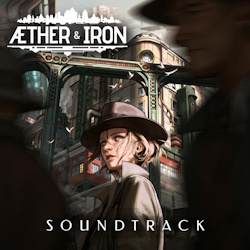
AETHER & IRON – Christopher Tin, Alex Williamson
 GAME ZONE REVIEW
Original Review by Jonathan Broxton
Aether & Iron is a new narrative role-playing game (RPG) from publisher Seismic Squirrel, creative director Duane Stinnett, and narrative director Tyler Whitney. The game is set in an alternate 1930s New York reshaped by the discovery of a new element called ‘aether,’ which has allowed for the development of anti-gravity technology and has transformed the Big Apple into a towering vertical city. The story follows a character named Gia, a smuggler who moves in a world of crime syndicates and dirty political intrigue; player choices directly influence not just her story, but the broader fate of the city as a whole. The game is reportedly visually spectacular, stylish, and striking, with New York-coded steampunk elements that give the whole thing a rich, appealing palette.
This stylishness also translates to the music, which was composed by Christopher Tin and Alex Williamson. Tin should be fairly well known in film music circles; he’s a Chinese-American composer from the San Francisco Bay Area, and is a renowned composer who spans the classical, film music, and game music worlds. As a game composer, he is best known for his work on the Civilization video game series, specifically the main theme “Baba Yetu” from Civilization IV, which became the first piece of video game music to win a Grammy Award in 2011. He jointly won my MMUK game score award in 2017 for his work on Civilization VI with Geoff Knorr, Roland Rizzo, and Phill Boucher, and he was nominated for another Grammy in 2023 for his score for the game Old World. Alex Williamson is less well known; I believe this is the first score I have heard from him, although he has provided additional music for several Civilization games in the past.
The bottom line is this: I rarely review video game scores, and when I do, they tend to be something very special indeed. In fact, the last game score I reviewed was Grant Kirkhope’s Mario + Rabbids: Kingdom Battle in 2017, and before that it was Austin Wintory’s Assassin’s Creed: Syndicate in 2015, so for me to be reviewing Aether & Iron at all should be an indication of just how good it is. It is, in a word, spectacular.
 In discussing the score, Tin and Williamson talk about their desire to strike a balance between jazz and orchestra, vintage and modern, and how they reframed those ideas into different moods and settings to match gameplay, including some quite excellent action music. The composers immersed themselves in classic Hollywood scores from the 1930s and ’40s – especially composers such as Franz Waxman, Max Steiner, and Bernard Herrmann – as well as several later film scores that were more loosely inspired by those earlier eras, most notably Jerry Goldsmith’s scores for Chinatown and L.A. Confidential. They eventually dubbed their final sound “cinematic noir,” and it really is a perfect description of the whole piece.
The final score feels like a perfect evocation of the Aether & Iron world, an intoxicating combination of smoky jazz and sweeping orchestra. To their credit, the score never slips into pure pastiche, and instead uses its inspirations as a foundation to build something fluid and dynamic. What stands out to me is how deliberately the music is structured to support a narrative. Rather than relying on segmented tracks tied to specific locations or characters, the score unfolds more like a classic film score, shifting moods seamlessly as the story progresses. It mirrors the feeling of moving through a novel, with themes and motifs evolving naturally instead of repeating in obvious loops. That approach gives the soundtrack a strong sense of cohesion, while also allowing it to adapt to everything from tense confrontations to quieter, more reflective moments.
The interplay between jazz instrumentation and traditional orchestral elements creates a sound that feels both nostalgic and slightly off-kilter – fitting for a world that’s familiar on the surface but fundamentally altered underneath. At times it leans into rich, romantic melodies; at others, it embraces a more dissonant, uneasy edge, and that contrast reinforces the game’s underlying themes. Then, occasionally, it explodes into vibrant action, accompanying the heroine Gia as she dashes for her life through New York’s rain-slicked streets, with the gleaming spires of the metropolis towering above her.
In a score of endless highlights, several cues stand out. The opening “A City of Aether and Iron” is simply magnificent – bold and dramatic, rich and luxurious, with a darkly romantic string theme backed by a luscious horn countermelody, elegant woodwind textures, harp glissandi, and rolling cymbals. In the second half of the cue, the brass section takes over in a glorious celebration of rousing heroism and panache, before concluding with a bittersweet oboe love theme that overflows with classic romance. These five minutes represent some of the most spectacular game music I have heard in quite some time. And it doesn’t stop there.
“Sun on the Breeze” is a frantic, bubbly, good-natured piece of hustle-and-bustle New York jazz, clearly inspired by George Gershwin. It’s infectiously upbeat, with call-and-response trumpets mimicking car horns, clattering wooden percussion, and an effortless sense of style and joie de vivre. “The Easy Kind of Trouble” is a dark, ominous march built around a heavy minor-key variation on the main Aether & Iron theme, and is laden with a sense of menacing intent. “White Street” continues down this darker path, a rush of tremolo strings and insistent percussion textures combining with a jazzy solo piano and portentous woodwinds to strike an evocative, sinister film noir mood. The tolling bells and staccato rhythms in the second half of the cue surprisingly evoke the tone of a biblical epic, bringing to mind hordes of Egyptians trudging through the desert.
“For Nellie” is a lighter and more playful variation on the main theme, filled with lithe flutes and elegant violins offset by an array of pizzicato textures to elicit a dreamy, romantic mood. “A Dangerous City” is the first of the score’s significant action sequences, a bold, staccato march with a strident piano rhythm and increasingly imposing string figures, adorned with a gorgeous, bright horn theme that gives it a delicious noir appeal. This cue is clearly influenced by the “Bloody Christmas” cue from Jerry Goldsmith’s L.A. Confidential, but Tin and Williamson bring enough of their own stylistic identity to the piece that it feels fresh and invigorating, even decades later. The subsequent “Take to the Streets” explodes with driving action power, clattering xylophones, explosive horns, and bombastic string figures carrying the main theme to dramatic new heights.
There’s a quirkiness to the internal rhythms of “Turning Over Stones,” which renders the main theme on an idiosyncratic solo piano and surrounds it with orchestral textures that range from eerily shrill to smoothly jazzy, later culminating in a percussion tattoo that feels like the build-up to an execution. There’s a spectacular explosion of choral majesty in the “Nations Crusade Adagio,” which also inserts a church organ sample and more tolling bells into the orchestra to heighten the religioso overtones of the entire piece. There is a powerful sense of dramatic destruction and cataclysmic force in the superb “What We Leave Behind.”
I love the way fragments of the main theme, arranged for a prepared piano, are woven throughout the mysterious, unnerving jazz of “A Good Day to Be Worried.” There is a wonderful theatricality to “Role of a Lifetime,” a sense of impending doom and encroaching danger, followed by a darkly magical sound in the grandiose “Elegy,” another masterpiece of sweeping strings, rolling percussion, and dramatic piano writing. The final cue, “In the City’s Shadow,” fully embraces the smoky jazz idiom, and is a wonderful piece full of marimbas, muted trumpets, brushed snares, and more – a superb final burst of New York at its moody midnight best, sending Gia to new adventures.
I also want to offer a special mention to the FAME’S Project Orchestra from Skopje, Macedonia, and its lead conductor Oleg Kondratenko, for their work here. They sound absolutely spectacular, generating an overtly magnificent sound that I deeply admire.
In the end, Aether & Iron leaves a lasting impression through its sense of atmosphere, cohesion, and emotional clarity. Christopher Tin and Alex Williamson have created a score that feels deeply attuned to its world: one that moves effortlessly between shadow and light, intimacy and spectacle, without ever losing its identity. It’s the kind of music that doesn’t simply fade when the experience is over, but lingers like distant horns echoing between skyscrapers, or the soft glow of neon reflected in rain-slick street. For lovers of vintage film noir, New York jazz, and cinematic action, this is an absolute treat.
Buy the Aether & Iron soundtrack from the Movie Music UK Store
Track Listing:
- A City of Aether and Iron (4:47)
- Sun on the Breeze (2:15)
- The Easy Kind of Trouble (2:56)
- White Street (4:33)
- For Nellie (3:58)
- The Quiet That Watches (5:17)
- A Dangerous City (4:20)
- Take to the Streets (2:25)
- Turning Over Stones (4:49)
- Nations Crusade Adagio (4:40)
- What We Leave Behind (2:41)
- A Good Day to Be Worried (4:58)
- Role of a Lifetime (2:03)
- Elegy (4:51)
- In the City’s Shadow (2:37)
Running Time: 57 minutes 03 seconds
Seismic Squirrel (2026)
Music composed by Christopher Tin and Alex Williamson. Conducted by Oleg Kondratenko. Performed by the FAME’S Project Orchestra. Orchestrations by XXXX. Recorded and mixed by XXXX. Edited by XXXX. Album produced by Christopher Tin and Alex Williamson.
Leave a reply to Benjamin Stock Cancel reply

Shop at the Movie Music UK Store

Member of the

 MOVIE MUSIC UK
You had me at Christopher Tin!