CITY HALL – Jerry Goldsmith
 THROWBACK THIRTY
Original Review by Jonathan Broxton
An underrated movie co-written by Nicholas Pileggi, the former investigative journalist best known for his work on Goodfellas, City Hall is a political crime thriller directed by Harold Becker. Set against the murky political landscape of New York City, the film stars Al Pacino as Mayor John Pappas and John Cusack as his idealistic deputy mayor, Kevin Calhoun, alongside a supporting cast that includes Bridget Fonda, Danny Aiello, and then-recent Oscar winner Martin Landau. The story begins with a tragic shooting in which a young boy is killed during a botched police operation targeting a suspected Mafia figure. The incident appears to be a routine case of excessive force, but Calhoun begins to suspect that the circumstances surrounding the event are more complicated than they initially appear. As he digs deeper, Calhoun uncovers a tangled web of connections linking the police department, the district attorney’s office, organized crime figures, and even members of the mayor’s own administration.
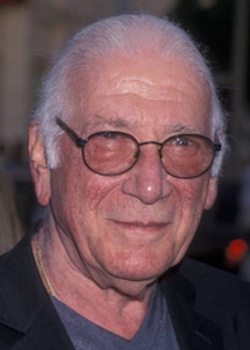
City Hall marked the second collaboration between director Becker and composer Jerry Goldsmith following Malice in 1993, and their work together here inspired Goldsmith to write one of his most intelligent and atmospheric political thriller scores, acting as something of a bridge between the jazzy tones of scores like Chinatown and the more aggressive sound he would revisit the following year in L.A. Confidential. Goldsmith also clearly took inspiration from Leonard Bernstein’s landmark 1954 score for On the Waterfront, another film that dealt with corruption and violence in city politics.
 Central to the score’s identity is its unusually prominent use of timpani, which functions as the soul of the metropolis, suggesting both the weight of political authority and the simmering tension and potential conflict bubbling beneath the surface of civic life. The terrific opening cue, “The Bridge,” establishes this tone with a darkly evocative and bleakly romantic mood, while the sensational “The Meet” stands out as one of the most dynamic action pieces of Goldsmith’s later career: a relentless, percussion-driven set-piece in which pounding drums, snarling brass, jazzy passages for woodwinds and piano, staccato strings, and Total Recall–esque jagged synthesized accents combine to create a vivid atmosphere of urgency and dread. Its propulsive energy is clearly a precursor to the celebrated “Bloody Christmas” cue from L.A. Confidential, and is arguably just as compelling. It’s fascinating to look back on this score from thirty years in the future; no one would write this type of dynamic, exciting music for this type of film in 2026, and we are all the poorer for it because it is brilliant.
Although the remainder of the score operates largely as dialogue-driven underscore, its comparative restraint reflects the exceptional impact of those opening moments rather than any drop in quality. Goldsmith sustains a hazy, slightly dirty, blues-inflected ambience throughout, using a modest ensemble to conjure a noir-tinged soundscape that enhances the film’s moral ambiguity; solo French horn and understated woodwinds articulate a pared-down main theme that distills big-city jazz into something more introspective and quietly menacing. Cues like “The Hospital” and “When I Was a Kid” are excellent examples of this type of writing, with the former adopting a hint of romance, and the latter a touch of bittersweet nostalgia.
I like the propulsive urgency of the action in “The Cabin” – more of those iconic ’90s Goldsmith synths – and then in later cues such as the excellent “The King Maker,” the more prominent jazz textures – easy strings, lazy pianos, and plucked basses underpinned by low percussion – add a layer of urban sleaze. Tracks like “Old Friends,” “Swartz is Dead,” and “Think About It” maintain a solemn, noir-like tension through minimalist orchestration, although occasionally Goldsmith injects a burst of thunderous percussive intensity to maintain the score’s internal sense of power and forward motion; the finale of “Old Friends” is especially effective in this regard.
In its closing passages, the score finds emotional resonance through the interplay of low piano figures and rumbling percussion, with “Take a Vacation” and the excellent conclusive “Count On It” hinting at a certain kind of resolution for Pappas and Calhoun without ever abandoning its underlying unease.
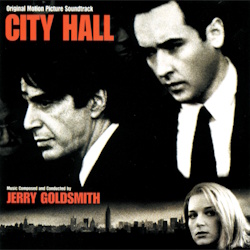
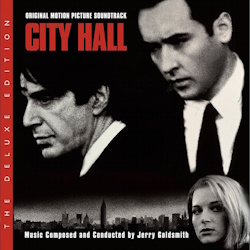 The score for City Hall was released at the time the film came out as a Varèse Sarabande 30-minute special – enjoyable, but nowhere near a comprehensive portrait of everything the score had to offer. In 2023 Varèse released an expanded version comprising a 16-track, 34-minute program of the score as heard in the film itself; a 6-track, 10-minute selection of previously unreleased alternates; and the 12-track, 30-minute sequence of the original 1996 CD.
City Hall was the first of four Jerry Goldsmith scores to come out in 1996 – the others being Chain Reaction, Executive Decision, and The Ghost and the Darkness – and while it is probably the least acclaimed and least remembered of the quartet, it should not be overlooked. While some listeners may find the dominance of the timpani-heavy action material occasionally overwhelming, City Hall ultimately emerges as a cohesive and mature work, one of the more thoughtful achievements of Goldsmith’s later career, and a rewarding listen for admirers of his darker, jazzier, more sophisticated dramatic writing, especially when that writing emerges into moments of bold, frenetic action.
Buy the City Hall soundtrack from theMovie Music UK Store
Track Listing:
- 1996 ORIGINAL RELEASE
- The Bridge (2:05)
- The Meet (2:57)
- The Hospital (2:17)
- When I Was a Kid (2:21)
- The Cabin (1:06)
- The King Maker (2:22)
- Old Friends (2:49)
- Swartz is Dead (2:45)
- Think About It (1:22)
- The Report (1:37)
- Take a Vacation (3:31)
- Count On It (4:50)
- 2023 EXPANDED RELEASE
- The Bridge (1:51)
- The Meet (3:00)
- The Hospital (2:20)
- Find Vinnie (1:05)
- The Funeral (0:34)
- When I Was a Kid (1:16)
- The Cabin (1:10)
- The King Maker (2:22)
- Call Me/Dead in the Water (1:16)
- Schwartz is Dead (2:52)
- Old Friends (2:48)
- Think About It (1:26)
- The Report (1:19)
- About the Mayor (0:52)
- Take a Vacation (2:53)
- Count On It/End Credits Suite (6:51)
- The Hospital (Alternate) (2:16) BONUS
- The Funeral (Alternate) (0:29) BONUS
- The Cabin (Alternate) (0:53) BONUS
- The King Maker (Alternate) (2:23) BONUS
- Take a Vacation (Alternate) (2:28) BONUS
- Count On It (Alternate) (1:20) BONUS
Running Time: 30 minutes 12 seconds – Original
Running Time: 74 minutes 25 seconds – Expanded
Varese Sarabande VSD- 5699 (1996)
Varese Sarabande VCL-0723-1234 (1996/2023)
Music composed and conducted by Jerry Goldsmith. Orchestrations by Arthur Morton. Recorded and mixed by Bruce Botnick. Edited by Kenny Hall. Original album produced by Jerry Goldsmith and Robert Townson. Expanded album produced by Mike Matessino and Neil S. Bulk.
Leave a comment

Shop at the Movie Music UK Store

Member of the

 MOVIE MUSIC UK
You said that this was the first of four Goldsmith scores to come out in 1996. I think you missed Star Trek First Contact on that list.