DARK COMMAND – Victor Young
 GREATEST SCORES OF THE TWENTIETH CENTURY
Original Review by Craig Lysy
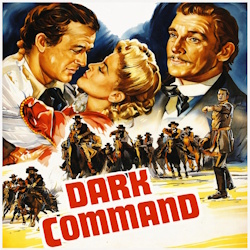
Renowned novelist W.R. Burnett had a well-established reputation for writing modern day crime stories. However, his 1938 novel “The Dark Command” was a departure, a rare historical drama, which became a best seller. Republic Pictures decided to capitalize on its success and purchased the film rights. Sol C. Siegel was assigned production with a $750,000 budget, Raoul Walsh was tasked with directing, and a team of four screenwriters was hired; F. Hugh Herbert, Lionel Houser, Grover Jones, and Jan Isabel Fortune. A stellar cast was assembled, which included Claire Trevor as Mary McCloud, John Wayne as Bob Seton, Walter Pidgeon as Will Cantrell, Roy Rogers as Fletch McCloud, Gabby Hayes as Doc Grunch, Porter Hall as Angus McCloud, Marjorie Main as Mrs. Adams, and Raymond Walburn as Judge Bruckner.
The story is set in Lawrence Kansas circa 1859 during the American Civil War. It explores the war being waged between free-state abolitionists and the Confederate Quantrill’s Raiders, which culminates on August 21 1863 with the now infamous Lawrence massacre where 150 men and boys were summarily executed. To not offend southern audiences, Will’s family name was changed from Quantrill to Cantrell, and his infamous raid was portrayed as a False Flag operation, instead of the fact that they had been coscripted into the Confederate army. Against this backdrop, a fictional story is added, which explores Mary McCloud’s marriage to school teacher William Cantrell, only to discover his dark secret – that he is a ruthless outlaw profiteering by murder to enrich himself. Mary’s naïve brother Fletch, a southern sympathizer, joins Cantrell as he believes he is fighting for the Confederate cause. It comes to pass that Mary’s former suitor Bob Seton is captured by Cantrell and ordered to be executed, only to escape with aide from Fletch. Afterwards Mary, Bob and Fletch race to Lawrence Kansas to warn residents of an impending raid, that ends with Cantrell dead and Mary and Bob ready to begin a life together in Texas. The film was profitable and induced the studio to commission new projects for their star John Wayne. Critical reception was favorable and the film received two Academy Award Nominations for Best Art Direction and Best Original Score.
Composer Victor Young was under contract for Paramount Pictures, but often loaned out to Republic Pictures, which was contracted to assist the studio produce films. Upon viewing the film, I surmise that Young understood that this was a classic archetypal “Good vs Evil” morality play, with a complex interactive dynamic, and shifting moral landscape. To that end, he would need to juxtapose musically the film’s protagonist, Bob Seton, and his antagonist, Will Cantrell. Additionally, a love triangle with Bob and Will competing for Mary’s love would offer fertile ground. Lastly, since this was a Civil War period piece, I believe Young understood that he would have to infuse his score with the requisite cultural folk songs, anthems, and hymns.
 For his soundscape Young composed six principal themes, of which five are personal character themes, and one transpersonal. Bob Seton serves as our idealistic hero who is morally steadfast, committed to the pursuit of justice and a resolute Marshall determined to maintain order and the rule of law. In the film opening, his theme offers soaring, fanfare eroica buttressed by swirling string vortices. During the film however, it emotes with warmth, confidence and nobility. Juxtaposed is our villain William Cantrell, who hides behind the veneer of a respectable as a schoolteacher. He is however in reality, an amoral, power-hungry outlaw leader known for his ruthlessness and brutality. Young astutely, and slowly develops Will’s Theme shifting it slowly, yet inexorably to evil as his false veneer of a respectable school teacher is shattered, fueled by avarice as he descends into infamy. Mary’s Theme offers gentility borne by strings and woodwinds tenero. I observed that her theme operates within a narrow emotional range as for much of the film she is conflicted in her feeling for Bob and Will.
Secondary themes include Fletcher McCloud who is young, naïve, innocent and confused. His theme, like Will’s shifts in the course of the story with a developmental arc, which takes him from a boy, to a man. It commences with naivety as he succumbs to the allure of becoming one of Will’s Confederate men. This is followed by his descent into shadow where his theme becomes dark and conflicted as he recoils from Will’s ruthless brutality. Lastly, his theme manifest hope as he regains his moral footing and gains redemption. Doc’s Theme, borne is by woodwinds and light strings, is playful, comedic and at times sardonic. He is a father figure to Bob, with who he conspires to support his dentistry business – Bob picks the fights, and breaks teeth in the fist fight, and Doc removes the teeth. The Pioneer Theme offers the one transpersonal theme in the score. It provides classic Western romanticism brimming with Americana optimism, which supports the travel of wagon train bringing homesteaders west seeking free land and a new beginning. It is also aspirational, when it reprises in the finale as Bob and Mary contemplate a new life together in Texas.
The score lacks a commercial release, as such I will use scene descriptors as cue titles for this review. “Logo” offers fanfare dramatico that supports the display of the Republic Pictures eagle emblem. “Main Title” opens with the soaring heroism of Bob’s Theme, which supports the flow of the opening credits set against brilliant sun rays piercing cloud banks. We flow atop strings romantico into Mary’s Theme, which yields to a reprise of Bob’s Theme by French horns nobile. The music supports narrative script declaring that the story is fiction, and offers a disclaimer regarding the principal characters and actual historical events. New narrative script declares the year 1859, and the civil warfare besetting Kansas as northern abolitionists, and southern pro-slavery advocates, seek to admit the territory as a free vs slave state as the Civil War looms. The Battle Cry for both offers narrative script; “On to Kansas!” Against this narrative, Young offers classic Western romanticism with his lyrical Pioneer Theme brimming with Americana optimism, which supports the travel of a long wagon train bringing new homesteaders seeking land and a new beginning.
“The Battle Begins” reveals a scene change to a man speaking before a crowd in front of a building in Atlanta with signage; “Georgia Emigration League: Kansas belongs to the South”. He declares that he will offer a silver watch and $5 in coin of the realm for every southern settler who will leave here for the rich and fertile plains of Kansas. He declares; “The south needs your vote! Dire, and dissonant horns resound to support a paddlewheel boat churning up the Mississippi River. We shift scenes again to Boston where a man speaks in front of a building with signage; “Boston Emigration Society: Kansas for the North”. He exhorts the crowd with offers of a silver watch and $5 in coin for good hard-working Northern famers to settle in Kansas. Blaring trumpets bellicoso and a locomotive motif propel a train with settlers westward. The Pioneer Theme reprises and takes us into “Dr. Grunch” and the wagon train, which has paused for the night as the camera focuses on the signage on his wagon; “Dr. Grunch with pricing for hair-cuts, shaves, pulled teeth, watch repairing and veterinary services. He has pulled the teeth of two men punched by a man (Bob Seton) defending President Pierce;
“Pierce’s most consequential and controversial action was signing the Kansas-Nebraska Act (1854), which allowed residents of the new Kansas and Nebraska territories to decide the issue of slavery by “popular sovereignty,” effectively repealing the Missouri Compromise of 1820. It caused widespread sectarian violence that accelerated the country’s descent into Civil War.”
“Doc and Bob” reveals Bob riding in Doc’s wagon and the discussing their futures. Young supports their progress with a plodding, and folksy rendering of Doc’s Theme led by a piccolo. We learn they are in cahoots; Bob punches troublemakers in the mouth, and Doc takes out their damaged teeth. “Lawrence, Kansas” reveals narrative script supporting their arrival carried by Doc’s folksy theme. As they pass down Main Street, we hear a children’s school choir singing strains of “My Country Tis of Thee” A Capella. Bob stops, and discloses his love of the song, and music. An inpatient Mary McCloud arrives and asks Bob to move his wagon as it is barring her way. When Bob relates his love of music, Mary solicits Mr. Will Cantrell, the schoolmaster to urge him to move. He does so, asking Bob to join them, and Bob declines. He then drives off as Mary thanks Will. It becomes clear that Will is somewhat frustrated that Mary eludes his hope for engagement. After this latest evasion, we return to Doc and Bob to discover Bob is smitten with Mary. In two unscored scenes Mary arrives home to find her brother Fletch and her father arguing over Fletch wearing a gun. He wants to be ready as he does not like the Yankees coming into town. Mary sides with father, takes his six shooter and they send Fletch on his way. In town Bob comes to the aid of a man being bullied by Yankees and a fight ensues. Mary observes Bob defending the man, and is impressed by his gallantry.
“Fletch and Bob” reveals that Fletch, who helped Bob in the brawl, bonding with Bob. He agrees to formally introduce Bob to Mary given that he has declared he wants to marry her. As they stroll down the street Young supports with interplay of Mary’s Theme as she is on Bob’s mind, and a happy-go-lucky Fletch’s Theme as they arrive at the town bank, owned by Fletch’s father Angus. He goes in, fetches his sister, takes her outside and introduces her to his friend, Bob. Well, Bob is tongue tied, and Mary becomes flustered. When he finally blurts it out – will you marry me, she becomes flummoxed with his audacity and departs in a huff. “Doc Encourages Bob” reveals the town preparing for the election of a Town Marshall, with the judge and town elders favoring Will. Doc encourages Bob to take stock of his life, and commit to something that will help Uncle Sam. Bob hesitates because he is illiterate, however Doc says that the school down the street can fix that. A gentle and paternal rendering of Doc’s Theme supports the discussion. In an unscored scene Bob solicits Will’s help, who graciously agrees to tutor him in the evening to save him the indignity of sitting with children. Yet their friendliness sours when Bob admits that the reason for his schooling is to become Marshall. When Will discloses that he is running, Bob departs saying it is too bad that he was going to lose. We are informed that Will’s maid Mrs. Adams, is a deception, as she is in reality, his mother.
“Cantrell vs Seton” opens with festive fanfare, which supports signs saying; “Cantrell for Marshall”. The music yields as he commences a speech to a crowd. He compliments Seton, whom he announces he is tutoring, for his courage and honesty. He then reminds the town that they need to elect a man of who knows the law and how to apply it. Bob is hesitant and feels queasy, yet Doc pushes him up to speak. In his speech Bob comes across as humble, genuine, a man of the people. He uses self-deprecating humor to endear himself to the crowd, which slowly warms to him. Back at the McCloud house, Mary and Fletch do the finishing touches on the dinner table, where they will celebrate Will’s victory. Celebratory fanfare and music announce the victor, which stuns Angus and Mary – Seton is the new Marshall. In “That’s How We Do It In Texas”, Bob pays a call on Mary and they engage in playful repartee. He tells her that he broached the marriage proposal out of order. When she asks how, he says I should have first said “I love You”. This takes her aback, and then he adds, and this should have followed, as he takes her into a passionate kiss. As he backs away, he says, that the right order down in Texas as he knocks over an end table. He then stutters and runs off awkwardly with embarrassment, as she contemplates what just happened, and smiles. Young supports with a nascent, tender form of the Love Theme, which is playful, yet uncertain in its expression.
“I’ll Be Running Kansas Yet” reveals Will is enraged from his ignominious defeat by the illiterate Seton. He rages to his mother that he is tired of his dead-end job, and will now set out using force of arms to achieve his destiny. His mother argues against taking a dark and violent path like his three brothers and threatens to shoot him if he does. Yet Bill is undeterred and resolute declaring as he storms out; “I’ll Be Running Kansas yet. I am going clear to the top, and it’s not for the view. Dire music punctuates this declaration. “Cantrell’s Raids Begin” opens with repeating four-note declarations of an aggressive Will’s Theme. Young renders it in a charging form, propelled by strings furioso, which empower Will and his men galloping in the countryside. He and his masked men use a false flag operation, declaring that they do not want slaves in Kansas, while rounding up slaves in Kansas and then selling them for $300 a head in Missouri. A proud rendering of Cantrell’s Theme empowers a montage of raids, ending with a final payoff where he declares he is done with slave running, and will now turn to gunning, which has a better payoff. “Seton Ambushes Cantrell” reveals Seton and his deputies tracking gunrunners (Cantrell) and two wagons of rifles they are smuggling. A proud Cantrell’s Theme supports his night time progress before shifting to a ferocious flight and pursuit musical narrative as Seton charges and Cantrell flees. Cantrell’s wagons both overturn to block the road, which allows him to escape without being identified.
In “Bob’s Veiled Threat” Young supports with an undercurrent of tension reflecting Bob’s suspicions of Will, as Mother Cantrell watches in the shadows through a partially opened door. The scene reveals him stopping by Cantrell’s when he sees a light burning. He solicits his assistance with two points of law, for which he is unsure. Bill retrieves the Territorial Code Book, and Bob pull out his pistol and does some maneuvers (intimidation) as he asks what are the penalties for smuggling unlicensed arms into federal territory. Will maintains his composure and reads; a $5,000 fine and/or 5 years in prison. Bob tells him he is a smart man and knows better than to be involved in gun smuggling. Will becomes defensive and asks if he is being accused? He then says gunrunning and teaching children are incompatible, don’t you know that? To which Bob replies as he departs; “I know it. Make sure you know it.” After he leaves, we see both Will and his mother are unsettled. In an unscored scene Bob takes Mary on a carriage ride out of town. As they pass the school, Mary calls out “Morning Will”, and we see he is displeased. Once out of town Bob admits Will does have cause for concern as he is trying to steal her away from him, which causes Mary to smile.
“Fletch Murders Hale” reveals politics being discussed in the barbershop. Hale, a wheat farmer castigates the south for demanding free slave labor, while in the north such laborers are paid a decent wage. Fletch takes offense, the argument escalates and becomes personal with Fletch calling Hale a liar. Hale’s punch lands Fletch on the floor, and in a fit of anger, he pulls out his pistol and kills Hale. Music enters in the aftermath with an anguished Fletch’s Theme as he realizes he killed Hale. This musical narrative is sustained in the following scene as we see a distraught Fletch pacing in his prison cell. A painful, and aggrieved musical narrative follows as Mrs. Hale arrives with her three young boys outside the McCloud house. From the road she rails over the McClouds sense of entitlement and wealthy privilege. She asks that with the murder of her husband; how will they will harvest their wheat and survive the winter. Inside Angus and Mary plead with Bob to release Fletch on bail to no avail. Bob argues that Fletch has the fastest horse in town and could easily flee across the border. He says that he will protect him, and assure he gets a fair trial. Mary makes a very personal and passionate plea for her brother with Bob, kissing him and begging him, but it is to no avail as he says with regret, that he has to follow the law. She becomes angry, and bitter, and accusing him as being cold as granite. He does not respond in kind and departs full of sadness.
“Cantrell’s Intimidation” reveals him visiting Fletch in jail with Mary. He pledges that he will ensure Fletch will not be convicted. A montage follows of a masked Cantrell and his masked henchmen raiding one juror’s house after another. He threatens each juror man at gunpoint, and warns of violence against their family if they vote guilty. Young supports each of Cantrell’s warning with dire chords, and the rides to each juror’s farm, with racing strings energico. “Not Guilty” reveals Fletch’s lawyer, Will Cantrell, making an impassioned argument that the charges constitute northern prejudice against southerners, that Fetch should be freed, and that Angus will be magnanimous in offering compensation to the Hale family. He closes diabolically by reminding the jurors to keep in mind the welfare of their families lest they make an incorrect verdict. The juror’s verdict is “Not Guilty” and the McClouds thank Will for saving Fletch. The judge then reads an urgent announcement, that the south has seceded from the union and war has been declared.
In “War!”, narrative script informs us that the war leaves Kansas defenseless and the territory is soon overrun by hordes of guerillas who raid, murder and pillage. Young supports with an amazing, sustained declaration of war by polyphonic horns militare. A grim marcia sinistri supports Will rallying a large group of men to his cause, assuring all of them that he will share with each the spoils of war. A montage follows of Cantrell’s destructive raids on one Kansas town after another propelled by his theme, now rendered with raw aggression, malevolence, and brutality. “The New Directive” reveals Cantrell on August 15, 1862 receiving crates of Confederate Army uniforms as he has been given a field commission of Captain in the Confederate Army under the Partisan Ranger Act. He orders all the men into the uniforms as they are now part of the Confederate Army. Cantrell’s Theme, now rendered more traditionally by horns militare propels his destructive raids. Bright fanfare patriottica resounds as a Lawrence Kansas newspaper headline announces; Marshall Bob Seton appeals for men to join the militia so as to restore law and order. As dozens of men sign up with Bob, many raise fears that Lawrence will soon be raided. The widow Hale yells, soon all of you will be as poor as me because you bank with the McClouds, who are financing the southern raiders. The men, who are all pro-Union finally realize the wisdom of her words and an angry mob head to McCloud’s bank to pull out their money.
“The Death of Angus” reveals the bank besieged and Angus ordering his staff to pay as long as the money holds out. Mary, Fletch and Bob all arrive as Angus fires a pistol into the ceiling to silence the crowd. He tries to reason with them, to no avail. When he protests being called a liar and a thief, he is shot, punctuated by a chord of death. Young supports with a lamentation as he warns Fletch that this is the fate for men who use guns. He expires, Mary sobs, and Fletch, propelled by his enraged theme, angrily grabs Bob blaming the killing on him. Bob pulls off his hands, and calmly says, steady. In an unscored scene mother and son argue over his enlistment in the Confederate army. Will says he is now rich, will buy them a big house with servants and beautiful things. His mother however will have none of it, saying she will not live with him in a life bought with illegal gains. She then drops a bombshell – Mary is leaving to return to the east. Will visits her and she says it is time to go as father is dead, Fletch intends to join the south, and you have joined the Confederate army, which endangers you here. He again proposes, but she declines, saying she does not love him, but values him as a dear friend. He will not take no for an answer. He takes her into his arms and again asks her to marry, and this time, she relents.
“Mary Marries Will” reveals an intimate ceremony in her house with a few close friends supported by a hymn like organ solenne. As they board the carriage, a man rides up seeking the Marshall, declaring that Bushropp’s Guerillas are sacking Thomasville. Will orders Marry sent to his house, and tells her these guerillas are under his command. He has to go and warn them to avoid a massacre by Seton’s militia. An aggrieved Mary’s Theme supports her realization, and dismay as mother Cantrell looks on. She gets off, and instead returns to her house as church bells sound the alarm. In “Bob Marches on Thomasville”, Young offers a dramatic musical narrative empowered by Bob’s bold fanfare, which supports a montage of the militia arming and assembling. A ferocious, horn declared musical narrative propels their ride out of town led by Bob. In the countryside we see Will and Fletch racing to warn the guerillas propelled by a fierce galloping motif. They reach the guerillas and the men dismount and setup for an ambush. A new galloping motif supports the approach of Bob’s militia. Bob halts the militia, seems wary, but signals to press on. Young supports this by stripping bravado from the music ans instead sowing tension. Will orders the men to fire on his order, and Fletch objects, saying it would be cold blooded murder. Will replies, such is the nature of war boy.
“Ambush” reveals Bob and the militia riding into an ambush. They are caught in a withering cross fire and suffer many casualties. Doc calls to Bob to jump in and the four survivors race off in a wagon with Will and his confederate cavalry in hot pursuit. Young whips his orchestra into frenzy with a propulsive flee and pursuit musical narrative embedded with both Will and Bob’s Themes. A stepped crescendo dramatico takes them to the edge of a 75-foot cliff. Now trapped, and with Will’s men closing, Bob drives the horses over the cliff and they crash into the waters below. (This specific stunt contributed to the formation of the Society for the Prevention of Cruelty to Animals (ASPCA) to monitor animal safety in films). A grim musical narrative unfolds as the men manage to survive, as do the two horses, and swim out of range of Will’s men gun fire. “Kansas Aflame” reveal a map of Kansas aflame with imagery of Cantrell’s Raiders superimposed. Young propels the destructive swath with Will’s Theme rendered as a brutal anthem of war. In town, Bob and the new militia ride past Mary’s house. We see her looking out the widow at them, clearly conflicted. In an unscored scene the Judge and town elders relieve Bob of his command, for incompetence, and he says he is more than thankful to go.
In an unscored scene, outside Bob and Doc come across a crowd running to the McCloud house, intent on driving Cantrell’s wife out of town. The town supports the Union, and the Confederate Raiders of Cantrell have killed many of the town’s kinfolk. Instigated by the vengeful widow Hale, they shatter the widows with a volley of rocks. Bob rides up, threatens the mob, who back down and leave. Inside Mary confides that she intends to flee to Missouri to join her husband. When he tries to inform her of what Will has done, she says it’s all lies. He says, it is not lies, and if she is of the same mind tomorrow, he will personally escort her to Missouri as he is also leaving Kansas. “Bob and Mary Depart” reveals he transporting her in a carriage to Missouri. A warm, and idyllic rendering of his theme supports empowered by French horns nobile. They stop in a stream to allow the horses to water, and reminisce. He speaks wistfully of the beauty of Texas in the spring, when the lupins blossom, say their flowers are almost as blue as her eyes. He then recalls their first meeting and repeats what he said then, that he loves her. Her yearning theme joins as he again asks her to marry him, to leave Will whom she does not love, and join him to setup a ranch in Texas. She is clearly distraught, says she cannot, and begs him to resume the journey. He does so, and a folksy, rendering of his theme carries their progress. They cross into Missouri, and he leaves the carriage to mount his horse. He again asks if she will change her mind, and she says, no. When she asks where he is heading, he says, Texas. They both depart yet we see the last words between them have yet to be spoken. Young supports the parting of their ways with a sad rendering of Bob’s Theme filled with shared disappointment.
“Mary Arrives” reveals an sentry informing Will that his wife has arrived at camp. The folk song “Ring De Banjo” played on a banjo supports. As she is driven into the raucous camp, the folk song “Oh! Susanna” played on banjo supports. She reunites with Will, yet offers her cheek when he embraces to kiss. Fletch also greets her, and he says the three will reacquaint for dinner. As they go inside, Will is surprised when she relates that Bob, the only friend she had left in Lawrence, brought her here. The music ends here and the dialogue carries the scene. His house is decorated with the spoils of war, and when he gifts her a jewelry box filled with the jewelry of many women, she realizes that Bob was telling the truth. As she asks if the rumors about him were true, soldiers enter with Bob bound. Will orders him released and declares he is my friend and guest. He then has Bob escorted to his quarters to wash up, and extends an invitation to dinner, which is accepted.
In an unscored scene, Will and Bob engage in repartee, which subsides when Mary arrives. Fletch arrives, but declines to dine with Bob at the table, and departs. To break the tension, Will proposes a toast for his friend Bob, that peace come quickly. He then informs Mary that he has purchased a mansion and land in Virginia’s Shenandoah Valley. She says although she like Virginia, she would first like to visit the entire south starting with Texas. A revelation received and understood by both men. “Fletch Saves Bob” reveals that outside, we see a ponderous Fletch as men and women enjoy drink and merriment supported by a banjo led small ensemble playing the folk songs “Gwine to Rune All Night” (De Camptown Races) and “Oh My Darling Clementine”. Back at the house, Bob is escorted out and Will orders his escort to take him to their side of the camp as he needs a good rest. They place Bob in a locked room, and back at the house Will orders Fletch to leave Bob to him. Fletch disobeys, goes to Bob, and gives him a pistol, saying the rumors about Cantrell are true. Back at the house Will and Mary quarrel as she realizes the stories about his brutality, murder and pillaging is true. He said he regrets nothing, that he would do it all again for her. She says she is his wife and will stay on condition that Bob is freed, and escorted safely out of camp. He agrees, but two gun shots unsettles him. He goes to see Bob, but is ambushed inside by Bob who knocks him out, followed by the guard. Fletch says he has horses ready and goes to the bridge, while Bob, wearing a Confederate tunic rescues Mary, sneaking unnoticed through the raucous drunken soldiers and pleasure women.
“Stop That Wagon!” reveals Will waking up and stumbling out of the cell as Bob, Mary and Fletch ride out of camp on a wagon. He sees them, and orders a pursuit. Once again Young whips his orchestra into a frenzied flee and pursuit musical narrative, within which is woven Will’s, Bob’s and Fletch’s Theme. Bob shoots several men, leaving three, but Fletch is mortally wounded in the back. Bob takes the reins and they escape as the three men pursuing give up. A bravado Bob’s Theme supports his arrival in town as he fires his pistol and sounds the alarm that an attack is imminent. Doc’s Theme joins as he tells Mary he is taking Fletch to their house for treatment. After the judge wakes up, the music become grim as he informs Bob that the Militia is on a mission to Dodge City, which leaves the city defenseless. Bob orders all the women and children into the town hall and every wagon in town brought to create barriers. In the following cue, the director shifts back and forth between Cantrell’s Raiders, and the town. Masterful is how Young, with each scene shift intensifies his musical narrative, fueling the coming attack, and growing desperation and panic in town.
“The Attack On Lawrence” reveals Will leading a cavalry column of hundreds to Lawrence, the seat of Union resistance in Kansas supported by a plodding, grim four-note ostinato. Back in town, people are in a panic, fleeing to the townhall. Young supports the with an energetic, and driving musical narrative of alarm. Shifting back to Cantrell, the musical pace is more aggressive and menacing as telegraph lines are cut. In town, a screeching violin ostinato stoke a rising fear as Bob valiantly tries to organize a defense. Back at the house a foreboding musical narrative supports as Doc prepares to operate for the first time in eleven years. Mary expresses faith in him, and he sends her away for bandages as he pulls out his scalpel. Her beleaguered Theme caries her downstairs where she is greeted my Mother Cantrell, who offers assistance. Returning to Cantrell, his cavalry is now propelled by Will’s Theme empowered by horns bellicoso and a fierce galloping pace. Bob now sees them approaching, leaves the first line of wagons, to take command of the second, which is fully armed. Returning to Cantrell’s Raiders the music swells ferociously to propel the now charging horde. Cantrell’s men are met by withering fire, suffer many casualties, forcing Will to order; “Take Cover!” Bob’s Theme is now ascendent as a battle anthem as Will orders a fire wagon to burn them out. A string furioso ascent supports the igniting of the wagon, joined by howling horns as it careens into the barricade. A conflagration erupts, and Young sow a tempest.
“The Race For Mary” reveals Will riding to the McCloud house after he is informed that she has returned there. After Bob sees Will ride off down the road to the McCloud house, he hides under a burning wagon that bolts through enemy lines. He then rides after Will, and Will’s menacing Theme supports his arrival. “Mother vs Son” reveals mother halting Will’s ascent up the stairs a rifle point. She calls him a cold-blooded murderer, curses the day she gave birth to him, and says she will kill him if he goes up. Will disregards her warning and resumes going up the stairs, but as she raises the rifle to fire, one of Will’s men shoots her through the window. Will’s now bereft theme supports her last words to him; “Give up killing, that the Devil’s beside him, and that he had reached the end of the road”. Bob enters warily, Will ducks behind a sofa, and Young sow a rising tension with tremolo strings. Will rises, aims but his mother yells no, swipes his hand so he misses and Bob kills him with multiple shots, punctuated with a death chord. Tumpets of victory sound to announce Bob’s triumph and conclude the scene. We shift to Lawrence consumed in a conflagration supported dissonant horns monstroso and swirling strings furioso. The Militia arrives, and the Raiders mount a retreat under fire. Youngs whips his orchestra into frenzy, which drives the chaos on the screen. We close with a music brightening with hope as the women and children run out of the burning townhall. “Finale” reveals that back at the house, Fletch wakes up, and everyone is happy, especially Doc who declares I am once again a doctor! Lawrence has been burnt to the ground, but Bob once again makes allusions to life in Texas, with Fletch adding a quote from Shakespeare; “All’s well, that ends well”. This usher in, “The End”, supported by a last reprise of the Pioneer Theme, which ends in a flourish.
Regretfully, there is no commercial release of this Academy Award nominated score, and there are no apparent recordings of suites or themes on any commercially available compilation albums. I sincerely hope this is one day rectified. Golden Age Western genre films were very popular with the public as they were at their core, easily understood morality plays, with the good and bad guys clearly defined, with the desired, and satisfying ending of the good guys winning. Such was the case with “Dark Command” which brought two fine actors John Wayne and Walter Pigeon into conflict. The confluence of their acting performances and Young’s musical themes elevated and enhanced what I believe to be, a classic hero vs villain conflict. Masterful is how Young dissolves Will’s veneer of respectability to reveal a truly malignant, malevolent and amoral monster. Equally masterful was how Young fleshed out and ennobled Bob’s folksy, humble, and noble nature to create a selfless hero. The score’s action writing was turbulent and tempestuous, interwoven with inspired thematic interplay of Will and Bob’s Themes. Films of this era also espoused the romanticism of the west and the spirit of Americana, and Young captured both of these eloquently with his Pioneer Theme among the best in the genre, while his infusion of folk songs, and military anthems provided the requisite cultural sensibilities. Folks, I believe this to be among the finest scores in Young’s canon and fully deserving of its Academy Award nomination. Until we get a re-recording, I highly recommend you take in the film to experience the power and magnificence of film music.
For those of you unfamiliar with the score, I have embedded a YouTube link to the film’s Main Title; https://www.youtube.com/watch?v=gi2GHXNaG_E
Track Listing:
- NOT AVAILABLE
Music composed and conducted by Victor Young. Orchestrations by Charles Bradshaw and Herman Hand. Recorded and mixed by XXXX. Score produced by Victor Young.

Shop at the Movie Music UK Store

Member of the

 MOVIE MUSIC UK