SABRINA – John Williams
 THROWBACK THIRTY
Original Review by Jonathan Broxton
Sabrina is a modern remake of Billy Wilder’s 1954 romantic comedy which starred Audrey Hepburn, Humphrey Bogart, and William Holden, and which was itself based on the stage play Sabrina Fair by Samuel Taylor. Directed by Sydney Pollack, the story follows Sabrina Fairchild (Julia Ormond), the shy and awkward daughter of a chauffeur who works for the wealthy Larrabee family on Long Island. Sabrina has spent her life quietly pining for David Larrabee (Greg Kinnear), the charming but superficial younger son. After a transformative stay in Paris, she returns home confident and stylish, immediately catching David’s attention, just as he is about to marry a woman whose family is vital to a major business deal. To protect the merger, David’s older brother Linus (Harrison Ford), the work-obsessed head of the Larrabee corporation, inserts himself into Sabrina’s life to distract her. His plan is to win her over and then send her back to Paris, but as they spend time together, Linus unexpectedly falls in love with her, and she discovers her long-standing infatuation with David has been eclipsed by a deeper connection with Linus.
The 1990s were filled with remakes of classic romantic stories updated to high-powered business settings (Pretty Woman, The American President, You’ve Got Mail), and Sabrina continued that trend. The film was seen as a vehicle for Julia Ormond following her mostly acclaimed debut playing Brad Pitt’s love interest in Legends of the Fall, but she was subject to inevitable scrutiny and criticism here, with many comparing her performance negatively against the iconic one previously given by Audrey Hepburn. Harrison Ford fared better, playing against his usual action-hero type, delivering a restrained, understated performance as the outwardly gruff Linus, while Greg Kinnear, in one of his early film roles, brought charm and youthful spontaneity to his performance as David. While reviews were mixed at the time Sabrina has since gained a reputation as a gentle, tender romantic drama in the classic Hollywood tradition.
 The score for Sabrina was by John Williams, and was his second score of 1995 after Nixon. It’s unclear why Dave Grusin didn’t score Sabrina – he had scored almost all of director Pollack’s previous films going all the way back to The Yakuza in 1974, including Absence of Malice in 1981, Tootsie in 1982, Havana in 1990, and The Firm in 1993, and he would return for Random Hearts in 1999 – but it’s likely that Grusin chose not to score it as he was starting to shift away from big Hollywood assignments so he could spend more time on his personal jazz projects for GRP Records. Similarly, Sabrina was likely part of the continuing effort by Williams to move away from the action-adventure blockbuster sound that dominated his work in the 1980s and much of the early 1990s, and this score gave him the opportunity to stretch different compositional muscles.
Williams composed an elegant, jazz-inflected score with a light, lyrical, and sophisticated tone, using a warm orchestral palette that suits the story’s nostalgic and romantic mood. Rather than using sweeping themes or big dramatic gestures, he writes in a style reminiscent of classic Hollywood romantic comedies blended with a French café ambiance representing Sabrina’s time spent in Paris. Tonally, it is similar to Frederick Hollander’s music for the 1954 film, and to the classic romance scores penned by other Golden Age composers in that period, as well as to his own scores for films such as The Accidental Tourist, parts of Always, and the more intimate jazz parts of earlier works like Fitzwilly or Penelope.
Sabrina is not one of Williams’s structurally complicated scores, but it does contain several recurring themes that run throughout the score, two of which are subsequently turned into original songs. The main “Theme from Sabrina” is for me the score’s highlight, a gorgeous piece of elegant romance that deftly moves from solo piano to a raft of swelling strings to the full orchestra as it develops, and is full of ornate syncopations and florid embellishments performed by lead pianist, the late great Mike Lang. Emotionally, the theme captures her innocence, her unrequited romantic longing for David, and then later her poise and self-assurance as she returns from Europe a changed woman. The theme and its 5-minute reprise comprise almost 10 minutes of the album’s running time alone, but it’s worth it; anyone who loves the sweeping romance of classic Hollywood will find themselves swooning at Williams’s version of it.
The second main theme is called “(In The) Moonlight” and is essentially the love theme for Sabrina and Linus. In context it underscores most of their romantic interactions, illustrating the increasing attraction that develops between them, almost against their mutual will. It is jazzier, more languid, and a tiny bit more contemporary than the main Sabrina theme, with more of a lounge feeling that comes from its increased use of plucked bass and brushed percussion. This theme then becomes an original song, “Moonlight,” which has lyrics by Alan and Marilyn Bergman and is expressively performed by Sting. Interestingly, years later, Williams revealed that he had written the melody for “Moonlight” many years previously as a tribute to Audrey Hepburn, who was a real life family friend, and so as such its incorporation here makes for a nice bit of musical serendipity.
The final main theme is called “How Can I Remember” but, somewhat ironically, it is the least memorable, being an enjoyable but somewhat insubstantial and intangible romantic piece. This theme appears mostly in scenes related to Sabrina’s sojourn in Paris, as well as to Linus and David’s ‘old’ memories of what Sabrina was like as a girl, as opposed to the sophisticated woman who returns from Europe. Like “Moonlight,” this theme also appears as a vocal version performed by lounge singer Michael Dees, and again with lyrics by Alan and Marilyn Bergman. I’m not sure who Dees is, or why he was chosen to sing this song other than the fact that he was cast to appear in the party scene at the Larrabee house, but vocally he is the weak link in the whole thing.
The rest of the underscore is less memorable, but did give Williams the opportunity to engage in some fun interludes that offer satisfying listening in the moment, even if they don’t linger for long afterwards. “Linus’ New Life” is a vigorous and more dramatic little scherzo that intertwines the main Sabrina theme and the melody from “Moonlight” into a more energetic setting. Slightly wistful, dream-like electronic sounds accompany the gentle piano textures of “Growing Up In Paris,” which is built mostly around the chord progressions of “How Can I Remember”. “Sabrina Remembers/La Vie En Rose” continues in mostly the same vein, while also offering sentimental accordion-led echoes of Hollander’s music from the 1954 film, which featured the melody from the classic Édith Piaf song “La Vie En Rose” prominently.
“Sabrina Comes Home” revisits the main Sabrina theme with poignant tenderness and a touch of sparkly Hollywood magic, blended with an upbeat version of the “Moonlight” theme for dancing strings. “Nantucket Visit” is another piece of sprightly, slightly whimsical, almost comedic writing which makes use of a harpsichord sound similar to the one Williams used in his comedy scores for Fitzwilly, and Alfred Hitchcock’s Family Plot, and as such is a nice piece of nostalgia for Williams fans. The conclusive “Sabrina’s Return to Paris” is a bittersweet woodwind-led version of “How Can I Remember,” which ends the score on an unexpectedly downbeat note
Rounding out the album is the 11-minute “Party Sequence” cue, which sees Williams providing a suite of lushly-arranged melodies from the great American songbook, which is heard as background source music during the aforementioned Larrabee party; these include Jack Segal and Robert Wells’s “When Joanna Loved Me,” Johnny Mandel and Paul Francis Webster’s “The Shadow Of Your Smile” from the score for the 1965 film The Sandpiper, Sammy Cahn and Jimmy Van Heusen’s “Call Me Irresponsible” from the score for the 1963 film Papa’s Delicate Condition, and Ned Washington and Victor Young’s “Stella By Starlight” from the score for the 1944 film The Uninvited. It’s all lovely, easy listening jazz which fans of the genre will adore.
Perhaps the main drawback to the score as a whole is that it is *too* laid back for its own good. While the melodies themselves are all appealing and beautifully arranged, there is a consistency of tone and approach throughout the score that doesn’t really seem to move with the dramatic development of the narrative as a whole, which results in a listening experience that is a touch repetitive. You don’t really get a sense that the music is really addressing the shifting relationships between Sabrina, David, and Linus, which in context means you never really get a sense of where they are with each other at any given time. It’s a rare dramatic mis-step from Williams, who is usually exemplary at this sort of thing, but here he appears to have gotten too caught up in creating a period-authentic sound, to the extent that he overlooked the actual story a bit.
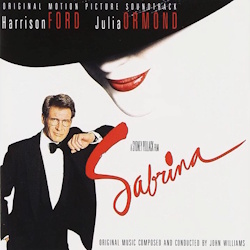
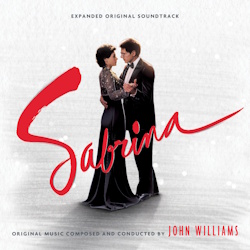 As I mentioned, the original 1995 album offers about 25 minutes of original Williams material, with the various songs, reprises, and jazz standard arrangements filling out the rest of the 50-minute album. In 2023 La-La Land Records released a 2-CD expanded release of the score, comprising the full 53-minute film score presentation, plus alternate cues, on disc one, and then a second disc of jazz and song arrangements from the party sequence entitled “Party In The Moonlight – Songs of Sabrina,” which includes the Sting and Michael Dees songs, plus a large number of additional pieces by numerous composers. It’s lovely, makes for extremely pleasant background listening, and Williams completists will want it, but I find that the original album gives me more than enough Sabrina for my needs.
The score for Sabrina, and the song “Moonlight,” were both nominated for Oscars in 1995, with both eventually losing to Alan Menken and Pocahontas. Ultimately, the score for Sabrina is charming and romantic, a lovely old-fashioned throwback to the Golden Era of Hollywood, and as such will be catnip for anyone who gravitates towards that style. It’s easy listening, delightful in the moment, and showcases a side to John Williams that he was rarely given the opportunity to express, but it’s also surprisingly thin at times, and it mostly lacks the dramatic oomph of his best works in the genre. I enjoy it, but it won’t be for everyone.
Buy the Sabrina soundtrack from the Movie Music UK Store
Track Listing:
- 1995 ORIGINAL RELEASE
- Theme from Sabrina (4:30)
- Moonlight (written by John Williams, Alan Bergman, and Marilyn Bergman, performed by Sting) (5:20)
- Linus’ New Life (2:45)
- Growing Up In Paris (3:02)
- (In the) Moonlight (2:59)
- Sabrina Remembers/La Vie En Rose (1:42)
- Sabrina Comes Home (4:14)
- Nantucket Visit (2:31)
- The Party Sequence – When Joanna Loved Me/The Shadow Of Your Smile/Call Me Irresponsible/Stella By Starlight (written by Jack Segal and Robert Wells/ Johnny Mandel and Paul Francis Webster/ Sammy Cahn and Jimmy Van Heusen/ Ned Washington and Victor Young) (10:53)
- Sabrina And Linus Date (2:40)
- How Can I Remember? (written by John Williams, Alan Bergman, and Marilyn Bergman, performed by Michael Dees) (2:50)
- Sabrina’s Return to Paris (2:22)
- Theme from Sabrina – Reprise (5:23)
- 2023 LA-LA LAND EXPANDED RELEASE
- Theme from Sabrina (Extended Version) (5:19)
- Main Title (1:28)
- To Paris (0:57)
- Learning the Ropes (1:34)
- Thinking of Home/Work Montage (2:10)
- Photographing Paris (1:51)
- Growing Up in Paris (3:01)
- La Vie En Rose (written by Louis Guglielmi and Édith Piaf) (1:20)
- The Drive (1:48)
- Sabrina Is Home (2:06)
- Linus and Mother (2:44)
- Off To the Vineyard (1:44)
- On The Porch (2:12)
- Beach Walk (2:21)
- Linus and Father (3:05)
- Sabrina to the Office (1:09)
- Dinner Montage (2:21)
- The Princess Grows (3:16)
- Have Your Tea (0:39)
- Eavesdropping (1:10)
- Sabrina’s Return to Paris (2:24)
- Wrapping It Up (1:35)
- Linus’ New Life (2:46)
- End Credits (4:24)
- (In The) Moonlight – Instrumental of Moonlight (2:59) BONUS
- To Paris (Alternate) (0:58) BONUS
- Learning The Ropes (Film Version) (2:13) BONUS
- Work Montage (Alternate) (1:47) BONUS
- Growing Up In Paris (Alternate) (2:43) BONUS
- La Vie En Rose (Alternate) (written by Louis Guglielmi and Édith Piaf) (1:18) BONUS
- Sabrina Is Home (Alternate) (1:59) BONUS
- On The Porch (Alternate) (2:12) BONUS
- Have Your Tea (Alternate) (0:38) BONUS
- Linus’ New Life (Alternate) (2:47) BONUS
- Theme from Sabrina (Reprise) (5:21) BONUS
- PARTY IN THE MOONLIGHT – SONGS OF SABRINA
- Moonlight (written by John Williams, Alan Bergman, and Marilyn Bergman, performed by Sting) (5:23)
- (In The) Moonlight Piano Improvisation (4:29)
- Stella By Starlight (written by Ned Washington and Victor Young) (2:58)
- Call Me Irresponsible (written by Sammy Cahn and Jimmy Van Heusen) (2:39)
- Moonlight Becomes You (written by Johnny Burke and Jimmy Van Heusen) (1:20)
- Isn’t It Romantic? (written by Richard Rodgers and Lorenz Hart) (2:36)
- (In The) Moonlight Piano Interlude (2:51)
- (In The) Moonlight Party Instrumental (3:17)
- All The Way/High Hopes (written by Sammy Cahn and Jimmy Van Heusen) (2:22)
- I Wish I Were In Love Again (written by Richard Rodgers and Lorenz Hart) (2:30)
- My Old Flame (written by Arthur Johnston and Sam Coslow) (0:35)
- How Can I Remember? (written by John Williams, Alan Bergman, and Marilyn Bergman, performed by Michael Dees) (2:50)
- How Can I Remember? Party Instrumental (3:17)
- (In The) Moonlight Piano Interlude No 2 (4:03)
- (In The) Moonlight Party Instrumental No 2 (4:13)
- For All We Know (written by Sam Lewis and J. Fred Coots) (3:37)
- When Joanna Loved Me (written by Jack Segal and Robert Wells) (2:36)
- The Shadow Of Your Smile (written by Johnny Mandel and Paul Francis Webster) (2:53)
- La Vie En Rose Party Instrumental (written by Louis Guglielmi and Édith Piaf) (1:12)
- How Can I Remember? Party Instrumental No 2 (2:56)
- (In The) Moonlight Party Instrumental No 3 (4:43)
- (In The) Moonlight Piano Closing (4:22)
Running Time: 51 minutes 11 seconds — Original
Running Time: 146 minutes 01 seconds — Expanded
A&M Records 31454 0456-2 (1995) — Original
La-La Land Records LLLCD 1616 (1995/2023) — Expanded
Music composed and conducted by John Williams. Orchestrations by John Neufeld, Conrad Pope, and Harvey Cohen. Recorded and mixed by Shawn Murphy. Edited by Ken Wannberg. Album produced by John Williams and Jonathan McHugh. Expanded album produced by Mike Matessino.

Shop at the Movie Music UK Store

Member of the

 MOVIE MUSIC UK