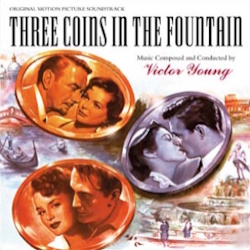
THREE COINS IN THE FOUNTAIN – Victor Young
 GREATEST SCORES OF THE TWENTIETH CENTURY
Original Review by Craig Lysy
During the 1950s a shift in movie making called “Hollywood on the Tiber” emerged. Rome and its Cinecittà studios blossomed, becoming a hub for international filmmaking. 20th Century Fox decided it wanted to feature their latest rising star Maggie McNamara in a romantic comedy, and chose Rome as the perfect location. Sol C. Segal was assigned production with a $1.7 million budget, Jean Negulesco was tasked with directing, and John Patrick would write the screenplay, adapting the 1952 novel ‘Coins in a Fountain” by John H. Secondari. A fine cast was hired, including Clifton Webb as John Frederick Shadwell, Dorothy McGuire as Miss Frances, Jean Peters as Anita Hutchins, Louis Jourdan as Prince Dino di Cessi, Rossano Brazzi as Giorgio Bianchi, and Maggie McNamara as Maria Williams.
The film explores the tradition long associated with the famous Trevi Fountain in Rome. According to the lore of the fountain, if you turn your back to the fountain and toss a coin with your right hand over your left shoulder into the fountain, you will be fated to return again and find love in Rome. To that end, the film explores the romantic fortunes of three women, Aria Williams, Anita Hutchins, and Miss Frances. The sub-narratives of the romances of these three women, set against a breath-taking sightseeing tour of Rome, culminate in the final scene when the three women are joined by their respective lovers, Prince Dino di Cessi, Giorgio Bianche, and John Frederick Shadwell. The film was a huge commercial success earning a profit of $10.3 million. Critical reception was tepid, saying it was a predictable romantic tale wrapped in a sightseeing tour of Rome and Venice, but the film received three Academy Award Nominations, including Best Picture, winning two for Best Cinematography and Best Original Song.
Victor Young was given the scoring assignment and found himself immediately in a production controversy. A conflict arose between the New York based 20th Century Fox sales office, which insisted that the film title be changed to “We Believe In Love” versus studio executive Darryl Zanuck and director Sol Siegel who insisted on retaining “Three Coins in the Fountain”. Siegel, in a cunning move, hired songwriters Sammy Cahn and Jule Styne to write a titular song, which would be sung by Frank Sinatra, and as such could not be changed. The song was a hit with the East Coast, and the rest is history, with Sinatra enjoying one of his career’s biggest hits, which went on to earn the studio $2 million in royalties.
 In conceiving his soundscape, Young decided that Kahn and Styne’s song melody was exquisitely romantic and quite malleable. As such he decided to interpolate the melody in many different emotional guises to provide the essential musical thread that would weave together his musical narrative. Foremost, was the use of the theme as a Love Theme for each of the three women. Young also wrote a number of original themes and dances, which included the Travel Theme, which supports scenes of the characters traveling. It offers a breezy, ten-note construct, borne pleasantly by warm French horns and contrapuntal woodwinds, shifting to strings and contrapuntal French horns. As for dances, he composed four; a Barcarolle, which offers a gentle, lilting sensibility in 6/8 time, in which the music expresses the soft, and gentle rocking rhythm of gondolas traversing the canals, often draped with romantic adornment. He also composed a tarantella, a traditional fast and festive southern Italian folk dance with an upbeat tempo and lively 3/8 time. He also composed a beautiful valzer elegante, which offered a graceful ¾ time and classical eloquence. And finally, he wrote a gorgeous Italian danza romantico, which graced us with his usual melodic lyricism. Lastly, Young infused his score with a number of original folk, and classical pieces to provide the requisite cultural sensibilities, including “Largo Al Factotum” from “Il Barbiere di Siviglia” by Cesare Sterbini and Gioachino Rossini, “Anima e Core” by Salvatore Esposito and Tito Manlio, “Nanni” by Franco Silvestri, and “O Ciucciariello” by Nino Oliviero and Roberto Murolo.
Cues coded (*) contain music not offered on the album. (*) “Logo” offers the extended Cinemascope version of Alfred Newman’s fanfare for 20th Century Fox. (*) “Three Coins in the Fountain” offers a wondrous musical highlight that achieves a sublime confluence of cinematography, Cahn and Styne’s song, and Sinatra’s warm baritone voice. In a masterstroke this opening scene establishes the film’s romantic narrative and draws the audience into the story. It opens with a camera montage of Rome’s famous fountains, which begins with the famous Trevi fountain. Young drapes the opening shot with sparkling harp glissandi tresses. The harps usher in Frank Sinatra’s sterling baritone vocal, joined by a string and woodwind ensemble romantico. Wordless, ethereal, mixed choir reprise the song melody as the montage of Rome’s famous fountains continues, with the montage closing as it began with the Trevi Fountain.
“Prelude” opens with grand fanfare magnifico, which support the commencement of the opening credits, and usher in a festive tarantella. At 0:58 two successive fanfare bravura support Producer and Director credits, which dissipate on a diminuendo and take us into the film proper. “Rome” reveals Maria Williams arriving at Rome’s bustling Fiumicino Airport, where she is greeted by Anita Hutchins, whose position she will be assuming at the U.S. Distribution Agency. Young supports with a sunny and vibrant rendering of the Main Theme. At 1:09 the melody shifts to the pleasant Travel Theme borne by warm French horns as we see them driving on a street traversing a tree rich park. At 1:18 the melody shifts to languorous iteration as the arrive at Villa Eden, which will serve as Maria’s residence. As she is introduced the music dissipates on a diminuendo gentile. An intervening unscored scene reveals Maria acquainting herself with Anita and Frances, her house mate, as she takes breakfast. Music resumes at 1:36 with the pleasant Travel Theme as Anita and Frances take Maria on a tour of Rome. At 1:59 warm fanfare by horns nobile support their arrival at Trevi Fountain, and usher in a romantic musical narrative of the Main Theme melody. They park, exit the car and Anita relates to Maria the lore of the fountain; that if you throw a coin into the fountain and makes a wish to return, you will. Maria and Frances both toss coins, but not Anita as she declares that she is engaged and does not intend to return to Rome. At 2:50 warm horns empower their departure joined again by the gentle Travel Theme. At 3:06 patriotic horns orgoliose declarations support their arrival at the U.S. Distribution Agency, which dissipates on a diminuendo as they enter the main office.
In an unscored scene Maria is introduced to her translator Giorgio Bianchi, and boss Mr. Burgoyne. He extends an invitation from his wife to attend their afternoon cocktail party, which is graciously accepted. In “The Cocktail Party” reveals the arrival of the dashing and handsome Prince Dino di Cessi, who immediately captures Maria’s fancy. Frances and Anita advise for her to stay clear of his charm, as he is a womanizer who is notorious for taking his girlfriends to Venice for romantic trysts. He returns Maria’s purse, which she had dropped from the balcony, charms her, and says he will return after extending his thanks to the host. Young supports the ambiance with a wonderful valzer elegante. “Tarantella” reveals Anita and Maria walking home together. When Maria asked why no men approached her at the party, Anita gives her the bad news; rich Italians do not date secretaries, and poor Italians lack the money to do so. They stroll together through the city streets enter a part of the city where women should have a male escort. Sure enough, a man pinches Maria in the but and makes his move. Luckily Giorgio arrives and chases the man away. Young animates their walk with a delightful and vibrant tarantella. “Café” reveals Giorgio, Maria and Anita enjoying lunch at a local café. Maria learns of where Prince Dino lives, that he lives with his mother, and that he is skilled playing the piccolo. Giorgio then out of the blue invites the two to accompany him to a family festa to celebrate his sister’s engagement. Giorgio is very happy when they both say yes. Young again offers the perfect ambiance supporting a beautiful Italian danza romantico by a small ensemble.
(*) “Giorgio and Anita” reveals he and a truckload of cousins and friends picking Anita up for the festa familia. The truck is rickety and has no brakes, but that does not deter them and the travel through Rome singing a festive Italian folk song “Nanni”. While stopped for an accident, Mr. and Mrs. Burgoyne see Anita and Giorgio together – a clear violation of his fraternization rule. Giorgio drives off and we shift to Villa Eden for an unscored scene where Maria receives an unexpected phone call from Dino. He asks her for a day trip to Venice, and after Frances coaxes her to go, agrees. Dino arrives and the women spring their trap; Frances is joining as she was also going to Venice and it made sense for her to join. Dino is outmaneuvered, accepts the inevitable, and the tree head off to his private plane. We return for Giorgio and Anita’s arrival at his family farm, carried by another round singing “Nanni”. He introduces Anita to his parents, sister, and followed by a call to dinner. They dine al fresco and after dinner she and Giorgio sit together on a bench and listen to a man singing the romantic ballad “Anima e Core” in Italian. Anita gets up and walks away and the singer continues the song in the background. An exploratory conversation unfolds as Giorgio admits he wants more out of life than what is offered by becoming a lawyer. He points to a stream below where he would often go as a boy, and Anita asks him to take her there. The depart and the scene closes with the singer concluding the song for the family.
“Anita” reveals Giorgio lifting her into the truck, which begins rolling down the hill. He desperately runs after her yelling for her to jump out, but she is too afraid to do so. Eventually she careens into a tree. Music enters with a crescendo appassionato, as he lifts her out, and surrenders to passion, yet his offer of a kiss is rejected. Undeterred he takes her into his arms, and confesses his undying love. As the crescendo crests, the Love Theme blossoms as he takes her into a kissing embrace, which she passionately accepts. Afterwards, the family raises down the hill to see if she is all right, but we see she is embarrassed by what just happen. “Barcarolle” offers a wondrous romantic score highlight, and one of Young’s finest compositions. It reveals Dino flying his plane with Maria and Frances passengers. As the camera looks out, we are offered a spectacular panorama of Venice and Young supports masterfully with an original barcarolle romantico, a musical form long associated with the city’s famous gondoliers. It offers a gentle, cradling sensibility in 6/8 time, in which the music expresses the soft, and gentle rocking rhythm of gondolas traversing the canals, often draped with romantic adornment. A montage of all the breath-taking aerial shots of St. Mark’s Basilica, St. Mark’s square and bell tower, the grand canal, the Doge’s palace and the Rialto bridge. At 0:52 the melodic line is taken up by strings romantico, embellished by mandolins, with contrapuntal warm French horns joined by quotes of the Main Theme as we see Dino sharing a gondola ride with Maria and Frances. A new montage unfolds and offers the perspective of the city seen from a gondola.
“Venetian Plaza” reveals them strolling St. Mark’s square carried warmly by the Main Theme. At 0:15 a sparkling flight motif emerges to support thousands of pigeons, which inhabit the plaza taking wing. In “Cafe #2” Dino, Maria and Frances are enjoying an al fresco lunch. Young reprises his music from the “Café 1” cue with his beautiful Italian danza romantico by a small ensemble. He excuses himself to take a call and Frances regrets being a third wheel. She tells Maria to stay tonight, and she will take the train back to Rome and cover for her in the morning. Dino returns and advises that the plane is ready and that he has an important meeting with his tenants. Maria says that is a shame that you and Frances are departing as she wanted to stay. We see that Dino is flustered again by circumstance intent on keeping him and Maria apart. At 1:19 a warm declaration by French horns of the Main Theme supports a fiery sunset over the Grand Canal. We conclude in Rome with Anita lost in a love-struck gaze at her office desk. In an unscored scene Maria is summoned to Mr. Burgoyne’s office and interrogated. He says he saw Giorgio and Maria together and asked her to confirm it. She did so, defending her friend and said they spent the weekend together. When he says she is soon going home to get married, Maria adds that this was just a ruse. When she suggests he speak with Anita directly, she is dismissed.
“The Tenement District” reals a tearful Anita packing her suitcase and informing Maria that she betrayed her and is leaving. Maria says that Burgoyne already knew and that she was defending her and trying to help. Anita replies that thanks to your help, Giorgio was fired without a recommendation, which means he will not be able to become a lawyer. Anita then storms out leaving a devastated Maria. Music enters with and extended exposition of the Love Theme draped with heartbreaking pathos as a despondent Maria sits down. We shift to the tenement district at night where we see Anita entering a tenement and knocking on a door. Giorgio answers, is surprised, and says that she should not have come here. At 0:52 the Love Theme shifts to solo violin romantico buttressed by warm French horns. The music shifts to aching regret when she asks to come in and expresses bitterness that her action may cause him to lose his dream of becoming a lawyer. Giorgio remains hopeful, and says he knew what he was doing when he broke the rules. At 2:21 Warm French horns offer the Love Theme full of yearning as she says that she has two days left, and would it help you at all if we spent them together? At 3:12 crescendo of hope supports the two joining in a kissing embrace as she admits that she is not engaged. At 3:22 a twinkling reprise of the Main Theme by glockenspiel and strings gentile support Maria’s visit to the Shadwell house where she frets to Frances that she is worried about Anita. She asks if John could assist Giorgio get his job back, and the two depart to solicit his help.
(*) “I Love Neo-Impressionist Art” reveals their arrival, and Maria repeating Frances’ coaching tips on Neo-impressionistic art, which she knows Dino loves. She goes in, informs John that Frances is waiting, and he departs. Maria then lures Dino into a personal tour after declaring her love of Neo-impressionist art. As they enter the gallery a twinkling harp descent motif supports, shifting to woodwinds sardonica as she sits and ponders one of the portraits. He asks if she likes it and she puts Frances’ coaching to good use, offering a very sophisticated impression from the painting, which amazes him as it perfectly aligns with his impressions. He is now enraptured by Maria and asks if they could share this experience through the afternoon. She smiles, and the twinkling harp motif reprises. “Dino and Maria” reveals Dino driving up to Villa Eden to drop Maria off. They both express compliments and she tells a white lie that she is three quarters Italian, and that is why she took this job assignment, so as to be with her own kind. He asks to see her again, she deflects, and he as a gentleman, escorts her to the gate. Young again offers the Main Theme romantically, not ardently with passion, but instead with a tender, strolling sensibility with a subtle undercurrent of yearning.
“Restaurant Montage” offers a montage of Maria researching Dino’s tastes for food, wine and opera, and dutifully taking notes. Young supports with a delightful musical narrative full of joie de vivre. “Excerpt from “The Barber of Seville” supports Dino and Maria attending a presentation of Giacomo Rossini’s famous opera, with the scene featuring the iconic aria “Largo Al Factotum”, Libretto by Cesare Sterbini. Unknown to Maria, the Burgoyne’s observed her and her date Dino through their opera glasses. “Opera House Restaurant” reveals John stopping by Dino and Maria’s table at the opera house restaurant. He is suspicious of Maria and probes as he believes her knowledge of art and opera are phony, however Dino repeatedly rescues her by asserting they share the same tastes. Foiled, John departs and Dino asks what should he order for her, and she responds with his favorites; Saltimbocca all Romano with the wine Lacrima Christi. He is amazed and relates how their tastes in all things perfectly align. She compliments him on his gallantry, and we see in her eyes how she has masterfully ensnared him. We also see that he has fallen for her, and he asks that she join him Sunday, to meet his mother, which in Italian culture is required prior to seeking an engagement. Young responds with one of the score’s finest compositions, an original valzer elegante.
“Piccolo Serenade” reveals Maria’s next subterfuge, her faux practicing with a piccolo prior to Dino’s arrival. Young offers an original, delightful, and fanciful piece for solo piccolo and small ensemble heard from a phonograph recording. He arrives early, is shocked by her interest in learning to play the piccolo, his favorite instrument. She feigns disbelief that he can play, and he takes the piccolo and to her amazement, plays a short spritely piece (not on the album). She says he plays like an angel, and he responds saying, perhaps we could learn to play duets. She says, I think I should like that…and at 0:56 the Love Theme enters as he takes her into a kissing embrace. Afterwards, he takes her arm and says we should not keep my mother waiting. At 1:24 warm French horns nobile declare the Love Theme, which fades eloquently on a diminuendo as Dino’s car arrives at his family estate. In an unscored scene Dino is sent away by his mother so she may have personal time with Maria. She expresses thankfulness that Maria has made her son happy. When Dino joins, he relates Maria’s talent with the piccolo and that she loves his favorite wine Lacrima Christi. Later they depart, and as he assists her into the car, he expresses happiness that mother likes her. He then adds that his mother has been the only woman he has ever trusted, until he met her. We see that Maria for the first time feels uncomfortable with her subterfuge
“Maria Confesses” offers a poignant score highlight. It reveals him stopping the car near the ruins of the Roman Coliseum, where he opens his heart begins to offer a confessional. She stops him, and apologizes for staging a deception to capture his heart. She relates all the time she spent researching his tastes in food, wine, art, opera and the piccolo, but now fully admits, that she knows nothing about any of it. Dino says he cannot believe it, yet when she assures him, it is true, he closes up, and with a face that displays betrayal, he drives off. Young supports with a sad rendering of the Love Theme, now draped with bitterness and regret, which concludes with heartache borne by a solo violin affanato. In an unscored scene a distraught Anita returns to Villa Eden. She is packing and relates to Frances that she is returning to the states as Giorgio believes he can now never earn enough to support her well, and that moving back to the family farm was also not an option. When Frances asks if she loves him, Anita says yes, and then collapses sobbing. Later Frances joins Maria, who is also packing to return with Anita. She says Dino has not even tried to see her. Frances is sympatico and says she knows it is awful for both of you. She departs saying she is glad she is not young and vulnerable.
“Shadwell’s Home” reveals John’s servant Louisa gifting Frances a cat to keep her company. Afterwards we see that Frances feels the loneliness, which Young supports with strummed harp and dispirited Main Theme. At 0:16 the music blossoms as she goes to the balcony and sees a panorama of Rome, that momentarily reminds her of why she came here, as it dissipates on a bittersweet violin solitario. “Frances” reveals John joining, and Frances dropping a bombshell – she has decided to return to the States with Anita and Maria. She wonders if she will continue on to become an old maid, or if a man will take a fancy to her. John commends her on how well he feels with her caring support, and then drops his own bombshell, asking if she ever considered marriage to him? Young supports with a tender, yet wistful rendering of the Love Theme as both contemplate how long it has taken to at last reach this point. She is happy as he tenderly, and affectionately kisses her hand. In an unscored scene Frances joins Maria and Anita by their packed suitcases and announces she is staying to get married! She says after being in love with him for fifteen years, John finally proposed. They all hug and share in Frances’ happiness.
“Night” reveals a restless, sleepless night for all three women as they each contemplate their futures. Young supports with a ticking clock motif, and a Love Theme draped with uncertainty. In “Good Morning” John’s maid Louisa compliments Frances on her beautiful, and youthful gown. Young supports with a spritely musical narrative abounding with joy. “The Doctor” reveals John exiting the doctor’s office where he has received a death sentence from a diagnosis of inoperative brain cancer. Young drapes us with the Main Theme that descends like a pall of despair. At 0:27 we segue into “Forgive Me” where John coldly breaks off the engagement, saying it was an obvious misunderstanding. He says she should return to America, as he has lost interest in completing his novel, and to please book him a summer vacation at the isle of Capri. A molto tragico rendering of the Main Theme supports as he departs for a final walk-through Rome’s gardens and ancient ruins, leaving a devastated Frances is his wake. At 1:13 a crescendo di speranza commences joined by repeating, uplifting declarations French horns nobile as we see Frances following him to the Vatican. We conclude on mandolins as John takes a seat at the Caffe Flavia.
In an unscored scene the waiter refuses to bring him a bottle of scotch, so he orders six double scotches lined up in a row. Frances arrives, joins him, and advises that after he left, she received a call from Dr. Martinelli. She asks if the diagnosis was the reason, he called the marriage off, and he blithely dismisses it as mere coincidence. She exhorts him to retain hope and go to America, but he refuses saying he has accepted his fate, as she should. The six scotches arrive, and he downs the first. He then asks here to manage the logistics of shipping his body back to America for burial. She breaks down and begins crying, and he expresses disappointment that she has lost her renown detachment. He asks her to leave as he wishes to be left alone. She moves to an adjacent table, and orders six double scotches. She coughs on the first sip; John joins and asks her to resume attending to his work. She counters saying, I thought you had given up? He responds does she often do this, and she answers, no, but now I do as my life is ending.
“The Formal Gardens” opens with slurred, sliding strings mimicking Frances’ drunken gait as a perplexed John follows. At 0:19 she finds a boy playing cautiously with a toy boat in a fountain. She exhorts him to be reckless and pushes the boat deep into the fountain. The boy cries, and she walks into the fountain and retrieves the boat. Young offers a playful and child-like musical narrative to support. At 0:53 a descent motif supports her pouting, and subsequent sitting in the fountain, in defiance to John’s entreaty to get out. The Child Theme reprises as Frances finally agrees to come out of the fountain and go home. At 1:15 John attends to Frances with a blanket and head compress. The Love Theme with celeste adornment tries to coalesce and emerge, as Frances throws a major pity party saying no one loves her. She begs John to help Giorgio get his job back as he is in love with Anita, and that he must also help Maria get her prince. She final falls asleep, and at 3:00 the Love Theme finally emerges, borne by solo violin d’amore. Since Frances is asleep, Young informs us that it emanates from John’s perspective, affirmed by his kiss to her forehead. Its exposition is exquisite and offers perhaps its most beautiful iterations in the score.
In an unscored scene, John visits Dino, and gifts him six first editions of his canon, something he had always desired. He then advises that he is returning to America to be married, and Dino and he toast. Afterwards, John shrewdly manipulates Dino by expressing sympathy for suffering Maria’s deception, yet then turns the table by criticizing her for going to such lengths to make herself appealing, and then stupidly admitting her deception. When he tells Dino that you will be free of her tomorrow as she is returning to America, we see mental gears churning in Dino, as John departs with a sense of great satisfaction. John then orders his limousine driver to take him to the Burgoyne residence. Back at Villa Eden Maria joins Anita with her suitcase and they bid goodbye to romantic Rome. The phone rings, and maria answers. After she hangs up, she tells Anita that Frances says to meet her at Trevi Fountain. They arrive and ask the taxi to wait.
“Finale” offers the score’s emotional apogee with a joyous, tear-evoking ending. It reveals no crowds and an empty fountain. The service man advises that the fountain is being cleaned, and Maria comments; “Clean out the old dreams. Make way for the new ones.” She adds the fountain is a fraud as she wished to stay in Rome for a year. Frances arrives and says the reason she asked them to meet her here is a surprise. Music enters with a magical, twinkling effervescence as the fountain turns on and its waters begin their cascading descent to the wish basin. Frances says look! And at 0:14 men’s chorus begin singing the titular song. Maria and Anita are stunned as one by one the men arrive as mixed chorus continues to sing. Dino, then Giorgio and finally John each take their beloved into a loving embrace and we culminate gloriously with a grand flourish.
I commend Nick Redman for the restoration of Victor Young’s wonderful score for “Three Coins in the Fountain”. The technical team utilized the original 35mm monaural source tapes and after editing, mixing and mastering achieved a rudimentary stereophonic audio, which offers a wonderful listening experience. This film offered three, interwoven romances set in Rome. Young, in a masterstroke of conception, decided that the best way to entwine the three stories was to utilize the titular song melody as the essential musical thread that weaves the three romances together in a unified musical narrative, and a shared fate linked to the Trevi Fountain. Cahn and Styne’s melody for the titular song was already romantic, Young, whom I consider a gifted and eloquent romanticist enriched its melody through orchestration, and use of solo instruments. Each romance was forced to overcome challenges, setbacks, despair, and joy. The way Young transformed the song melody to express this wide spectrum of emotions was masterful. In terms of cultural sensibilities, I believe that after listening to the CD and watching the film, that Victor Young has Italian blood flowing in his veins. His usage of folk songs, and dances such as the Barcarolle, the Tarentella, danza Italiana, and waltz offered exceptional compositions, and some of the finest in his canon. The confluence of his music and the sightseeing cinematography of Italy’s architecture and countryside was sublime. Folks, I believe Young’s music elevated the film’s narrative, emotionally empowered each of the three romances, and once again revealed Young’s mastery of his craft. I highly recommend you purchase this fine album and take in the film as well to experience Young’s exquisite romanticism.
For those of you unfamiliar with the score, I have embedded a YouTube link to the beautiful Barcarolle; https://www.youtube.com/watch?v=WcSRFP7vbKc&list=RDWcSRFP7vbKc&start_radio=1
Buy the Three Coins in the Fountain soundtrack from the Movie Music UK Store
Track Listing:
- Prelude (1:14)
- Rome (3:15)
- The Cocktail Party (3:16)
- Tarantella (2:13)
- Café (2:04)
- Anita (0:58)
- Barcarolle (2:40)
- Venetian Plaza (0:40)
- Café #2 (1:44)
- The Tenement District (3:45)
- Dina and Maria (1:54)
- Restaurant Montage (1:26)
- Excerpt from The Barber of Seville (written by Giacomo Rossini) (4:49)
- Opera House Restaurant (3:15)
- Piccolo Serenade (1:47)
- Maria Confesses (2:41)
- Shadwell’s Home (0:44)
- Frances (1:03)
- Night (0:56)
- Good Morning (1:00)
- The Doctor/Forgive Me (2:18)
- The Formal Gardens (3:51)
- Finale (1:21)
Varese Sarabande CD Club VCL 1104 1033 (1954/2004)
Running Time: 48 minutes 54 seconds
Music composed and conducted by Victor Young. Orchestrations by Edward B. Powell. Recorded and mixed by XXXX. Score produced by Victor Young. Album produced by Nick Redman and Robert Townson.

Shop at the Movie Music UK Store

Member of the

 MOVIE MUSIC UK