NIXON – John Williams
 THROWBACK THIRTY
Original Review by Jonathan Broxton
I am not a crook! — Richard Nixon, November 17, 1973
I shall resign the Presidency effective at noon tomorrow — Richard Nixon, August 8, 1974
Director Oliver Stone’s film Nixon is an epic biographical drama tracing the life of the 37th President of the United States, Richard Nixon. Structured as a psychological portrait, the film moves back and forth in time, depicting a number of major turning points: his humble California upbringing in the 1930s and 40s, his early political rise in the 1950s and his stint as Vice President under Dwight Eisenhower, his triumphant election victory in 1968, the pressures of the Vietnam War, and above all the widening shadow of the Watergate break-in and subsequent cover-up which led to his eventual downfall and his resignation as president in 1974. Stone presents Nixon as both deeply ambitious but profoundly insecure, a man shaped by personal trauma and driven by a desire for power and recognition that eventually turned to paranoia, criminality, and disgrace. Watergate, for those who don’t know, refers to an event where a group of Nixon operatives broke into the Democratic National Committee’s headquarters in the Watergate office complex in Washington DC in order to illegally plant surveillance equipment, ostensibly to obtain political intelligence on the Democratic Party prior to the 1972 election.
Anthony Hopkins starred as Nixon, delivering an electrifying performance that earned him a Best Actor Oscar nomination, and the film has a stellar supporting cast that included Joan Allen as his wife Pat Nixon – who also received an Oscar nomination – James Woods as his chief of staff H. R. Haldeman, Ed Harris as CIA operative Howard Hunt, and Bob Hoskins as FBI director J. Edgar Hoover, plus Powers Boothe, E. G. Marshall, David Paymer, David Hyde Pierce, Paul Sorvino, Mary Steenburgen, J. T. Walsh, and even Larry Hagman. However, despite general critical acclaim, the film only grossed $13.6 million domestically against a $44 million budget, making it one of the biggest box-office failures of 1995.
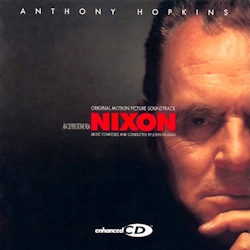
 The score for Nixon was by John Williams, who also received an Oscar nomination for this work. It was the third collaboration between him and Oliver Stone after Born on the Fourth of July in 1989, and JFK in 1991. Working on films for Stone often brought out a different musical side to Williams that stands in marked contrast to his work for, say, Steven Spielberg, and other directors of his ilk. Whereas Spielberg often asked Williams to write music that was generally heroic, upbeat, adventurous, and positive, Stone was the opposite; his films often had a negative outlook on America, and were more interested in exposing its corrupt underbelly than patriotically celebrating its triumphs. As such, Williams’s scores for them tended to be darker, a little less hopeful, perhaps a little more circumspect, while still leaving room for moments of great power and elegiac beauty. Nixon is a score like that.
The score is built around two main recurring themes which address the duality of Nixon’s personal and political life. The first theme is what I am calling the ‘Nixon Political Theme,’ and is likely to be the one that is remembered the most, as it is the one which dominates the sensational, ferocious opening cue “The 1960s: The Turbulent Years”. This cue does not actually appear in the film itself in this form – it is a concert arrangement, parts of which were used in the theatrical trailer – but despite this it is likely to remain the score’s defining musical identity. It’s a thunderous, nightmarish orchestral anthem which, in addition to its frenetic pace and militaristic tone, also emanates an overarching sense of dread. The theme comes across like an inspired combination of the “Imperial March” from The Empire Strikes Back and the theme from Hook, while simultaneously foreshadowing some of the music Williams would write for Star Wars Sith characters beginning with The Phantom Menace in 1999. It’s an astonishing piece of music, overflowing with tumultuous percussion, powerful pulsating brass, surging strings, and an overarching sense of menace, and is one of my favorite Williams compositions of the entire decade.
The Political Theme appears in several cues in the body of the score itself. It underpins the “Ellsberg Break-In and Watergate” sequence on sinister woodwinds, combining with fascinating electronic textures, percussive pianos, and brooding string ideas in a way that feels reminiscent to the conspiracy music from JFK. It appears in a subdued way during the opening moments of “Making a Comeback” before heading off into an expansive, albeit meandering sequence of string textures. It throbs ominously during the conclusion of “Track 2 and The Bay of Pigs,” and then rises to a fantastically dark crescendo in the threateningly triumphant “Miami Convention, 1968,” which acclaims Nixon as he becomes the Republican Party nominee with music that, on the surface, is intended to be victorious and celebratory, but clearly has much more portentous underpinnings. There are some interesting tonal parallels here with the T-Rex finale of the score for Jurassic Park, which is also supposed to be celebratory, but also acknowledges the inherent danger of the situation.
The second main theme is what I am calling the ‘Nixon Personal Theme,’ and this theme is more to do with wholesome nostalgia, and the fact that, at his best, especially during his early career, Nixon genuinely had the desire to do good work and serve the American public to make things better. This theme is actually introduced during the opening moments of the first cue, but really announces itself in the yearning, hopeful “Growing Up in Whittier,” where the theme is carried by a superb trumpet solo by the legendary Tim Morrison. Later, in “Losing a Brother,” Williams uses an achingly emotional trumpet reprise of the theme underneath a host of darker orchestral textures that give weight to Nixon’s memories of losing his brother to childhood tuberculosis.
The Personal Theme reaches its climax during “The Farewell Scene,” which plays in response to the events of August 8, 1974, when – despite having famously declared that he was ‘not a crook’ during a speech broadcast several months previously – Nixon became the first U.S. president to resign from office, mostly due to the looming threat of his potential impeachment over Watergate. Cleverly, Williams combines the melody of the Personal Theme with some of the chord progressions and thematic ideas from the Political Theme, illustrating the bittersweet nature of the whole situation – how this ambitious young man who wanted to serve his country was ultimately undone by his own paranoia, resentment, and deceitfulness.
Other moments of note in the score include “Main Title/The White House Gate,” which features brooding, slightly dissonant music that surprisingly veers almost into light horror tones and makes excellent use of low-end piano clusters reminiscent of James Horner’s work in the political thriller genre. “Love Field: Dallas, November 1963” is almost unbearably tense, and is full of creeping violins, metronome brasses, and dark pianos repeating the underlying chord progressions of the Political Theme, slowly building and building as JFK’s death draws ever nearer. The performance of “The Battle Hymn of the Republic” is surprisingly effective, adding some welcome buoyancy to a score dominated by gloom, as well as a touch of irony considering the film’s subject matter. Finally, “The Meeting with Mao” lightens the tone a little more, with its delicate writing for harps and strings offering an unusual tonal combination that somehow feels both hesitant and reluctant, but also oddly encouraging. Only Nixon could go to China, as the old Vulcan proverb says.
After spending years writing a series of hugely popular adventure, fantasy, and science fiction scores, Nixon sort of marked the beginning of a change of style for Williams, a more serious and thoughtful and introspective approach which continued on throughout much of the rest of the 1990s on scores like Sleepers, Rosewood, the lower-key parts of Amistad and Saving Private Ryan, and even the Jurassic Park sequel The Lost World.
For those whose taste is for Williams’s upbeat marches, soaring love themes, and dramatic action cues, scores like Nixon are something of a departure, being much more downbeat in tone, and much more reserved in composition. It seems like it would be very difficult to score a movie of this type, especially when it involves a personality such as Nixon, where the tone of the music has to be balanced perfectly so as not to influence the viewer in to making a certain kind of judgement about the character, while still adding the right amount of drama and weight to the scene. The fact that Williams did this so well really drives home the fact that he is a not just a crowd-pleasing theme composer, but is also exceptionally intelligent dramatist who understands and articulates the narrative needs of his films adeptly and skillfully, especially when those needs require subtlety and restraint.
Buy the Nixon soundtrack from the Movie Music UK Store
Track Listing:
- The 1960s: The Turbulent Years (5:04)
- Main Title/The White House Gate (4:17)
- Growing Up in Whittier (2:42)
- The Ellsberg Break-In and Watergate (2:43)
- Love Field: Dallas, November 1963 (4:51)
- Losing a Brother (3:18)
- The Battle Hymn of the Republic (written by William Steffe and Julia Ward Howe) (1:03)
- Making a Comeback (2:20)
- Track 2 and The Bay of Pigs (4:47)
- The Miami Convention, 1968 (3:19)
- The Meeting with Mao (3:09)
- I Am That Sacrifice (4:49)
- The Farewell Scene (5:01)
Running Time: 67 minutes 50 seconds
Hollywood Records 162-043-2 (1995)
Music composed and conducted by John Williams. Orchestrations by John Neufeld. Featured musical soloist Tim Morrison. Recorded and mixed by Shawn Murphy. Edited by Ken Wannberg. Album produced by John Williams.
Leave a comment

Shop at the Movie Music UK Store

Member of the

 MOVIE MUSIC UK
Great review. I always enjoyed Williams’ music for these more adult-centered suspense dramas. This one especially reminds me of some of his concert music, which is often dark and dissonant.
I’m also a fan of the dark pianos. Both Williams and Horner knew their way around the instrument.