JAY KELLY – Nicholas Britell
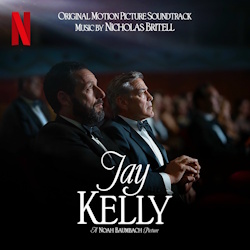 Original Review by Jonathan Broxton
If there’s one thing Hollywood loves, it’s movies about Hollywood. From Singin’ in the Rain to The Artist, Sunset Boulevard to La-La Land, to recent TV shows like The Studio, any time a filmmaker makes a movie about Tinseltown itself, the industry tends to fall over itself to praise it. Such is the case with director Noah Baumbach’s new film Jay Kelly, which is a self-critical, satirical, but also warm-hearted and nostalgic look at the life of a major movie star suffering an existential crisis. George Clooney plays Kelly almost like a weird reflection of himself; a lantern-jawed ageing matinee idol who has had enormous success on the big screen, but has a difficult personal life – he is mostly estranged from his daughters, has no real friends, has unresolved issues and regrets in his past, and doesn’t see his assistants and managers as actual people with lives of their own, despite them mostly idolizing him. When he is asked to attend a film festival in Italy to receive a lifetime achievement award, Kelly takes the opportunity to try to reconnect with his family, rekindle his personal and professional life, and overcome his anxieties – but not everything will go to plan.
It’s actually fascinating watching Clooney playing Kelly, because you really do get the sense that Kelly is who Clooney would be in real life if he was more of an asshole; self-absorbed, oblivious, someone who sees himself as a man of the people but is mostly out of touch with actual reality. He is ably supported by a who’s who of superb character actors – Laura Dern, Billy Crudup, Riley Keough, Jim Broadbent, Greta Gerwig – and the screenplay, co-written by Baumbach with actress Emily Mortimer, takes endless pot-shots at the absurdity of certain aspects of the Hollywood lifestyle, while also still managing to convey a deep love for the magic of the movies and the way they touch the public heart. Best of all, though, is a subdued and restrained Adam Sandler playing Kelly’s long-suffering manager Ron Sukenick, who conveys all the pathos and heartbreak of a man whose platonic love for Kelly is never properly reciprocated with unexpected depth and emotion. This could be the role that finally snags him an Oscar nomination.
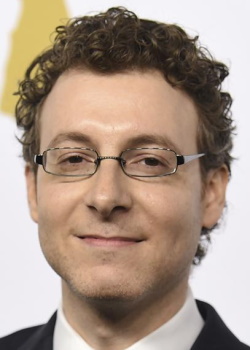 The score for Jay Kelly is by composer Nicholas Britell, who has been taking it easy on the movies recently, having spent several years working hard on television scoring multiple seasons of Succession and Star Wars: Andor. His last really significant big-screen scores were for Cruella and Don’t Look Up in 2021, and it’s nice to see him back here. Jay Kelly is a fascinating score, conceptually, because not only does it act as regular underscore for the film we are watching, but it also works as a sort of meta-score for the movie star life that Kelly has in his head, scoring Jay Kelly the persona as much as it is scoring Jay Kelly the person.
Baumbach asked Britell to write music that feels like a throwback to the big, lush Hollywood melodrama scores of the 1940s and 50s, full of themes and warmth and nostalgic emotion, and Britell delivered that in spades. He is a composer who thinks very deeply and intellectually about his scores, what they sound like, what instruments are being used, and why, and for Jay Kelly he made three distinct choices which make it stand out.
First, Britell recorded the score using old-fashioned analog tapes rather than the digital industry standard, which Britell felt gave a warmer, more intimate sound redolent of classic Hollywood. Second, in terms of instrumentation, Britell focused his main theme for Jay on the sound of a felt piano, a prepared piano which produces a softer, more delicate sound by placing a strip of felt between the hammers and the strings. Britell explained that the sound was intended to convey the notion that Jay was held back and slightly separated from reality, and it is only during the finale that piano sound switches to the traditional timbre of a Steinway grand. Finally, there is the idea that the main theme for Jay is performed backwards during the unusual scenes where Jay is ‘in his memories,’ remembering key moments that became turning points in his life and career, specifically his relationships with his former best friend Timothy, his estranged daughter Jessica, and his mentor director Peter Schneider. A not insignificant amount of the score was written even before the film began production, and Baumbach played it on set for the actors with the intention that could help influence their performances.
Jay’s theme is present all throughout the score; interestingly, the melody itself has all the hallmarks of something from the Great American Songbook, Gershwin or Cole Porter or someone like that. It first appears in a brief snippet, gently during the “Opening Quote,” before rising to the fore properly during “Picture Wrap and Jay Kelly Theme,” a cue which is bright and vivacious and full of spirited string runs, waltz-like rhythms, and classical elegance. The “Piano and Strings” version of the theme is a little bit forlorn, a little bit withdrawn, recognizing Jay’s fragile mental state. “Searching for Daisy” has a comedic charm, “The Chase” revisits the lush waltz sounds with sardonic forcefulness, and “Here in Italy/Driving with Alba” augments the theme with a wonderfully rich countermelody for solo violin.
The first time we hear Jay’s theme in its reversed state – an idea Britell calls the ‘Shadow Theme’ – is during the “Timothy Memory’ sequence, where Jay remembers his now-fractured relationship with his former college roommate and regrets the way he treated him, to the strains of muted pianos. Later, the fractured jazz of the “Jessica Memory” and the tender affection of the “Daphne Memory” offer similar downbeat textures that are excellent in context, each again playing around with the structure of Jay’s theme.
The other major theme in the score is the theme for Adam Sandler’s character Ron. Britell says Ron’s Theme lives in the same world as Jay’s theme but has a different tonality, the former almost sounding like an echo of the latter. It’s yet another clever thought process from Britell, as it perfectly captures the sort-of-symbiotic but also unequal relationship between Jay and Ron; there is more of a busy, can-do hustle to the rhythms underpinning Ron’s theme, illustrating his relentless drive to do what he can for Jay, even though he is often unappreciated for doing so. You can hear it clearly in “He Has a Black Eye,” in “Jay and Ron,” and then later in a more emotional version in “Crying in Italy,” where his theme is arranged for the felt piano.
Other interesting cues include the soft shuffle jazz and improvisational stylings of “Practicing the Score – Cast and Crew Prepping,” the lush romance of the superb “To Paris – Fanfare” which acknowledges Jay’s professional triumphs and apparent Hollywood glamor, the sunny and sentimental warmth of “The Carnival of Life,” and the touching wistfulness of “Do You Remember This Like I Do? – Cinema Theme,” which flickers like some long-forgotten echo of the silver screen. In “The Forest” Britell finally replaces the felt piano on Jay’s theme with the brighter sounds of a grand piano, acknowledging the fact that Jay has reconciled his relationship with Jessica – or, at least, he has in his own mind.
The climax of the film takes place at the film festival in Tuscany, where the filmmakers play a tribute montage of Kelly’s films – which, in reality, are Clooney’s own films, including Leatherheads, Syriana, Michael Clayton, and several others – and Kelly has a deeply emotional reaction to the whole thing that he did not expect. On paper, this could have been a massively self-indulgent Hollywood circle jerk moment, the worst kind of self-congratulatory slop, but Clooney/Kelly actually nails the absurdity of it all by undercutting the thunderous acclaim with a fourth wall break and final line delivery where he asks the audience/director if he can have a do-over: of his emotional reaction to the montage? Of his life? It’s intentionally left ambiguous.
Britell pulls out all the stops during these conclusive 10-15 minutes, moving from a pretty version of Jay’s theme in “Dressing for the Tribute – Cheesecake and Felt Piano” to sweeping orchestral fireworks in “The Tribute,” and then delivering a satisfying emotional catharsis in the beautiful “Can I Go Again? – Finale,” before reprising all the score’s main themes for the end credits in the “Jay Kelly Suite”.
Taken at face value, Jay Kelly is a pleasant, albeit somewhat restrained, soundtrack album full of pretty piano and string textures and old-fashioned romantic themes, and if that’s where your requirements end, then it will likely be satisfactory right there. However, for me, the best parts of Jay Kelly come from Nicholas Britell’s intellectual design and structure, his clever manipulation of both the theme and its orchestration, and the overarching dual-purpose meta narrative that blurs the line between fiction and reality and somehow scores the film from two perspectives simultaneously – that of the movie that we, the audience, are watching, and then of the story that the character Jay Kelly plays in his own head in order to make sense of his life. It’s very, very clever, and is the final thing that will likely push Britell over the line to his fourth Oscar nomination.
Buy the Jay Kelly soundtrack from the Movie Music UK Store
Track Listing:
- Opening Quote – Jay Kelly (0:45)
- Practicing the Score – Cast and Crew Prepping (2:22)
- Picture Wrap and Jay Kelly Theme (1:28)
- He Has a Black Eye? – Ron’s Theme (1:03)
- To Paris – Fanfare (1:05)
- Timothy Memory – Shadow Theme (0:54)
- Jay Kelly Theme – Piano and Strings (1:34)
- In Paris / We’re Taking a Train (1:40)
- Joie de Vivre – Felt Piano (0:57)
- The Carnival of Life (1:51)
- Jessica Memory (1:19)
- Searching for Daisy (1:26)
- Daisy (0:40)
- I’m Sorry About the Eiffel Tower (1:50)
- Daphne Memory (1:15)
- Do You Remember This Like I Do? – Cinema Theme (2:18)
- Jay and Ron (0:51)
- The Chase (0:53)
- Night Train – Reflection in D Minor (1:52)
- Here in Italy / Driving with Alba (2:54)
- Crying in Italy / Ron’s Theme for Felt Piano (1:29)
- Real Life Hero (0:45)
- Chasing Dad (1:46)
- The Forest (1:39)
- Dressing for the Tribute – Cheesecake and Felt Piano (2:31)
- The Tribute (2:11)
- Can I Go Again? – Finale (3:17)
- Jay Kelly Suite (5:03)
- Jay Kelly Theme – Quintet (Single Version) (2:13)
- Joie de Vivre – String Orchestra (Bonus Track) (0:59)
- Fanfare – Quintet (Bonus Track) (0:59)
- Cinema Theme – Quintet (Bonus Track) (0:56)
- Jay Kelly Theme – String Orchestra (Bonus Track) (2:17)
Netflix Music (2025)
Running Time: 55 minutes 03 seconds
Music composed and conducted by Nicholas Britell. Performed by the London Contemporary Orchestra. Orchestrations by Nicholas Britell and Matt Dunkley. Featured musical soloist Nicholas Britell, Rob Moose, and Caitlin Sullivan. Recorded and mixed by Geoff Foster and Tommy Vicari. Edited by Todd Kasow. Album produced by Nicholas Britell.

Shop at the Movie Music UK Store

Member of the

 MOVIE MUSIC UK