SENSE AND SENSIBILITY – Patrick Doyle
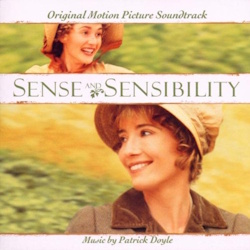 THROWBACK THIRTY
Original Review by Jonathan Broxton
“I come here with no expectations, only to profess, now that I am at liberty to do so, that my heart is and always will be… yours.”
Although she had always been popular, 18th century English writer Jane Austen received a new surge of publicity in 1995 following the release of adaptations of two of her best-known works: the BBC mini-series based on Pride and Prejudice starring Colin Firth and Jennifer Ehle and featuring that swimming scene, and this film, adapting her 1811 novel Sense and Sensibility. The story of Sense and Sensibility follows the Dashwood sisters – practical and reserved Elinor, passionate and romantic Marianne – after their father’s death leaves them in reduced financial circumstances. Forced to relocate to a modest cottage in Devon, they navigate love, heartbreak, and the constraints placed on women of their class in Georgian-era England; both sisters are expected to marry to secure their family’s future, and while Elinor quietly longs for the earnest Edward Ferrars, Marianne falls deeply for the dashing but unreliable John Willoughby, overlooking the steadier Colonel Brandon.
The film emerged during a surge of interest in British heritage cinema in the 1990s, initiated in part by the Oscar-winning success of films like Howard’s End and The Remains of the Day. Producer Lindsay Doran and screenwriter/actress Emma Thompson championed the project for years, and eventually chose Taiwanese director Ang Lee to helm the film; although initially he seemed to be an unexpected choice for a film based on a quintessentially English novel, he actually brought an interesting perspective to the story, highlighting its universal themes. The film reflects both Austen’s sharp social observation and her deep familiarity with the precarious position of unmarried women in the gentry. Money, inheritance, and marriage prospects were not abstract ideas but lived realities for Austen and her family, and these concerns are woven throughout the story’s exploration of romantic choice, economic vulnerability, and the constraints of social propriety – something that Lee was also familiar with from traditional Taiwanese culture.
The film featured an outstanding array of acclaimed English actors in the leading roles – Emma Thompson as Elinor, Hugh Grant as Ferrars, Alan Rickman as Brandon, debonair newcomer Greg Wise as Willoughby – plus a whole host of colorful character actors in supporting roles, including Gemma Jones, Harriet Walter, Hugh Laurie, Imelda Staunton, and Tom Wilkinson. However, the breakout performer was the then 19-year-old Kate Winslet as Marianne, who stole every scene she was in and within two years was surviving the sinking of the Titanic with Leonardo DiCaprio. The film was a gorgeous, sumptuous production – camera work, production design, costumes, all stunning – and it ultimately received seven Academy Award nominations, with Thompson winning for Best Adapted Screenplay.
 One of the other Academy Award nominations Sense and Sensibility received was for its score, by Scottish composer Patrick Doyle. He was very much a part of the same ‘scene’ as the film’s main stars and filmmakers – Doyle had scored all of Kenneth Branagh’s films to that point, including Dead Again and Much Ado About Nothing which starred Thompson, and Branagh and Thompson were still married when production on Sense and Sensibility began. It was the first time he had worked with Lee, however, and he asked Doyle to write a score that was gentle, intimate, and perhaps a touch introverted, a reflection of the suppressed emotions of that society, only occasionally allowing the music to let itself go and engage in more unrestrained outbursts of emotion. It was still exceptionally beautiful, though, and was very much pitched in a similar vein to works by great English classical composers like Ralph Vaughan Williams, Hubert Parry, Edward Elgar, and to a lesser extent Gustav Holst.
As Doyle often did at that point in his career, two of Doyle’s main themes come from his setting of existing texts to new music, and both of them relate to Marianne. The lyrics for “Weep You No More Sad Fountains” were taken from a book of songs written in 1603 by English Renaissance composer John Dowland and the theme is intended to represent Marianne’s innocence, romantic outlook, and connection to nature. Meanwhile, the lyrics for “The Dreame” come from a poem by Renaissance-era playwright Ben Jonson, which in context Marianne learns from Colonel Brandon, and refer to the writer discovering love in a dream and being filled with feelings of desire and guilt. The transition between the two themes represent the progression of Marianne’s character, as she matures from a willful and quixotic teenager dreaming of being swept off her feet to a more practical and level-headed young woman who finds meaning in the love and stability that Brandon can bring to her life. Both songs are performed beautifully by operatic soprano Jane Eaglen, with the latter having the solid aspect of an Anglican hymn.
The two melodies from the songs then combine with a third theme for Elinor, plus some one-off set pieces, to create a wonderful evocation of a time and place in English history – a specific culture, a specific sensibility, if you will. Elinor’s music tends to be modest, elegant, and carefully structured. Her cues often rely on simple melodic shapes, delicate orchestration, and gentle string writing, mirroring her emotional discipline. Conversely, as I noted, Marianne’s music is more sweeping and passionate, featuring fuller textures and broader melodic lines that reflect her romantic idealism and expressive nature, although in time these too temper to reflect the character’s changing perspectives on life and love. For a lot of its running time the score leans towards a bittersweet emotional palette, capturing the sisters’ precarious situation and the quiet ache of unspoken love, giving the film a warm but slightly wistful tone. However, on occasion the music erupts with unexpected gaiety and frivolity, especially during sequences at balls and events in London and at Barton Park, the estate where the Dashwood cottage is located, and in these moments the score is a vivacious delight.
The instrumental palette focuses mostly on lush strings, delicate woodwinds, and a featured solo piano, augmented very occasionally by plucked percussion – harps and so on – and the merest kiss of brass to add a little bit of depth to the bass here and there. Marianne’s theme from the opening song receives a gorgeous and lyrical exploration throughout the lovely and pastoral but slightly melancholy “My Father’s Favourite,” which passes the melody around from piano to oboes and back again, atop a poignant string wash. Later cues such as “Preying Penniless Women,” “All The Better For Her,” “Patience,” and “All The Delights Of The Season” offer different explorations of Marianne’s theme with different emotional drivers, adding depth to the score as a whole.
“Devonshire” presents the first rendition of the main theme for Elinor, a pretty and elegant but a little restrained melody which nevertheless tends to accompany the happier moments of the sisters’ lives. It appears with hesitant elegance in later cues such as “Grant Me An Interview” as Elinor and Ferrars embark on their sweetly awkward romance in a scene full of unspoken words and missed opportunities, and then plays a major part in the score’s finale.
Other cues of note include the playful and whimsical “A Particular Sum,” the morose interplay between piano and strings in “Not A Beau For Miles,” and the more intensely ravishing strings of “Felicity” which was written for the scene where Marianne first encounters Willoughby on horseback in a rainstorm, but which appears to have been excised from the final cut of the film.
Elsewhere, “Steam Engine,” “Willoughby,” and “Miss Grey” are a trio of fun and elaborate country dances that feature in the London ball sequence; the upbeat and playful nature of the pieces, which are chock full of spirited string runs and all manner of twittering flutes, stand in interesting juxtaposition to the actual emotional content of the scene, where Marianne is heartbroken to find out that Willoughby has become engaged to someone else.
The subsequent “Excellent Notion” is a fragile, crystalline piece for solo harp, just delightful, and then both “Leaving London” and “Combe Magna” offers somber codas to the London scene, the strings offering downbeat variations on both sisters’ themes as they reluctantly return to their country home, their dreams of love apparently dashed, and their futures apparently in ruins. The darkness of the “Combe Magna” cue continues on in “To Die For Love” as Marianne – who has been caught in a second torrential rainstorm during her sadness over losing Willoughby and caught pneumonia – teeters on the verge of death, but is tenderly nursed back to health by Colonel Brandon, who declares his love for her.
Thankfully the film allows Doyle to give everyone a happy ending in “Throw The Coins,” which underscores the conclusive scene where Brandon happily marries the fully-recovered Marianne, Ferrars finally overcomes his stutter and marries Elinor, and the village celebrates their union. Doyle scores the scene with a vibrant statement of Elinor’s theme – fully realized as a love theme – awash in dancing violins and heralded by cymbal clashes. While not quite as satisfying as the joyous finale from Much Ado About Nothing, the scene and the music fulfils the same purpose here, and the film ends with a beautiful crane shot of the crowd outside the church, framed by the lovely English countryside.
The success of Sense and Sensibility (and Pride and Prejudice) helped ignite a mainstream Jane Austen renaissance that lasted through much of the rest of the 1990s, and saw a number of straightforward big-screen adaptations of several of her other novels – Emma, Persuasion, Mansfield Park – as well as Austen-inspired works ranging from Bridget Jones’s Diary to Clueless, the latter of which was a teen comedy version of Emma transposed to contemporary Los Angeles. Similarly, the success of Doyle’s score helped maintain his status as one of the premier composers for period costume dramas, and anyone who has an affinity for that gently romantic, quintessentially English sound will likely find it to be as irresistible as I do.
Buy the Sense and Sensibility soundtrack from the Movie Music UK Store
Track Listing:
- Weep You No More Sad Fountains (performed by Jane Eaglen) (3:05)
- A Particular Sum (1:15)
- My Father’s Favourite (5:27)
- Preying Penniless Women (1:32)
- Devonshire (1:04)
- Not A Beau For Miles (1:57)
- All The Better For Her (1:17)
- Felicity (1:22)
- Patience (1:42)
- Grant Me An Interview (1:05)
- All The Delights Of The Season (1:14)
- Steam Engine (1:19)
- Willoughby (1:39)
- Miss Grey (2:21)
- Excellent Notion (1:39)
- Leaving London (2:12)
- Combe Magna (2:59)
- To Die For Love (2:55)
- There Is Nothing Lost (0:59)
- Throw The Coins (3:08)
- The Dreame (performed by Jane Eaglen) (2:30)
Running Time: 42 minutes 41 seconds
Sony Classical SK 62258 (1995)
Music composed by Patrick Doyle. Conducted by Robert Ziegler. Orchestrations by Lawrence Ashmore. Featured musical soloists Tony Hymas, Jonathan Snowdon, Richard Morgan and Robert Hill. Recorded and mixed by Paul Hulme. Edited by Roy Prendergast. Album produced by Patrick Doyle and Maggie Rodford.

Shop at the Movie Music UK Store

Member of the

 MOVIE MUSIC UK