HELL AND HIGH WATER – Alfred Newman
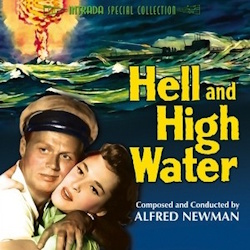 GREATEST SCORES OF THE TWENTIETH CENTURY
Original Review by Craig Lysy
The genesis of Hell and High Water lay with a story outline titled “Submarine” written in 1951 by David Hempstead. The nuclear suspense drama captured 20th Century Fox Chief of Production Darryl F. Zanuck’s attention. He commissioned a screenplay, and after three rewrites by Beime Lay Jr, then Jesse L. Lasky Jr. and finally Samuel Fuller, a screenplay, which met Zanuck’s expectations was realized. Raymond A. Klune was placed in charge of production with a $1.9 million budget with Fuller tasked with directing. A fine cast was assembled, which included Richard Widmark in the starring role of Commander Adam Jones. He was joined by Bella Darvi (Zanuck’s paramour) as Professor Denise Gerard, and Victor Francen as Professor Montel.
The story is set post WWII during the rising tensions of the Cold War. A nuclear explosion is detected off a remote island northeast of Japan and a mission is planned to determine the country behind the explosion. Retired submarine commander Adam Jones receives a $5,000 offer to command the mission, which will use a WWII Japanese submarine that will trail the Communist Chinese freighter Kiang Ching, which is suspected of transporting vital supplies to the target island. Jones recruits former crew members, but is forced to depart early before his torpedo tubes could be validated as functional as the Kiang Ching has set sail. After much intrigue and fighting Jones discovers a plot to trigger WWIII by a false flag operation with an American B-29 bomber dropping an atomic bomb on Chinese Manchuria. The plan is sabotaged by renown French professor Montel when he manages to detonate the bomb during takeoff, which destroys the island. The film made a profit of $830,000 with a net favorable critical reception. The film received one Academy Award Nomination for Best Special Effects.
As with any Darryl F. Zanuck project, Alfred Newman, Director of Music at 20th Century Fox, personally took the lead. Upon viewing the film, I believe Newman understood that the film was a covert military suspense thriller seeking to unravel a mystery, which could change the fortunes of humanity. Central to the film’s narrative was the indomitable and no-nonsense commander Adam Jones, and so a heroic musical narrative would be needed to empower the mission and drive the film’s forward momentum. Newman also needed to speak to the aquatic underworld given that much of the film is set aboard a submarine. And of course, a love theme would be needed to speck to the romance that develops between Adam and Denise.
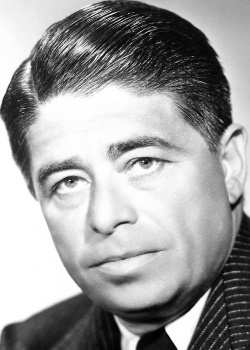 For his soundscape Newman composed five themes. The Main Theme is pervasive in the film, propels its narrative and fuels its forward momentum. It serves as Captain Jones’ personal identity, and by extension, the men under his command, and the mission. It offers a classic major modal marcia orgogliosa buttressed by patriotic and martial elements. It is rendered in a multiplicity of forms, with the simplest being its trumpeting fanfare. Denise’s Theme serves as her identity as the only woman on board, which later develops into a Love Theme for her and Adam. Newman was asked by director Samuel Fuller to interpolate a faux French romantic ballad melody, “Mam’selle” by Edmund Goulding. The melody offers a welcome respite from the militaristic, suspense and action writing, which dominates the film. The Underwater Theme supports shots of the submarine when underwater. It emotes as a foreboding otherworldly misterioso with undulating strings playing over a formless substrate of textural strings with cymbal adornment. Newman infuses this theme with a myriad of textural effects to support various circumstances, including; muted trumpets, dire trombone figures, quotes of the Love Theme, as well as the Main Theme. For our villains, the Chinese Theme emotes as a heavy, oppressive (it has a weighty descending contour) and forceful horn empowered expression draped with oriental auras and textural adornment. The Atomic Bomb Theme offers a swelling, catastrophic eruption effect, much like the expanding mushroom cloud, propelled by a series of horrific declarations by horns monstruose. Masterful is how Newman’s swelling monstrosity mirrors the visual swelling upwards of the monstrous mushroom cloud. Lastly, Newman interpolates a Cole Porter song “Don’t Fence Me In” (1934) as a theme for crewman Lin Cha.
Cues coded (*) contain music not found on the album. “The Atom Bomb” offers a score highlight where Newman masterfully sets the tone of the film. For me, Newman adopts, rather exceptionally I believe, a Herrmannesque manner to support the atomic bomb blast. The film opens with Newman’s iconic 20th Century Fox fanfare replaced with a catastrophic Atomic Blast Eruption Theme propelled by repeating, horrific declarations by horns monstruose. At 0:11 we flow into the film proper with a distant view of an island as the music dissipates on a diminuendo. Narration informs us that in 1953 of a mysterious atomic blast on a remote island far northeast of Japan near the arctic. It closes with; “This is the story of this explosion…” At 0:42 the Atomic Blast Theme reprises as the screen is engulfed in an atomic explosion. As the blinding fireball soars ever upwards into a massive mushroom cloud, so too does Newman’s music, achieving a horrific confluence. At 0:58 declarations by trombones dramatico support the flow of the opening credits in bright read letters against the mushroom cloud. At 1:34 we shift to the trumpet declared Main Theme rendered as a marcia eroica. At 1:58, we close the opening credits with a horrific reprise of the Atomic Blast Theme. “Paris” reveals a panorama of Paris, which Newman animates with vibrant Parisian energy and sensibilities. At 0:31 we shift to drama atop two, four-note stepped horn ascents, which sow urgency as several men get into a black car, which races through the streets of Paris. We close at 1:06 with the Main Theme march as the car turns into Aeroport d’Orly.
“Denise Enters” reveals Herald Tribune reporter Sol McCreary joining Professor Montel at the airport café. He asks him to confirm that he is traveling to Vienna to speak at a conference. Music enters to support the arrival of Professor Denise Gerard, softly introducing her theme on English horn, with a shift to clarinet as Professor Montel leaves the group to meet her. She is nervous and a misterioso unfolds as she hands him a note from Professor Ganhov. At 0:39 a more romantic rendering of her theme emerges as he reads the note, which triggers a discussion in French. They depart, and at 1:02 we segue into “World Broadcast” with strident thrusts by muted horns and percussion that play over a retinue of foreboding strings and woodwinds. We shift to a view of parliament in London joined by a montage of BBC broadcasts with breaking news; “Renown Nobel Prize nuclear scientist Professor Montel has disappeared on route to a conference in Vienna”. Newman continues to sow tension with a strident musical narrative infused with orientalism as the broadcast adds that he is the fifth nuclear scientist to disappear behind the Iron Curtain. We shift to Berlin, and then Rome a month later as the report states that this was not a kidnapping, but a pre-arranged plan. At 1:38 declarations of the Main Theme support the landing of an airplane at Honedo Airport in Japan. Music beginning at 1:58 was apparently dialed out of the film. Newman offered a misterioso draped with orientalism as we see a man who identifies himself to customs as Mr. McDougal. An American naval officer greets him as Submarine Captain Adam Jones, but he says that he is mistaken.
“Rendezvous” reveals a Japanese man named Eddie, gifting Jones with an envelope, which he says contain your instructions. He instructs him to proceed to the taxi pickup area and to take taxi #63. Jones does so and music enters as he is dropped off among some warehouses. Jones knocks, is admitted and taken downstairs where a Japanese man introduces himself as Hokado Fujimori. He examines McDougal against a photo of Captain Adam Jones, and says welcome Captain Jones. Newman supports the scene up to this point with an intangible, textural misterioso of intrigue, sowing unease with an undercurrent of nebulous string figures, and foreboding woodwinds. Music ends here as Fujimori escorts Jones in to a command center and introduces him to Mr. McAuliffe, Colonel Schuman, Mr. Aylesworth and Professor Montel. They brief him on the island, and the mission, provide him $25,000 up front, and $25,000 upon completing the mission In “His Own Price for Dying” Jones agrees with the caveat that the sub be armed with torpedoes, and that he wants his own key men, who served him before. Both conditions are granted, and Professor Montel closes the scene saying; “Each man has his own reason for living, and his own price for dying”. Newman supports with muted trumpets and a foreboding oboe solitari expressing a deconstructed fragment of the Main Theme. At 0:31 the Main Theme regains cohesion, offering a noble statement.
“There’s No Tomorrow” reveals bustling work by a construction team, Jones, and his crew working on the mothballed sub to bring her back to operational status. Montel and Denise join below and Jones informs the crew that they are passengers for the mission. There are objections from some crewmembers who voice the ancient myths long perpetuated as part of maritime culture, which believe that women bring bad luck as they create distractions among the crew, could anger the sea gods, and bring storms or misfortune. Denise, in a soliloquy, wins the crew over with a calm, and measured speech. Music enters with the muted trumpet and solo oboe motif draped with foreboding Chinese auras as we return to the deck the following day when Fujimori and Dr. Montel arrive. At 0:50 an ominous, pulsing clock motif joins as they say that the Communist Chinese freighter Kiang Ching has unexpectedly set sail and that he must depart immediately and overtake her. At 1:07 strident percussion punctuates as Jones says he cannot as he needs a test run and must also test the torpedo bays. They counter saying he should perform these en route, which Jones says is a recipe for disaster. When they say depart at once or cancel the mission, he grudgingly agrees supported by a plaintive statement of the Main Theme. At 1:37 the Main Theme rendered as a marcia orgogliosa propels the sub sailing out of harbor to her destiny. We conclude at 2:15 with a bravado statement of the Main Theme as Jones orders the crew below and dives, as we watch the sub descend into the ocean depths.
“Submerged Submarine” reveals Jones ordering a hull integrity test by putting the sub on the ocean bottom. He informs Denise that if the hull fails, they die quickly. We see the sub drifting to the ocean floor and Newman sow tension by introducing his Underwater Theme, which emotes with strings undulating over formless, textural strings with cymbal adornment to create an otherworldly misterioso. At 0:33 dire trombones resound as the sub hits the ocean floor. Jones order the air bank opened to take the sub up, but the primary bank fails, and they are not sure which is the emergency bank. Denise can read Japanese glyphs and identifies the emergency bank. Chief Holter opens it and repeating declarations by trombones dramatico and jagged strings support the sub’s ascent to the surface. At 1:07 trumpets militare and field drums offer quotes of the Main Theme as Jones orders red lights, raises the periscope and looks out. Foreboding horns orientali resound as we see an external shot of the submarine. Jones thanks Denise for her assistance translating, and at 1:42 Newman drapes us with soft, mystical, oriental auras as Dr. Montel informs Jones that Denise has a Master degree in Oriental Languages. He thanks her for being aboard, and she thank him supported by a tender quote of her theme. At 2:06 the Main Theme resounds with trumpet declarations and martial field drums as we see the submarine sailing on the surface. A warm and heartfelt extended rendering of the Main Theme plays under the dialogue as Dr. Montel and Jones discuss the mission, and Denise who Montel asserts was a prodigy. A non-musical interlude follows where we see a sailor flirting with Denise, a drunk recruit joins, and a fight breaks out with Denise suffering a lip cut. Jones pummels the drunk, restores order and goes into to check on Denise. At 2:43 we segue into “Choppy Seas”, however the scene to which this music was attached, evidently ended up on the editing room floor. It opens with the Atomic Blast Theme, which dissipates, flowing into a tender rendering of Denise’s Theme. At 3:28 a proud rendering of the Main Theme as a marcia patriottica resounds, but then slowly loses it bravado, assuming a softer expression. “Denise” reveals Jones personally ministering to Denise’s wounds. She is uncomfortable with him wiping the grease from her face, and he backs off. He then pulls out his log and begins debriefing her. Newman supports their extended interaction in this scene with the Love Theme rendered with simplicity by harmonica and strummed guitar. Most satisfying is that Newman achieves a Parisian sensibility that speaks to her heritage, and the harmonica and guitar work perfectly for the small quarters used for the scene. The following two cues were evidently attached to scenes edited out of the film. “Captain Jones” offers an intimate exposition of Denise’s Theme by harmonica and strummed guitar. At 0:48 we segue boldly into “Sub Through Choppy Seas” atop the Main Theme.
“61 J Capsule” reveals a plane arriving at pre-planned rendezvous coordinates and dropping a package. In the control room Jones reads a communique from Fujimori; “Kiang Ching transporting an unconventional 61 J Capsule.” Jones asks what this is, and Dr. Montel replies, a device to detonate an atomic bomb. Newman supports by sowing a very disquieting and foreboding musical narrative using a repeating, descending four-note motif draped in twinkling auras, which shifts ever downward in register from an oboe, to English horn, to abyssal tuba. At 0:39 we segue into “The Red Sub” with a dire surging crescendo propelled by strings furioso and a forthright Main Theme as a hostile sub is detected by sonar and Jones searches the horizon through the periscope. At 0:58 the Main Theme darkens and an ominous musical narrative unfolds as Jones realizes they are being hunted. Hydrogen gas is at 4% so he will soon have to surface and purge the explosive gas, but by doing so they become vulnerable to attack. At 1:55 “Up at Sub” Jones orders “Take her up!” and a confident, trumpet led Main Theme supports the sub surfacing. A tense musical narrative unfolds as Jones ascends to the bridge and he and two other sailors try to detect the enemy sub by scanning the horizon. Below Dr. Mendel and Denise return to the control room in violation of captain’s orders. Jones wants to be prepared to defend himself, and so at 2:49 trumpets declare a heroic iteration of the Main Theme as he orders battle stations, and the deck gun made ready. A diminuendo usher in a musical narrative of tension, which slowly becomes increasingly ominous as the Chinese sub surfaces and transmits a signal asking for identity and destination. Jones responds they are a scientific mission, and the Chinese commander demands to board for inspection. When Jones says to repeat the message, the Chinese open fire. At 4:02 Jones orders a course change that turns the sub towards the Chinese sub empowered by a proud Main Theme. This obscures the deck gun behind the Conning tower, which he now orders loaded. A second Chinese shot initiates a battle with the Main Theme rendered as a march dominating. At 4:23 dire horns evoke the Atomic Bomb Motif joined in unholy synergy with the Chinese Theme, a textural motif expressed by violins, ominous bass chords, vibraphone, and gong strikes draped in Chinese auras. Interplay between the two themes unfolds as the battle ensues. At 6:24 the Main Theme resounds as Jones orders a crash dive, but the last man down collapses wounded, unable to close the hatch. Water pours in and Dr. Montel tries to close it but catches his thumb, which requires Jones to cut it off to seal the hatch. The sub sinks to the ocean floor and the Chinese Theme now dominates, unopposed as we see their sub moving towards them. Newman sow suspense and a grim narrative as the sub closes, passes over the American sub and slowly settles on the bottom a hundred yards from the American sub.
“The Ocean Floor” reveals both crews waiting quietly, and Newman sustains tension by subtly offering a bleak, random, and formless textural musical narrative, which never resolves. At 4:43 a slow, two-note ostinato by yearning strings supports Jones lifting Denise from the cold sub floor and carrying her to his cabin. He lays her in his bed and begins to caress her. She does not resist, and so he takes her into a kissing embrace, which she willingly accepts. At 5:13 the Love Theme borne by flute romantico and a retinue of strings supports as they repeatedly kiss, blossoming at 6:13 for a beautiful performance. Yet a repeating Underwater Theme intrudes, reminding Jones of their dire circumstances, and so he decides to not continue the love-making and instead resume the mantle of captain. He ends things tenderly, departs, and announces to the crew that he is going to make a break. “The Sub’s Rising” reveals Jones ordering ahead one-third and a depth of 175 ft. The ship rises and departs, is heard by the Chinese captain, who orders his sub underway. Both subs rise from the ocean floor engulfed by an ominous Underwater Theme. The Chinese fire a torpedo, which misses, and reveals their position. At 1:03, Jones, empowered by a bold Main Theme orders right full rudder and ramming speed. A battle narrative follows with the Main Theme dominating the Chinese Theme. They sheer off the Chinese sub’s periscope, circle round and again ram the Chinese sub mid-section, puncturing its hull. At 3:10 we segue into “The Victorious Sub” as Jones orders reverse and to surface, and the Main Theme is rendered triumphantly as an anthem of victory. At 3:32 an aggrieved Denise’s Theme supports her call for help as she tends to her father who fell on the floor after the collision. At 3:40 the proud Main Theme resumes as a marcia della vittoria to support the sub reaching the surface. At 4:15 the Main Theme softens and flows into Denise’s Theme as Jones visits Dr. Montel who has been treated and is resting. At 4:53 a thankful rendering of the Main Theme supports the crew cooling down on the deck and at last breathing fresh air.
(*) “Don’t Fence Me In” reveals the crew relaxing below as a Chinese crewman Chin Lee sings the Cole Porter song as he plays the ukulele. We flow into “We’ve Sighted Land” where Jones is called to the control room for a land sighting. We open ominously with two quotes of the Atomic Bomb Motif as he views the island through a periscope. A trumpet declared variant of the Main Theme resounds as the sub approaches the island. At 0:31 we shift to nighttime on the deck as a team is dispatched by raft to the island. Newman sow suspense with a drum dominated textural ambiance as they land. Dr. Montel detects high levels of radiation on his Geiger counter from a complex guarded by Chinese guards. A guard surprises them, and opens fire, killing one before being killed. Now discovered, Jones orders an attack. A ferocious gunbattle unfolds unsupported by music. “Oil Tank Explosion” reveals Jones and his men outgunned, and pinned down, and so he directs fire at the enormous oil tanks, and one by one a cascade of massive explosions turns the tide of battle, and consumes the research facility in a cataclysmic conflagration. Jones orders a retreat to the beach and they struggle with their wounded to make progress. Newman supports with dynamic thematic interplay of the Chinese Theme, a heroic Main Theme and repeating eruptions of the powerful Atomic Bomb Theme. As they set off in a raft, they come under fire, which they overcome and gain a prisoner, a Chinese officer. A triumphant rendering of the Main Theme carries their paddling through patches of burning oil.
In an unscored scene, Dr. Montel advises Jones that Denise had translated the Chinese Major’s orders. He says that Ho Sin is the pilot of the plane, and that the remote Island of Kevlock is the only island known to have an airfield. He says to proceed north at once. Jones objects, saying he has fulfilled his contract and refuses to go. He relents and orders the sub north when Dr. Montel reminds him of the closing paragraph of his contract, which stipulates that he, not you decides when the mission is completed. “Stormy Sea” reveals the sub traversing stormy seas, and Newman propels her progress with a determined rendering of the Main Theme emoted with strength in the lower register by trombones and tuba, with woodwind adornment. At 0:52 a dire Chinese Theme resounds as we see the sub arrive at the island. Below deck Jones prepares to scrub the mission as Dr. Montel injured knee prevents him from climbing and descending to the raft. He insists that Jones take his daughter, who has the same training a his to identify elements and the bomb. Jones refuses, but Denise’s rebuke that he can give orders, but not take them, causes him to relent.
“Kevlock Island” reveals Jones and his team paddling to the island at night. Newman sow unease and tension with a repeating motif of a bass drum cadence joined by an alto flute and eerie vibraphone effects. They see a complex guarded by two sentries. At 2:10 an enemy patrol arrives carried by their theme, and Jones and Denise scurry to hide. At 2:59 we segue into “Your Record, Captain” as Jones asks Denise to clarify what she meant when she says he cannot take orders. He relates an incident when he violated orders to save men’s lives and ended up losing his sub and crew of twenty-six. He says he would do it all over again if he had too, but we see he is remorseful. Newman supports the intimate moment with Denise’s Theme, with no romantic overtones. He moves away, she joins and apologizes. At 3:52 an alto flute usher a now softer and more tender iteration of her theme, which blossoms as they discuss their plans after completing the mission; she intends to return home to Paris, and he says he has no plans. She invites him to come to Paris as Americans enjoy the city. Throughout this intimate sequence, the bass drum cadence remains steady, informing us that danger lurks. At 5:33 he gives her a pistol, tells her to remain, while he checks their surroundings. The drum-based tension motif resumed, joined by lurking statements of the Chinese Theme. At 6:36 we segue into “The Enemy” atop dire declarations of the Chinese Theme as Jones see the false flag B-29 bomber with a U.S.A. air force emblem. At 6:56 we segue into “The Killing” atop a tense violin sustain as a Chinese soldier arrives and repeatedly yells; “Lin Fan!” Chinese textural effects join an eerie vibraphone as the soldier searches and Denise hides in the shadows.
In “Escape” the Chinese soldier sees her, fires a machine gun volley and misses. Denise comes out of the shadows and kills him, which alerts the other Chinese soldiers and Jones, with both converging on her. She is in shock and a tragic rendering of her theme supports. At 0:37 a dire Chinese Theme supports their approach as Jones reaches Denise, who is frozen in shock. He exhorts her to run with him, and her beleaguered theme propels their escape. At 0:46 a cyclic string motif with abyssal horns and drum strikes supports the Chinese soldiers fanning out to find the assassins. Main Theme trumpets join as Jones and Denise reach cliffs overlooking the beach. A sailor has the raft ready, they board, and manage to escape back to the sub. In an unscored scene back on the sub, Jones is perplexed as to why there is a U.S. B-29 bomber at a Chinese air base. He decides to have Chin obtain information from the captured Chinese major. They plant a hidden microphone in the room, and then Chin allows Jones to punch him twice as a ruse to convince the major that he is also a prisoner. In the torpedo room, the major has managed to find a large wrench, which he hides when the bound Chin is tossed in the room. Chin succeeds in convincing the major that he is one of his men, and then gets him to disclose the information; the false flag bomber carrying a nuclear bomb, with bomb Manchuria to ignite WWIII. Then Denise yells that the major has discovered that Chin is a plant and they race to rescue him, but it is too late as he has been bludgeoned to death with a wrench. Jones is devastated at Chin’s death and just stares at his body, unable to speak.
“Chin Lee’s Burial” reveals Chin’s burial at sea. Newman’s conception of the music is unusual and complex. He offers string figures and drums, with a ghostly reprise of the “Don’t Fence Me In” song sung by Chin, joined by ethereal wordless women’s chorus, and “Taps” on a bugle. In an unscored scene Jones relates his plan to the crew; he will go ashore alone, they will take the sub and submerge at periscope depth one-half mile off the runway shore, he will signal when the plan takes off, they will surface and fire all guns at their disposal as the plane because of its heavy load of fuel will be very low and an easy target. Once destroyed, submerge and wait it out. Tomorrow at 2200 surface and pick him up at the rendezvous point, and depart if he does not show up. Dr. Montel objects, saying that this is a civilian mission, not a military mission, and orders Jones to depart. Jones refuses, declares that he is in command, and says the bomber must be stopped. Later, the crew report that Dr. Montel has left the ship. He finds Denise, blames her for letting him go, and berates Montel very harshly. She breaks down, screams stop, and drops a bombshell – that he is her father. A remorseful Jones, takes her into a comforting embrace and apologizes.
“The Bomber is Destroyed – Parts 1 & 2” reveals Jones commanding the sub, at periscope depth one half mile off the runway shore. Newman sow tension as they wait. Jones sees Montel’s signal, orders an emergency surface, and a proud Main Theme buttressed by trumpets patriottiche fanfare as the crew arms the sub’s canon, large machine gun, and themselves with hand-held machine guns and rifles. At 0:45 a menacing Chinese Theme supports the sight of the plane lifting off. Strings energico animate the crew readying their weapons and taking aim. The Chinese Theme joins the tension motif as the plane arrives, and the crew opens fire. At 1:31 a descent motif supports the bomber aflame, descending, and making a desperate attempt to return to the runway. It fails, and at 1:47 it explodes, unleashing an atomic mushroom cloud, supported by a monstrous eruption of the Atomic Bomb Theme. The sub is shown diving deep and at 1:52 sharp, stabbing orchestral thrusts support the sub being buffeted by shockwaves as everyone is tossed to the floor. This narrative buttressed by a repeating Atomic Bomb Theme continues as people are tossed about and external shots show the sub being rocked back and forth. At 2:17 a subdued Main Theme struggles to arise as the shock wave dissipates and everyone regains their footing. At 2:30 the Main Theme regains its strength and unfolding with dignity. At 2:53 a diminuendo supports Jones assessing the aftermath and discovering that the plane did not crash in the sea, but instead into the island, which has been destroyed. Dire declarations by horns funebri support Jones’ revelation. At 3:17 Denise looks through the periscope, and steps back in disbelief, when she realizes that her father is dead. An anguished rendering of her theme supports her devastation as Jones takes her into his comforting embrace. At 3:29 we segue into “Homeward Bound” atop the Main Theme rendered as a threnody as we shift to the rising mushroom cloud, and final words of Dr. Montel; “Each man has his own reason for living, and his own price for dying”. We close the film at 4:17 with a grand declaration coda of the Main Theme
I would like to thank Nick Redman and Douglass Fake for their restoration of Alfred Newman’s score to the suspense-thriller “Hell and High Water”. The technical team utilized the original 35mm magnetic film sources and significantly improved the quality of the monaural audio, although some ‘wobbliness’ is occasionally heard. Never the less the listening experience is enjoyable. I believe Newman realized that he was scoring a B film and that his music would be needed to overcome some of its flaws, propel its pacing, and enhance its narrative. His Main Theme offers classic militarism and patriotic heroism, which bonds the men, sub and mission with the audience. The Parisian Love Theme offers a well needed intimate and romantic respite from the action and suspense themes. The underwater soundscape was well-conceived and expertly joined mystery, tension and suspense to enrich the submarine’s underwater scenes. What struck me most about this score is how Herrmannesque it is in both its conception and execution. The first example is the astounding and monstrous music created for the atomic blast, which in every way mirrors the ever swelling and expanding mushroom cloud cataclysm displayed on the screen. Herrmann was well-known for his cell structure method of scoring, using repeating and shifting succinct, short-note motifs to evoke tension, suspense and mystery. There are several cues in this score where I would have guessed upon first listen, that Herrmann wrote them, had I not written this review. Folks, this is by no means a tier one Alfred Newman score. Nevertheless I must acknowledge how masterfully he wove together the adventure, heroism, suspense and romantic elements of his soundscape, to achieve a score that enhanced its film in every conceivable way. I recommend you purchase the album, and take in the film to see how film music can elevate a flawed film.
For those of you unfamiliar with the score, I have embedded a YouTube link to a ten-minute suite: https://www.youtube.com/watch?v=LQlbOF5pUGo&list=RDLQlbOF5pUGo&start_radio=1
Buy the Hell and High Water soundtrack from the Movie Music UK Store
Track Listing:
- The Atom Bomb (2:16)
- Paris (1:21)
- Denise Enters/World Broadcast (2:41)
- Rendezvous (1:26)
- His Own Price for Dying (1:05)
- There’s No Tomorrow (2:32)
- Submerged Submarine/Choppy Seas (4:56)
- Denise (2:27)
- Captain Jones/Sub Through Choppy Seas (1:01)
- 61 J Capsule/The Red Sub/Up at Sub (8:56)
- The Ocean Floor (7:27)
- The Sub’s Rising/The Victorious Sub (5:21)
- We’ve Sighted Land (1:57)
- Oil Tank Explosion (2:04)
- Stormy Sea (1:04)
- Kevlock Island/Your Record, Captain/The Enemy/The Killing (7:48)
- Escape (1:32)
- Chin Lee’s Burial (0:51)
- The Bomber is Destroyed – Parts 1 & 2/Homeward Bound (4:29)
- Mam’selle (2:42) Bonus Track
- To Romance (0:40) Bonus Track
- Don’t Fence Me In (1:24) Bonus Track
- Wild Bomb Mushroom Effect (Vibraphone Version) (1:56) Bonus Track
- Wild Bomb Mushroom Effect (Cymbals/Gong Version) (2:06) Bonus Track
- The Atom Bomb (Revised) (2:16) Bonus Track
Intrada Special Collection Volume 19 (1954/2005)
Running Time: 72 minutes 18 seconds
Music composed and conducted by Alfred Newman. Orchestrations by Edward B. Powell. Recorded and mixed by XXXX. Score produced by Alfred Newman . Album produced by Nick Redman and Douglass Fake.

Shop at the Movie Music UK Store

Member of the

 MOVIE MUSIC UK