NUREMBERG – Brian Tyler
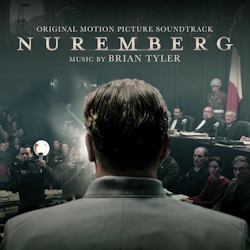 Original Review by Jonathan Broxton
The Nuremberg War Trials, held in the eponymous city from 1945 to 1946, were a series of military tribunals convened by the Allied powers to prosecute leading figures of Nazi Germany – many of whom were close advisors to Adolf Hitler – for crimes committed before and during World War II. They were unprecedented in scope: for the first time in modern history, high-ranking political, military, and industrial leaders were held individually accountable for war crimes and crimes against humanity, and the trials established that “following orders” was not a sufficient defense for atrocities such as genocide, mass enslavement, and the systematic destruction of civilian populations. 19 of the 24 men that were tried were found guilty, and of those 12 were sentenced to death; ultimately, the trials effectively put a pin in the final parts of war, and started the world on the long road to recovery.
There have been countless books, films, and TV series about the war trials, the most acclaimed of which was director Stanley Kramer’s 1961 film Judgment at Nuremberg, for which Maximilian Schell won the Best Actor Oscar. This new film, simply called Nuremberg, takes a fresh look at the proceedings; it is directed by James Vanderbilt, and stars Rami Malek as Douglas Kelley, a United States Army Military Intelligence Corps officer who served as chief psychiatrist during the first months of the Nuremberg trials. Malek is supported by an excellent cast including Leo Woodall, John Slattery, Colin Hanks, Richard E. Grant, Michael Shannon, and especially Russell Crowe who has been tipped as a potential Oscar nominee for his standout work portraying Hermann Göring.
The score for Nuremberg is by composer Brian Tyler; he previously scored Vanderbilt’s only other film as a director, the political drama Truth in 2015, although he has worked on several other films that Vanderbilt wrote and/or produced, going all the way back to one of his earliest efforts, Darkness Falls, in 2003. Tyler is one of the most successful composers working today, with multiple Marvel movies, multiple Fast and the Furious movies, the Now You See Me franchise, the Yellowstone TV franchise, and recent box office smashes like the Super Mario Bros movie to his name. However, for all his success in the action and fantasy genres, I have personally always had a major soft spot for the scores where Tyler pulls back slightly and writes music that is more classical, more emotional, more lyrical, more serious: The Greatest Game Ever Played, Partition, Columbus Circle, Redeeming Love, the aforementioned Truth. Now Nuremberg joins that list.
 Tyler was clearly deeply moved by the film, and felt it was important to give it a significant sense of drama, and as such his response was essentially to write a 25-minute concerto for full orchestra and chorus, which is presented as five movements or suites at the beginning of the album. Stylistically there are some echoes of John Williams’s Schindler’s List in the frequent use of solo violins and in the general ‘reverence’ of the tone. In other places I picked up some little echoes of James Horner’s writing from 1990s scores like The Pelican Brief and Apollo 13, especially in the use of certain wooden percussion sounds, as well as some contemporary Hans Zimmer in the descending two-note brass motif that dominates the darker parts of the suite.
But, to be clear, this is in no way a piece of pastiche; this music feels heartfelt and emotional and moving in all the best ways. There are some very subtle flavors of traditional Jewish folk music in some of the chord progressions Tyler uses too, which clearly acknowledge the millions of victims of the Holocaust, but thankfully do not fall into the trap of using that sound as a cliché.
Several moments stand out: the tragic beauty of the first half of “Begin,” the more martial percussive sounds and brooding melodrama of the second half of the same cue. The shrill and slightly dissonant opening moments of “Resistance,” which sometimes emerges into some coolly contemporary action and suspense stylistics employing subtle electronics and the aforementioned nervous wooden percussion patterns. The use of marching boots as part of the percussion section in the menacing “Never Shall We Forget” is brutal and immensely effective.
At least two recurring themes, one noble and determined, one heartfelt and poignant, run through much of the suite, allowing the score to develop and clear melodic identity that I enjoy. The performance of the ‘heartfelt and poignant’ theme towards the end of “Resistance” is especially beautiful. And then “Tzedek, Tzedek Tirdof” is just gorgeous, sweeping and forthright and underpinned with a sense of righteousness. The cue title is a Hebrew phrase from the Torah that means “justice, justice you shall pursue,” and is a fundamental Jewish concept that calls for the pursuit of justice in all aspects of life, from formal court systems to daily interpersonal relationships. Hugely appropriate.
The bulk of the actual underscore itself builds on textures and ideas from the suite, often repeating sections verbatim, which means that the album does suffer from a little mid-album repetitiveness, but this is more a reflection on the front-loaded nature of the album rather than the quality of the actual writing, which remains exceptionally high quality. Some moments I did especially note include the guttural electronic parts and use of dramatic tolling bells in “Welcome to Nuremberg,” the urgency and general aggressiveness of “The Charges,” and the return of the stomping boots in the belligerent “Stormfront”.
The prominent performance of the dramatic main theme at the beginning of “The Hunt” is notably excellent, as is the return of the woodblock tick-tock percussion in “Fissure” and throughout the potent, insistent, sometimes harshly dominant “Modesty vs Vanity”. The sense of relief in the string writing in “Judgement” is palpable, while the wordless male voice choir adds a subtle layer of gravitas.
In general there is quite palpable sense of thrusting forward motion, a sense of rushing headlong into the story, throughout much of the bulk of the actual underscore, which really gives the whole thing an unexpected breathless, kinetic quality, which feels like it is capturing the energy and urgency of Kelley’s experiences. It’s very engaging from start to finish. The almost 14-minute “Nuremberg End Title” ends the score in magnificent fashion with an excellent summation of everything the score has to offer, and for me is one of the highlight cues of Tyler’s recent career.
In online posts Tyler said that “it was beyond an honor composing the score for Nuremberg” and that he “composed this score with the intent of bridging the gap of time and making its events feel dangerously current and emotionally resonant today.” I couldn’t agree more. When you look at the state of much of American politics right now there are a number of alarming parallels between where we are right now and what was happening in Nazi Germany in the early 1930s, and films like this are invaluable reminders of what can happen when fascists gain power, and what brave men and women need to do to stop it. Brian Tyler’s music for this film does exactly what he intended: it honors and gives gravitas to the work of Douglas Kelley and everyone involved in the war trials, eulogizes those who were the victims of that despicable regime, and uses contemporary musical techniques to make it relevant to modern audiences.
Buy the Nuremberg soundtrack from the Movie Music UK Store
Track Listing:
- Nuremberg Suite Part I – Begin (5:48)
- Nuremberg Suite Part II – Resistance (7:18)
- Nuremberg Suite Part III – Hope (3:36)
- Nuremberg Suite Part IV – Never Shall We Forget (4:33)
- Nuremberg Suite Part V – Tzedek, Tzedek Tirdof (3:07)
- Welcome to Nuremberg (4:52)
- The Charges (4:33)
- Stormfront (3:27)
- Rorschach (1:26)
- Goring and Hess (4:46)
- The Hunt (3:00)
- Fissure (2:52)
- Modesty vs Vanity (5:32)
- Judgement (3:42)
- Justice and Atonement (1:27)
- Unheard Warnings (1:36)
- Epilogue (2:29)
- Nuremberg End Title (13:44)
Sony Classical (2025)
Running Time: 78 minutes 00 seconds
Music composed and conducted by Brian Tyler. Orchestrations by Kenny Wood. Recorded and mixed by Greg Hayes. Edited by Matthew Llewellyn and Ben Zales. Album produced by Brian Tyler.
-
February 6, 2026 at 8:01 amMovie Music UK Awards 2025 | MOVIE MUSIC UK

Shop at the Movie Music UK Store

Member of the

 MOVIE MUSIC UK