COPYCAT – Christopher Young
 THROWBACK THIRTY
Original Review by Jonathan Broxton
Copycat is a psychological thriller directed by Jon Amiel, starring Sigourney Weaver, Holly Hunter, Dermot Mulroney, and William McNamara. Weaver plays Dr. Helen Hudson, a brilliant criminal psychologist and expert on serial killers who becomes agoraphobic after being attacked by one of her former subjects, Daryll Lee Cullum, played in an extended cameo by jazz singer Harry Connick Jr. Years later, and now living in near-total isolation in her San Francisco apartment, Helen is drawn back into criminal investigation when a new serial killer begins terrorizing the city, and she is asked to consult with the lead detectives, M. J. Monahan (Hunter) and Reuben Goetz (Mulroney). Eventually the trio realizes that the killer appears to be copying famous murderers, mimicking the methods of killers such as the Boston Strangler, Son of Sam, Jeffrey Dahmer, and Ted Bundy. However, things quickly become personal when the killer begins targeting Helen herself, forcing her to confront her trauma and step outside her apartment for the first time in years.
Copycat was part of a wave of highbrow serial-killer thrillers that were greenlit following the success of The Silence of the Lambs in 1991, and I have always considered it to be one of the better ones. The screenplay, by Ann Biderman and David Madsen, is clever and intelligent, and offers a surprising amount of psychological depth, particularly in terms of Sigourney Weaver’s portrayal of a woman who is paralyzed by fear but is forced to confront the thing that terrifies her the most. It was an interesting ‘playing against type’ role for Weaver, considering that she is most famous for her tough-as-nails portrayals of action heroines like Ellen Ripley from the Alien franchise.
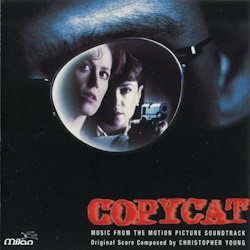
 The score for Copycat was composed by Christopher Young, a composer well known for his darkly textured and psychologically charged music in thrillers and horror movies. This film marked the first of five collaborations between Young and British director Amiel; their later work would include such titles as The Man Who Knew Too Little in 1997, Entrapment in 1999, The Core in 2003, and Creation in 2009. Amiel always inspired Young to excellent work, and that is certainly the case with Copycat.
In many ways the score is a prototypical Young thriller score – it’s one of several that he was asked to write following the success of Jennifer 8 in 1992, and which Young himself playfully dubbed ‘Jennifer 9,’ ‘Jennifer 10,’ ‘Jennifer 11,’ and so on, but to simply dismiss it as a Jennifer 8 clone would actually be doing it a disservice. Contrary to what one may expect, Copycat is actually one of his more restrained and cerebral efforts; it’s less overtly horror-driven, and is instead steeped in unease and tension, often functioning as an aural reflection of Helen’s psychological state.
Much of it is built around delicate, suspenseful motifs rather than full themes, using fragmented melodies and ambiguous harmonies that mirror her isolation and fear. The orchestration emphasizes strings and sparse piano figures, often suspended over eerie sustained tones that create a sense of claustrophobia. There’s also a notable contrast between the intimate, lightly jazzy, almost chamber-like passages that underscore Helen’s interior world and the tense, rhythmic cues that accompany the killer’s activities or police pursuit scenes. This duality – moody introspection versus bombastic menace – gives the music a psychological depth beyond conventional thriller scoring.
The essence of Helen’s self-imposed seclusion is musically carried by the gorgeous main title theme “Copycat,” which clearly has some elements of Jerry Goldsmith’s Basic Instinct to it, blended with the icily beautiful string-and-piano writing from Young’s Species earlier in 1995. Young’s use of tinkling bells, harps, and light metallic percussion throughout the cue is also quite impressive in and of itself, giving the score a unique timbre, despite it occasionally reminding me of the magical DeLorean motif from Alan Silvestri’s Back to the Future. This overall sound is quintessential Young; the music is strikingly beautiful on the surface, but has a distinctly anxious quality too that keeps the listener just that tiny bit on edge.
Later cues like the more conventionally romantic “Housebound,” the haunting “In Darkness,” and the sensitive “Silhouette” feature a secondary theme for Helen herself, which revisits the same stylistics as the main theme but is built around a different melody, and has perhaps just the slightest touch of jazz in the sound of the piano (performed by Gary Nesteruk of the Santa Monica Music Center), shrouding Helen’s reclusive life in a sense of mystery and also a little bit of sadness.
The six-minute “Shoot Him or Stick Him,” which underscores the pivotal opening scene of Helen being attacked and almost killed by Daryll Lee Cullum in a public bathroom, is the blueprint for the score’s action and suspense music, in which elongated textures and edge-of-seat nervous sustains are peppered with subliminal references to Helen’s theme, before erupting into a hotbed of scything strings, thunderous percussion rumbles, nervous piano clusters, and stabbing brasses that sometimes explode with violent volume.
Elsewhere, cues like the insistent and insect-like “Silent Screams,” the raw and strident “Murder’s an Art,” the determined-sounding “Take a Life,” “Next to the Devil,” the chilling “Pastoral Horror,” and the hysterical, frightening explosion of sound in the appropriately-named “Panic” build on this overall vibe in a variety of excellent ways. I love the way Young uses wood block percussion to ramp up the tension in “Murder’s an Art,” and then how he ends the cue with a worried, sickly-sounding version of Helen’s theme. The use of breathing effects throughout the shrilly unnerving “Gallows” is clever, as is the more frantic and jarring version of the main title theme in “Butchers & Bakers,” which sees the main motif backed by undulating tremolo strings.
The penultimate cue, “Who’s Afraid,” sees Young adapting the jazzy theme for Helen during her final confrontation with the killer; the way he defaces the main melody with shrieking, dissonant string textures at the outset of the cue is clever, and then the sense of relief and resolution that emerges in its wake is excellent at re-affirming Helen’s agency and independence as she literally puts an end to her fears. The final cue “Lay Me Down” is a resolute and positive-sounding reprise of the wonderful main theme that again offers some appropriate catharsis for the story as a whole.
The album, on Milan Records, contains around 45 minutes of score, plus a couple of source music pop songs, and two operatic classical cuts from Rossini’s The Barber of Seville and Puccini’s Tosca, the latter pair representing Helen’s in-movie personal musical taste. Copycat is an outstanding thriller score, for me one of Christopher Young’s genre best, combining a pair of excellent chilly-beautiful main themes with some vivid and sometimes vicious action. The album is a little hard to come by these days, but it’s well worth seeking out for fans of Young’s iconic thriller sound.
Buy the Copycat soundtrack from the Movie Music UK Store
Track Listing:
- Get Up To This (written by Derrick Gumbus and Loren Chaney, performed by New World Beat) (3:54)
- Carabu Party (written and performed by Steven Ray) (2:55)
- Techno Boy (written by Jerome Evans, performed by Silkski) (3:21)
- Main Title (3:00)
- Shoot Him or Stick Him (6:02)
- Housebound (2:05)
- Silent Screams
- Murder’s An Art (5:57)
- In Darkness (2:14)
- Take a Life (2:09)
- Next to the Devil (1:30)
- Pastoral Horror (4:17)
- Silhouette (2:36)
- Gallows (2:01)
- Butchers & Bakers (2:31)
- Panic (1:09)
- Who’s Afraid (3:35)
- Lay Me Down (4:51)
- Largo Al Factotum from The Barber of Seville (written by Gioachino Rossini, performed by Roberto Servile and the Failoni Chamber Orchestra of Budapest, cond. Will Humburg) (4:32)
- Vissi d’Arte from Tosca (written by Giacomo Puccini, performed by Gabriela Beňačková and the Czech Philharmonic Orchestra, cond. by Bohumil Gregor) (3:20)
Running Time: 63 minutes 53 seconds
Milan Records 74321-33742-2 (1995)
Music composed by Christopher Young. Conducted by Pete Anthony. Orchestrations by Christopher Young and Pete Anthony. Featured musical soloist Gary Nesteruk. Recorded and mixed by Robert Fernandez. Edited by Thomas Milano. Album produced by Christopher Young and David Franco.
Leave a reply to Michael Thiermann Cancel reply

Shop at the Movie Music UK Store

Member of the

 MOVIE MUSIC UK
How about a review of Young’s Nosferatu? I’ve never heard a score as often as this one, and unfortunately, it gets lost in the film music community…