POWDER – Jerry Goldsmith
 THROWBACK THIRTY
Original Review by Jonathan Broxton
Powder is a science fiction-drama film written and directed by Victor Salva, starring Jeff Goldblum, Mary Steenburgen, Lance Henriksen, and Sean Patrick Flanery in the title role as Jeremy “Powder” Reed, a reclusive young man with albinism and extraordinary intellectual and psychic abilities. Jeremy was raised in isolation by his grandparents after his mother was struck by lightning while pregnant with him, but after their deaths Jeremy is brought into the wider world by the kind local sheriff Barnum (Henriksen), school counselor Jessie (Steenburgen), and science teacher Ripley (Goldblum), who recognizes Jeremy’s genius-level intellect and apparently paranormal abilities, which include reading minds, sensing emotions, and even manipulating electrical energy. However, despite their efforts to help him adjust, Jeremy faces alienation, ridicule, and even violence from his peers due to his appearance and strange powers.
Powder is an ambitious film that tackles themes such as empathy, spirituality, and the fear of difference, and which poses moral questions about human cruelty and emotional numbness, suggesting that true enlightenment requires understanding and compassion. However, the film’s release was overshadowed by the controversy surrounding director Victor Salva’s prior criminal conviction for child molestation during the production of his directorial debut film Clownhouse in 1988. Salva’s past became widely publicized when Powder was released by Disney, who stated that they learned of Salva’s crime only after production of Powder had begun. Ultimately the whole thing significantly affected the film’s reception and legacy, despite its positive thematic ambitions.
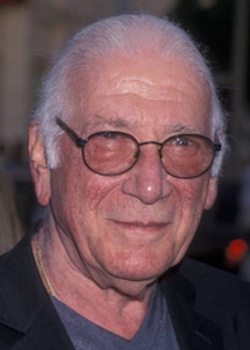 Although the film was actually a moderate financial success at the time it is mostly forgotten today – Salva is now better known for creating the popular horror franchise Jeepers Creepers – but one of the few aspects of the film that has endured is it’s score, which was written by Jerry Goldsmith. According to the album’s liner notes Salva had grown up as a massive film music aficionado and had dreamed of having Goldsmith score one of his films; Goldsmith responded to the film by writing one of the most straightforwardly beautiful scores of his entire career.
Goldsmith’s music plays a crucial role in shaping the film’s emotional atmosphere. The main theme, which is built around a gentle, ascending melody for strings and woodwinds, captures the wonder and sadness of Jeremy’s existence, and is both lyrical and deeply compassionate. Moments of revelation or transcendence are underscored with ethereal harmonies and luminous orchestration, lending the film a spiritual, almost sacred tone. Elsewhere, Goldsmith weaves subtle electronic textures into the orchestral writing, hinting at Jeremy’s unique connection to electricity and energy, and occasionally dips into darker moments of angry dissonance to underscore the scenes where Jeremy is being victimized by bullies. But, apart from all this, it’s the main theme that dominates, and is the score’s entire emotional anchor.
It’s very rare that I fall in love with a piece of music as soon as I hear it in the cinema, but that’s what happened with Powder. The central theme appears for the first time in the its amazing, glorious, soaring main title cue, “Theme from Powder”. After a slow, deliberate opening which sees the orchestra backed by magical, twinkling electronic textures, Goldsmith introduces his main theme on a tender oboe, and over the course of the next four minutes or so gradually increases the intensity and power, adding a piano countermelody, and building to a crescendo, until the entire orchestra has taken over. It’s stunning – just stunning – up there with Medicine Man and Rudy as one of my all-time favorite Goldsmith emotional themes. The first time I heard it I simply melted, and even now, thirty years later, it retains its power to move me.
For all intents and purposes much of the rest of the score is a set of variations on the theme, but it is so good that the score does not become tiresome or overly-repetitive. The statement of the theme in the second half of “Spoon Trick and the Trestle” is warm and delicate. There is a lovely, appealing love theme that appears in “First Kiss,” a variation/offshoot of the main Powder theme, which is again surrounded by shimmering metallic textures, and is clearly a precursor to more lyrical sections of the score that he would write for Star Trek: Insurrection in 1998. Both ideas then coalesce into the extended piece “Steven and the Snow,” which is essentially an expressive tone poem full of gorgeous colors and textures.
As I mentioned, there are other cues of note which add a layer of dramatic depth to the score. The first portion of the aforementioned “Spoon Trick and the Trestle” contains the first of several slightly jarring and shrill passages which use eerie string harmonics, glassy electronic sounds, and orchestral dissonances to illustrate how Jeremy’s powers sometimes confuse and frighten those around him. This comes to a head in the subsequent “Nightmare in the Forest,” an expressive cue which opens with a sense of pastoral mystery, but eventually becomes an alarming piece of bold orchestral horror music that underscores a scene where Jeremy uses his powers to make a hunter feel the same fear and pain as the deer he has just shot. The same darker tone is heard in the penultimate “Freakshow,” which underscores the scene where Jeremy – having been accused of being gay by his bully John Box – uses his telepathy to reveal that Box’s father accuses him of the same thing, and is brutally beaten for doing so. The aggressive brass writing here is especially impressive.
This final act of savagery leads into the score’s emotionally devastating finale in which Jeremy – having realized that humanity is not yet ready to accept someone like him – runs naked into the cornfield behind his house during a thunderstorm, is struck by lightning, and vanishes into the ether; the energy wave that Jeremy’s disappearance creates passes through Barnum, Jessie, and Ripley, who were chasing him trying to save him, leaving them speechless and weeping, overcome with emotion.
Goldsmith’s cue for this scene, “Everywhere,” is absolutely incredible, a spirit lifting, emotionally overwhelming, near-operatic powerhouse of a cue repeats the main theme over and over in different guises – including one which switches key and presents it for resounding horns – building and building and building, until the moment at 2:58 when the timpani rolls and cymbal crashes initiate the final massive religioso statement of the theme, at which point I am usually in tears. I adored it when Goldsmith wrote music which had no other aim than to wring every last drop of emotion from its audience, a lump to the throat and a tear to the eye. Powder does that, and then some.
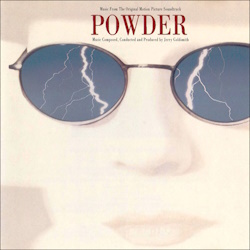
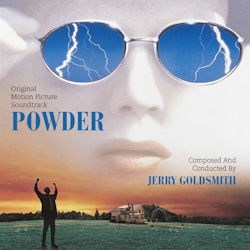 The original 1995 Hollywood Records album of Powder contained just over 35 minutes of score – nowhere near enough – and went out of print almost immediately, making it a prized collectable on the secondary market for many years. Thankfully in 2016 Intrada Records released a limited edition album, expanded to more than hour, containing more gorgeous statements of the main theme, more moments of frightening dissonance, and even some cues which were dropped from the final cut of the film, finally presenting the score as it deserves to be heard.
Trivia note: Goldsmith’s main theme was, somewhat unusually, adapted into a song with lyrics by David Zippel for classical crossover singer Sarah Brightman. The song, called “Someone Like You,” has nothing to do with the film itself, and instead appears on her 1997 solo album Timeless. It’s a nice song, and a cool little bonus for fans.
Critics and film music enthusiasts have, on occasion, been quite harsh on Powder, as they were on a lot of Goldsmith’s 1990s work at the time. And, truthfully, if you came to Goldsmith via his groundbreaking and challenging work in the 1960s and 70s, then something like Powder could come across as intellectually simple, nauseatingly saccharine, and overly-manipulative. Sure; Powder is clearly not Planet of the Apes, but neither is it meant to be. Instead, Powder represents Jerry Goldsmith at his most emotionally direct and traditionally beautiful. It’s a score that helps elevate the film beyond its sentimental script, emphasizing themes of empathy and transcendence through music that feels both intimate and epic, and if you can concentrate on that while also overlooking the repellent parts of the director’s past, there is plenty to enjoy.
Buy the Powder soundtrack from the Movie Music UK Store
Track Listing:
- 1995 ORIGINAL RELEASE
- Theme from Powder (4:32)
- Spoon Trick and the Trestle (2:17)
- Nightmare in the Forest (5:10)
- First Kiss (2:25)
- Steven and the Snow (8:26)
- Freakshow (4:42)
- Wanna See A Trick? (4:01)
- Everywhere (3:54)
- 2016 EXPANDED INTRADA RELEASE
- Emergency Room (1:50)
- The Incubator (2:14)
- Powder (3:31)
- The Books/You’re Afraid (5:03)
- The Window (0:39)
- The Spoons/Enemies (1:49)
- New School (1:03)
- Jacob’s Ladder/After Shock (2:30)
- He Bites (0:50)
- I’m Okay (1:41)
- Unhappy Days (0:15)
- No Questions (1:42)
- The Storm (0:56)
- Nature Walk/Duncan’s Revelation (5:16)
- Not a Friend (1:23)
- Holding On (0:38)
- Tricks/The Hat (4:02)
- I’ve Tried (0:48)
- The Silver Box (8:26)
- First Kiss (2:25)
- Going Home (1:25)
- The Shower (0:32)
- That’s What He Said (1:00)
- Freak Show (4:42)
- The Farm House (1:34)
- Going Away (3:55)
- Theme from Powder (4:33)
Running Time: 35 minutes 27 seconds — Original
Running Time: 65 minutes 14 seconds — Original
Hollywood Records HR-62038-2 (1995)
Intrada Records Special Collection Volume ISC 351 (1995/2016)
Music composed and conducted by Jerry Goldsmith. Performed by The National Philharmonic Orchestra. Orchestrations by Alexander Courage. Recorded and mixed by Bruce Botnick. Edited by Ken Hall. Album produced by Jerry Goldsmith. Expanded album produced by Douglass Fake.

Shop at the Movie Music UK Store

Member of the

 MOVIE MUSIC UK