SANDS OF IWO JIMA – Victor Young
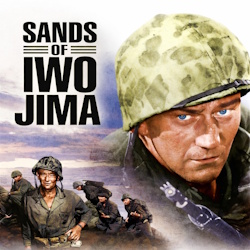 GREATEST SCORES OF THE TWENTIETH CENTURY
Original Review by Craig Lysy
Writer Harry Brown wrote a story that offered an account of the epic battle by the Marines to take the island of Iwo Jima during WWII. He then teamed with fellow writer Edward Grant to adapt it and write a screenplay, which they presented to Republic Pictures. Republic Pictures management thought the story of one of America’s greatest achievements in the war would resonate with the public. As such they purchased the film rights, placed Herbert Yates in charge of production with a $1.4 million budget, and tasked Allan Dwan with directing. An outstanding cast was assembled, which included John Wayne in the starring role of Sergeant John Stryker. He was joined by John Agar as PFC Pete Conway, Forest Tucker as PFC Al Thomas, Adele Mara as Allison Bromley, and Arthur Franz as Corporal Robert Dunne, and the narrator.
The film is set in in the Pacific during WWII and features the epic Battle for Iwo Jima from 19 February to 26 March 1945. The island had two strategic air force runways, and was also an advance warning station that alerted the homeland of the approach of American bombers. The story follows the fortunes of Sergeant John Stryker, a tough, by the book sergeant whose rigorous training demands arouses anger in the ranks. He is self-tortured and drinks himself into stupor each night as his wife took his son and left him. When they invade the Island Tawara, his training methods work and propel the men to victory, earning their respect. In the next offensive, he leads his men during the attack of Iwo Jima, with a mission to secure the high ground at Mount Suribachi. After many casualties they succeed, yet at this moment of triumph a sniper kills Stryker who does not live to see the immortalized raising of the flag on the mountain’s summit. The men find his unfinished letter to his son in his pocket, and Peter agrees to finish it a noble tribute. The film was a modest commercial success, however critical reception was mixed, with most lauding Wayne’s outstanding performance, but decrying the plot’s cliches and the screenplays poorly developed characters. The film received four Academy Award Nominations for Best Actor, Best Writing, Best Film Editing, and Best Sound Recording.
Victor Young was assigned to the project, and upon viewing the film I believe he realized he was afforded a tremendous opportunity – scoring a now immortalized and iconic event, that is forever enshrined in the collective consciousness of the United States; the raising of the U.S. flag on the summit of Mount Suribachi. Also important to the film’s narrative were two romances involving Pete and Allison, John and Mary, Stryker’s conflict with Peter, and lastly, Stryker’s tortured psyche resultant from his wife leaving him with their son. As with all films in this genre, Young understood that he would need to infuse his score with the requisite military anthems and marches. Lastly, as with all war movies, there would be the usual challenges of breaking through the sound effects.
 For his soundscape Young composed four themes. Foremost, and pervasive is the Marine Hymn, which serves as an idée fixe for the story. This well known, and iconic anthem empowers Stryker, and by extension his squad on a personal level, but also on a transpersonal level the entire marine corps and war effort. Masterful is how Young renders the hymn in different guises, which reflect the emotional dynamics of the scene; solemn, proud, aggressive, weary, elegiac, and dispirited. A second theme for the marines is a classic marcia militare, which exudes pride, resoluteness and aggression. However, there are scenes when it loses it vitality, and reflects the exhaustion of the men after a rigorous training ordeal, or the aftermath of a battle. Juxtaposed is the Japanese Theme, a pentatonic anthem empowered by horns bellicoso. Young uses the theme to evoke Japanese pride, defiance, and menace. Lastly, Young was renowned for his unabashed romanticism, and he does not disappoint with his molto romantico Love Theme for Peter and Alison. In cue 4, a score highlight, we achieve sublimity with its yearning melody carried by a solo violin romantico with a warm contrapuntal cello. Young also adapts this theme, evoking sadness and foreboding as Peter confides to his buddy’s his misgivings as to whether he will survive the war.
Scenes coded (*) contain music not found on the album. “Main Title” offers an album-film variance. The film and album sync for the first twelve seconds and then diverge. We open with a foreboding prelude, which slowly builds dramatically, ushering in at 0:13 an abridged Marine Hymn sung proud and forthrightly by men’s chorus as the opening credits unfold against a back drop of the marine emblem. At 1:00 synchrony is restored as Young uses repeating horn declarations of the hymn’s opening bars, with the Marine March, and a fleeting fragment of the Love Theme. We close on a grim diminuendo and flow into (*) “Narration”, which is supported by a solemn instrumental rendering of the patriotic hymn “My Country ‘Tis of Thee”. The narrative script lauds the Marine Corp and thanks them for their assistance in making this film. We enter the film proper in (*) “Boot Camp”, which offers narration by Robert Dunne supported by the steady, and determined cadence of the Marine March. He relates after Guadalcanal was declared secure, his battalion was pulled out and sent to Camp Paekakariki in New Zealand for rest, refitting, and the training of green replacements from home. We close on a diminuendo as the new recruits arrive at the tent. They acquaint and bond and await the arrival of their squad leader, Sergeant John Stryker. When he arrives, he lays down the law, his expectations and demands that they must be followed or there will be Hell to pay.
(*) “Saddle Up!” opens with grim trumpet declarations as Stryker yells “Saddle Up! A training montage unfolds empowered by the steady cadence and powerful strides of the Marine March, buttressed by trumpet declarations of the Marine Hymn. After a rest stop, Peter Conway rebuffs Stryker’s praise of his former CO, Peter’s father who died in battle. As the men resume marching a grim musical narrative unfolds as we see Conway has a grievance with Stryker who reminds him of his father. He relates that was never able to please his father, and now Stryker, who is cut from the same cloth. (*) “Leave” reveals the men enjoying leave for the first time in months at a dance club. Young supports with a slow danza romantico ambiance. When Allison, a beautiful blonde offers Peter a dance, it is love at first sight as they take to the dance floor and dance cheek to cheek. In “At the Dancing Club” Harris has had enough of the slow music, grabs a trumpet and begins playing a high-octane Swing music tune, the orchestra joins, and wham, we now have a party! Peter however has other things on his mind and asks Allison if she wants to join him outside for some fresh air. (*) “Peter and Allison” reveals our love birds on a balcony bench overlooking the sea, supported by the slow danza romantico resumes. Peter says he is happy he met her tonight, and we flow into “Sweet Memories” carried by their Love Theme, a lush, string borne romanza, which blossoms as he takes her into a kissing embrace. She recognizes his growing passion, and says let’s walk to the train so you do not miss it, and we close on a diminuendo tenero.
In an unscored scene a drunk and staggering Stryker is hidden from the shore patrol by his men and saved from a night in the brig. The next two scenes offer romantic score highlights. “Private First Class Peter in Love” opens with declarations of the Marine Hymn as narration informs us of the men hitting their pub tents for the night after a day of exhausting up hill hiking. In his tent, Peter asks Bob if he believes in love at first sight? He says yes, and Peter expounds on the many girls he has fooled around with, and how he believes Allison is the one. A soft and tender rendering of the Love Theme supports his musings, as Stryker, in the next tent, listens intently. Bob falls asleep, and we end with a pleasant diminuendo. The next day Stryker offers Peter a ride into town, which he accepts. On the way in Peter drops all pretenses when Stryker questions the wisdom of committing to a girl when you do not know if or when you may come back. Peter accuses him of being his father reincarnated, for whom he was never good enough, and could never please. He angrily says to stay out of his personal life, and they drive in with no further talking. (*) “I Have Something To Prove” reveals Peter laying on a sofa with his head on Allison’s lap. He is lost in thoughts, yet Allison elicits him to talk. He asks if she thinks he is a brave man, because he has something to prove to someone who is dead (his father). She says she believes he is, and he sits up and says he should be talking about the two of them. He says he loves her, and asks her to marry him, to which she agrees lovingly. Young supports the entire scene with their Love Theme, which blossoms when the commit to love, and seal with a kissing embrace.
“Training Camp Music” reveals Regazzi listening to a phonograph playing a Tarantella in camp. Stryker comes across PFC Choynski who relates he needs to transfer as he cannot learn his bayonet footwork because he is all thumbs. Stryker decides on a novel approach – dancing! He joins Choynski and tells him to lead and they dance to the Tarantella, shifting rhythmically from left foot to right. The kid develops some rhythm, and Stryker departs ordering him to practice this 30 minutes a day. He keeps practicing and uses the song’s cadence to synchronize his footwork and bayonet thrusts! He yells’ “Sarg! I got it!” and a proud Marine Hymn resounds as Stryker smiles and walks away. (*) “Marriage” reveals Peter and Allison leaving the church supported my Felix Mendelssohn’s “Wedding March” (1842). His squad buddies offer their congratulations and exhort him to leave as they ship out in forty-four hours. As Peter and Allison ride away, the cuddle in the back seat and their Love Theme supports, joined by a lullaby when she opens the guy’s gift and discovers two knitted baby shoes.
“First Mission on the Front” reveals the men have shipped out and a flotilla of ships are taking them to their first mission, which remains a secret. Young propels the scene with a dramatic churning motif for strings joined with declarations of the Marine Fanfare. At 0:28 ominous pentatonic horns giapponesi sound as they are briefed on their mission – Tarawa Island. A grim musical narrative unfolds as they are told that elite Japanese Marines hold the island and will fight to the death to hold it. At 0:51 the Marine Fanfare sounds when they are told that they will land at Red Beach 3. A dire musical narrative unfolds as the U.S. and Japanese themes join in interplay. A sad Love Theme joins at 1:08 as a pensive Peter stare out to see, his thoughts clearly on Allison. Stryker orders him to rejoin the briefing as he does not want his men to die because he failed to listen. At 1:32 a shattering, dissonant crescendo di orrore roars as U.S. battleships and cruisers discharge a withering bombardment, joined by aerial B24 carpet bombing.
“The Battle of Tarawa Island” reveals Stryker briefing his men when loud speakers announce for all troops to report to the disembark stations. A dire Marine March sounds as they all scramble. As they stand on deck, an ominous Marine Fanfare sounds as the camera pans the men’s faces, revealing each contemplating their mortality. At 0:22 a sad rendering of the Love Theme supports the camera reaching Peter. Trumpets militare declare the Marine Fanfare and at 0:40 a crescendo dramatico buttressed by swirling strings and trumpet militare declarations of the Marine Fanfare unfolds as the men are ordered to climb down and board their landing craft. At 1:04 The Marine Fanfare propels a ferocious musical narrative where American and Japanese identities engage in a horrific musical narrative as Stryker’s personally tosses satchel bomb packs into the massive Japanese pillbox. At 2:32 a weary Marine Fanfare sounds as the men achieve their first victory. At 2:43 a cyclic motif supports the arrival of tanks, churning up from the beach. Shipley has suffered a mortal wound and at 2:52 an A Marine Elegy unfolds to support his passing. At 3:25 a sliding two-note motif propels the men advancing against fierce resistance, as the American and Japanese themes contest musically. We close darkly as Mac stops for coffee and chit chats with a mortar squad instead of bringing bullets back to his desperate mates George and Charlie. This abandonment leaves them defenseless and they are viciously swarmed and bayoneted by Japanese. At 4:05 Young sow suspense as Mac returns and finds George whose last words were; “What kept you, Thomas? No ammo. What kept you, sports?” As he dies, we see guilt and devastation on Mac ‘s face and we conclude on a diminuendo of sadness.
In (*) “Hold The Line”, Stryker is ordered to take a position where they expect a night time Japanese counterattack. He has lost three men of his squad and is told he must hold a line that really requires a platoon with four times more men. He heads out and orders teams of two men into widely spread foxholes, and adds no talking as they must not give away their position to the Japs. Young fills us with foreboding and sow tension with his musical narrative. Later that night, Young uses an eerie other worldly string tremolo to sow anxiety as they hear repeated pleading cries in English; “Corpsman”. Tension mounts on a repeating two-note motif as Stryker orders no response, as he senses a Japanese trick, which elicits Peter’s anger. But then the man starts calling out Stryker. Peter insults him and says he is going to rescue the soldier, and adds you will have to kill me to stop me. Stryker cocks his gun and says with steely resolve; “That’s exactly what I will do”, as he points his barrel between Peter’s eyes. The pleading for Sarge continues as the scene fades to black. The next day narration informs us that they island had been secured, the dead buried, and the wounded taken back to the ships. A weary, plodding march supports Stryker’s exhausted, dirty and bloodied squad and many others marching to the departure point, crowned by a reserved Marine Hymn as they pass by “old Glory” fluttering in the breeze.
“Dead Soldiers Tribute” reveals ceremonial burials at sea, which Young supports with a somber, and elegiac musical narrative. At 1:07 Taps is heard as Stryker joins the twelve men left in his squad. He offers them good and bad news; Helenopolis is dead, but Choynski, Soames and Bass made it and are homeward bound on a hospital ship. He orders them all below to clean up and wash out their clothes. We close darkly at 1:48 carried by low register piano, which usher in a somber Marine Hymn as a deeply affected Thomas who is wracked with guilt, reluctantly leaves to join his mates. Stryker then orders Conway to get two bottles of sake and give it to the men, adding that it came from a dead “Jap”. Back at camp in Hawaii, Bass returns with new recruits. Under questioning he reveals to Stryker that Thomas took over 40 minutes to return with the ammo. Stryker realizes that Thomas was derelict in his duty and orders him to join him on a walk. They eventually stop and Stryker pummels him with a punch blaming him for Helenopolis’ death and Bass’ injuries. A brutal fight ensues, with a captain arriving and ordering it stopped. He threatens Stryker with a court martial but Thomas saves him by saying it was a judo lesson. After the captain leaves, they reconcile when Thomas offers his genuine regrets and desire for redemption.
“Mary and her Baby” offers one of the score’s most beautiful passages, unfortunately, most of it ended up on the editing room floor. It reveals mail call, and Peter opening a letter from Allison saying he is the father of a beautiful baby boy. Young supports his joy with a tender lullaby joined by their Love Theme. Music after 0:44 was dialed out of the film. It features interplay of the Love Theme and Lullaby for a truly heartwarming musical narrative where the music blossoms with joyous love. Stryker orders the men to assemble, and announces ten days of shore leave, which elicits a joyous response from the men. That night in (*) “Mary”, the men all party at a Honolulu bar, but Stryker secludes himself at another bar. Soft Hawaiian source music wafts like an evening breeze. A mature bargirl approaches him, and he reluctantly buys her a drink and allows her to join him. She tries to engage in conversation, and asks him if he would like a drink at her house, but he is brusque. She apologizes, thanks him for the drink, gets up to leave, and he relents, and asks her to stay and finish her drink. He apologizes for being angry, and she says you mean, unhappy? Her insight captures his attention. She adds that her name is Mary and that she is unhappy too. He then gets up and agrees to join her at her house. She is out of liquor, and he gives her $5 to buy some. She leaves and Young weaves a subtle tension. A glass shatters in the next room and Stryker moves to investigate. He is surprised to find a hungry toddler. Mary returns with whiskey, but also food for her child. Young supports with tender interplay of the Love Theme and Lullaby Theme. He helps her prepare the child’s food and she relate that you seem familiar with babies. He says he is, walks into the kid’s room and tosses a bill fold into the crib. He then says he will be going. She is very thankful, says he is a good man, kisses his cheek, and says she will pray for him. For me, this is the most beautiful and romantic set pieces of the score, achieving a perfect confluence with the actors and the film narrative.
(*) “I Don’t Like You” reveals Charlie and Stryker going into a bar for drinks. At another table, the guys are celebrating Peter being a father. Stryker tries to join, but is instead rebuffed by an angry Peter who declares he does not like him, and will raise his boy to be a better man than you or my father. Stryker does not add fuel to the fire, and Peter and the men shove off. Soft Hawaiian source music supports the aftermath as Stryker realizes there is no way to end Peter’s hostility. The next day during live grenade training, Peter is off in another world reading a letter from Allison. New trainee PFC McHugh loses the hand grenade, which flies backwards and lands at Peter’s feet. He does not respond to Stryker’s call “Grenade! Hit the deck!”, forcing him to make a flying tackle to save his life. He dresses down Peter for again being disengaged and inattentive. The lieutenant discovers that Stryker has a shrapnel wound and calls in a corpsman. We close the scene with Thomas telling Peter that Stryker just saved his life, which causes him to reflect. “The War Goes On” offers narration saying they were again shipping out to destination unknown. Dramatic music with Japanese Fanfare supports the narration. At 0:22 the Love Theme joins as Peter relates to Bob, that he has feelings that he is not going to come out of this alive. Bob exhorts him to never think like that, and at 1:05 a dramatic musical narrative unfolds as the narrator informs us that after five days, their deployment orders were received – Iwo Jima.
“The Assault on Iwo Jima” reveals the naval and aerial bombardment of Iwo Jima. Young opens with an onslaught of dramatic horns of war as crew run to their battle stations and battleships pummel the island with monstrous volleys. Churning strings energico propel the film’s forward momentum buttressed by declarations of the Marine Anthem. A diminuendo at 1:05 usher in a foreboding musical narrative as the men wait on deck, and ponder their fate. At 1:27 the men climb down to the LSTs (Landing Ship Tanks) with the Marine Anthem propelling them towards the beach. Aircraft Carriers launch their planes to provide air to ground support as the LSTs near the beach. At 1:46 strident Japanese Fanfare resound with defiance and Young unleashes a ferocious musical narrative as the marines hit the beach. As the onscreen battle unfolds, so to do the musical themes contest. At 3:00 the music become grim and beleaguered as the marines suffer casualties. At 3:43 we descend into anguish, when seventeen-year-old McHugh, a book reader, is struck down and we see a book title in his pocket; “Our Hearts Were Young and Gay”. (*) “Pinned Down” reveals Stryker and his squad suffering more wounds and pinned down by a large pillbox machine gun. Their situation is grim and Young speaks to this. Regazzi volunteers to find a bazooka and runs off as the men keep their heads down against withering fire. In “The Trenches” Young slowly builds a crescendo of hope buttressed at 0:38 by the Marine Anthem as Regazzi returns to Stryker’s amazement, not with a bazooka, but a flamethrower tank! At 0:48 dire horns and swirling strings empower the pill box being engulfed by the tanks flaming salvos. At 0:58 we descend into weariness and exhaustion as the men move out for what will be the pivotal battle – Mount Suribachi.
“Cries in the Night” opens with the Japanese Theme ascendent, and defiant as Stryker’s squad reaches Suribachi’s slope and bed down for the night. At 0:05 a beleaguered Love Theme reflects Peter thoughts of Alison and his son, jarred by a reprise of the Japanese Theme. At 0:27 The Marine Hymn joins as Peter and John discuss his son, whom he has decided to name Sam after his father. We see that Peter has reconciled with his departed father, and his surrogate father, Stryker. At 0:34 a grim musical narrative supports Stryker reporting to Lieutenant Crowe who orders him to prepare his squad to move out at 0700. The next day at 1:17 a pensive musical narrative unfolds empowered by the Marine Hymn as the squad moves forward. The music after 1:57 seems attached to a scene edited from the film. (*) “Assault on Mount Suribachi” reveals Stryker leading his squad up the mountain under heavy fire. Music enters atop a dire Japanese Anthem as a sniper shoots Sid. Peter kills the sniper, and as Stryker kneels beside the kid, Young supports with a solemn elegy draped with Jewish auras as he recites with his dying last breathes the sacred prayer of Judaism; “Shma Israel Adonai Elohenu, Adonai Echad” “Hear, O Israel: The Lord is our God, the Lord is one.” Stryker’s squad moves on and is again beset by the Japanese Anthem as a soldier ambush them and bayonets Flynn before being shot. They have now lost Flynn, Stein, and Fowler and a grim musical narrative carries them upslope.
“Mount Suribachi Victory” offers the score’s emotional apogee, with one of the finest elegies in Young’s canon. It reveals that Stryker and the men have reached the summit. He reveals the flag they are to plant on the summit to crown their conquest of the island. He pulls out a cigarette, says he has never been happier, and music enters as a crashing death chord as he is shot in the heart by a sniper and killed instantly. A charging motif propels a vengeful Peter, colliding with the Japanese Anthem as he shoots the sniper in his spider hole. Al pulls a letter from Stryker’s pocket addressed to his son, and Young offers an elegy led by refulgent violins draped with ethereal auras, and echoes of a solemn Marine Hymn as he reads it aloud;
“Dear son, I guess none of my letters have reached you, but I thought I’d better try again ’cause I have the feeling that this may be the last time I can write you”. Stryker expresses a desire to have spoken with his son directly and gives him advice. He tells his son to care for his mother, avoid hurting others, and follow his heart. He admits to being a failure in many ways and hopes his son will not repeat his mistakes. “If there was only more time, I…”
The letter ends unfinished, with Peter declaring that he will finish it. The confluence of music and the reading of the letter demonstrates the power of film music. At 2:21 drum rolls usher in an ascending stepped crescendo, with each step synced to one of the men lifting their head to behold the iconic flag raising on Mount Suribachi. At 2:36 a march-like crescendo supports the lifting up, and implanting of the flag, crowned with a choral rendered Marine Anthem. “Marines’ March Reprise” offers a more bravado rendering of the previous cue from 2:21 – 3:53.
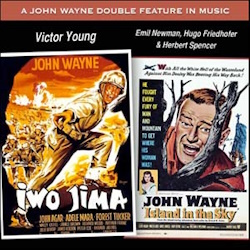 I would like to thank Clément Fontaine of Disques CinéMusique for reissuing Victor Young’s score for “Sands of Iwo Jima” as part of a two-score compilation album which also features music from Emil Newman’s 1953 score for another John Wayne film, Island in the Sky. The original archival acetate sources were transferred to tape, and then to vinyl. The restoration and mastering process on balance was good, but the monaural audio has some imperfections, which do not seriously degrade the listening experience. The backdrop of the film was two intense WWII battles; however, the nexus of its narrative were three intimate character driven stories; Sergeant John Stryker being tormented by his estrangement to his wife and son, Stryker’s conflict with Peter Conway, who resents his dead father who was Stryker’s commander, and sees Stryker as a reincarnation of him, and Peter’s love affair with Allison. Since this is a film about marines, Young chose to employ its famous anthem as a leitmotif for the them, Stryker and his squad, and Stryker himself as the central character, the hub to which all spokes connect. How he manipulates the anthem is remarkable, effectively rendering it to express the full spectrum of human emotions. An original marcia militare is often linked synergistically with the anthem, providing vital energy, which buttresses it, and propels the film’s forward momentum. However, it is the Love Theme for Peter and Allison where the score achieves its zenith.
Young was a lover of Russian romantics, with Sergei Rachmaninov being his favorite composer. Drawing inspiration from this grand age, he composed a yearning, string borne melody of extraordinary beauty, which upon hearing, elicits a quiver and a tear. I also laud the gorgeous and supremely moving elegy, which supports Al reading Stryker’s unfinished letter to his son. Folks, this score will not show up on a Victor Young Top Ten Scores list. However, it offers a score that fits its film like a glove, as well as one of the finest Love Themes, and elegies in Young’s canon. For these reasons I recommend that you purchase this compilation album for your collection.
For those of you unfamiliar with the score, I have embedded a YouTube link to the Main Title: https://www.youtube.com/watch?v=mRXm7oEqP8g&list=PLy5kryT0xrJPtDYWi7A-DGcsiGBUzQXQJ&index=1
Buy the Sands of Iwo Jima soundtrack from the Movie Music UK Store
Track Listing:
- Main Title (0:59)
- Sweet Memories (0:38)
- At the Dancing Club (1:20)
- Private First Class Peter in Love (2:17)
- Training Camp Music (1:06)
- First Mission on the Front (1:40)
- The Battle of Tarawa Island (4:45)
- Dead Soldiers Tribute (2:22)
- Mary and her Baby (2:56)
- The War Goes On (1:30)
- The Assault on Iwo Jima (4:30)
- The Trenches (1:37)
- Cries in the Night (2:13)
- Mount Suribachi Victory (3:52)
- Marines’ March Reprise (1:48)
Disques CinéMusique DCM-140 (1949/2012)
Running Time: 34 minutes 15 seconds
Music composed and conducted by Victor Young. Orchestrations by Sidney Cutner, Ernest Gold and Leo Shuken. Recorded and mixed by XXX. Edited by XXX. Score produced by Victor Young. Album produced by Clément Fontaine.

Shop at the Movie Music UK Store

Member of the

 MOVIE MUSIC UK