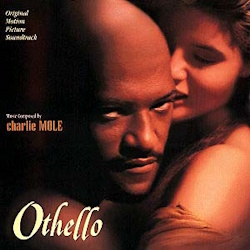
OTHELLO – Charlie Mole
 THROWBACK THIRTY
Original Review by Jonathan Broxton
O, beware, my lord, of jealousy, it is the green-eyed monster which doth mock the meat it feeds on.
One of William Shakespeare’s most enduring and celebrated plays, Othello is a classic tale of jealousy, manipulation, and betrayal, with hint of racism thrown in for good measure. In the story Othello, a respected Moorish general in Venice, secretly marries Desdemona, the daughter of a nobleman. His ensign, Iago, jealous of Othello’s success and resentful at being passed over for promotion, schemes to destroy him. Iago tricks Othello into believing that Desdemona has been unfaithful with his lieutenant, Cassio. Consumed by jealousy, Othello murders Desdemona – only to discover too late that she was innocent and that Iago deceived him. Overcome with grief and guilt, Othello takes his own life, while Iago is exposed and punished.
There have been numerous classic portrayals of Othello in the years since the play was first performed in 1604, ranging from Orson Welles’s 1951 screen version, to Laurence Olivier’s controversial performance in blackface at the National Theatre in London in 1964, and James Earl Jones on Broadaway in 1981 opposite Christopher Plummer. This version from 1995 was the directorial debut of British actor Oliver Parker and starred Laurence Fishburne as Othello, Irène Jacob as Desdemona, Kenneth Branagh as Iago, and Nathaniel Parker as Cassio. The film was very well-received by critics, with David Johnson’s shadowy cinematography, and Branagh’s performance as Iago receiving especially positive notices; Branagh received a Screen Actors Guild Award nomination that year, although the film was rather unexpectedly overlooked entirely by the Oscars.
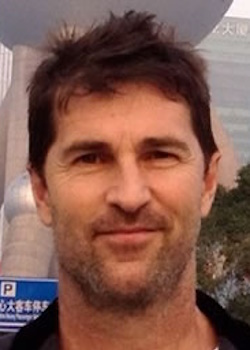 This version of Othello also saw the mainstream film music debut of English composer Charlie Mole. Mole studied classical music and composition at Oxford University, but actually began his career as a songwriter, and he wrote hit songs for and with artists including Chaka Khan, Kylie Minogue, and Lenny Kravitz, among many others. His music for Othello, is a very different kettle of fish. It is dark and orchestral, but also incorporates numerous ethnic and period-specific instruments that suggest both the Venetian setting and Othello’s own Moorish North African origins, ranging from an oud (a short-necked lute), a shawm (an early type of oboe), and various other percussion and woodwind items, to various vocal elements, all of which regularly combine to give the score a richly textured, exotic atmosphere. I guess the closest score of this type to it would be the early cues from Patrick Doyle’s Henry V, which have a similar sense of oppressive and weighty melodrama.
Mole’s orchestral sound is built around a bank of the lowest low strings, cellos and basses rumbling and churning in the depths, while higher register woodwinds and the specialty instruments dance around them. Only in a few cues here and there does the brass section add a sense of increased power and grandeur, and so for the most part the music broods in an array of moodily romantic, but always tonal and approachable, music that speaks to the deadly love triangle between the three protagonists, and actually become darker as the score progresses as Iago’s treachery kicks in.
The score’s primary main theme is introduced in the “Main Title,” but it is not until the subsequent “The Arrival” that it receives its first really prominent statement, and outstanding emergence of power and solemn drama that blends the full orchestra with the oud, the shawm, and the metallic percussion items, to outstanding effect. Later cues such as the duplicitous “Divinity of Hell,” the thick and treacherous “The Turret,” and the melancholically evocative “The Well” feature prominent performances of this main theme, and almost all of them feature in scenes where Iago is pouring verbal poison into Othello’s ear, inciting him to murder.
The score’s main romance theme for Othello and Desdemona is first hinted at in “The Garden,” where it is carried by warm strings and evocative ethnic woodwinds. The romance theme similarly plays through the tragedy-laden “Flashback,” as Othello remembers his and Desdemona’s courtship, and reflects on his growing suspicions about her, fueled by Iago’s manipulative insinuations, but then reaches its prettiest heights during “The Prayer,” underscoring Desdemona’s monologue, pleading her innocence to Iago, with a gorgeous oboe solo. “The Willow Song” then a offers a gorgeous rendition of the romance theme as a song performed with fragility by Irène Jacob; the version on the soundtrack album is taken straight from the film mix, and includes dialogue and sound effects, but it not in any way distracting.
Like The Willow Song, “Torch Dance” and “Revelry” are period-appropriate source music dance pieces which Mole wrote months prior to the rest of the score so they could be played for the cast during filming, and they have an excellent and authentic renaissance sound that I really enjoy, and again make superb rhythmic use of the oud, the shawm, the nativist percussion items, and even some occasional wordless vocals.
“The Fight” is a vivid and sometimes quite abstract action sequence full of unusual string combinations and slightly unusual rhythmic ideas; the percussion here is interestingly different too, as Mole appears to use some Indian instrumentation, notably a tabla, to underscore the confrontation between Othello and Cassio. Elsewhere, cues like “The Beach,” “The Fit,” and “Go!” feature a recurring motif for slashing strings that plays like a flipside of the romance theme and seems to accompany Othello’s increasing distress at Desdemona’s behavior and his belief of her infidelity, which becomes more anxious as the cues progress.
The final trio of cues, comprising “Desdemona’s Death,” “Iago’s Stabbing,” and the “Burial” offer a series of excellent explorations of both main themes for the full ensemble, at their most dramatically potent and emotionally heightened. “Desdemona’s Death” starts out almost like an action cue, mysterious percussion patterns and punchy strings all leading up to the terrible moment where Othello, driven mad by Iago’s incessant lies and his own insecurities, smothers his wife with a pillow, and Mole’s strings reach a deadly crescendo.
“Iago’s Stabbing” has a brutal version of the main theme underpinning it, and then the “Burial” scene features a fulsome and melodramatic final refrain of the romance theme for Othello and Desdemona, which is very beautiful but tinged with bitterness and regret, and ends on a tolling bell. This all flows into the excellent “End Titles” suite, which again offers several richly rendered statements of all the score’s main thematic ideas; taken in total, these final 13 minutes offer an extended sequence of utterly compelling Shakespearean musical tragedy.
Unlike many of Shakespeare’s other major works, Othello has surprisingly failed to inspire that many memorable film scores. Orson Welles’s Othello had an excellent but little-known score by Italian composer Angelo Francesco Lavagnino. A 1955 Russian adaptation of the story has a superb score by Aram Khachaturian which is better known as a classical suite than as film music. Olivier’s 1965 film re-uses the stage music by Richard Hampton, the 1991 BBC TV adaptation with Anthony Hopkins has a score by the late Stephen Oliver, and Elliot Goldenthal has his 1997 ballet score for the American Ballet Theatre and the San Francisco Ballet.
For Charlie Mole, however, and although he has since gone on to write plenty of music for British film and television – including picking up an Emmy nomination for Mr. Selfridge in 2013 – Othello remains for me the high point of his career in film music, and anyone who appreciates darkly romantic scores for period dramas will do well to seek this out.
Buy the Othello soundtrack from the Movie Music UK Store
Track Listing:
- Main Title (3:15)
- The Garden (1:23)
- The Arrival (3:39)
- Torch Dance (2:40)
- Revelry (4:17)
- The Fight (4:27)
- Divinity of Hell (3:38)
- Flashback (3:10)
- The Beach (1:03)
- The Fit (2:18)
- Behind Bars (2:08)
- The Turret (2:05)
- Go! (2:18)
- The Prayer (1:54)
- The Well (1:12)
- The Willow Song (1:43)
- It is the Cause (1:42)
- Desdemona’s Death (3:32)
- Iago’s Stabbing (1:37)
- Burial (3:47)
- End Titles (4:36)
Running Time: 56 minutes 24 seconds
Varese Sarabande VSD-5689 (1995)
Music composed by Charlie Mole. Conducted by Nick Ingman. Orchestrations by Nick Ingman, John Bell and James Shearman. Featured musical soloists John Themis, Paul Clarvis, and Keith Thomson. Special vocal performances by John Themis and Nick Curtis. Recorded and mixed by Mike Ross-Trevor. Edited by Andrew Glen. Album produced by Charlie Mole.

Shop at the Movie Music UK Store

Member of the

 MOVIE MUSIC UK