THE FANTASTIC FOUR: FIRST STEPS – Michael Giacchino
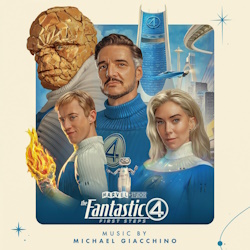 Original Review by Jonathan Broxton
WARNING: THIS REVIEW CONTAINS PLOT SPOILERS. IF YOU HAVE NOT YET SEEN THE FILM, YOU MIGHT WANT TO CONSIDER WAITING UNTIL AFTER YOU HAVE DONE SO TO READ IT.
Marvel have been trying to make the Fantastic Four happen for years. The characters, which first debuted in the comics in 1961, were reportedly favorites of the legendary Stan Lee, and are often referred to as “Marvel’s first family”. The group comprises Reed Richards, also known as Mr. Fantastic, a brilliant scientist who can stretch his body into incredible shapes and lengths; Sue Storm, the Invisible Woman, who can become invisible and generate powerful force fields; Johnny Storm, the Human Torch, who can engulf himself in flames and fly; and Ben Grimm, transformed into the rock-like Thing, whose immense strength contrasts with his gruff but lovable demeanor. The four gained their powers after exposure to cosmic rays during a space mission, and their adventures often blend science fiction with personal drama and epic battles against various supervillains.
The Fantastic Four first appeared on screen in a popular animated TV show beginning in 1967, but subsequent film adaptations have had a rocky history, to put it mildly. The first attempt, a 1994 low-budget production produced by Roger Corman, was never officially released and is widely believed to have been made solely to retain the film rights. A more polished version arrived in 2005, directed by Tim Story, starring Ioan Gruffudd, Jessica Alba, Chris Evans, and Michael Chiklis, and was successful enough to be followed by a sequel, Rise of the Silver Surfer, in 2007, which introduced cinema audiences to the iconic cosmic character Silver Surfer and teased the arrival of Galactus. However, the sequel failed to impress critics or perform strongly enough at the box office to continue the series.
In 2015, a darker, grittier reboot directed by Josh Trank was released, starring Miles Teller, Kate Mara, Michael B. Jordan, and Jamie Bell. This version significantly reimagined the characters and their origin story, but it was met with overwhelmingly negative reviews and performed poorly financially, ending plans for a sequel. All of these films existed outside what is now known as the Marvel Cinematic Universe, but this new film – The Fantastic Four: First Steps – finally brings the team into the established MCU timeline for the first time, as was teased in the post-credits sequence of Captain America: Brave New World earlier this year. Directed by Matt Shakman, this version stars Pedro Pascal as Reed, Vanessa Kirby as Sue, Joseph Quinn as Johnny, and Ebon Moss-Bachrach as Ben, and is essentially a remake of Rise of the Silver Surfer, as the quartet must do battle with the planet-eating space god Galactus (Ralph Ineson) and his argentine herald (Julia Garner) before it destroys the Earth – with the added twist that Sue is pregnant, and Galactus believes that the unborn child possesses enormous power.
Critical and fan response to the movie has been almost wholly positive, with many people praising its lighter tone, the chemistry of between the cast, the impressive special effects, and the stylish retro-future art direction and costume design, which takes a quirky 1960s aesthetic but peppers it with fantastic technological advances. However, for me, the best part of the entire project is its absolutely sensational score, which sees composer Michael Giacchino returning to the MCU for the first time since Spider-Man: No Way Home in 2021.
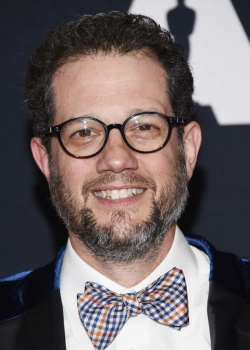 There has been a recent trend in comic book films – not completely, not everywhere, but noticeable enough – for their scores to be dark, serious affairs. I’m not sure where this all started, or why – my feeling is that it was Zack Snyder and Man of Steel – but it began to feel like certain filmmakers and their composers were sucking all the life, all the energy, all the color, all the fun out of what are, essentially, escapist stories for children. Thankfully, composers like Christophe Beck and Laura Karpman are starting to reverse that trend, at least at Marvel, and now Michael Giacchino has restored things entirely with this score, which has so much fun and energy, so much zip and pizazz, that it can barely contain itself.
Of late Giacchino has been on something of an exotica kick, as heard in his 2024 concept album Exotic Themes for the Silver Screen, which re-imagines many of his scores in the retro lounge ‘exotica’ style from the 1950s; Medal of Honor, Star Trek, and Up, as if performed by Les Baxter. The Fantastic Four: First Steps is similarly inspired by that retro-kitsch sound, to musically match the visual palette of the film, but then Giacchino injects this into a massive, soaring, action-packed orchestral super-hero extravaganza of the highest order. It shouldn’t work but, good lord, it does, and the resulting score is for me one of the best of the year.
The score is based around several recurring themes, the most important of which is introduced in the opening cue, “The Fantastic Four: First Steps Main Theme.” This main theme actually comprises several different elements in one, which are sometimes heard independently of each other, but most often come together as a satisfying whole. There is a bright and plucky fanfare for brass (0:00, the very first thing you hear), a four note motif that matches the syllables ‘fan-tas-tic-four’ (first heard at 0:27) and which is sometimes actually sung, and a more upbeat and poppy ‘linking motif’ (first heard at 2:35) which recalls the vibrancy of his scores for The Incredibles and, to a lesser extent, Tomorrowland. Usually, when composers get their choirs to sing the name of their film, the end result is somewhat cheesy – Leonard Rosenman and Robocop 2 is a prime example of this – but somehow Giacchino makes it work here. It’s certainly cheesy, but it’s cheesy good, not cheesy bad.
The track presents several variations on these core elements, including a pretty music box lullaby version for little baby Franklin at 0:57, a bold and forthright ‘hero variation’ underpinned with driving percussion beginning at 2:09, and finally a huge resounding statement at the end which sees the main melody counterpointed with full, emphatic brass. Throughout the cue Giacchino adorns his orchestral ensemble with intentionally retro electronic tonalities and quirky staccato vocal stylings, and these really flesh out the sonic palette and reflect the film’s time period. It’s just outstanding, an ear worm of the highest order. I have been singing it in my head for days.
The score proper begins in earnest with “Pregnancy Testing 1, 2, 3,” as Sue and Reed learn that they are finally pregnant after years of trying for a baby, and Giacchino reprises the ‘baby Franklin/music box lullaby’ variation of the main theme throughout it. This is followed by the brilliant “Fantastic Four, First Cue,” which underscores the montage ‘origin story’ sequence at the beginning of the film, which tells an abridged version of how the four gained their superpowers, and shows them fighting against several iconic supervillains from Fantastic Four comic book lore, including Red Ghost and his Super-Apes, Diablo, and others. Giacchino scores the sequence with yet more vibrant and action-packed statements of all the elements of the main theme, although listeners should note the little motif at the 3:53 mark on ultra-low brasses, which appears to be the first statement of a secondary theme for Paul Walter Hauser’s character Harvey Elder, aka Mole Man, who plays an important role in the film’s second half.
The score’s second important recurring theme is introduced in the third cue, “Herald Today, Gone Tomorrow,” when Earth is visited by the metal-skinned Silver Surfer, who flies on a magic craft shaped like a surfboard and acts as the mouthpiece for Galactus, a gigantic cosmic being who consumes the life force of planets. The theme for the Silver Surfer, whose real name is Shalla-Bal, is actually unexpectedly thrilling and positive considering that she is presented as the film’s primary antagonist, but with this music Giacchino cleverly foreshadows Shalla-Bal’s heroic turn in the second half of the film; more on that later.
One of the most impressive things about the Silver Surfer theme is the choral writing; this is something that Giacchino has always been great at, but the content here is next level. There’s a recurring joke that Giacchino asks his choir to sing the names of people associated with the singers – spouses, children – when he wants non-specific syllables, but I’m wondering whether here the choir is actually singing in Shalla-Bal’s language, Zenn-Lavian, as the translation of that language into English is a major plot point. Either way, it sounds absolutely epic in context – the cue starts out with dark, menacing rumbles, the vaguest hints of the theme emerging from the brooding depths of the orchestra beginning around the 0:30 mark, and continues with passages of intense dissonance, including an anguished-sounding variation on the main FF theme at 2:55.
The film’s opening act then ends with “Out to Launch,” as the Fantastic Four journey into outer space in their refurbished faster-than-light starship to confront Galactus and try to convince him to not devour the Earth. The cue has the same emotional intent as the launch sequence of James Horner’s Apollo 13; bold, intrepid, hopeful, defiantly patriotic, and filled with a sense of adventure. The music builds and builds over the course of several minutes, including a fantastic passage for syncopated pianos, until the 3:44 mark, when the rocket blasts off, and Giacchino somehow presents the most soaring version of the main theme yet, orchestra and choir reaching for the heavens. It’s just sensational.
The sequence from “A Galactus Case of the Munchies” through to the end of “Starship Birth” underscores the Fantastic Four’s encounter with the Silver Surfer and Galactus himself, amid the ruins of an exo-planet he has just eaten. Both “A Galactus Case of the Munchies” and “Bowel Before Me” are unnerving, eerie, and at times terrifyingly apocalyptic, as Giacchino adds immense power and scale to Galactus’s presence with his massive throbbing orchestra, subtle electronics, and huge chanting choir. There is a sequence in the former cue at the 1:16 mark which has the same sort of style and scale as Howard Shore’s Lord of the Rings scores, and then at 1:12 the in the latter Giacchino introduces his massive theme for Galactus himself, capturing his size and fearsome appearance with throaty, raspy brass clusters. The action sequence that ends the cue is terrific, recalling the most energetic parts of scores like John Carter and Jupiter Ascending.
“The Light Speed of Your Life” contains a stunning performance of the Silver Surfer theme in all its glory, as she follows in the temporal wake of the Fantastic Four’s ship, trying to prevent it from returning home. The speed and intricacy of the writing here is phenomenal – the rhythmic passages move around the orchestra like a thing possessed – and then the enormous bursts of the Silver Surfer theme at 1:02, accompanied by the full chanting chorus at 1:52, and at 2:41, are sensational. The track ends with a brilliant final flourish of the Silver Surfer theme with an agonized statement of the Fantastic Four theme in counterpoint, the extravagance of which carries on into the subsequent “Nothing Neutron Under the Sun,” which adds a layer of electronic percussion, as if the ensemble wasn’t rich enough already. The guttural minor-key version of the four-note FF ‘syllable motif’ at 1:04 is awesome, as is the Penderecki-esque dissonance in the final moments.
Eventually, the stress of the Galactus encounter results in Sue going into labor, and in “Starship Birth” she actually delivers her little son Franklin, as the rest of the crew are trying to slingshot their spaceship around the fringes of a black hole to pick up enough speed to return home, while simultaneously avoiding both the Silver Surfer and Galactus. Giacchino beautifully interrupts the action with a lovely, delicate, spacey statement of the main theme’s lullaby variation to acknowledge this.
Returning home having failed to stop Galactus’s progress towards Earth, the Fantastic Four come up with a secondary plan: using a new technology that Reed has invented, they will build an array of ‘teleportation bridges’ all across the Earth, with the intent to literally move the entire planet to a different solar system, beyond Galactus’s reach. “Span-tastic Voyage” underscores the montage sequence of the teleportation bridges being built with a series of dramatic, determined, sometimes whimsically delicate performances of the main theme. However, disaster strikes, and in “The Bridges of Silver Surfer County” Shalla-Bal returns to Earth, discovers Reed’s plan, and singlehandedly destroys almost all the bridges before they can be activated. A harrowing version of the Silver Surfer theme accompanies her global rampage of devastation, full orchestra and chorus.
With all other options exhausted, the Fantastic Four resort to a final, desperate plan: they intend to lure Galactus down to the surface of Earth, using baby Franklin as bait, and teleport him to the far reaches of the galaxy using the last remaining teleportation bridge that Shalla-Bal did not destroy, which is in the middle of Times Square in New York. To prepare for the event the citizens are evacuated underground to Subterranea, the domain of former supervillain Mole Man, who shockingly agrees to help the Fantastic Four; “A Mole in Your Plan” underscores the evacuation with militaristic snare drum riffs, and allusions to the Mole Man theme that first appeared in the “First Cue”.
“A Walk on the City,” “The Other Sue Drops,” and “Don’t Sue the Baby!” underscore the final confrontation between Galactus and the Fantastic Four on the streets of New York, as the giant demi-god clomps his way through the streets, drawn by his instinctive desire to take baby Franklin’s yet-unknown powers. Giacchino pits the Galactus theme and different elements of the main FF theme against each other throughout the sequence; initially, Giacchino appears to be taking inspiration from Akira Ifukube’s Godzilla scores to juxtapose Galactus’s immense size against the puny buildings of downtown Manhattan, with great bulbous brass phrases, but these soon give way to another set of thrilling, intricate, complicated action and light horror cues that set the pulses racing.
Shalla-Bal’s heroic intervention at 4:47 in “The Other Sue Drops” is terrific – she has seen the destruction and pain Galactus causes, and has turned on her master to help the Four – but it all comes at a cost as, shockingly, Sue uses up all her energy and is killed during the last moments of the battle. However, “Don’t Sue the Baby!” reveals the full extent of baby Franklin’s powers when he is placed on his dead mother’s chest to say goodbye – and he brings her back to life. Giacchino scores the scene with a sense of heartbreaking anguish that slowly turns into joyous relief and a moment of tenderness between mother and son, before climaxing with a flourish in “Without Further Adieu”.
“Carseat Drivers” is an amusing piece of jaunty and jazzy exotica that arranges the main theme like the score for The Incredibles, and this then segues into the two pieces that form the core of the end credits – “Fantastic Four to Be Reckoned With” before the mid-credits scene setting up Avengers: Doomsday, and “The Galactus/Silver Surfer Suite” after it. One fun piece of trivia to note: the mid-credits sequence features a piece of score written by Alan Silvestri, confirming that he is returning to the MCU to score the next film.
It would be remiss of me to ignore the four bonus cues at the end of the album: the “Fantastic Four Power Hour Cartoon Theme” is a fun piece parodying Giacchino’s own main theme in the style of a 1960s Hoyt Curtin theme, the “Ted Gilbert Show” theme is a silly piece of kitsch that acts as the mischievous main theme for the in-movie chat show host played by Mark Gatiss, and “H.E.R.B.I.E.’s Lullaby” is an oddball song performed in a robot voice by Matthew Wood, who performs the voice of the Four’s mechanized domestic servant.
However, I was absolutely astonished by how good “Let Us Be Devoured” is. It’s an original song written and performed by Inside Out 2 composer Andrea Datzman, ostensibly in the style of Joan Baez folk ballad, which in movie context is intended to be a sort of counter-culture ‘welcome’ for Galactus from a hippy cult that worships him as a savior. The lyrics are ironic, but are delivered with complete sincerity, and Datzman’s songwriting prowess is incredibly authentic in its intentional mimicking of that style. Her voice is lovely too. I don’t remember hearing it in context – it perhaps features in a deleted scene – but it plays over the final part of the end credits crawl, although I think it’s placement there renders it ineligible for the Oscars. It’s a shame, though, because it’s a winner all the way.
As you can see from all this breathless prose, I think Fantastic Four: First Steps is an absolute triumph, the best Michael Giacchino score in many years, the best Marvel score in many years, and the best score of 2025 to date. It’s a fantastic return to a time when superhero scores were consistently heroic and optimistic, full of themes and variations, memorable and hummable, but also clever and detailed enough to satisfy the intellectual needs of those who enjoy delving into those aspects of scores. With this score, Giacchino has stretched his musical muscles to their fullest, burned brightly, and clobbered his musical competition into submission. It will take something quite brilliant to top it.
Buy Fantastic Four: First Steps soundtrack from the Movie Music UK Store
Track Listing:
- The Fantastic Four: First Steps Main Theme Extended Version (4:10)
- Pregnancy Testing 1, 2, 3 (1:58)
- Fantastic Four, First Cue (5:34)
- Herald Today, Gone Tomorrow (3:48)
- Out to Launch (6:10)
- A Galactus Case of the Munchies (3:08)
- Bowel Before Me (3:08)
- The Light Speed of Your Life (3:43)
- Nothing Neutron Under the Sun (2:23)
- Starship Birth (5:07)
- Span-tastic Voyage (6:36)
- The Bridges of Silver Surfer County (1:34)
- A Mole in Your Plan (3:09)
- A Walk on the City (6:09)
- The Other Sue Drops (5:34)
- Don’t Sue the Baby! (2:53)
- Without Further Adieu (1:24)
- Carseat Drivers (1:17)
- Fantastic Four to Be Reckoned With (2:28)
- The Galactus/Silver Surfer Suite (7:24)
- Tripping the Lights Fantastic (2:16)
- The Fantastic Four Power Hour (Cartoon Theme) (0:34)
- The Ted Gilbert Show (0:40)
- Let Us Be Devoured (Studio Version) (written and performed by Andrea Datzman) (3:42)
- H.E.R.B.I.E.’s Lullaby (performed by Matthew Wood) (1:18)
Hollywood Records/Marvel Music (2025)
Running Time: 82 minutes 07 seconds
Music composed by Michael Giacchino. Conducted by Cliff Masterson and Alfonso Casado. Orchestrations by Jeff Kryka and Logyn Okuda. Recorded and mixed by Peter Cobbin and Kirsty Whalley. Edited by Paul Apelgren, Stephen M. Davis, Alex Levy and Naschia Wachsma. Album produced by Michael Giacchino.
-
August 13, 2025 at 8:52 am5 Fantastic Fours (and an animated series) – Professor Popinjay's Non-Reviews
-
September 20, 2025 at 5:58 pm5 Fantastic Fours (and an animated series) – Professor Popinjay's Compendium of Perspicacity
-
February 6, 2026 at 8:00 amMovie Music UK Awards 2025 | MOVIE MUSIC UK

Shop at the Movie Music UK Store

Member of the

 MOVIE MUSIC UK