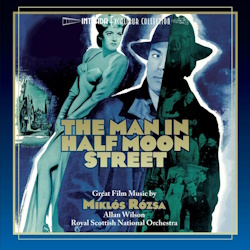
THE MAN IN HALF MOON STREET – Miklós Rózsa
 GREATEST SCORES OF THE TWENTIETH CENTURY
Original Review by Craig Lysy
Paramount Pictures decided that the stage play The Man in Half Moon Street by Barré Lyndon, which opened at London’s New Theatre on March 22, 1939, and ran for 172 performances, would translate well to the big screen. Film rights were purchased, Walter MacEwen was placed in charge of production, and Ralph Murphy was tasked with directing, with Garret Ford and Charles Kenyon writing the screenplay. For the cast, Nils Asther would star as Dr. Julian Karell, joined by Helen Walker as Eve Brandon, Reinhold Schünzel as Dr. Kurt van Bruecken, Paul Cavanaugh as Dr. Henry Latimer, Edmund Breon as Sir Humphrey Brandon, and Matthew Boulton as Detective Inspector Ned Garth.
The film is set in London and explores humanity’s ageless quest for immortality. Dr. Julian Karell is a physician-scientist who more than a century earlier, discovered a means of achieving immortality. He achieves this by murdering young men and surgically removing their glands, and then ingesting their contents. These ingestions last only ten years and must be repeated or rapid aging will onset. It comes to pass that he becomes engaged to Eve Brandon, but informs her that their wedding will need to wait until he completes a very important experiment with his colleague Dr. van Bruecken. Both physicians are over ninety years of age, but have the appearance of a thirty-five-year-old. The ten-year cycle for both men is imminent and new donor/victims must be found, however van Bruecken has grown weary of life through murder and so refuses to assist. He recruits a new physician and medical student, but the student dies and his death triggers an investigation by Scotland Yard. Julian tries to flee with Helen to a new location, but on the train, time runs out and he rapidly ages and dies horrifically on the train platform. The film was neither a commercial or critical success, and received no Academy Award Nominations.
Paramount Pictures director of music Robert Emmett Dolan assigned Miklós Rózsa to the project. With this film, which followed “Double Indemnity” (1944), Rózsa would continue a remarkable run in the Film Noir genre. Upon viewing the film, I believe he realized that it was in totality, a melodrama, morality play, romance tale and horror story. Historically a film which offered this degree of narrative complexity served to bring out his best. The quest for immortality served as the nexus of the story, as such, Julian was the lynch pin, and intersection of for all the film’s sub-narratives. Also important is Eve, who serves as a catalyst that precipitates Julian’s self-destruction. He longs for intimacy, and she is the cure he has long sought; however, he and the audience know that marriage is impossible as she will age, and he will not. Yet, like a moth to the flame, he flies.
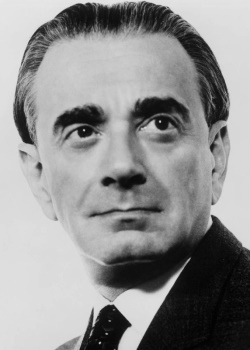 For his soundscape Rózsa drapes us in dark, foreboding, and somber tones. Foremost, he supports our protagonist Julian with a tritone, which in music is described as the “Devil’s Interval” as it eschews harmony, instead creating dissonance, tension and torturous instability. This perfectly speaks to his obsession for eternal youth, which distorts all facets of his life, creates an estrangement of conscience, and poses an insurmountable impediment to love and intimacy. It by extension, also speaks ominously to his laboratory where the diabolical harvesting of a young medical student’s glands would take place. The Elixir Theme supports a concoction Julian made to temporarily maintain his youthful appearance until he could harvest glands from a young man to sustain him for ten years. Rózsa imbues it with a refulgent, otherworldly construct animated by swirling woodwinds with twinkling accents. Eve’s Theme, which also serves as a Love Theme for her and Julian, offers a sweeping and florid romanza for which Rózsa was renown. Strings romantico offer its yearning melodic line joined by contrapuntal horns. In the bonus cue the theme’s exposition by pianist Michael Lang is rapturous, and offers a score highlight. The juxtaposition of such beauty with Julian’s obsession serves to create an ever-increasing tension, which cannot be reconciled. Also, worth noting is once again Rózsa graces us with a supremely beautiful waltz, which supports Julian’s introduction to Eve’s father and friends.
Cues coded (*) contain music not found on the album. In these opening cues Rózsa perfectly establishes the tone of the film. “Prelude” opens with dire declarations of the Julian’s Theme as the Paramount Pictures logo displays. The foreboding theme continues to unfold as the film title displays and the flow of the opening credits commence. At 0:18 Love Theme soars for a sumptuous exposition, its beauty and grace offering a striking juxtaposition to Julian’s Theme. At 1:33 we segue into “Ghostly Prologue”, which supports entry into the film proper. A panorama of the Big Ben dominated skyline is draped in fog and supported by an extended exposition of Julian’s Theme rendered as an eerie, woodwind led misterioso, draped in sadness. The camera draws us to 44 Half Moon Street and a plaque that says Dr. Julian Karell, as the narrator asks, “Who Was Dr. Julian Karell”. A montage unfolds of others offering their opinions; Dr. Kurt van Bruecken says that he was a fine scientist, but adds that he forgot a spiritual truth; that no man can be a law unto himself. Inspector Ned Garth is harsh, and says he was a cold-blooded murderer. Eve relates that he was tender and fine, a man with a dream.
(*) “Julian Visits Eve” reveals Julian visiting Eve at her house as she plays the melody of the Love Theme on piano. He states his amazement of how so many flowers are blooming in her garden in May. She laughs, takes his hand and shows him tonight’s invitation, dated June 13th which Rózsa supports with a valzer romantico. She escorts him in to meet her family and guests with the waltz setting a pleasant ambiance. She receives a request that Lady Minerva Aldergate wishes to see her beau, and they walk to join her. She sends Eve away, and acquaints herself with Julian, who she believes bears a striking resemblance to his grandfather, who was her paramour. He relates to her a tale of his grandfather climbing up her balcony for a secret romantic interlude, and she is startled that he knew of this. He relates that his grandfather babbled, in realty he was his grandfather. He then excuses himself to rejoin Eve. She asks that he come and meet her father, Sir Humphrey Brandon. The introduction is cordial, and he asks Julian to reveal the portrait he painted of Eve. The unveiling brings universal paise, and Julian uses it as an opportunity to take Eve away for a private moment. A guest, who is familiar with art, is vexed by the portrait as its style and brush strokes duplicate an artist that painted a century ago. In the parlor she plays the Love Theme as he confesses his love, only to find that he will be inaccessible for a month while he performs an important experiment. She says this just adds to the mystery about him.
In (*) “Julian’s Sudden Departure” this elicits him to turn off the light and declare that he intends to propose. The Love Theme supports gracefully as he again expresses his love, but the moment is lost as the butler advises that he has a telephone call, which takes him away to the adjoining room, carried by a misterioso rendering of his theme. He answers, says he will return at once, and advises the butler that he must depart at once and to offer his apologies to Eve and the guests. He departs through the garden carried by a determined rendering of his theme as Eve calls out to no avail. As he disappears, his theme rendered as a misterioso carries Eve’s return from the balcony. (*) “Bad News” sustains the misterioso as we shift to a fog shrouded sign “Half Moon Street” and we see a taxi drop Julian off at his house. He enters, call’s out to his butler Simpson, and his melody descends into sadness as he hands Julian a note. He opens it and dire fanfare dramatico declarations resound. It is from Dr. Van Bruecken; “Departure delayed. Should symptoms develop before I arrive, use the prescribe remedy with utmost caution”. He dictates a return telegram instruction van Bruecken to come at once supported by a grave rendering of his theme. After Simpson departs, Julian looks at his hands and walks to his study carried by muted trumpet declarations of his theme. Inside foreboding woodwinds offer his theme, punctuated by muted trumpet declarations as he looks at his face in the mirror. We see a growing anxiety as muted trumpets again resound as he examines his hand under a magnifying glass.
“Laboratory” offers a complex musical narrative as Rózsa must emote ever shifting emotional dynamics with interplay of three themes. It reveals Julian going into his laboratory carried by a grave rendering of his theme. At 0:17 he opens his safe, and we behold an elixir with Rózsa introducing the Elixir Theme, which emotes with a refulgent, otherworldly construct animated by swirling woodwinds with twinkling accents. He pours a small glass and locks the safe. His theme reprises as a misterioso, but I discern undercurrents of sadness. He returns to his study and ignores a phone ringing as he pours water from a pitcher and mixes it with the elixir. He picks up the phone and it is Eve, and at 1:46 a romanza unfolds on her theme as he apologizes for his urgent departure, which she happily takes in stride. He apologizes that he will be away for a month with an important laboratory experiment. He ends the call, and at 2:37 the otherworldly Elixir Theme supports him drinking the elixir, and then angrily smashing the glass into the fireplace, punctuated with his angry theme. He goes to his desk, unlocks a drawer and his theme shifts again to a misterioso as he places a book on his desk. It is a journal, and interplay of his theme and Eve’s Theme unfolds as he writes an entry attesting to the accuracy of their ten-year calculations, with the caveat that van Bruecken’s delayed arrival is dangerous. We conclude on a crescendo dramatico rendering of his theme, which crests with ominous horn declarations as he closes the journal and we see its cover title; “Vitas Immortalis”.
(*) “The Encounter” reveals Julian trailing a young medical student along the fog shrouded Thames River. Rózsa sow suspense with a stalking rendering of Julian’s Theme as he closes in on the man. The young man steps to the edge and jumps into the water and begins to drowning. Julian comes to the bank and jumps in and a molto dramatico crescendo empowers his rescue. A policeman arrives above and sets off to investigate as Julian assist the man to the street above. They just manage to elude the policeman and escape in a taxi. (*) Julian And The Medical Student” reveals that Julian has taken an interest in the Alan Guthrie, a medical student, and was aware of his gambling debt, which drove him to attempt suicide. He has Alan change into warm clothes and warm himself by the fire where they reacquaint. While the man’s stares at the fire, Julian mixes potent sedative into a glass of water. Rozsa supports the scene with an ominous rendering of Julian’s Theme, which portends a dark purpose. In the morning Julian writes in his journal that he rescued a suitable subject and the blood tests are satisfactory. Muted trumpets punctuate the last line; van Bruecken arrives today. Simpson enters and advises that the young man is angry and demands his clothes so he may leave. In an unscored scene Julian goes up to his room and advises that he is an associate of Dr. van Bruecken, and that they have succeeded in transplanting glands from one human being to another, which ends aging. The young man is ensnared and accepts Julian’s offer to join the team and partake of the miracle.
(*) “The Engagement Ring” reveals Julian presenting Eve with an engagement ring, for which she is overjoyed. Rózsa supports with the Love Theme, which blossoms as he takes her into a kissing embrace. In the garden the music retreats under the dialogue as she insists that he secure father’s blessing, to which he agrees, but tomorrow, as he must greet Dr. van Bruecken and get him settled. He departs and meets his friend, who in many ways is a father figure. (*) “Van Bruecken’s Revelation” reveals the two reacquainting and reminiscing. There is affection between the two, but van Bruecken questions the wisdom of their experiment, only to have Julian counter that his latest refinement will make the change permanent. Julian brings out some port but as they prepare to toast, van Bruecken’s right hand trembles and he drops the glass. He says he had a stroke last year, and can no longer operate. He says he must find a surgeon to take his place. A grave and extended exposition of Julian’s Theme supports as he goes to his lab, opens the safe and pours a glass of the elixir. Van Bruecken asks if he has found a subject, and Julian affirms that he has, one with good blood tests. He pours the elixir and as he mixes it with water, van Bruecken asks how long he has been taken it. He says two weeks after he noticed that his face changing. van Bruecken says you are mad and that you are killing yourself. Julian’s Theme surges dramatically as van Bruecken asks to see his hands, and is amazed that they are youthful. The next day in an unscored scene, Julian attempts to recruit two surgeons, but each decline.
(*) “A Long Engagement” reveals Julian arriving for tea with Eve’s father. When he leans to kiss, she pulls back and says your eyes look different, and he says he is just tired. She now accepts him and the Love Theme blossoms as they kiss. She departs to show her father the engagement ring, and muted trumpets of concern sound as he nervously looks at his hands. Eve shows father her engagement ring, and he and his personal physician, Dr. Latimer head downstairs to meet him. Father approves, but insists that it be a long engagement, so he has time to get to know him better. As Julian prepares to depart, Dr. Latimer offers him a whisky and soda so they can talk, which Julian agrees. Latimer is suspicious that Julian and van Bruecken are seeking surgeons, and offers his hospital in hopes of gaining prominence of being associated with the renown surgeon, but Julian declines, saying that they prefer to use his own laboratory. Julian then departs, saying that van Bruecken does not like to be let waiting for dinner. The next day, Sir Brandon and Dr. Latimer meet with inspector Garth asking him to investigate and get finger prints of Julian, as they are suspicious of his experiments. The inspector declines as no laws have been broken, but he says he will crosscheck Julian’s fingerprints if they can obtain them.
(*) “Alan Becomes Paranoid” reveals Julian discovering Alan reading his journal. Alan voices concern that he is repeatedly drugged, which Julian casually states that it is to keep him calm for his own sake. Alan says he has had enough and wants out. Julian, without hesitation says very well, and says for him to leave, but adds that you need to remember what is waiting for you out there. A foreboding Julian’s Theme supports under the dialogue, but it becomes increasingly sinister as Alan notices that Julian’s handwriting in the journal never changes, that an entry made many years ago says that he is able to dominate van Bruecken as he is younger, and finally that the subjects all seem to die. Alan collapses as van Bruecken enters and says that he must stop drugging the man as his heart will not stand it. In two unscored scenes, the doorbell rings, Julian answers and Dr. Latimer just walks in, saying he is calling on Dr. van Bruecken. He purposely drops his cane to obtain Julian’s fingerprints, which he secures when Julian picks it up. Julian advises that Dr. van Bruecken was under the weather and unavailable to meet. Dr. Latimer says then some other time and departs, instructing his driver to take him to Scotland Yard. In the inspector’s office he shows with a projector a fingerprint found during an investigation of an unsolved 1877 Cornis murder. He then show’s Julian’s fingerprint and they are identical. This causes a conundrum; fingerprint science is infallible, yet Julian was not even born in 1877. They consider that Eve’s portrait matched a portrait painted almost a century ago, but that is again discounted as it would make Julian over 90 years old. Back at the laboratory Julian receives a telegram that his French surgeon has been denied entry to England and that he will have to come to Paris for him to perform the surgery. An argument ensues as van Bruecken accuses Julian of becoming ignoble, inhumane and obsessed for his own selfish benefit, not for the welfare of humanity.
(*) “I Will Send Her Away” offers a beautiful score highlight with sterling thematic interplay. It reveals Eve calling, and saying she is coming over as what she has to say is too important to say over the phone. After Julian hangs up, Van Bruecken then tells him that he must end this relationship with Eve, as she will age, and he will not. Julian says he will go through with the marriage, inform her of his circumstances, and then make her immortal also. Yet when van Bruecken says he wants no part of it then, Julian relents and agrees to let her go, punctuated by a grave quote of his theme. In the garden he tells Eve that he is breaking off their engagement as he will not be able to make her happy. She will not accept this and finally worms the truth out of him – that his experiments seek to end the aging of the human body. She marvels at this and says they will be in this together. Rózsa masterfully offers a tête-à-tête of an aspirational rendering of Julian’s Theme, and their Love Theme. He walks her out hand in hand past an unseen van Bruecken who watches from high up the stairs. A grave quote of Julien’s Theme supports van Bruecken’s disappointment. Outside he gives her a parting kiss supported by the Love Theme, and then she drives away.
(*) “The Boy Is Dead” reveals Julian returning supported by grim quotes of his theme. He finds a very troubled van Bruecken, and asks what has happened? Van Bruecken replies, that the boy has died. An ascent motif carries Julian rapid run upstairs, crowned with dire declarations of his theme as he lifts up the sheet covering the body. Julian’s Theme becomes grim when Van Bruecken joins and says that this boy had as much a right to live as you do. Julian’s Theme transforms into a truly dark iteration as they argue with Julian saying the advancement of science and his needs matter more. Dire declarations of Julian Theme sound as van Bruecken says he has had enough, and walks away declaring that he will not go on! Empowered by a torturous Julian’s Theme, they take their argument to the study, and as Julian fetches the elixir, van Bruecken grabs his walking cane. As Julian prepares his drink, van Bruecken smashes the elixir bottle and collapses in a chair. Surprisingly, Julian is forgiving. He pats van Bruecken on the shoulder, and says he will find a way to get through this. He then tells van Bruecken that they have to dispose of the body.
In (*) “Inspector Garth”, as Julian walks out to the street, he is greeted by Inspector Garth. Julian invites him in and the inspector begins a series of probing questions, which a very calm and composed Julian answers. He discloses his work and provides a tour of his laboratory. When asked if any of his donors died, he points to cages of monkeys, and says they are all quite alive. The doorbell rings, and police escort a cab driver in who identifies that he drove a soaking wet Julian and young man home. Julian states that he recognizes the cab driver, and the inspector says they may leave. He says that the young man was Alan Guthrie and that he has gone missing for a week. He then hands Julian a warrant and orders two policemen to search the house while they wait in the study. He relates that Scotland Yard has six unsolved murders, all spaced exactly ten years apart, all young medical student, each apparently used as a guineapig. He said the first corpse had fingerprints that matched yours, to which Julian replies, that would seem to invalidate fingerprint science. The inspector answers firmly, no. The police return and state only Dr. van Bruecken is in the house, and the inspector dismisses them. Julian then asks, are you saying that I am Mr. Cornis and that I am 90 years old? The inspector is angry and walks out, clearly vexed by this conundrum. He escorts the inspector out, and at a public mailbox shows him a letter he is mailing o Dr. Latimer. He adds, that he should be patient, as I am sure he will share it with you. The inspector departs, and music enters with a suspenseful rendering of his theme as he walks to his car. As he gets in the music swells ominously as we see the dressed corpse of Alan sitting in the passenger seat.
“Transition I and Body Is Found” reveals a fog shrouded Thames River. A bass clarinet leads us to a fishing boat where the captain is unable to pull up the anchor. At 0:57 a crescendo dramatico empowers a mate assisting to pull up the anchor, which crests horrifically at 1:03, crowned by a quote of Julian’s Theme as a corpse reaches the surface. At 1:07 a sinister rendering of Julian’s Theme supports as the cabdriver confirms this was the boy he transported to Julian’s house. The inspector orders a post mortem and his men to the Karell residence to arrest him. At 1:19 Julian’s Theme is rendered darkly as a dirge as van Bruecken opens Julian’s journal. Julian calls and tells him to join him at Victoria Station. At 1:57, Julian’s Theme descends into despair as Van Bruecken remains, and sets the journal aflame in the fire place. The police arrive and ask for the whereabouts of Dr. Katrell, but van Bruecken answers with a vacant affect saying that he has burned his life work, because no man is greater than God. We shift to an art gallery where an expert confirms to the inspector that the two paintings, set fifty years apart, were painted by the same man. Sir Brandon calls and says Eve and Julian have eloped, will marry in Paris, and he demands they be stopped. The inspector sends police to the docks, and train station intent on stopping them.
“Transformation” At the train station Julian asks Eve to get their tickets and proceed to platform ten, where he will join her. At an apothecary he desperately tries to buy medicine he needs, but the pharmacist says he cannot provide it without another doctor’s prescription. A flummoxed Julian storms out. He evades police scouts and manages to reach the platform and board the train. Inside their car he struggles to lower the blinds and becomes ill. His theme weakens and takes on the tones of the Elixir Theme, informing us that he desperately needs it. He asks Eve to get water, and after she leaves, he begins to rapidly age with his theme empowering a crescendo di orrore. At 1:44 dire horns of doom resound as he turns off the lights, sits, and turns away from the door. A diminuendo of death supports Eve’s return, joined at 2:10 by a ticking clock motif as each tick brings him closer to death. We dissolve into a surreal etherealness as she realizes first when holding his hands, and then turning to look at him that he had greatly aged. She says that this experiment is not new, but began many years ago, which he affirms. He hands her wedding ring and says he must leave her. She however will not let go, saying he will remain alive in her heart forever.
“Finale” reveals the train stopping at the next station where the inspector and his men wait. He orders all the cars searched and Julian exits as an enfeebled old man carried by a desperate rendering of his theme, which shifts to a crescendo dramatico. His running elicits the inspector to dispatch men. Julian collapses and at 0:37 his theme descends unto death with progressively weakening statements, which fade to nothingness. At 0:59 an English horn lamentation supports Eve hearing that an old man died of a heart attack. She wants to remember Julian as he was, not what he ended up and so does not join. She asks for her bags and narration joins;
“That which alone endures on earth,
Is the spirit in which a man faces his fate,
This he passes on to his fellow man”.
As she walks, her Love Theme, which now will never be, carries her departure, swelling dramatically to a fortissimo conclusion to end the film. Lastly, there are two wonderful bonus cues; “Waltz” graces us with a full exposition of yet another classic Rózsa valzer romantico, while “Love Theme” offers a rapturous performance by Mike Lang on piano.
I wish to thank Kevin Kaska for this compilation album, which in addition to The Man in Half Moon Street includes selected pieces from “Valley of the Kings” (1954), “Jacaré” (1942), and “The Strange Love of Martha Ivers” (1946). The re-recording with Alan Wilson and the Royal Scottish National Orchestra is excellent, and offers an enjoyable listening experience. Regretfully there are twelve scenes worth of music for “The Man in Half Moon Street” not found on the album, with several offering excellent music. I believe that Miklós Rózsa’s paradigmal score to “Double Indemnity” (1944) transformed the Film Noir genre. I also believe that Rózsa understood that Julian Katrell was the nexus of the film’s narrative and that he was not a sympathetic character. He was an amoral serial murderer suffering an estrangement of conscience, driven by an obsession for eternal youth, which corrupted, and distorted all facets of his life. He conceived a sinister theme underpinned by a tritone, which spoke to this obsession. It permeates the entire film casting a pall of dark purpose with only brief respites of love, and tenderness when Eve helps him temporarily regain his humanity. Rózsa throughout his career was renowned for his gift for writing molto romantico Love Themes and waltzes. Juxtaposed to Julian’s sinister theme is Eve’s Love Theme, a gorgeous, yearning string borne romanza, and a sumptuous valzer romantico.
I highly recommend cues 5 and 6 on the album as they provide extended performances. In the film, two scenes offer testaments to Rózsa’s genius. The first being in the train car when the ten-year gift of eternal youth ends and Julian begins to rapidly age with his theme empowering a crescendo di orrore. The second scene reveals Julian as an enfeebled old man fleeing the police carried by a desperate rendering of his theme, which shifts to a desperate crescendo dramatico. When his heart gives out and he collapses, his theme descends unto death with progressively weakening statements, which fade to nothingness. Folks, this film was neither a commercial or critical success, however I believe Rózsa’s music enhanced it in every way, providing a well-conceived and executed Film Noir score. If you enjoy Film Noir scores, mystery, yearning Love Themes and classic waltzes, this is the score for you, and recommend you purchase this quality album.
For those of you unfamiliar with the score, I have embedded a YouTube link to a ten-minute suite: https://www.youtube.com/watch?v=ErXPed1S6zU
Buy the Man in Half Moon Street soundtrack from the Movie Music UK Store
Track Listing:
- Prelude and Ghostly Prologue (3:25)
- Laboratory (4:20)
- Transition I and Body Is Found (2:49)
- Waltz (2:18)
- Love Theme (3:00)
- Transformation (3:16)
- Finale (02:12)
Intrada MAF 7132 (1945/2014)
Running Time: 21 minutes 20 seconds
Music composed by Miklós Rózsa. Conducted by Allan Wilson. Performed by The Royal Scottish National Orchestra. Original orchestrations by Miklós Rózsa and Eugene Zador. Recorded and mixed by Phil Rowlands. Edited by XXX. Score produced by Miklós Rózsa and Robert Emmett Dolan. Album produced by Douglass Fake, Roger Feigelson and Kevin Kaska.

Shop at the Movie Music UK Store

Member of the

 MOVIE MUSIC UK