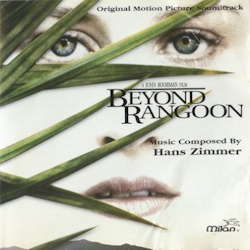
BEYOND RANGOON – Hans Zimmer
 THROWBACK THIRTY
Original Review by Jonathan Broxton
Beyond Rangoon is a political drama/thriller directed by John Boorman, inspired by the real events of the 1988 Burmese Uprising, when students and civilians protested against the military regime of then-dictator Ne Win, leading to thousands of deaths. Patricia Arquette stars as Laura Bowman, an American doctor who travels to Burma (now Myanmar) in the late 1980s with her sister Andi (played by Frances McDormand) in an attempt to recover from the traumatic murder of her husband and son. Their vacation unexpectedly coincides with the uprising, and while attempting to leave the country Laura loses her passport, inadvertently becoming trapped in the increasingly volatile nation. As she navigates a dangerous and unfamiliar landscape, Laura becomes a reluctant witness to the government’s violent repression of student demonstrators; however, she is guided by a former university professor turned dissident U Aung Ko (playing a fictionalized version of himself) who helps her understand the political crisis engulfing the country, and to flee to safety.
Although Beyond Rangoon was not a major box office success, and although the film has become somewhat obscure in the intervening decades, the film received praise at the time both for its political bravery and for Arquette’s performance, and it remains one of the few Western films to tackle Burma’s political history head-on. One of the few aspects of the film that has maintained a degree of prominence is its score, which was written by Hans Zimmer. Put simply, Beyond Rangoon is utterly beautiful – in my opinion, it’s one of the best scores of Zimmer’s entire career. In many ways Beyond Rangoon can be seen as a companion score to Mike Oldfield’s The Killing Fields, Georges Delerue’s Platoon, and to a lesser extent Brian Gascoigne and Junior Homrich’s score for Boorman’s 1985 film The Emerald Forest, in that it juxtaposes scenes of political violence and war in developing countries against music of serene beauty, resulting in a magical atmosphere that comes across as almost ethereal in nature.
 The score was written for a small string section – just violas, cellos, basses, no violins – augmented by Richard Harvey’s collection of ethnic flutes, and a large array of electronic/keyboard textures to flesh out the sound. Tonally, there is quite a bit of overlap between this score and the Oscar-winning score for The Lion King in terms of its depiction of untouched natural landscapes, but beyond the this score is something of a standalone wonder, almost unique in Zimmer’s 1990s filmograophy. I did note a few fleeting similarities to earlier scores like A World Apart, Fools of Fortune, K2, The Power of One, maybe The House of the Spirits, and even Backdraft in the few ‘action’ moments, but these are simply examples of Zimmer’s compositional style of the era.
Interestingly, Zimmer didn’t really make any significant attempts to research traditional Burmese music for his score, and instead relied on the ethnic flutes and pipes performed by Richard Harvey to capture the sound and soul of the setting. The main melody of the score is carried by Harvey almost every time it appears, and his performances are often accompanied by lovely counterpoint from a solo (possibly sampled) female voice representing Laura as a character, and then by bells, chimes, and other ethnic percussion items which appear to be a sonic representation of the Irrawaddy River, the main waterway that runs through Myanmar, and around which a lot of the film’s action takes place.
The opening cue, “Waters of Irawaddy,” offers the first performances of the main theme, slow and languorous and as elegantly mystical as the river itself. After 30 years this piece remains one of my all-time favorite Zimmer themes; although it is rendered mostly on the most modern electronic instruments that were available in 1995 there’s nevertheless something ancient and timeless about it, captivating, almost as if it comes from some long-forgotten period in human history. The second cue, “Memories of the Dead,” contains a thoughtful arrangement of the same theme, and then the third cue “I Dreamt I Woke Up” (which was co-composed by Nick Glennie Smith) initially maintains the sense of calmness and peace for several minutes until the music changes gear and presents the score’s first action sequence.
The action music in Beyond Rangoon is laden with breathy, shrill-sounding pipes overlaid against clattering percussion patterns and darker, more intense electronic textures, some of which remind me of the more aggressive parts of James Horner’s score for Braveheart. The secondary theme that emerges during this cue has a melodic progression very similar to the score for The Lion King, and Zimmer uses it in a similar way here as he did there, to musically describe the anguish felt by the Burmese people at the hands of their repressive government, as well as capturing Laura’s horror as she witnesses it firsthand.
The brief “Freedom from Fear” builds on these action stylistics to excellent effect – there’s almost a sense of reaching, striving, climbing, to the way the cue is structured – and then “Brother Morphine” slowly builds to present a further stunning performance of the central theme, again carried by Harvey’s flutes.
In “Our Ways Will Part” Zimmer again plays around with elements of both the main theme and the secondary theme, but also introduces a dramatic new third theme around the 1:30 mark that is very different from the rest of the score as it has a sort of defiant, almost heroic tone to it that is very compelling. Elsewhere, in terms of emotion, Zimmer brings in some moments of real despair and distress to represent the increasingly large numbers of atrocities Laura and U Aung Ko witness; something that is under-discussed to this day is Zimmer’s skill at emotional storytelling in settings like this, and how he can change things in his writing to subtly shift the emotional focus of the cue. This is one of those where he does that with real skill, and the vocal performances in this cue are very impressive too.
After a slow, slightly abstract opening “Village Under Siege” gradually emerges into the score’s most intense action sequence, parts of which underscore the harrowing scene where Laura has to shoot a Burmese soldier to keep from being raped. The intensity of the rhythmic element increases significantly here, but even when all this is going on Zimmer never loses sight of his core instrumental palette; I especially like the way he uses the watery percussion items in a more bombastic way, layered within the strings.
The final cue, “Beyond Rangoon,” is a 10-minute showstopper, an all-encompassing reprise of everything the score has to offer. Starting with a rapidly paced flute solo, it builds and builds through a series of dramatic action sequences, including superb performances of both the secondary theme and the tertiary theme, until finally emerging into an incredibly powerful rendition of the main theme at the 4:00 mark which really does give you shivers up your spine. The bass-heavy electronics, the way those keyboard tones combine with the strings and percussion, the specific phrasing of the instruments… this is classic, vintage Zimmer from the best part of his Media Ventures years, and it’s cues like this that caused me to fall in love with his music from this era.
As I said earlier, even after thirty years, Beyond Rangoon holds up as one of the finest dramatic scores of Hans Zimmer’s career. The specificity and purposefulness of the ensemble of the sound is outstanding – this is electronic music that is designed to be electronic music, not a bad approximation of an orchestra, and is all the better for it. The trio of main themes are outstanding, and the way the whole thing captures both the beauty of the Burmese landscape, and the suffering felt by the Burmese people during this turbulent era, showcases Zimmer at his emotionally sensitive best. Younger readers who think that Hans Zimmer’s music begins and ends with The Dark Knight, Interstellar, Man of Steel, and Dune should go back and experience this underrated masterpiece, and be enthralled.
Buy the Beyond Rangoon soundtrack from the Movie Music UK Store
Track Listing:
- Waters of Irawaddy (3:46)
- Memories of the Dead (1:43)
- I Dreamt I Woke Up (8:41)
- Freedom From Fear (1:06)
- Brother Morphine (1:03)
- Our Ways Will Part (7:11)
- Village Under Siege (4:07)
- Beyond Rangoon (10:09)
Running Time: 38 minutes 34 seconds
Milan 73138-35725-5 (1995)
Music composed by Hans Zimmer. Conducted by Nick Glennie-Smith. Orchestrations by Fiachra Trench and Nick Glennie-Smith. Additional music by Nick Glennie-Smith. Featured musical soloist Richard Harvey. Recorded and mixed by Paul Hulme. Edited by Adam Smalley. Album produced by Hans Zimmer and Adam Smalley.
Thanks, Scott.

Shop at the Movie Music UK Store

Member of the

 MOVIE MUSIC UK