JUDGE DREDD – Alan Silvestri
 THROWBACK THIRTY
Original Review by Jonathan Broxton
The character Judge Dredd was well-known to British comic book fans for almost 20 years prior to him debuting on film. Created by writer John Wagner and artist Carlos Ezquerra, he first appeared in the second issue of the British science fiction comic magazine 2000 AD in 1977, and quickly became the most iconic character of the anthology, known for his authoritarian demeanor, brutal sense of justice, and unwavering loyalty to the law. Set in a post-apocalyptic future, the Dredd stories have strong satirical and political overtones, exploring themes ranging from fascism to state surveillance, corporate corruption, and dystopia. Dredd himself is not the protagonist in a traditional sense – instead, he is a symbol of rigid, authoritarian justice, who has no personal ambition, rarely shows emotion, and sees mercy as weakness. Attempts to adapt Judge Dredd for the big screen began in the 1980s but the screenplay was stuck in development hell for years; the film eventually moved forward in 1994 with director Danny Cannon, a self-proclaimed fan of the comic, who was given the green light by the studio on the strength of his directorial debut The Young Americans in 1993. Unfortunately, subsequent interference and script re-writes heavily altered his intended vision, resulting in a film which disappointed long-time fans of the series.
The resulting film sees Sylvester Stallone donning Dredd’s iconic helmet and armor in the title role. Set in a dystopian future where much of the world has become a radioactive wasteland known as the Cursed Earth, humanity survives in overcrowded Mega-Cities. Mega-City One, stretching along the East Coast of what was once the United States, is plagued by crime. To maintain order, society has instituted a force of Judges – police officers who serve as judge, jury, and executioner – the most feared and respected of whom is Judge Dredd, a legendary enforcer known for his unshakable commitment to the law. But when a shocking crime rocks Mega-City One, Dredd finds himself accused and stripped of his authority. As the city teeters on the edge of anarchy, he must uncover a dangerous conspiracy that reaches deep into the heart of the justice system itself, and reveals some shocking truths about his own past. The film co-stars Rob Schneider, Diane Lane, Armand Assante, Jürgen Prochnow, and Max Von Sydow, and was expected to be a blockbuster in the summer months of 1995.
 Unfortunately, the film received mostly negative reviews; while some critics praised the production design and some action sequences, most found the script muddled and the tone inconsistent, while fans of the comic were especially disappointed by the lack of fidelity to the source material. In particular, the casting of Stallone as Dredd was criticized, as were the film’s attempts to make Dredd relatable, which contradicts his essence in the comics, where he functions more as an idea than a man. In the film Dredd has a backstory involving betrayal, family, and a desire to reclaim his name – conventional Hollywood storytelling – and he is portrayed with Stallone’s trademark swagger and one-liners, turning him into more of a generic 1990s action hero. Worst of all, he frequently removes his helmet, violating the central symbolic rule of the character.
The troubled development of Judge Dredd extended to its score as well. Composer David Arnold, who had previously worked with director Cannon on The Young Americans, was the original choice to score the film, but producer Andrew Vajna – who apparently wanted a ‘safer pair of hands’ than the relatively inexperienced Arnold had at that time – insisted on hiring the legendary Jerry Goldsmith instead. Goldsmith accepted the job, and composed and recorded a short piece of music used in the film’s trailers and marketing, featuring a main theme that likely would have formed the foundation of his full score, but as post-production delays mounted, Goldsmith had to withdraw from the project, and Alan Silvestri ultimately stepped in to complete the score.
In the end, Silvestri’s score is probably the best thing about the finished project. It’s a massive, thunderous, balls-to-the-wall action sci-fi adventure score of the highest quality, and is one of my all-time favorite Silvestri efforts. The music was recorded across multiple sessions in both London and Los Angeles, and it’s just sensational – a huge, muscular, bombastic epic that draws on the action style of previous scores such as Back to the Future, Predator, and The Abyss, as well as less well-known efforts like Ricochet, and then turns everything up to the max.
Silvestri’s score leans heavily on his signature brass-heavy orchestration, driving percussion, and bold, rhythmic motifs, blended with some more futuristic-sounding electronic textures that help to evoke the dystopian setting outside Mega-City One. The main theme is a heroic, militaristic fanfare that gives Dredd a sense of grandeur and authority, but unlike a lot of Silvestri scores, Judge Dredd does not rely on overly-complex thematic interplay; instead, the score overwhelms with raw power. In the liner notes for the expanded soundtrack release, Silvestri reveals that “there was something about the character Judge Dredd that was almost like a Roman gladiator for me,” and this inspired the way he orchestrated the main theme march, focusing prominently on a huge brass section accompanied by clanging anvils and militaristic percussive ostinatos, conveying a sense of heraldic splendor. The action cues are fast-paced and kinetic, and there are also some darker, more ominous cues that underscore the film’s conspiracy elements and the morally grey world of the Judges.
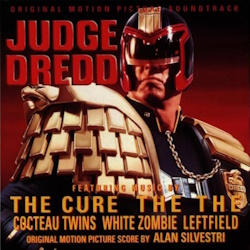 The original soundtrack release for Judge Dredd combined 25 minutes of original rock songs by artists ranging from The Cure to Rob Zombie to the Cocteau Twins (which I’m not going to go into) with around 40 minutes of score, presented as seven suites of between 3½-9½ minutes. Almost all of this music was drawn from the first London sessions, and does not appear in the film in these specific versions – the final cut of the film used the subsequent Los Angeles pickup sessions almost exclusively – but despite this, the music remains outstanding.
The “Judge Dredd Main Theme” builds out of an ominous opening for eerie choral textures and glassy metallic sounds, and goes through a series of spectacular revelatory orchestral crescendos that accompany the establishing vistas of Mega-City One, before eventually exploding into the first of several massive statements of Dredd’s major-key heroic fanfare. This music is vintage Silvestri at its best; it overflows with his signature chord progressions, instrumental combinations, and compositional touches, and will prove to be tremendously satisfying to anyone who has ever been drawn to his particular style of writing.
“Judgement Day” is part of the score which explores the conspiracy drama at the heart of the film, and sees Silvestri engaging in some apocalyptic writing for orchestra and choir, creating some undulating textures for the higher end of the strings that evoke a sort of majestic sense of scientific wonderment, and presenting the first appearance of a recurring motif at the 3:28 mark that can be read as a musical representation of Dredd’s steely determination to clear his name, and which is often combined with a darker variant of the same motif that represents Dredd’s evil twin clone brother Judge Rico. In film context a version of this music plays as Dredd’s mentor Chief Justice Fargo is banished from Mega City One and staggers out into Cursed Earth to await his fate.
“Block War” is a gargantuan action piece which takes Dredd’s heroic theme, the conspiracy motif, and the determination motif, and layers them all against the thunderous first performance of the Dredd March, as heard at the beginning of the piece, and almost constantly thereafter. The music here is sensational – a driving, martial powerhouse of a cue that throbs with relentless forward motion and dramatic forcefulness. The interplay between the brass and percussion sections here is tremendous, sometimes almost Goldenthal-esque in its trilling vibrancy, as they pass their rhythms back and forth between each other to create a constant sense of kinetic energy.
“We Created You” again explores the darker and more ominous aspects of the cloning conspiracy plot with low string figures, glassy waterphones, and moments of revelation that echo parts of Death Becomes Her, before concluding with a serious chorally-inflected statement of Dredd’s heroic theme. The subsequent “Council Chaos” starts out by treading similar ground, with more emphasis on the conspiracy motif and the determination motif, but quickly erupts into another spectacular action sequence featuring some astonishingly fast-paced and complicated brass riffs, and several massive statements of Dredd’s heroic theme, including some accompanied by triumphal triangle rings.
“Angel Family” underscores Dredd’s encounter with the titular nuclear mutants out on the wasteland of the Cursed Earth and is an aggressive, sometimes dissonant cue filled with Predator-esque ethnic woodwinds, rattling percussion textures, and shrieking electronics that stand at odds with Dredd’s more traditional orchestral tone. Some of the percussion items Silvestri uses here are fascinatingly exotic, having an almost Middle Eastern vibe, and the different combinations and sonic layers he creates with them are outstanding; even though they are vastly different from anything else in the score, they perfectly capture the danger the Angel Family presents to Dredd and his reluctant sidekick Fergie.
 The 9½-minute “New World” is the score’s epic finale, and again opens with a moody slow-build through elements of both the conspiracy motif and the determination motif. It gradually becomes more operatic and dramatic as Dredd and Rico face off mano-a-mano, with the fate of Mega City One in their hands, and Silvestri’s accompanying music is full of grandiosity – brass fanfares and soaring strings accompanied by a choir, with allusions to both Dredd’s heroic theme, and to the Dredd March with its clanging anvils. The more downbeat and introspective variation on Dredd’s heroic theme on wistful woodwinds is unexpected, but the conclusion of the piece is spectacular, as it returns to present Dredd’s heroic theme one last time, in its most triumphant setting yet.
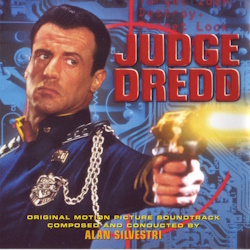
As I mentioned earlier, the original 1995 soundtrack for Judge Dredd featured 40 minutes of the ‘first version’ of the score recorded in London, arranged into suites. For almost two decades fans wanted to hear the actual in-film version of the score from the Los Angeles sessions, broken down into proper cues, and in 2015 Intrada Records obliged with a superb expanded 2-CD version of exactly that, featuring the full 67 minute score, 71 minutes of ‘original and alternate takes,’ and, as a fun bonus, Jerry Goldsmith’s wonderful 52-second original trailer music. Prior to this release, Goldsmith’s trailer score had only been available as a Joel McNeely re-recording performed by the Royal Scottish National Orchestra for Varèse Sarabande’s Hollywood ’95 compilation album, and so it’s good to finally have Goldsmith’s own version available here in its rightful setting.
As far as the actual score is concerned, truthfully, the difference in sound quality between the London session recordings and the Los Angeles session recordings is negligible, so the real excitement with the Intrada release comes from hearing the music in proper score context, and from discovering all the little twists and variations on the main themes that Silvestri couldn’t include on the original album.
 “Block War,” “Parking Penalty,” “Shuttle Crash,” the “New Order Montage,” and “Send In the Clones” are fantastic action moments, while “The Law” and “Hidden Photo” offer some softer and more contemplative woodwind variations on Dredd’s heroic theme that accompany his emotional discoveries about his past. Elsewhere, cues like “I’ve Heard It All,” “Aspen,” “Dredd’s Arrest,” and “Say It Ain’t So” revel in the brooding operatic drama of the conspiracy motif and the determination motif with the frequent addition of overwhelming choral forces. The in-film finale of “New World” is an improvement over the one on the original album, too, as Silvestri allows the whole thing to climax with a spectacular fortissimo flourish that is immensely satisfying.
Whichever album you choose – both are worthwhile in different ways – Judge Dredd remains a magnificent score, in my opinion one of Alan Silvestri’s career best. The sweeping and bold heroism of the Dredd theme is outstanding, the hyper-masculine muscularity of the march and the related action music is utterly compelling, and the whole thing contains some of the most powerful orchestral forces that Silvestri ever put together. Although I admit I liked the film a great deal at the time, hindsight has cooled my opinion somewhat, and I now wish that Silvestri had been able to apply this music to a film worthy of the true 2000 AD Judge Dredd legacy, and not the sloppy Hollywood version that they eventually made. I am the law!
Buy the Judge Dredd soundtrack from the Movie Music UK Store
Track Listing:
- 1995 ORIGINAL RELEASE
- Dredd Song (written by Robert Smith, Simon Gallup, Perry Bamonte, Jason Cooper and Roger O’Donnell, performed by The Cure) (4:16)
- Darkness Falls (written by Matt Johnson, performed by The The) (3:43)
- Super-Charger Heaven (written by Rob Zombie, performed by White Zombie) (3:36)
- Need-Fire (written by Elizabeth Fraser, Robin Guthrie, and Simon Raymonde, performed by Cocteau Twins) (4:19)
- Release the Pressure (written by Neil Barnes, Adam Wren, Sebastian Beresford, performed by Leftfield) (7:39)
- Judge Dredd Main Theme (4:56)
- Judgement Day (5:53)
- Block War (4:39)
- We Created You (3:36)
- Council Chaos (5:43)
- Angel Family (5:36)
- New World (9:13)
- 2015 EXPANDED INTRADA RELEASE
- Main Title (5:00)
- Block War (5:01)
- I’ve Heard It All (2:23)
- Aspen (3:25)
- It Ends (0:41)
- The Law (1:54)
- Pawn Shop (1:43)
- Parking Penalty (0:54)
- Dredd’s Arrest (1:32)
- Say It Ain’t So (2:23)
- Judgement Day (4:23)
- Hidden Photo (0:39)
- Shuttle Crash (2:37)
- Access Denied (1:03)
- Angel Family Values (6:01)
- We Created You (3:46)
- New Order Montage (2:12)
- Hershey’s Close Call (0:18)
- Janus! (0:57)
- Council Chaos (7:30)
- Hershey’s Apartment (1:14)
- Twice You Owe Me (1:17)
- Griffin Gets It (0:58)
- Send In The Clones (1:15)
- New World (7:47)
- Judge Dredd – Trailer (written by Jerry Goldsmith) (0:47)
- Main Title (4:56) – Original/Alternate Take
- Block War (3:05) – Original/Alternate Take
- I’ve Heard It All (0:36) – Original/Alternate Take
- Dredd and Fargo (0:33) – Original/Alternate Take
- You’re A Legend (0:23) – Original/Alternate Take
- Aspen (2:27) – Original/Alternate Take
- Aspen – Alternate (2:27) – Original/Alternate Take
- I Judged Him (0:56) – Original/Alternate Take
- Hershey Objects (0:21) – Original/Alternate Take
- Bon Appetite (1:42) – Original/Alternate Take
- Brief Reunion (1:32) – Original/Alternate Take
- Council Chaos (5:46) – Original/Alternate Take
- Choose (5:17) – Original/Alternate Take
- Choose – Alternate (4:42) – Original/Alternate Take
- Choose – Revised (5:14) – Original/Alternate Take
- New World (2:25) – Original/Alternate Take
- New World – Alternate (2:25) – Original/Alternate Take
- Judgement Day (5:53) – Original 1995 Soundtrack Assembly
- Block War (4:39) – Original 1995 Soundtrack Assembly
- Angel Family (5:36) – Original 1995 Soundtrack Assembly
- New World (9:13) – Original 1995 Soundtrack Assembly
Running Time: 63 minutes 09 seconds – Original
Running Time: 137 minutes 48 seconds – Expanded
Epic Records 480855 2 (1995) – Original
Intrada Special Collection Volume ISC-316 (1995/2015) – Expanded
Music composed and conducted by Alan Silvestri. Orchestrations by William Ross, Conrad Pope, Steven Scott Smalley and John Eidsvoog. Recorded and mixed by Dennis Sands. Edited by Kenneth Karman. Score produced by Alan Silvestri. Expanded album produced by Douglass Fake and Roger Feigelson.

Shop at the Movie Music UK Store

Member of the

 MOVIE MUSIC UK