ARSENIC AND OLD LACE – Max Steiner
 GREATEST SCORES OF THE TWENTIETH CENTURY
Original Review by Craig Lysy
Renowned producer and director Frank Capra saw opportunity with the popular success of the Broadway play “Arsenic and Old Lace”, which was adapted from Joseph Kesserling’s novel of the same name. He purchased the film rights, however the contract stipulated that the film could not be released until the Broadway run had ended. Due to the enduring success of the play, the film debut was delayed by almost two years. Capra would manage production with a budget of $1.2 million, and also direct, with Julius J. Epstein and Philip G. Epstein writing the screenplay based on Joseph Kesselring’s novel. A fine cast was hired, with Cary Grant starring as Mortimer Brewster, Priscilla Lane as Elaine Brewster, Raymond Massey as Jonathan Brewster, Jack Carson as Officer Patrick O’Hara, and Peter Lorre as Dr, Herman Einstein.
The story is set in the 1920s and revolves around Mortimer Brewster who descends from a respected family that can trace their lineage back to the original Mayflower settlers. He is a theater critic, and for years he has railed against marriage in his newspaper articles, which he believes to be an old-fashioned superstition. So, with true irony, he falls in love with his neighbor Elaine Harper, daughter of a minister. They marry and he dutifully goes to advise the two spinster matriarchs of the family, aunts Abby and Martha. He discovers however a horrible secret, that his aunts have for years have been murdering lonely old bachelors with a concoction of elderberry wine, arsenic, strychnine and cyanide. His crazy and delusional uncle Teddy has been burying the bodies, believing them war casualties from Teddy Roosevelt’s campaigns. Things worsen with the arrival of his brother Jonathan, who happens to be a serial murderer. After much farcical intrigue Teddy and the aunts are institutionalized and Mortimer and Elaine leave for their honeymoon and a new life together. The film resonated with the public and was a huge commercial success, earning $4.8 million. Critical reception was universally favorable, with many complimenting the macabre comedy. However, the film received no Academy Award Nominations.
 Max Steiner was overjoyed when the studio assigned him to “Arsenic and Old Lace”, as he had always wanted to collaborate with Frank Capra, and relished the challenge of scoring a macabre comedy, a genre he had long desired to take on. Steiner was given tremendous latitude to score the film as Capra left the project after the final shoot to manage production of a series of American WWII propaganda films. This gave Steiner a free hand to utilize his gifts. I believe that Steiner understood that he was tasked with supporting the film’s comedic and slapstick elements, as well as the macabre. He was given only a few weeks to write the score, a rushed timeline to which he was all too familiar. He would later find it tragic comic that the film ended up being delayed two years.
For his soundscape Steiner’s Main Theme drew inspiration from notes written on the film’s script in the scene that Mortimer discovers the horrible truth about his two aunts. He resolves that he must commit both of them to the Happy Dale sanatorium, and in a conflicted state of anxiety and elation he sings the nursery rhyme “There is a Happy Land Far, Far Away”. The melody has a happy go lucky spirit to it, and Steiner in a masterstroke, chose to use it melody to juxtapose the macabre activities of his aunts. Also instructive is how Steiner employed the classical “Bridal Chorus” from “Lohengrin” (1850) by Richard Wagner, by inverting its melody in a descending contour to express the growing impatience and frustration of their honeymoon delay by his fiancé Elaine.
“Main Title” opens with Max Steiner’s iconic Warner Brothers fanfare, which supports the studio logo followed by the flow of the opening credits. At 0:09 we segue with a vibrant and spirited rendering of the Main Theme, the song melody of “There is a Happy Land Far, Far Away”. At 0:25 the theme darkens against imagery of a black cat and Halloween owl. Yet at 0:35 the Main Theme resumes its vibrant and spirited exposition. At 0:53 grim spiraling descent motif concludes the credits and at 1:07 usher in a dire statement of “The Sidewalks of New York” melody, which supports narrative script; “This is a Halloween tale of Brooklyn, where anything can happen – and it usually does. At 3 p.m. this day, this was happening. . .” Steiner, with his usual aplomb perfectly sets the tone of the film. At 1:18 we segue into “Baseball a la Brooklyn” empowered by the iconic “Take Me Out to the Ball Game Music by Albert von Tilzer as we see a raucous crows watching the Dodgers at Brooklyn Stadium. A strike three call enrages the batter who punches the umpire, which triggers a massive brawl of players and fans. At 1:53 we flow into the melody of the song “Daisy, Daisy” as we see new narrative script advising that there is romance in the air as a ship sails up the East River. At 1:58 Wagner’s “Bridal Chorus” joins as we see a sign “Marriage License Bureau”. At 2:15 the music sours as Mortimer and Elaine reach the clerk and he gets cold feet.
“Brewster Bows Out” reveals Mortimer grabbing Elaine and bolting from the line, fleeing to a phone booth carried by an animated flight rendering of the Bridal Chorus” melody with comedic accents. He tells Elaine that he just cannot go through with the marriage as she looks up at him with puppy dog eyes. At 0:40 a molto romantico rendering of the Love Theme joins as her passive acceptance disarms him, and he relents. At 1:12 the Bridal Chorus supports their return to the line. At 1:28 an East Asian lady turns around and winks, supported by an Oriental version of the Bridal Chorus. This is followed by a sardonic version of the melody as a man turns around and offers a wry grin. At 1:40 a dreamy rendering of “The Sidewalks of New York” melody supports narrative script; “And now back to one of Brooklyn’s most charming residential districts”. We close darkly with chimes misterioso as the camera pans a cemetery that displays a tombstone; “Jacob John Vandemeer died 1654” followed by narrative script; “From here, you are on your own”. (*) “Piano Sonata No. 11 in A Major, K.331, 3rd Movement” reveals Teddy Brewster sitting in the parlor playing the spritely Mozart piece on a harpsichord as his sister Abbey converses with Reverend Harper. The reverend is displeased with her Brother Mortimer’s latest book; “Marriage, A Fraud and a Failure”. Police officers Brophy and O’Hara arrive to pick up their donation of toys. Abbey dispatches Teddy to get more toys upstairs and on the landing, he shouts “Charge”, and recreates Teddy Roosevelt charge up Kettle Hill.
“Just Look in the Window Seat” offers a wondrous score highlight, with ever shifting variations of the Bridal Chorus with interplay of the Love Theme. The cue just sparkles! It reveals Abbey insisting they take some beef broth and she prances to the kitchen carried by a prancing danza felice with interplay of the Main Theme. Martha Brewster arrives and the sisters chat and then escort the policemen out. They return and Abbey informs Teddy that another Panama Canal lock will need to be dug in the basement, and then informs Martha of the location of their latest victim as they walk over to look. The prancing danza felice with interplay of the Main Theme creates a sparkling, and surreal musical narrative that belies their dark secret. As they reach the window seat to open it, the window above it opens and Elaine greets and hugs them supported by a celebratory Bridal Chorus Theme. An extended rendering of the theme with interplay of the Love Theme ensues as an amorous Mortimer chases Elaine around the family cemetery. He catches her and they kiss twice as he relates his honeymoon plans at Niagara Falls. At 3:10 Elaine departs to inform her father and Mortimer prepares to notify his aunts. We close with the Bridal Chorus Theme rendered maestoso with a sparkling celebratory coda.
“Mortimer’s Ghastly Discovery” reveals Mortimer advising Abbey and Martha of his marriage. Martha goes to fetch a cake while Abbey searches for notes Mortimer left for his new book. She finds a picture of his younger brother Jonathan and off-putting music enters as we see him with a disturbing expression. He suggests she burn it and as she recalls his bizarre behavior a queer, percolating bassoon joins. She joins Martha in the kitchen, and Mortimer is shocked when he opens the lid of the window seat and finds a corpse. At 0:19 sparkling tremolo violins usher in the Bridal Chorus Theme as Mortimer tries to answer Elaine’s whistle. A cascading descent motif of disbelief follows as Mortimer is stunned as the sisters return to join him, and giddily begin tossing rice. He says Teddy needs to immediately go to the sanitarium as he found a dead body in the window seat. He is then stunned as the aunts blithely admit that not only do they know about the corpse, but it was they who poisoned him with Elderberry wine. They hid the body so as to not disturb the reverend. As they return to the kitchen a dark interlude follows, joined at 0:53 by a refulgent reprise of the Bridal Chorus Theme as Elaine pokes her head through her house’s window and whistles.
In an intervening unscored scene, Mortimer joins the aunts in the kitchen in a panic saying they have to do something. They say they are as Teddy is digging a Panama Canal lock to bury him with the others. The subsequent disclosure that this will be their twelfth victim stupefies Mortimer. They add that Teddy digs the grave as he believes he is burying another victim of Yellow Fever. The aunts return to frost the cake, Mortimer frets, and decides to call judge Cullman, but he is not at home. Elaine arrives and Mortimer throws her out in a panic saying he’ll call in the morning. Elaine storms home and Mortimer calls the Happydale Sanitarium trying to reserve a bed for Teddy as the two aunts interview Mr. Gibbs, an old man with no relatives who is seeking to rent a room. They offer him a glass of elderberry wine, Mortimer hangs up, and then joins and screams as Gibbs prepares to drink. He chases Gibbs out like a raving lunatic, which greatly disappoints the aunts. Mortimer leaves and tells the two to remain here and not let anyone in.
At 1:11 the music of cue 12 “Mortimer’s Ghastly Discovery” resumes darkly as they put Mr. Hoskin’s hat in a cupboard that contains the hats of their eleven previous victims. As they prepare for dinner a quaint dance-like variant of the Main Theme supports. At 1:43 we segue into “The Prodigal Son Returns” with a foreboding descent motif by piano as two men knock on the front door and the sisters decide not to answer. At 2:06 a dire musical narrative supports the entry of Jonathan, and his friend, Dr. Einstein. At 2:27 a twisted and grim rendering of “Home Sweet Home” supports Jonathan saying that in is youth he could hardly wait to escape this house, but now is happy to escape back into it. The music from 3:04 – 5:26 is not heard as I believe the scene was edited. We flow with a dire musical narrative into “Jonathan Becomes Disagreeable” as the aunts confront him and order them to leave. At 0:24 a tense misterioso unfolds as he says he is Jonathan, but they do not believe him until he identifies Abbey’s granite ring, and Martha’s acid scar on her neck. They slowly come to the realization that he is Jonathan but inquire why is face is so scarred. At 0:49 the music becomes menacing as he turns and blames Dr. Einstein for his disfigurement. We close with a misterioso of uncertainty as Jonathan warns the doctor that he must give him the face of an absolute nonentity. In an unscored scene Mortimer secures the judge’s signature on the commitment order.
(*) “Jonathan’s Scheme” Einstein and Jonathan inspect the basement and find that Teddy’s Panama Canal is 4 x 6 feet – a perfect size to bury the corpse of Mr. Spinalzo. They plan to send Teddy and the sisters to bed, and then to surreptitiously bring the corpse in through the window. Jonathan and Einstein depart to move the car and the sisters brief Teddy on moving the latest yellow fever victim to the Panama Canal after lights out. Steiner supports the scene unobtrusively under the dialogue with a sinister musical narrative. “A Frightful Sight at the Window” opens with a sparkling Main Theme as the sisters fret that poor Mr. Hoskins must be uncomfortable in the window seat compartment. At 0:14 a swirling motif supports Abbey taking Martha to see Mr. Hoskins as she was away when he ‘fell ill’. As the reach to open the lid, a horrific stinger at 0:19 usher in a dire statement, which supports Jonathan opening the drapes to frighten them. They bring their luggage in through the window and order the sisters up to bed. Abbey remains downstairs, and a menacing misterioso joins as Jonathan orders her to turn off the light and come up, which she does carried by a sparkling Main Theme. Jonathan ascends to the third-floor laboratory. At 1:22 a suspenseful ascent motif carries Teddy upstairs. Steiner sow tension punctuating his foot falls as he walks through the dark, and grabs Mr. Hoskin’s corpse. At 2:09 Steiner interpolates Frédéric Chopin ‘s grim Marche funèbre from “Sonata in Bb-, Op.35 No.2 (1837) to support Teddy carrying the corpse downstairs for burial. At 2:39 a massive orchestral crash supports Teddy tossing the corpse to the floor. At 2:50 sinister musical narrative supports Einstein and Jonathan’s emergence from the lab, and descent downstairs and bring the corpse into the house through the window. A knock on the door is heard at 2:28 supported by a string tremolo with sparkling ascent figures. At 3:35 a tentative Bridal Chorus Theme supports Elaine opening the door. The music descends into menace as she is confronted by Jonathan who is less than hospitable. They acquaint, we see that she is surprised that he is Mortimer’s brother Jonathan, and he is surprised that she is Mortimer’s wife. She says that now that they are acquainted, she’ll be on her way.
In “Silencing Elaine”, as she is departing, he asks again why she came here at this time of night. She says she saw a car drive in and thought it was Mortimer. With that revelation Jonathan relocks the door and moves towards her empowered by a dire musical narrative with a swelling menace. Jonathan forcibly grabs her, cups her mouth with his hand, and drags her down into the basement. At 0:18 the sisters come out dressed in black supported by funereal auras. They ask what is going on, but are interrupted by knocking on the door. A hysterical Elaine bolts up from the basement, Abbey lets a frantic Mortimer in, and they all reunite. Mortimer is dumbfounded at Jonathan’s appearance and that he has returned. After 0:35, an extended unscored interlude follows where Mortimer, and the sisters discover the corpse of Mr. Spinalzo, and deduce that Jonathan is the culprit. Mortimer orders Jonathan to leave with the corpse, but he refuses and prepares to draw his knife when officer O’Hara arrives. Mortimer convinces him to stay and have some cake, and then gives Jonathan one last chance to leave with the corpse or he will expose him. Mortimer returns to the kitchen, and Jonathan stews with anger, vowing to stay and extract revenge against his brother. He and Einstein discover a corpse in the basement and when Mortimer returns, they call his bluff saying if he exposes their corpse, they’ll expose his. Mortimer panics and manages to escort Officer O’Hara out with a promise to meet later to discuss his book. Mortimer rushes out to get a physician signature for Teddy’s commitment, and Jonathan and Einstein learn the shocking family secret when the sisters reveal that they have mercy killed twelve men. Jonathan relates that he too has killed twelve and he will add a thirteenth, Mortimer, to break the family record. Mortimer obtains the doctor’s and Teddy’s signature on the commitment order as the sisters perform the joint burial service for Mr. Hoskins and Mr. Spinalzo, singing a Capella Beethoven’s hymn “With All the Saints in Glory”.
At 0:39 we resume cue 15 with “Operating on Mortimer” as Jonathan and Einstein tie up and gag Mortimer. Woodwinds of alarm and tremolo strings support as Mortimer is bound. An ominous musical narrative unfolds where Steiner sow terror as Jonathan speaks of his hatred of Mortimer and desire to recreate his diabolical murder in Melbourne. He voices years of grievances as he opens a suitcase full of knives, scalpels and other tools of torture and mutilation, promising Mortimer exquisite pain. In an extended unscored scene, Einstein is frantic and says he cannot assist without a drink. He grabs the elderberry wine and pours a glass for himself and Jonathan. They toast and raise their glasses only to drop and shatter them when Teddy burst out of his room and blares his bugle. They rush to begin the procedure when officer O’Hara arrives. Jonathan dupes him into believing they are enacting a play and O’Hara plays along. Jonathan sneaks up behind with a knife, but is knocked unconscious by Einstein. Two more police arrive and Jonathan believes they have come for him and a brutal fight ensues. Jonathan is knocked out and the police lieutenant arrives and identifies Jonathan as an escapee from a jail for the criminally insane.
In a final unscored farcical scene, Teddy is committed, the sisters insist on joining him at the sanitarium and commit themselves, with Dr. Einstein signing. The police do not believe their tale of thirteen bodies being buried in the basement and prepare to leave when Elaine comes running up screaming from the basement, having discovered the 13 bodies. Before she can tell the police Mortimer silences her with a forced kiss and carries her out, with the sisters explaining to the police that they are off on their honeymoon. We flow into “End Title” empowered by the Main Theme rendered as a march, which concludes with grand fanfare. At 0:13 we segue into “End Cast” propelled by a festive statement of the Main Theme. “Arsenic And Old Lace Trailer Score” offers a wonderful bonus cue, which features an enjoyable suite, with interplay of the Main Theme, Love Theme, and Bridal Chorus Themes, which make for a very entertaining trailer.
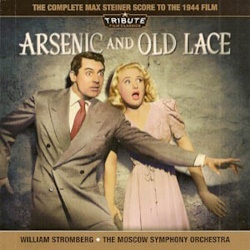
I would like to thank Anna Bonn, John Morgan, William Stromberg and Tribute Film Classics for this wonderful album, which also features a re-recording of “The Adventures of Don Juan”, also by Steiner. The audio quality is excellent as is the performance of the Moscow Symphony Orchestra under the baton of William Stromberg. Max Steiner reveled with the opportunity to score a macabre comedy and was innovative with his approach. To animate the two sisters, he chose to juxtapose their macabre murders by interpolating the song melody of “There is a Happy Land Far, Far Away”. The sparkling melody has a happy go lucky spirit to it, with boundless joie de vivre. This was brilliantly conceived and perfect in supporting the blythe detachment of the sisters from their nefarious deeds. For our long-suffering and baffled Elaine, Steiner interpolated Wagner’s Wedding Chorus, which is indelibly associated with the joy of matrimony. Throughout the film Elaine is frustrated by the denial of her honeymoon for reasons never fully explained, and Steiner inverting its joyous melody in a descending contour, repeatedly dangling it just out of her reach. His Love Theme for Elaine and Mortimer is original and classic Steiner, offering a beautiful string borne romanza. For the remainder of the score Steiner channels the emotional dynamics and undercurrents of the scene embracing buffoonery, hysteria, panic, and diabolical menace. Folks, I believe this score broke with convention and that the juxtaposition of music and film narrative achieved a marvelous synergy. I found the score enjoyable, funny and masterfully attenuated to the film. I highly recommend this outstanding album for purchase, as well as streaming the film to marvel at the score’s performance in context.
For those of you unfamiliar with the score, I have embedded a YouTube link to its trailer; https://www.youtube.com/watch?v=lwGwyfBkveg
Buy the Arsenic and Old Lace soundtrack from the Movie Music UK Store
Track Listing:
- Main Title/Baseball a la Brooklyn (2:50)
- Brewster Bows Out (2:19)
- Just Look in the Window Seat (3:33)
- Mortimer’s Ghastly Discovery/The Prodigal Son Returns (5:26)
- Jonathan Becomes Disagreeable (1:18)
- A Frightful Sight at the Window (4:41)
- Silencing Elaine/Operating on Mortimer (2:50)
- End Title/End Cast (0:52)
- Trailer Score (2:53)
- Baseball a la Brooklyn (Alternate) (1:20)
Tribute Film Classics TFC1009 (1944/2012)
Running Time: 28 minutes 02 seconds
Music composed by Max Steiner. Conducted by William Stromberg. Performed by The Moscow Symphony Orchestra. Original orchestrations by Hugo Friedhofer. Recorded and mixed by Alexander Volkov. Edited by XXX. Score produced by Max Steiner. Album produced by John Morgan, William Stromberg, and Anna Bonn.

Shop at the Movie Music UK Store

Member of the

 MOVIE MUSIC UK