IL POSTINO – Luis Enríquez Bacalov
 THROWBACK THIRTY
Original Review by Jonathan Broxton
One of the most surprising global hits of the 1990s was Il Postino, The Postman, an Italian romantic drama film based on the novel Ardiente Paciencia by Antonio Skármeta, and directed by English filmmaker Michael Radford. The film is set in the early 1950s on a small, picturesque island off the coast of Italy and centers on Mario Ruoppolo, a shy and uneducated local man who takes a job as a postman. His only task is to deliver mail to Pablo Neruda, the famous Chilean poet, who has taken refuge on the island after fleeing Augusto Pinochet’s government and going into political exile. As Mario and Neruda begin to interact, Mario becomes fascinated by the poet’s charisma, politics, and especially his romantic use of language; eventually, Mario seeks Neruda’s guidance in learning how to express himself, particularly because he has fallen in love with Beatrice Russo, a beautiful but reserved woman who works at a local café.
The film starred the beloved Italian comedian and actor Massimo Troisi as Mario, with Philippe Noiret as Neruda, and Maria Grazia Cucinotta as Beatrice. The film was popular in Italy when it was first released there in September 1994, but became an unexpected global hit after being picked up for international distribution by Miramax in the summer of 1995, and promoted within an inch of its life. Much was made of the fact that Troisi was in poor health during production, suffering from a serious heart condition, and tragically died just one day after principal photography wrapped, having postponed a necessary surgery in order to complete filming. However, even without this tragic side story, the film itself is lovely; it has a gentle tone, a poetic sensibility, and features a poignant lead performance by Troisi which speaks to the power of language and poetry and how it has the capacity to transform lives for the better. The film was nominated for five Academy Awards, including Best Picture, ultimately winning one, for Best Score.
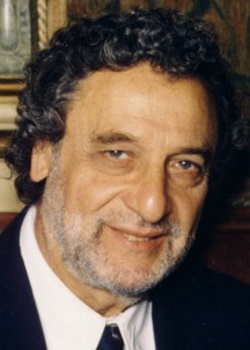 The score for Il Postino offered a late career resurgence for its composer, Luis Enríquez Bacalov. Born in Argentina in 1933, Bacalov spent most of his adult life and career living and working in Italy, and was a major film composer in the Italian film industry in the 1960s and 70s; his most famous scores were for spaghetti westerns such as Django, Sugar Colt, Quién Sabe, Lo Chiamavano King, and Il Grande Duello, and gritty crime thrillers such as The Summertime Killer, Milano Calibro 9, Il Boss and I Padroni Della Città. He also received an Oscar nomination for Best Music Adaptation or Treatment in 1967 for Pier Paolo Pasolini’s The Gospel According to St. Matthew, and he scored Federico Fellini’s City of Women in 1980, Fellini’s first film after the death of Nino Rota.
For the longest time I harbored an irrational dislike of the score for Il Postino, for the simple reason that I thought it unfairly deprived James Horner of his first Oscar. Horner wrote Braveheart and Apollo 13 in 1995, two of the scores that were instrumental in fashioning my love of film music, and he was nominated for both of them, but then lost to Bacalov and the Harvey Weinstein-led promotional juggernaut that accompanied the film all through 1996’s Oscar season. However, having had 30 years to come to terms with all this, I can now finally admit to myself something that most people have known for a long time: that the score for Il Postino is actually really lovely.
Bacalov’s music is lyrical, wistful, and intimate, mirroring the film’s poetic atmosphere and the emotional journey of its main character. It features simple melodies arranged with lush orchestrations, creating a sense of nostalgia and quiet longing, and there’s a gentle Mediterranean warmth in the instrumentation too, which includes featured performances by strings, Bacalov’s solo piano, Riccardo Pellegrino’s mandolin, and Héctor Ulises Passarella’s bandoneon accordion, all of which evoke the island setting and the simplicity of Mario’s world. Finally, Bacalov also draws on elements of tango and classical Latin American music to reflect Pablo Neruda’s Chilean identity; this is something that Bacalov also has vast experience of, having written and arranged multiple tangos himself over the decades.
The score is dominated by its main theme, which first appears in the opening “Titoli,” and in numerous cues thereafter. It is a delicate and haunting melody that recurs in a range of tonal and instrumental variations, and mostly plays during scenes of quiet introspection, gradually building emotional depth as Mario develops his relationship with Neruda, with poetry, and ultimately with Beatrice. In the “Titoli” the theme is carried by a gorgeous bandoneon backed by warm, shimmering strings, and then in subsequent cues like “In Bicicletta” and “I Suoni dell’Isola” the theme becomes more charming and imaginative, enlivened by the introduction of lightly comedic woodwinds, sunny guitar textures, undulating pianos, and subtle percussion.
The theme takes on the style of a children’s music box in the dream-like “Postino Bambino.” The “Trio Version” is a pretty arrangement that has more focus on Bacalov’s florid solo piano and the solo violin. Both “I Sogni del Postino” and “Milonga del Poeta” become more serious and dramatic, and represent Mario as he becomes more politically conscious and the story moves toward its bittersweet conclusion; the increased use of more modern percussion textures, more purposeful-sounding guitars, and a more soulful bandoneon performance in these cues achieves this new emotional tone. The final three cues – “Il Postino Poeta, “Il Postino (Harpsichord and String Version),” and “Il Postino (Guitar and Bandoneon Version),” offer yet more variations on the main theme, all of which are delightful.
Just one or two cues do not feature the main theme as its central element. There is a vintage recording of Francisco Canaro and Luis Cesár Amadori’s 1931 tango piece “Madreselva” performed by the legendary Carlos Gardel, and then a new instrumental arrangement of the same piece that is romantic and evocative. There is a lovely, playful, fanciful theme for Beatrice – the object of Mario’s initially unrequited desires – in the cue which bears her name; Beatrice’s theme is essentially an offshoot of the main theme, a variant on the same melody, and with basically the same orchestral and instrumental palette, albeit with slightly more emphasis on pizzicato strings. There is a vague hint of the circus in the magical and wonder-filled “Metafore,” and then “Loved by Women” is a fun piece of traditional period jazz, built around a toe-tapping central tune.
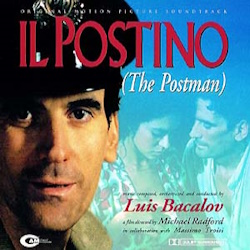
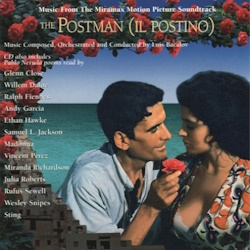 The soundtrack for Il Postino was originally released by CAM Records to coincide with the film’s initial Italian theatrical premiere in September 1994. When the film was picked up for North American distribution by Miramax in June 1995 – and subsequently heavily marketed for Oscar consideration – an expanded soundtrack was released which augmented Bacalov’s score with more than 20 minutes of spoken word poetry recited by an eclectic array of pop stars and actors including Sting, Wesley Snipes, Ralph Fiennes, Ethan Hawke, Rufus Sewell, Glenn Close, Samuel L. Jackson, Andy García, Willem Dafoe, Madonna, and Julia Roberts; each track is a Neruda poem set to music by Bacalov, and they are nice enough, albeit a little superfluous.
The one thing to be aware of with Il Postino is the fact that an affinity for the main theme is absolutely essential in order to appreciate the score at all, as for all intents and purposes the main theme and its instrumental variations are the entire score. If you don’t like it, you’re out of luck; there are no really prominent sub-themes to latch on to, and no action cues to appreciate. Personally, I do not have this issue, as I found the theme to be a delight – a perfect depiction of a time, a place, and a romantic attitude that captivates from start to finish.
Did Il Postino deserve to win the Oscar for Best Score in 1995? In my opinion, no, in the same way that Nicola Piovani did not deserve his win for Life is Beautiful a few years later – both were lucky recipients of the 1990s Miramax marketing machine. But I am glad it gave some long-overdue attention to Luis Enríquez Bacalov in the latter half of his career; although he scored a few more independent American films in the immediate aftermath of his win, he never really capitalized on the success of Il Postino in the decades that followed, and by the time he passed away in 2017 at the age of 84 he had not scored a major film for many years. As such, if Il Postino inspires people to check out some of his more groundbreaking and interesting work from the 1960s and 70s, all the better.
Buy the Il Postino soundtrack from the Movie Music UK Store
Track Listing:
- EUROPEAN RELEASE
- Il Postino (Titoli) (2:41)
- In Bicicletta (2:25)
- Madreselva (written by Francisco Canaro and Luis Cesár Amadori, performed by Carlos Gardel) (3:13)
- Postino Bambino (0:49)
- Beatrice (4:04)
- Metafore (2:01)
- Loved By Women (3:27)
- Il Postino (Trio Version) (2:34)
- I Suoni dell’Isola (2:28)
- I Sogni del Postino (3:19)
- Pablito (0:41)
- Milonga del Poeta (1:12)
- Madreselva (Instrumental) (written by Francisco Canaro and Luis Cesár Amadori) (2:17)
- Il Postino Poeta (3:21)
- Il Postino (Harpsichord and String Version) (0:44)
- Il Postino (Guitar and Bandoneon Version) (3:09)
- Despierta Ya (performed by Alma Rosa) (4:26) Bonus
- NORTH AMERICAN RELEASE
- Theme (1:53)
- Morning (Love Sonnet XXVII) (read by Sting) (0:52)
- Poetry (read by Miranda Richardson) (1:40)
- Leaning Into The Afternoon (read by Wesley Snipes) (1:35)
- Poor Fellows (read by Julia Roberts) (1:29)
- Ode To The Sea (read by Ralph Fiennes) (1:36)
- Fable of the Mermaid and the Drunks (read by Ethan Hawke) (2:08)
- Ode to a Beautiful Nude (read by Rufus Sewell) (2:30)
- I Like For You To Be Still (read by Glenn Close) (1:33)
- Walking Around (read by Samuel L. Jackson) (3:07)
- Tonight I Can Write… (read by Andy Garcia) (2:44)
- Adonic Angela (read by Willem Dafoe) (1:21)
- If You Forget Me (read by Madonna) (2:01)
- Integrations (read by Vincent Perez) (1:33)
- And Now You’re Mine (Love Sonnet LXXXI) (read by Andy Garcia and Julia Roberts) (3:04)
- The Postman (Titles) (2:41)
- Bicycle (2:27)
- Madreselva (written by Francisco Canaro and Luis Cesár Amadori, performed by Carlos Gardel) (3:16)
- The Postman Lullaby (0:50)
- Beatrice (4:06)
- Metaphors (2:02)
- Loved By Women (3:28)
- The Postman (Trio Version) (2:35)
- Sounds of the Island (2:29)
- The Postman’s Dreams (3:21)
- Pablito (0:43)
- Milonga del Poeta (1:13)
- Madreselva (Instrumental) (written by Francisco Canaro and Luis Cesár Amadori) (2:18)
- The Postman Poet (3:25)
- The Postman (Harpsichord and String Version) (0:46)
- The Postman (Guitar and Bandoneon Version) (3:16)
Running Time: 42 minutes 51 seconds – European
Running Time 68 minutes 16 seconds – North American
CAM 493108-2 (1994) – European
Miramax Records/Hollywood Records 162 029-2 (1995) – North American
Music composed and conducted by Luis Enríquez Bacalov. Performed by the Symphony Orchestra of Rome. Orchestrations by Luis Enríquez Bacalov. Featured musical soloists Luis Enríquez Bacalov, Héctor Ulises Passarella, and Riccardo Pellegrino. Recorded and mixed by Fabio Venturi, Marco Streccioni and Franco Finetti. Edited by XXXX. Album produced by Luis Enríquez Bacalov. Expanded album produced by Jeffrey Kimball, Joseph Magee, and Julie Goldstein.

Shop at the Movie Music UK Store

Member of the

 MOVIE MUSIC UK